
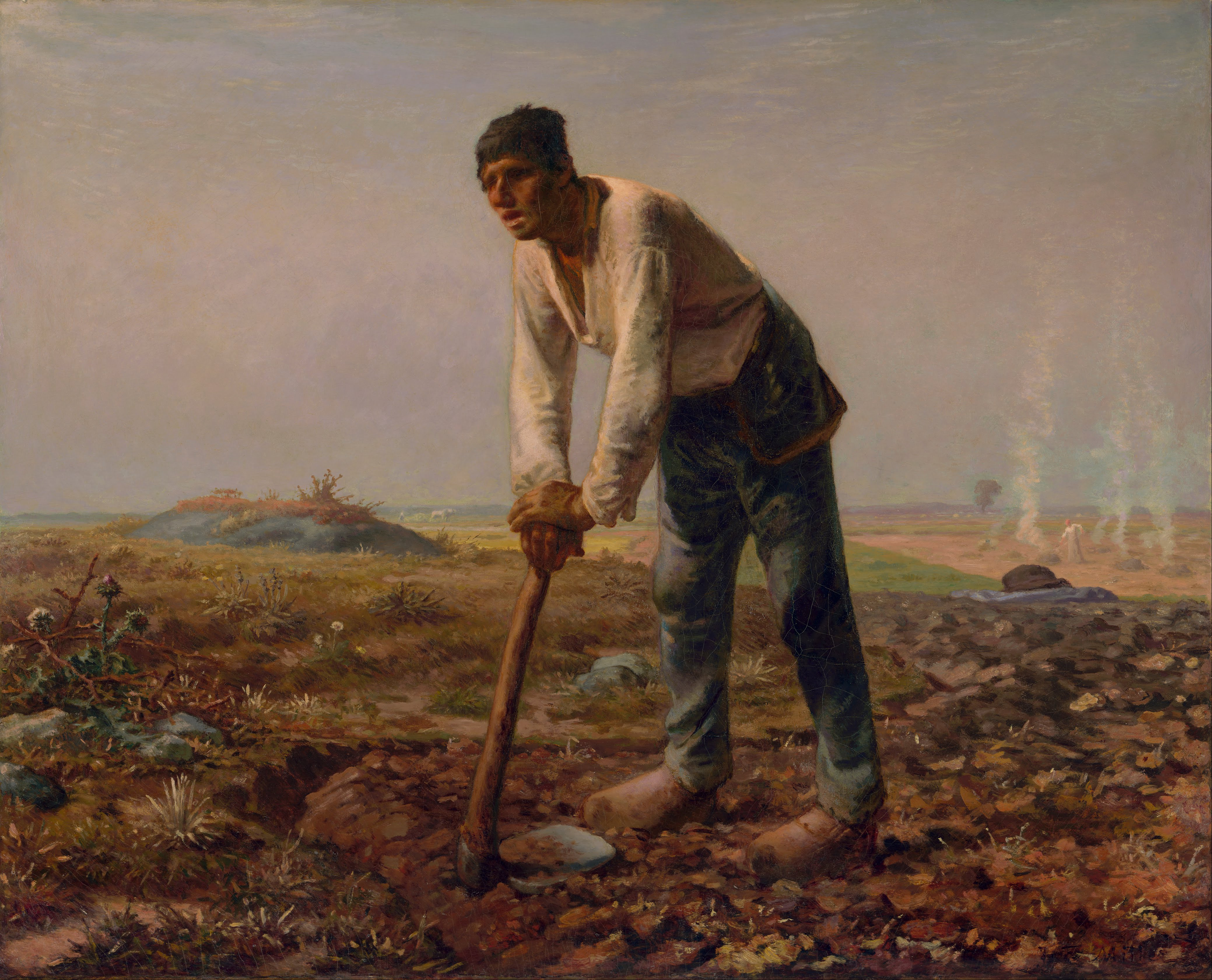
The Man with a Hoe

Matthew 13:1-9. Pause. Look. Listen. Let the parable take you where it will.

Millet,_Jean-François_-_Man_with_a_Hoe_-_Google_Art_Project

As the Sunday Morning Forum at St. Margaret’s Episcopal Church prepares to meet, Hovak Najarian and Kathleen Kelly shared observations, poetry, and questions to lead into the Gospel parable (Matthew 13:1-9, 18-23) and to inspire your learning.

From Hovak:

Sunday’s Gospel gives us the parable of the sower and Jean Francois Millet’s painting,The Sower, came to mind immediately.  This popular painting has been reproduced many times and it is likely you are familiar with it.  [it is available on T-shirts.]  There is a great deal that could be written about Millet’s Sower, but the focus of Christ’s parable was on what happens when seeds fall onto various surfaces … the message is not about the sower himself.

From, The Sower, my mind shifted to Millet’s, The Man With The Hoe, and a poem by Edwin Markham.  Instead of writing a commentary this week, I would like to share this painting and poem with you.  It is not related to either of the readings for Sunday but the painting is worth seeing and the poem worth reading.

From Kathleen:
In one sense, it could be said that the parable IS about the sower —  a farmer who is willing to “squander” seed by tossing it in all directions  (without regard for the conditions) as though there is no limit to the abundance of this resource.

Be well. Do good. Pay attention. Keep learning.

Image: Jean-François Millet [Public domain], via Wikimedia Commons (Link)
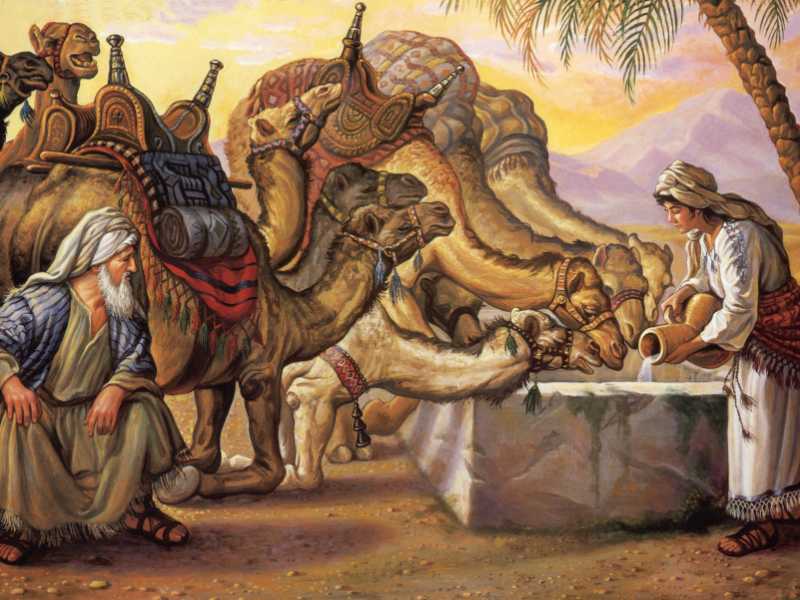
Rebekah watering the camels

A discussion snippet: art and the meeting of Eliezer and Rebecca.

Rebekah watering the camels.

In the Sunday Morning Forum at St. Margaret’s Episcopal Church in Palm Desert, a discussion arose about the Poussin art (see our post) depicting the encounter of Eliezer and Rebecca at the well (see Genesis Genesis 24). Hovak Najarian later sent this note to the group:

Camels were not to be seen In the painting discussed at the Forum last Sunday.  “Those bizarre objects” (camels) had no place in the ordered classical setting of Poussin’s, Eliezer and Rebecca.
I thought you might enjoy seeing another artist’s depiction of Rebecca at the well.  The artist of the attached painting did not shun camels!  I could not find the name of the artist….
Do you know the name of the artist? Let us know.

Be well. Do good. Pay attention. Keep learning.

Eliezer and Rebecca | Art for Proper 9A

“Portray ‘several women’ in which you can see different beauties.”

eliezer-and-rebecca-at-the-well-1648

Eliezer and Rebecca, oil on canvas, 1648, Nicolas Poussin, 1594-1665

Commentary by Hovak Najarian

When Abraham decided it was time for his son, Isaac, to be married, he wanted the bride to be from the land of his origin, Mesopotamia. He sent his servant, Eliezer, on a journey to select an eligible bride. When Eliezer reached the City of Nahor in Chaldea, he prayed that water from a well would be provided by the woman that was meant to be Isaac’s bride. Rebecca was at the well when Eliezer arrived and she gave water to him and his camels. After hearing the purpose of the journey, Rebecca received her family’s approval and agreed to marry Isaac. Nicolas Poussin’s painting depicts the meeting of Eliezer and Rebecca.

In the sixteenth century, an artwork’s complexity and its intellectual endeavor led to a hierarchy based on genre. The highest praise was given to history paintings. This genre included classical themes and biblical subjects, as well as historical events. A typical history painting was not only highly accomplished technically, it included numerous people in an architectural and/or landscape setting. In composition, there would be continuity through gestures, body language, facial expressions, and eye contacts. The recognized master of history painting during the seventeenth century was Nicolas Poussin, a Frenchman, who lived and worked in Rome. At a time when seventeenth century art was often overabundant and unrestrained, Poussin was a classicist. His work was controlled and organized intellectually; he noted, “I am forced by my nature towards the orderly.”

While technical problems in painting were being resolved, the use of oil paints and great artistic skills brought about an appreciation that went beyond subject matter. The manner in which a work was painted – the accepted sense of “beauty” at the time it was made – appealed aesthetically to the senses and led to connoisseurship. Jean Pointel, a wealthy French banker and silk merchant was among the collectors of Poussin’s work. Without suggesting subject matter, Pointel commissioned Poussin to create a painting that, “would portray ‘several women’ in which you can see different beauties.” Poussin used this commission as an opportunity to depict the meeting of Eliezer and Rebecca at the well of Nahor.

In Eliezer and Rebecca, Poussin made no attempt to depict a Near Eastern setting. Even Eliezer’s camels – those “bizarre objects” – that would be included surely by a romanticist, were eliminated. At the left side of the painting, a group of Pointel’s “different beauties,” are posed like Roman statues. Except for the woman pouring water and glancing at Rebecca, they seem hardly aware of Eliezer’s presence (in the center wearing a turban). The three women to the right of Rebecca, however, are observing the proposal and reacting with facial expressions and body language. Every aspect of Eliezer and Rebecca is planned, ordered, and controlled. Poussin’s figures exist in the realm of an idealized classical world.

Hovak Najarian © 2017