Out of the depths I cry to you, O Lord. Lord, hear my voice! Let your ears be attentive to the voice of my supplications! Psalm 130:1-2
Welcome!
The readings on Sunday, June 30, 2024 (Proper 8B) continue the story of David after the death of King Saul. Psalm 130 is a cry for attention and help and a confident expression that the Lord hears and will answer. There is a patient and hope-filled waiting.
Read Psalm 130 from the Tanakh. Listen carefully. In this translation, which words speak most clearly to your heart? What difference do these words make to you? To those you love?
Psalm 130:1–8 (Tanakh)
1A song of ascents. Out of the depths I call You, O Lord.
2O Lord, listen to my cry; let Your ears be attentive to my plea for mercy.
3If You keep account of sins, O Lord, Lord, who will survive?
4Yours is the power to forgive so that You may be held in awe.
5I look to the Lord; I look to Him; I await His word.
6I am more eager for the Lord than watchmen for the morning, watchmen for the morning.
7O Israel, wait for the Lord; for with the Lord is steadfast love and great power to redeem.
8It is He who will redeem Israel from all their iniquities.
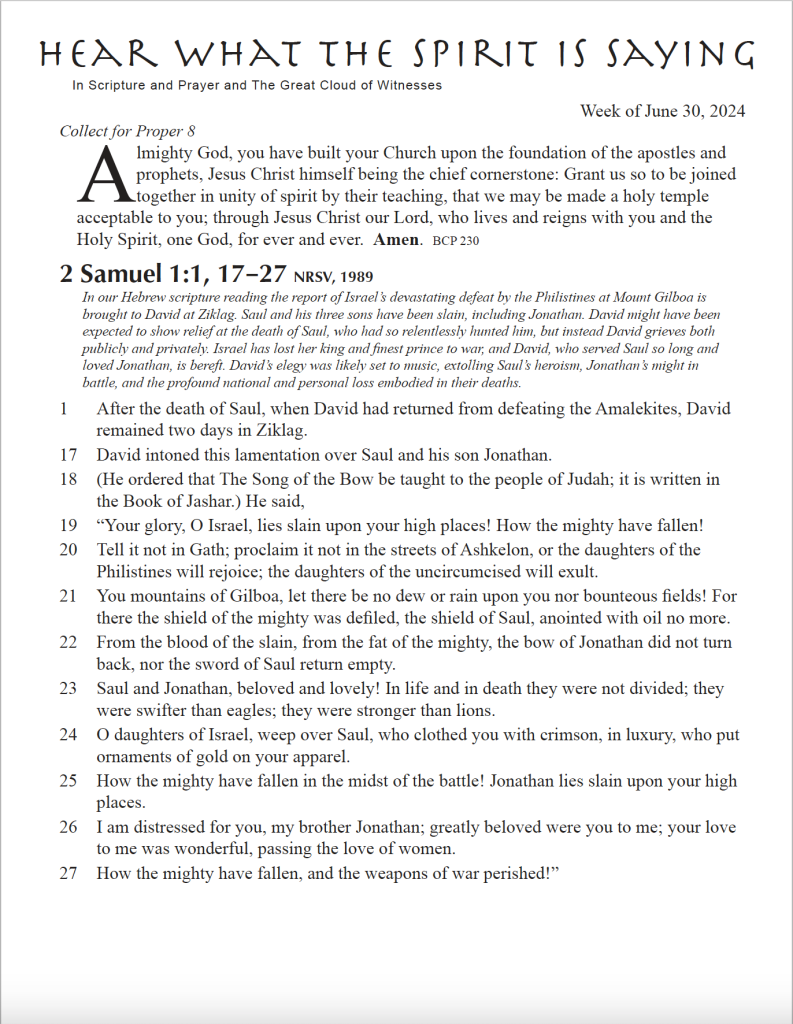
View or download the handout we used in our Wednesday morning forum:
Click the image to view or download our study guide
*Most Wednesday mornings a group of us gather online to explore the readings that will be used in worship the following Sunday. This week’s handout features readings, commentaries, and notes for the Sixth Sunday after Pentecost (June 30, 2024) in Year B of the Revised Common Lectionary. Please: View or download the handoutwe used to guide our discussion and tune our hearts to the Spirit.
“O Lord, make us have perpetual love and reverence for your holy Name, for you never fail to help and govern those whom you have set upon the sure foundation of your loving-kindness…. ” Collect of the Day
Welcome!
The readings from Sunday, June 23, 2024 (Proper 7B) featured the story of David and Goliath. The verses from Psalm 9 came from a heart and a community that, through experience, trusted God in even the most difficult moments of life. Our* discussion focused on the Psalm. You are invited to join the Psalmist in lifting your heart to God.
Click image to view or download our study guide
*Most Wednesday mornings a group of us gather online to explore the readings that will be used in worship the following Sunday. This week’s handout features readings, commentaries, and notes for the Fifth Sunday after Pentecost (June 23, 2024) in Year B of the Revised Common Lectionary. Please: View or download the handoutwe used to guide our discussion and tune our hearts to the Spirit.
When the elders of Israel went to Samuel to demand that he appoint a king, it was argued they would need one to protect them from their enemies. Samuel was not convinced that Israel required a king but after arguments, Saul was anointed.
Among Israel’s enemies were the Philistines whose army had gathered at the Valley of Elah to confront Saul’s forces. During this stand-off a huge warrior named Goliath (reported to be nine feet, nine inches tall) came forward from the Philistine camp with taunts. He challenged the Israelites to send someone to fight him. The nation of the victor, he said, would rule over the other. King Saul was a tall man with experience in battle but he would have been no match for this Philistine giant.
Meanwhile, David, the youngest son of Jesse, was sent by his father to take food to his brothers who were serving in Saul’s army. When David saw Goliath and heard his taunts, he said he would fight him. He had killed wild beasts while protecting his sheep and was very accurate with his sling. There was neither fear in David nor a need to wear burdensome armor. When Goliath saw he was being approached by an armor-less boy with a shepherd’s staff and sling, he was both surprised and amused. He said “Am I a dog that you come to me with sticks?” David, however, quickly dispatched the giant with a stone hurled from his sling. The stone penetrated Goliath’s unprotected forehead and he fell. David then used Goliath’s own sword to behead him.
Osmar Schindler’s colored lithograph, David and Goliath, depicts the self-assured giant standing with his head back in laughter at the sight of David. The men in the Philistine army behind him were anticipating a show-down between two warriors and they too must have wondered what was going on with the appearance of David. In his right hand Goliath is holding a spear and his left hand is resting easily on his waist. He did not take David seriously. Even his shield-bearer is standing aside and leaving him not fully protected. Goliath’s thoughts were perhaps “Are you kidding? What is this?”
Regardless of size differences, David was not intimidated. Before going out to confront Goliath, he told Saul, “The Lord who saved me from the paw of the lion and the paw of the bear will save me from the hand of the Philistine.” In the foreground, David has both feet planted firmly on a boulder as he looks at Goliath. He is ready and in a moment the stone placed in his sling’s pouch will be swung and released to put an end to Goliath.
There are many paintings and drawings of David’s encounter with Goliath. They range from Sunday School cartoons to gory images of Goliath being beheaded or David holding up Goliath’s severed head. David is well represented also in sculpture. Two of the most noted sculptures of David are Donatello’s David (with Goliath’s head at his feet) and Michelangelo’s David (holding a sling over his left shoulder).
David slays Goliath
Michelangelo, fresco, Sistine Chapel
Donatello, David, bronze, Bargello National Museum
More about the lithograph process: Osmar Schindler’s image of David and Goliath is a lithograph [litho: stone, graph: drawing (drawing on stone)]. The process is based on oil and water not mixing. When making a lithograph, a drawing is made with a greasy crayon on a flattened smooth-surfaced limestone. The surface is treated with a weak acid solution which rolls off the crayon drawing and covers the unmarked areas of the stone. After the drawing is removed with a solvent, the surface is made wet. Water clings to the treated surface but not to where the drawing was made (and removed). When the stone is inked with a large roller, the ink is rejected by the watered surface and clings only to where there was once a drawing. Paper is placed over the inked stone and it is run through a press. When the paper is pulled off the stone, the image (once a drawing on the stone) is now on the paper (in reverse). Multiple prints may be made by this process. If color is to be used, a separate stone is used for each color. Artists may color a lithograph by hand after it has been printed. ~Hovak Najarian
For more art and art commentary search the Art & Music Category or use Hovak Najarian as your search term.
Wind in the Chimes: In a moment of decision where do you put your trust?
Psalm 20:7
Some put their trust in chariots and some in horses, but we will call upon the Name of the Lord our God.
Psalm 20:7 (The Book of Common Prayer, 1979: Psalter)
Our sacred text is living and dynamic. New understandings about God and about God’s people continue to emerge. These understandings continue to expand with each new experience—of individuals and communities—and new questions and understandings are born in the answering.
In our moment(s) of crisis “trust in chariots and horses” could be read as trust in wealth, material goods, political power, physical power, and strength, or in clever manipulation of law and order. The text asserts that in our ancestor’s moment of crisis they “will call upon the Name of the Lord our God.”
This text asks you and me—in our moment of need or crisis: in what (or in whom) do you trust? As we work out our individual answers and join others in a similar journey, I hope we can assert with the Psalmist that “WE will call upon the Name of the Lord our God”
About Wind in the Chimes
Wind in the Chimes (renaming and reintroduction of Wind Chimes, 7/21/20)
Wind in the Chimes: Prayer as responding to God with or without words
O wonder of wonders! when I think of the union of my soul with you, O God! You make my soul flow out of herself in joyful ecstasy, for nothing but you can content her. A spring of divine love surges over my soul, sweeping her out of herself into you, O God, her original source.
Wind in the Chimes: A brief meditation about prayer changing the one who prays
I pray because …
In a scene from Shadowlands, a film based on the life of C.S. Lewis, Lewis has returned to Oxford from London, where he has just been married to Joy Gresham, an American woman, in a private Episcopal ceremony performed at her hospital bedside. She is dying from cancer, and, through the struggle with her illness, she and Lewis have been discovering the depth of their love for each other.
As Lewis arrives at the college where he teaches, he is met by Harry Harrington, an Episcopal priest, who asks what news there is. Lewis, hesitates; then, deciding to speak of the marriage and not the cancer, he says, “Ah, good news, I think, Harry. Yes, good news.”
Harrington, not aware of the marriage and thinking that Lewis is referring to Joy’s medical situation, replies, “I know how hard you’ve been praying…Now, God is answering your prayer.”
“That’s not why I pray, Harry,” Lewis responds. “I pray because I can’t help myself. I pray because I’m helpless. I pray because the need flows out of me all the time, waking and sleeping. It doesn’t change God—it changes me.”
It doesn’t change God; it changes me. Prayer is not a message scribbled on a note, jammed into a bottle and tossed into the sea in hopes that it will wash up someday on God’s shoreline. Prayer is communion with God. We speak to God, but God touches, embraces, shapes and changes us. Whether we pray for rain or pray for sunshine, our prayer is answered, because in the act of praying we receive the gift we really seek—intimacy with God.
Source: Thomas G. Long, Whispering the Lyrics: Sermons for Lent and Easter, Lima, OH: CSS Publishing Co., 1995 quoted in Pulpit Resource, January, February, March, 1998 p. 30
More
Prayer is responding to God, by thought and by deeds, with or without words.
1979 (Episcopal) Book of Common Prayer, 856
About Wind in the Chimes
Wind in the Chimes (renaming and reintroduction of Wind Chimes, 7/21/20)
“We are determined to have a king over us, so that we also may be like other nations and that our king may govern us and go out before us and fight our battles.” 1 Samuel 8:19b-20
Israel Demands a King, engraving, 1778, J. Winter, active 18th century. This engraving was published in The Bible and its Story, 1909, Edited by Charles Horne and Julius Brewer.
When the prophet Samuel was advanced in years the Israelites began to worry about their future. Who would be their leader and how would they be able to deal with their enemies? The elders went to Samuel with their concerns and said “You are old and your sons do not follow your ways, appoint for us a king to govern us, like other nations.” Samuel was displeased that they asked for a king. When he prayed, God instructed him to listen to the people, but also to warn them solemnly about what they could expect if they were to bed given a king. Samuel warned the elders to be careful about what they wished but they would have none of it and said, “No… we are determined to have a king…
Winter’s Israel Demands a King (detail above) the figures are placed in an open courtyard and strong opposing opinions are suggested by a face-off between Samuel and the elders. Samuel, a slightly hunched over old man, is at the left. He has assumed a solid stance and is pointing forcefully with both index fingers as he states his opposition to Israel having a king. To the right an animated spokesperson for the elders is leaning forward as he argues forcefully to make a point. He seems ready to interrupt Samuel at any moment. The gestures of the elders are exaggerated for effect and their claw-like hands are emphasized. A young man standing behind Samuel seems to be taken aback by the demanding elders. Have they no respect … how could they talk to Samuel like that? After listening, praying, and explaining what it would be like to have a king, Samuel followed the people’s wishes and anointed a king.
J. Winter, Israel Demands a King (full engraving)
In medieval art, illustrations were added to enhance the text of gospel books. Often subjects were events in the life of Jesus, Mary, his mother and the Apostles, and Old Testament kings, prophets and events in other’s lives were illustrated. Illustrations also presented artists with an opportunity to venture into less-depicted subjects but sometimes these did not have visual impact. An engraving of Samuel arguing with elders could not compete with the drama of Moses and the Israelites crossing the Red Sea or Elijah ascending to heaven in a fiery horse drawn cart. When a subject lacked action an artist was challenged to generate interest by staging the subject in a dramatic way. This could engage a viewer and describe a work’s subject but often these were not enough. The arrangement of figures in Winter’s IsraelDemands a King requires knowledge of the biblical text in order to understand the subject being depicted.
At mid-fifteenth century the printing press was invented and by the end of the century, books were being published. Instead of hand-painted illustrations as in gospel books, art in the form of engravings, could be inked and printed with the text. Engravings continued to be popular even after the halftone (a photo-mechanical process) was introduced in the late nineteenth century.
Wind in the Chimes: To whom do you turn in the midst of trouble?
Prayer and Peace in a single verse
Trouble, danger, chaos, upset, frustration: whatever you call it, it can happen in just a moment or last years. From moment to moment in a day, day by day in a week, week by week in a month, month by month in a year, we may experience “trouble.”
In the midst of trouble, the Psalmist is our guide: that is the point to turn with heartfelt trust (like the Psalmist) and declare, “you [my God, my Lord] preserve me against the wrath of my enemies; you stretch out your hand, and your right hand delivers me.” You are not alone in the midst of trouble.
Trust these words. Let your God walk with you, love you, and deliver you. God’s Peace is yours, always, in the midst of trouble.
About Wind in the Chimes
Wind in the Chimes (renaming and reintroduction of Wind Chimes, 7/21/20)
I give you thanks, O LORD, with my whole heart; before the gods I sing your praise… Psalm 138:1 (NRSV)
Welcome!
Psalm 138 (NRSVue) gives thanks and speaks powerfully to the majesty and humility of the God who loves us. Sometimes it helps to hear more than one translation of the ancient text to discover new dimensions of our relationship with God.
Here is Psalm 138 from the New Jerusalem Bible:
1I thank you, Yahweh, with all my heart, for you have listened to the cry I uttered. In the presence of angels I sing to you,
2I bow down before your holy Temple. I praise your name for your faithful love and your constancy; your promises surpass even your fame.
3You heard me on the day when I called, and you gave new strength to my heart.
4All the kings of the earth give thanks to you, Yahweh, when they hear the promises you make;
5they sing of Yahweh’s ways, ‘Great is the glory of Yahweh!’
6Sublime as he is, Yahweh looks on the humble, the proud he picks out from afar.
7Though I live surrounded by trouble you give me life—to my enemies’ fury! You stretch out your right hand and save me,
8Yahweh will do all things for me. Yahweh, your faithful love endures for ever, do not abandon what you have made.
Here is Psalm 138 from the Tanakh:
1Of David. I praise You with all my heart, sing a hymn to You before the divine beings;
2I bow toward Your holy temple and praise Your name for Your steadfast love and faithfulness, because You have exalted Your name, Your word, above all.
3When I called, You answered me, You inspired me with courage.
4All the kings of the earth shall praise You, O Lord, for they have heard the words You spoke.
5They shall sing of the ways of the Lord, “Great is the majesty of the Lord!”
6High though the Lord is, He sees the lowly; lofty, He perceives from afar.
7Though I walk among enemies, You preserve me in the face of my foes; You extend Your hand; with Your right hand You deliver me.
8The Lord will settle accounts for me. O Lord, Your steadfast love is eternal; do not forsake the work of Your hands.
As always, our sacred text (in its various English translations) questions us even as we speak, listen to, and hear the words:
Throughout the day, how often do you pause and give thanks? How often is thanksgiving done with all your heart? How might you experience or describe a half-hearted thanksgiving? A whole-hearted thanksgiving? (v. 1)
In verse 1 the Psalmist sings before “gods” (NRSV), “angels” (NJB), or “divine beings” (Tanakh). Which translation speaks to your heart? Why is that? Close your eyes, picture and feel and hear yourself singing your thanksgiving in such hallowed company. Well?
In the NRSVue verse 3 reads: “On the day I called, you answered me; “you increased my strength of soul.” The NJB translates God’s answer as “you gave new strength to my heart.” The Tanakh translates God’s answer as “You inspired me with courage.” Again, which translation speaks to your heart and why is that?
With these few examples from verses 1 and 3, I encourage you to allow the text (in various translations) to question you. Become quiet. Hear what the Spirit is saying to you. Hear how the Spirit—in the sacred text—both questions and encourages you.
*Most Wednesday mornings a group of us gather online to explore the readings that will be used in worship the following Sunday. This week’s handout features readings, commentaries, and notes for the Third Sunday after Pentecost (June 9, 2024) in Year B of the Revised Common Lectionary. Please: View or download the handoutwe used to guide our discussion and tune our hearts to the Spirit.






 Hear what the Spirit is saying

.jpg)

