“Once in Royal David’s City,” Four Ways

“Once in Royal David’s City”–King’s College Choir
“Once in Royal David’s City”–Mormon Tabernacle Choir
“Once in Royal David’s City”–Sufjan Stevens
“Once in Royal David’s City”–Will Todd Trio

Once in royal David’s city
stood a lowly cattle shed,
where a mother laid her baby
in a manger for his bed;
Mary, loving mother mild,
Jesus Christ, her little child.

He came down to earth from heaven
who is God and Lord of all,
and his shelter was a stable,
and his cradle was a stall.
With the poor, the scorned, the lowly
lived on earth our Savior holy.

Jesus is our childhood’s pattern;
day by day, like us he grew;
he was little, weak, and helpless,
tears and smiles like us he knew;
and he feeleth for our sadness,
and he shareth in our gladness.

And our eyes at last shall see him,
through his own redeeming love;
for that child so dear and gentle
is our Lord in heaven above;
and he leads his children on
to the place where he is gone.

Three Lauridsen Pieces

Morten Lauridsen’s O Nata Lux, Ave Maria, and O Magnum Mysterium are easy favorites among choral music nerds aficionados. They are relatively new pieces, so they might not be as widely known as more traditional Lessons and Carols standards. However, I feel that his compositional style perfectly captures the essence of the Advent season–a balance between exultant and somber.

In each piece, listen for dissonance. He often has different voice parts sustain intervals of a second. In many works, these close intervals are a challenge to listen to, but in his, they add richness, depth, a blend of bitterness and sweetness. (Yes, Advent is a glorious thing, but we know that it brings us closer to Lent and to remembering His sacrifice.)

Listen also for a melody. It’s there, of course, but it’s kind of hard to sing back, isn’t it? His pieces almost saunter through the text. It’s not just about arriving at a cadence; it’s about what happens along the way. These works invite the listener to sit and muse for a bit on what it’s all about–the mystery of the Incarnation, the devotion of Mary and Joseph, the humility that caused the King of Kings to take the form of a helpless baby–it’s almost as if Lauridsen wants us to hit the pause button and just sit for a minute. (And during this busy season, couldn’t we all afford to just sit for a while?)

So I hope these pieces bring you some joy–and a little stillness–as you go about your Christmas preparations. Enjoy!

O Nata Lux
O Light born of Light
Jesus, Redeemer of the World
with loving-kindness deign to receive
suppliant praise and prayer.

Thou who once deigned to be clothed in flesh
for the sake of the lost,
grant us to be members
of Thy blessed body.

O Magnum Mysterium
O great mystery
and wonderful sacrament
that animals should see the new-born Lord
lying in a manger!

Blessed is the Virgin whose womb
was worthy to bear
Christ the Lord.
Alleluia!

Ave Maria
Hail Mary, full of grace, the Lord is with thee.
Blessed art thou among women,
and blessed is the fruit of thy womb, Jesus.
Holy Mary, mother of God,
pray for us sinners,
now and in the hour of our death. Amen.

Meditations for Earth Day

I’ve never thought of myself as much of an environmentalist, but I grew up in a very rural area, surrounded by woods, grass, creeks, and all kinds of critters. (Sometimes known as “wildlife” in non-Southern regions!) The older I get, and the more my husband and I move around, the more I’ve come to appreciate nature in its many different forms, and it breaks my heart to think of how carelessly, even callously, we sometimes treat the beautiful home that God has given us. Being pregnant in the Spring brings this to mind even more, as everything is blooming and beautiful. I am so grateful for the natural treasures God has entrusted to us, and I can’t wait to share them with my daughter as she grows up.

Earth Day falls on Sunday, April 22, and there couldn’t be a more perfect time to reflect on the beauty and creativity of the Lord and to thank Him for this gorgeous place He’s given us to live!

There are many, many hymns and songs that are appropriate for this time of year, and it was hard to narrow them down. Below are five favorites, but if you feel the urge to dig for more, this is a great resource. I’ve included the texts for the lesser known pieces. Happy Earth Day!

For the Beauty of the Earth–John Rutter
For the beauty of the earth
For the beauty of the skies
For the love
which from our birth
Over and around us lies

Lord of all to thee we raise
This our joyful hymn of praise

For the beauty of the hour
Of the day and of the night
Hill and vale
And tree and flower
Sun and moon and stars of light

Lord of all to thee we raise
This our joyful hymn of praise

For the joy of human love
Brother, sister, parent, child
Friends on earth
And friends above
For all gentle
Thoughts and mild
For all gentle
Thoughts and mild

Lord of all to thee we raise
This our joyful hymn of praise

For each perfect gift of thine
To our race so freely given
Graces human and divine
Flow’rs of earth and buds of heav’n

Lord of all to thee we raise
This our joyful hymn, our joyful hymn of praise
This our joyful hymn of praise

He’s Got the Whole World in His Hands–arr. Marian Anderson, performed by Jessye Norman and Kathleen Battle

His Eye is On the Sparrow–performed by Kathleen Battle

This is My Father’s World–instrumental guitar
This is my Father’s world
and to my listening ears
all nature sings, and round me rings
the music of the spheres

This is my Father’s world
 I rest me in the thought
of rocks and trees
of skies and seas
His hand the wonders wrought

This is my Father’s world
the birds their carols raise
the morning light, the lily white
declare their Maker’s praise

This is my Father’s world
He shines in all that’s fair
in the rustling grass I hear Him pass
He speaks to me everywhere

This is my Father’s world
oh let me ne’er forget
that though the wrong seems oft so strong
God is the ruler yet

This is my Father’s world
why should my heart be sad?
The Lord is King, let the heavens ring
God reigns, let the earth be glad!

All Things Bright and Beautiful–John Rutter

Were You There?

To me, a Maundy Thursday or Good Friday service seems incomplete if I don’t hear, at least once, the old spiritual “Were You There When They Crucified My Lord?” The text and melody are so simple, yet profound, and I imagine I am not the only one who continues humming it long after the service is over. (Unless it’s a Maundy Thursday service, in which case, I can usually keep quiet at least until we make it to the car!)

As is the case with most of our beloved spirituals, there isn’t a clear composer or date of composition for “Were You There.” We know that it must have originated in the mid-1800s, before the Civil War and the abolishment of slavery. Spirituals developed as “work songs” that were sung while tending the fields, doing laundry, or fulfilling other responsibilities. Because of this, they tend to have simple melodies that are easy to learn and pleasant to sing. Most spirituals contain hidden messages of escape and freedom (such as “Deep River,” “Steal Away,” “Wade in the Water,” and “This Train is Bound for Glory”). Many of these songs carried literal directions, while others subtly provided inspiration for those who may have been thinking of making an escape.

However, it seems that “Were You There?” contains none of these messages, and is, instead, a song of reverence for Jesus’ suffering. Jesus’ story must have been one that American slaves could identify with, as they, too, knew what it was like to be mocked, humiliated, beaten, and abused.

Over time, “Were You There?” and several other spirituals have been included in our collection of regularly sung hymns. This is credited largely to African American composer Harry T. Burleigh (1866-1949). The majority of his life’s work was devoted to arranging spirituals and publishing them to ensure that they would not be forgotten. In 1924, G. Ricordi published his arrangement of “Were You There?” for high voice and piano. This particular arrangement is most closely associated with contralto Marian Anderson, as she released a recording of the piece in 1939.

Though we probably all know the text by heart, I’ve provided it below, along with two recordings of the work.

Were You There?

Were you there when they crucified my Lord?
Oh, sometimes it causes me to tremble, tremble, tremble.
Were you there when they crucified my Lord?

Were you there when they nailed him to the tree?
Oh, sometimes it causes me to tremble, tremble, tremble.
Were you there when they nailed him to the tree?

Were you there when they laid him in the tomb?
Oh, sometimes it causes me to tremble, tremble, tremble.
Were you there when they laid him in the tomb?

Were you there when God raised him from the tomb?
Oh, sometimes it causes me to tremble, tremble, tremble.
Were you there when God raised him from the tomb?

Source: Lutheran Hymnal 

 Marian Anderson

Solo Piano Meditation

“The Crucifixion”

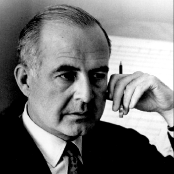
Samuel Barber  (1910-1981) was a highly versatile composer known for his two operatic works (Vanessa and Antony and Cleopatra), along with his many works for orchestra, strings, piano, and voice. Of his compositions for voice and piano, perhaps his best known and most loved is his collection of Hermit Songs. The Hermit Songs is a setting of semi-reverent, semi-crass texts written by Irish monks between the 8th and 13th centuries. The cycle was commissioned by the Elizabeth Sprague Coolidge Foundation in 1953. That same year, it was premiered at The Library of Congress by soprano Leontyne Price. Barber accompanied.

Of the ten Hermit Songs, the most poignant to me has always been “The Crucifixion.” (Listen once, and you’ll understand exactly why.)

Given that we are just over halfway through Lent, it seems appropriate to share it today. The text reads as follows:

At the cry of the first bird
They began to crucify thee, O Swan.
Never shall lament cease because of that.
It was like the parting of day from night.
Ah, sore was the suffering borne
By the body of Mary’s son.
But sorer still to Him was the grief
Which for His sake came upon His mother.
–Translation by Howard Mumford Jones

Easter Hymn Post–“The Old Rugged Cross”

may have mentioned this before, but I love hymns. The texts possess a richness that is, in my opinion, difficult to find in any other genre, with the exception of the art song. This holds true for “The Old Rugged Cross.”

To be honest, I’ve never heard “The Old Rugged Cross” sung in an Episcopal church…or in any church other than the tiny Baptist church I attended as a very young child. And when we sang it, my friend, it didn’t have to be Easter. “The Old Rugged Cross” was appropriate on Christmas Eve, the Fourth of July, Mother’s Day, and any other day you can think of. Or at least that’s how it seemed to me.

So, given my early acquaintance with the hymn, I’ve never really given much thought as to who wrote it or why, but I’m glad that I started doing a little digging. It is difficult to get solid information on the hymn because most of the stories are passed down by word of mouth or presented on personal websites. However, here’s what I’ve found: The hymn was written by an itinerant Methodist minister named George Bennard (1873-1958) in 1913.

Image

While on his route through the northern states, he began meditating on Christ’s suffering on the cross. He is reputed to have written, “I saw the Christ of the cross as if I were seeing John 3:16 leave the printed page, take form, and act out the meaning of redemption.” (1)

When he arrived home to his apartment in Albion, Michigan, he began setting text to a tune he had already composed. One story goes that he only had the phrase “On a hill far away stood an old rugged cross” until he was harassed by some teens during a service. According to the story, after that incident, the rest of the words came to him. The composition process did not happen quickly, and he spent the next few months revising the text and asking for input from friends and colleagues.

In 1913, the hymn was debuted at the First Methodist Episcopal Church of Pokagon, Michigan. Four members of the choir sang, accompanied by piano and violin. His friends, Rev. and Mrs. Leroy Bostwick, paid to have the hymn printed.

The song grew in popularity and became well-loved throughout the northern states. In 1915, two years after its debut, evangelist Billy Sunday and his song leader Homer Rodeheaver bought the rights to the song for $500, and its popularity grew nation-wide thanks to Billy Sunday’s tent revivals.

Bennard died in 1958 after writing several more hymns and spending his adult life ministering to others. Because he sold the rights to “The Old Rugged Cross” so soon after its composition, he never became wealthy from the song.

When I’ve heard the hymn, it’s usually been in a slow, gospel style like this. However, there are also jazz renditions, instrumental blues covers, and, of course, Elvis.

The melody and the style might not be everyone’s cup of tea, but the words truly are timeless. And, like I learned at that little Baptist church, appropriate all year long.

On a hill far away stood an old rugged cross
The emblem of suffering and shame
And I love that old cross
Where the dearest and best
For a world of lost sinners was slain

Chorus:
So I’ll cherish the old rugged cross
‘Til my trophies at last I lay down
I will cling to the old rugged cross
And exchange it someday for a crown

Oh, that old rugged cross so despised by the world
Has a wondrous attraction for me
For the dear Lamb of God left His glory above
To  bear it to dark Calvary

In that old rugged cross, stained with blood so divine
A wondrous beauty I see
For ’twas on that old cross Jesus suffered and died
To pardon and sanctify me

To the old rugged cross I will ever be true
Its shame and reproach gladly bear
Then He’ll call me someday to His home far away
Where His glory forever I’ll share.

Sources:
http://www.lectionary.org/HymnStories/The%20Old%20Rugged%20Cross.htm (1)
http://www.the-oldruggedcross.org/history.htm
http://www.albionmich.com/history/histor_notebook/R980413.shtml

Hymn History: “All Hail the Power”

Church music has such a rich history, but we often know very little about the brave men and women who wrote our beloved hymns. As we transition into Fall, I’m hoping to write a bit more about some of these people–what their lives were like, what they did, and why they might have been inspired to write such powerful music. Today’s focus is on Edward Perronet, who wrote the text to “All Hail the Power (of Jesus’ Name).”

Edward Perronet (1726-1792) was born in Kent, England to a family that had fled France due to religious persecution. His father, an Anglican minister, was strongly supportive of the teachings of John and Charles Wesley and of George Whitefield. Edward also grew up to be an Anglican minister, though he disagreed with many practices of the Anglican church. In the 1740s and ’50s, he spent a great deal of time traveling and evangelizing with the Wesleys. Their group suffered frequent persecution and violence because of their teachings. John Wesley often encouraged Perronet to preach, but Perronet found preaching in front of the Wesleys to be far too intimidating, so he always found ways to avoid preaching in their presence. During one service, John Wesley decided that he had had enough, and, in front of the entire congregation, he called Perronet up to preach. Perronet, realizing that he had no way out, strode behind the podium and said, “I will now deliver the greatest sermon ever preached on earth.” He proceeded to read “The Sermon on the Mount” and quietly sat down.

After several years of ministering with the Wesleys, Perronet decided to part ways. The three felt that they had too many disagreements (and that Perronet was too opinionated) to effectively minister together. It was at that time that Perronet began serving at an independent church in Canterbury, where he worked until his death in 1792. Perronet’s last words were, “Glory to God in the height of His divinity! Glory to God in the depth of His humanity! Glory to God in His all-sufficiency! Into His hands I commend my spirit!”

Perronet wrote most of his hymns and poems anonymously, but “All Hail the Power of Jesus’ Name” was published in 1779, and it has been a standard in most Christian hymnals ever since. It is the only work in his name that is well-known. The song has been referred to as the “National Anthem of Christendom,” and it has been translated into nearly every language. Of it, one writer wrote, “So long as there are Christians on earth, it will continue to be sung; and after that, in heaven.”

All hail the power of Jesus’ Name!
 Let angels prostrate fall;
Bring forth the royal diadem, 
and crown Him Lord of all!

 Ye chosen seed of Israel’s race,
 ye ransomed from the fall,
Hail Him Who saves you by His grace,
 and crown Him Lord of all!

 Let every kindred, every tribe on this terrestrial ball,
To Him all majesty ascribe, 
and crown Him Lord of all!

 Oh, that with yonder sacred throng 
we at His feet may fall!
We’ll join the everlasting song, 
and crown Him Lord of all!

Resources: http://www.theeffectivetruth.info/testep.html, http://www.cyberhymnal.org/bio/p/e/perronet_e.htm

The Rutter Requiem and Why It’s Awesome. Yes, I Use the Word “Awesome” Too Much, but It Totally Applies Here.

If you grew up Episcopalian or Catholic (I didn’t), you probably have a head start on all this “requiem” business, but if you’re still catching up (like me), here’s a synopsis: The requiem began as a type of mass to honor the dead. Traditionally, there are twelve parts to the requiem, beginning with the Introit and ending with the In paradisum. However, as composers began to play with the format, they began to see it more as an art form and less as a rigid liturgy. The Rutter Requiem, for example, has only seven movements. The Duruflé has nine, the Mozart seven-ish, and so on. Anyway, more on those later.

So growing up, I’d never heard of the Rutter Requiem. When I finally did, I was about nineteen, thinking that I knew oh-so-much about music (for the record, I didn’t…and still don’t!). I was given the chance to sing the second movement, “Out of the Deep” with a choir at a conference. Long story short, I’d never heard music like that before, and I couldn’t wait to find a way to hear the rest of the Requiem. I mean, I was hooked. It changed how I felt about sacred music in general. Fast forward about seven years, and I still love this work so much and could pretty much never get tired of it.

I’m not going to ramble with biographical info about John Rutter or even with more info about the Requiem itself. You can get all that stuff with a quick Google search. What I’m going to do is much more important–

Requiem aeternam
Out of the Deep (My favorite. Has been referred to as “Anglican blues.” Ahhhhh.)
Pie Jesu
Sanctus
Agnus Dei (My other favorite.)
The Lord is My Shepherd (My last favorite. Yes, I have three favorites.)
Lux aeterna

I hope you love it like I do. More requiem fun to follow.

So what do you think? Does this speak to you? It’s much more moving to hear it in person, of course, but even the recording is still pretty great. Do you have favorite movements? Favorite masses? Let’s chat it up in the comments!

Reflection on Purcell, Handel, and Bach

Over the last few days, we’ve looked at the lives of Henry Purcell, George Frederic Handel, and Johann Sebastian Bach. We’ve talked about their education and about their compositional styles and about what they’re known for in the church. What we haven’t talked about is why they should matter to us.

For me, it’s pretty simple. Traditional sacred music presents us with an opportunity to be connected with history and to collectively make art. Music is dependent upon performers, so whether or not we are the “best” musicians, we get to take part in this historic ritual together. Whether it’s Purcell, Handel, Bach, Mendelssohn, Fanny Crosby, or John Rutter, sacred music is timeless. Bach’s message from 1723 is, I think, the same message that we believe today.

Though we can enjoy sacred music and be inspired by it, we can also create it together for God’s enjoyment. Choral and congregational singing is an incredible tradition God has given us, and it provides us with an opportunity to be connected to the composer, to each other, and–hopefully–to God.

Almighty God, beautiful in majesty and majestic in holiness, who teaches us in Holy Scripture to sing your praises and who gave your musicians Johann Sebastian Bach, George Frederic Handel, and Henry Purcell grace to show forth your glory in their music: Be with all those who write or make music for your people, that we on earth may glimpse your beauty and know the inexhaustible riches of your new creation in Jesus Christ our Savior; who lives and reigns with you and the Holy Spirit, one God, for ever and ever. Amen.–Collect for Feast of Bach, Handel, and Purcell, July 28

So what have I missed? How does sacred music affect you? Do you tend to prefer traditional hymns or larger works like the ones we’ve heard from Purcell, Handel, and Bach? Do you prefer participating in these works through performing or through listening? (Both are equally important!)

Johann Sebastian Bach (1685-1750)

I cannot begin to state  how nervous I am to write about Bach. He is so important to church music, and his body of work is so vast that I’m sure I’m going to leave something out. Please feel free to correct or add on in the comments!

Deep breath….

Here we go.

Born into a musical family, Bach began his training with his father and his older brother. He played both violin and organ, but his primary interest was in composition. Like many composers, he learned composition by studying or arranging works by other composers. In doing so, he became well versed in French, German, Austrian, and Italian styles. Bach held a number of positions over the course of his career–organist at Arnstadt (1703-1707), organist at Muehlhausen (1707-1708), court organist and concertmaster for the duke of Weimar (1708-1717), and music director at a court in Coethen (1717-1723). He finally settled in Leipzig in 1723 where he served as “Cantor of St. Thomas and Director of Music in Leipzig” at St. Thomas’s School.

[Here I will greatly simplify Bach’s work so that I don’t go on and on and on about preludes, fugues, toccatas, and whatnot.] Bach wrote many works for harpsichord and organ. He also wrote for violin, cello, various combinations of chamber ensemble, and voice. In A History of Western Music, Donald Grout explains that Bach wrote in “all the genres practiced in his time with the exception of opera.”(1)

In church, we know Bach largely for his choral anthems, but he also wrote cantatas (both sacred and secular), motets, two Passions (St Matthew and St John) and the Mass in B Minor. During his lifetime, he was respected, but not overly popular. His potential fame was eclipsed by many of his contemporaries, and due to rapidly changing trends in music, much of his work fell into obscurity until the 1800s.

Bach was a profoundly religious person, and the letters “SGD,” standing for “Soli Deo Gloria” or “to the glory of God alone” can be found on many of his manuscripts. Gerhard Herz writes,

That Bach was a Christian has never been doubted. Yet he was not, as many writers have pointed out, a Christian who lived apart from his time, but one who in every respect lived and remained within the social and religious boundaries of his century. Bach’s personality and creations, which today move us chiefly aesthetically and emotionally, are deeply rooted in the ethos of the old Lutheran church.(2)

Grout writes,

Among the qualities that account for the continuing vitality of [Bach’s] music are his concentrated and distinctive themes, his copious musical invention, the balance he struck between harmonic and contrapuntal forces, the strong rhythmic drive, clarity of form, grand proportions, imaginative use of pictorial and symbolic figures, intensity of expression always controlled by a ruling architectural idea, and technical perfection of every detail.(3)

St Matthew Passion–“Kommt, ihr Tochter, helft mir klagen” —
(Wiki page about St Matthew Passion)

St John Passion–“Ruht wohl ihr heiligen Gebeine“–
(Wiki page about St John Passion)

Mass in B MinorDona Nobis Pacem

Mass in B Minor–Osanna in excelsis

Jesu, meine Freude (Jesus, my joy)

Herz und Mund und Tat und Leben (Heart and mouth and deed and life)

Everyone’s favorite wedding song (next to “Canon in D”)

There are so many great recordings of Bach, so if you feel up to it, do a little digging on YouTube or iTunes. I’ve only included choral arrangements, but there are many instrumental and solo works that are equally important.

Fun fact: The “BWV” that you see on the videos stands for “Bach-Werke-Verzeichnis” (Bach Works Catalogue), and it was developed by Wolfgang Schmieder in 1950 to help us keep track of Bach’s works. This is common for composers with a large output. For example, Mozart’s works are organized by “K” number because that system was developed by Ludwig von Koechel. Similar systems exist for Schubert, Handel, Wagner, and many other composers.

So, what are your thoughts on Bach? Love him? Hate him? Let’s discuss!

Resources:
1. Grout, Donald Jay and Claude Palisca. A History of Western Music. London: W.W. Norton & Co., 2001.
2. Herz, Gerhard. “Bach’s Religion,” Journal of Renaissance and Baroque Music. Vol. 1, No. 2 (Jun., 1946), pp. 124-138.
3. Grout, Donald Jay and Claude Palisca. A History of Western Music.