7:58-59 Then they dragged him out of the city and began to stone him; and the witnesses laid their coats at the feet of a young man named Saul. While they were stoning Stephen, he prayed, “Lord Jesus, receive my spirit.”
ANGELICO, Fra (b. ca. 1400, Vicchio nell Mugello, d. 1455, Roma) The Stoning of St Stephen 1447-49 Fresco, 326 x 236 cm Cappella Niccolina, Palazzi Pontifici, Vatican Click image for more information.
Psalm 23:1 The LORD is my shepherd, I shall not want.
Le Breton, Jacques ; Gaudin, Jean Jesus the Good Shepherd Stained-glass composition by J. Le Breton (glass studio of Gaudin, Paris), 1933. Cathédrale d’Amiens (1508-1519) Amiens France Click image for more information.
Luke 24:13 That very day, the first day of the week, two of the disciples were going to a village called Emmaus
WILDENS, Jan Landscape with Christ and his Disciples on the Road to Emmaus 1640s Oil on canvas, 123 x 168 cm The Hermitage, St. Petersburg Click image for more information.
Acts 2:14a But Peter, standing with the eleven, raised his voice and addressed them, “Men of Judea and all who live in Jerusalem, let this be known to you, and listen to what I say.
LORENZO VENEZIANO (active 1356-1372 in Venice) Apostle Peter Preaching c. 1370 Poplar panel, 24 x 33 cm Staatliche Museen, Berlin Click image for more information.
John 20:18 Mary Magdalene went and announced to the disciples, “I have seen the Lord”; and she told them that he had said these things to her.
UNKNOWN MASTER, Italian (active mid-14th century in Rimini) Crucifixion with Saints and Noli Me Tangere around 1350 Tempera and gold on wood, 56 x 38 cm Pinacoteca, Vatican Click image for more information.
Romans 8:6 To set the mind on the flesh is death, but to set the mind on the Spirit is life and peace.
SCHÖN, Erhard
(b. ca. 1491, Nürnberg, d. 1542, Nürnberg)
The Six Excellent Spiritual Gifts
c. 1535
Woodcut
Germanisches Nationalmuseum, Nuremberg Click image for more information.
1 Samuel 16:13 Then Samuel took the horn of oil, and anointed him in the presence of his brothers; and the spirit of the LORD came mightily upon David from that day forward.
ANGELICO, Fra
(b. ca. 1400, Vicchio nell Mugello, d. 1455, Roma)
King David Playing a Psaltery
c. 1430
Pen and brown ink and purple wash on vellum, 197 x 179 mm
British Museum, London Click image for more information.
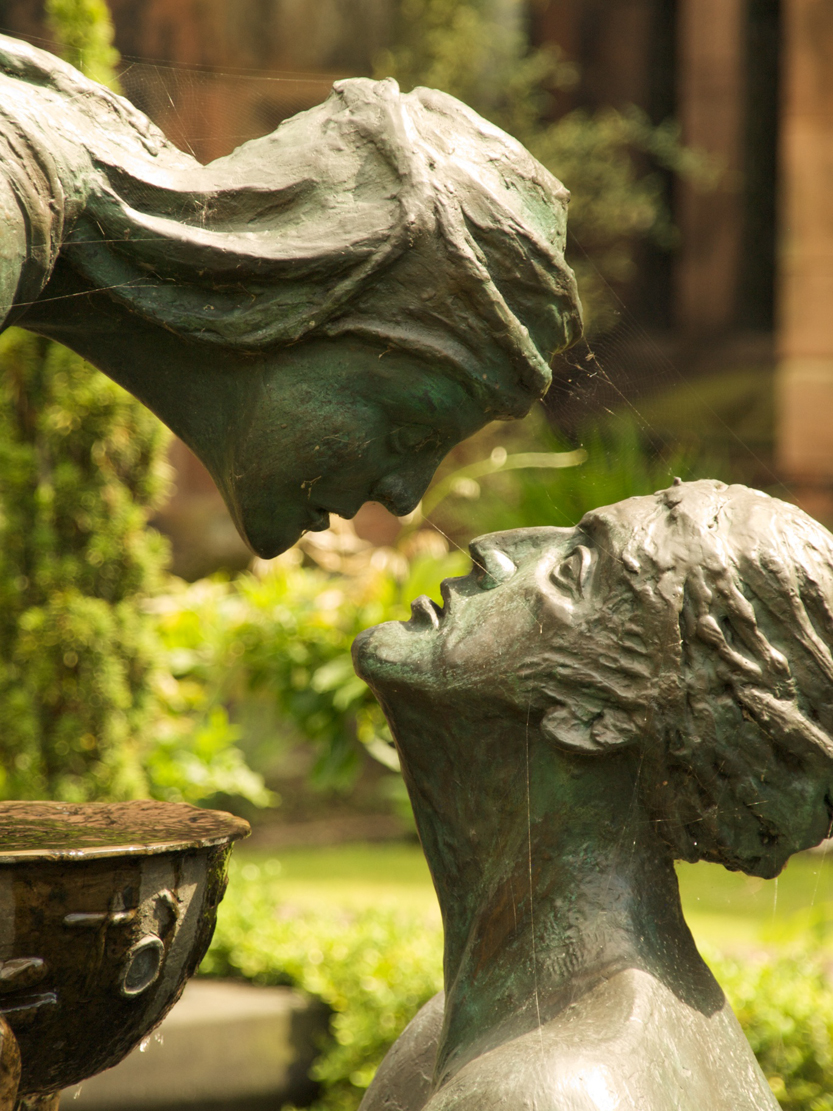
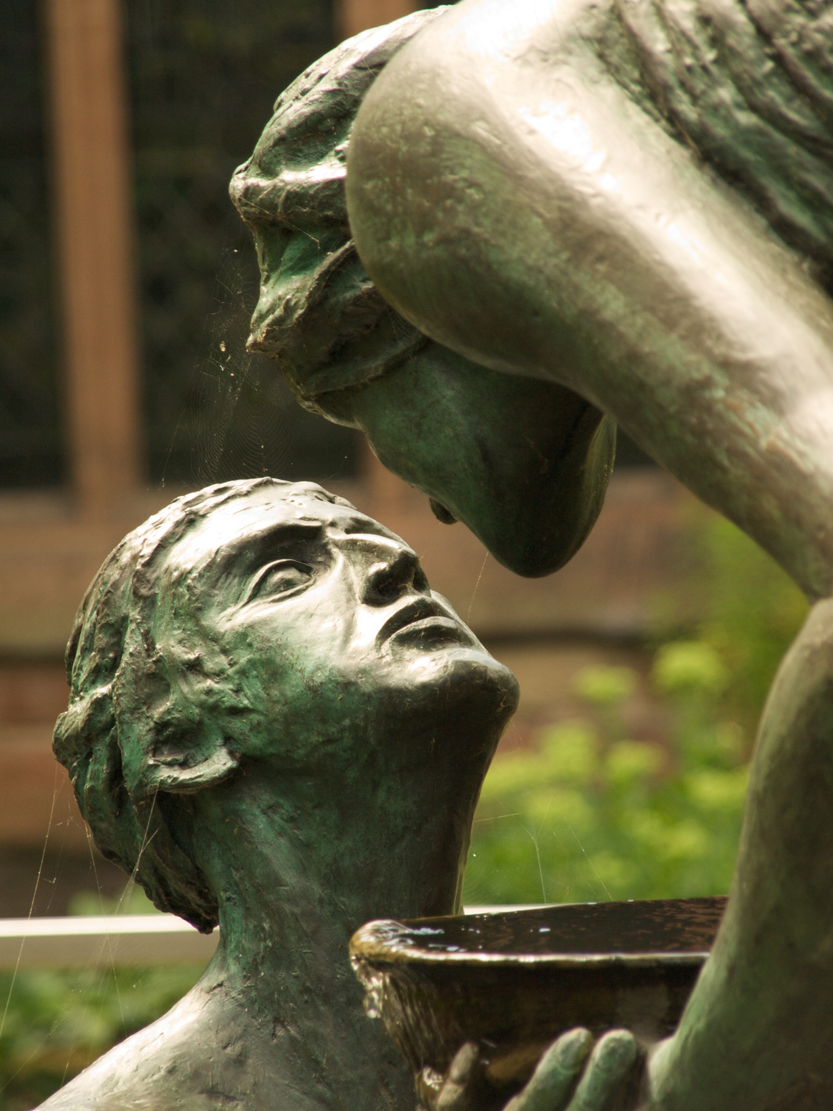
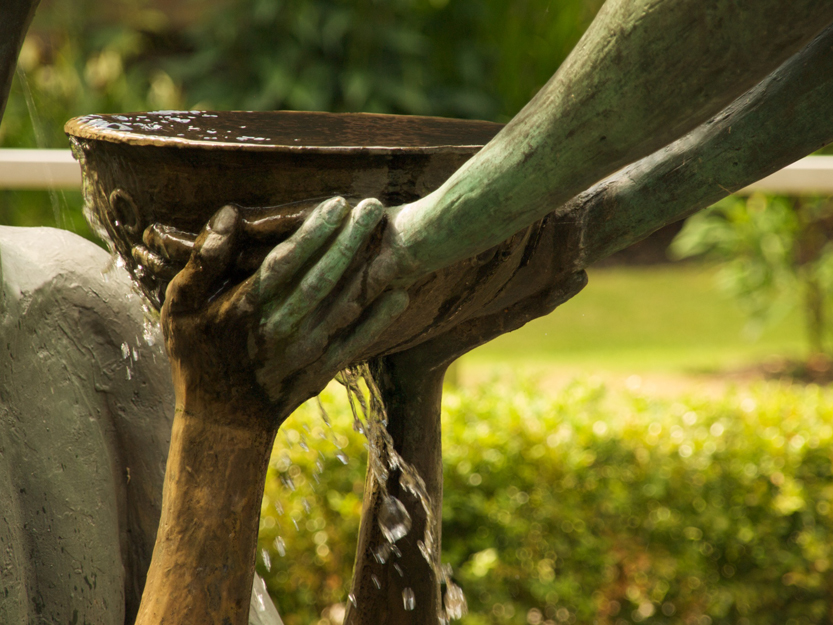
John 4:7 A Samaritan woman came to draw water, and Jesus said to her, “Give me a drink.”
Broadbent, Stephen, 1961- Christ and the Samaritan Woman Sculpture, freestanding, metal Chester Cathedral Chester GB Click image for more information.
Detail Views
Thanks Hovak.
After over two years of highly informative commentary, Hovak Najarian finds he needs more time for his primary calling. He is, after all, an artist first and that takes time.
We have left the door open in hopes that he will share his thoughts from time to time.
Also, his work remains on the blog (search tags for ‘Hovak Najarian’) and we are in the process of re-indexing his comments and will link to them in future as appropriate.
Again, Thanks Hovak.
Stan
I add my thanks to Stan’s. In the last two years I have learned more about art than I have in my previous 62 years. It has been a joy to read Hovak’s commentaries on the art selected for each Sunday. His commentaries have helped me understand better the way art can lead a person into a deeper faith and how a talented human can use art to express the faith within. I have come to appreciate how art through the centuries has both informed the faith and shaped the faith. I see with new eyes
Hovak, with a grateful heart I pray that God will bless ‘the work of your hands’ as you pursue your art; may God bless your every endeavor. Dan Rondeau
I encourage you to offer your thanks to Hovak in person, by card, or even on our blog (use the comment section of this Sunday’s post to offer your thanksgiving; Stan and I will make sure it is delivered). ~dan rondeau
John 3:1-2a Now there was a Pharisee named Nicodemus, a leader of the Jews. He came to Jesus by night…
Tanner, Henry Ossawa, 1859-1937 Nicodemus and Jesus on a Rooftop Painting 1899 Pennsylvania Academy of the Fine Arts Philadelphia, PA Click image for more information.
Commentary by Hovak Najarian
Nicodemus and Jesus on a Rooftop, Oil on Canvas, 1899, Henry Ossawa Tanner, 1859-1937
When America was a young nation, it looked to Europe for its fine arts and a person pursuing a career in painting went there to study. In the eighteenth century, Benjamin West studied in Italy, settled in London, and became the president of the Royal Academy of Art. In the nineteenth century, artist James Whistler also worked in England. Lengthy stays in Europe became almost a rite of passage in the twentieth century as American artists sought to absorb European culture and become part of revolutionary developments. When poet and art collector, Gertrude Stein was asked why she left Oakland, California, she said, “Because there was no there, there.” The hub of activity in the arts was Paris.
In addition to studying art, there were other factors that would lead a person to Paris. Opportunities for women and people of color in the arts were limited in America. Mary Cassatt went to Paris in the nineteenth century and remained there for a successful career. Henry Tanner, an African American, also made Paris his home.
Tanner’s father, a Bishop in the African Methodist Episcopal Church, moved his family from Pittsburgh, Pennsylvania to Philadelphia where his children would have better schools. An eduction in the liberal arts led Henry to develop a love of painting and he enrolled in the Pennsylvania Academy of Fine Arts. His instructor, Thomas Eakins, was one of America’s finest artists but after a visit to France in 1891, Tanner decided to leave America and live in Paris. At the time Tanner arrived in Paris, the art world was undergoing a revolution. Many of the Impressionists were still living. The Post-Impressionists and the Synbolists opened the way for developments beyond Impressionism and their work would influence painters throughout the twentieth century. Tanner learned from these developments and the mood established by the colors, spatial relationships, shadows, and figures in his “Nicodemus and Jesus on a Rooftop (shown here) indicates he was well aware of modernist trends. Tanner was mindful of the importance of his subject and created a sense that a serious conversation was taking place in a private, almost secret, meeting. While planning his composition, it is likely that Tanner recalled his father’s stories of how his ancestors in slavery had to worship in secret. The time Jesus and Nicodemus met was at night but Tanner chose to interpret it as a rooftop meeting at dusk. The sky is a blue-gray an the colors are muted. [In the Near and Middle East, rooftops were places to meet and socialize in the evening. During summer nights it was a place to sleep.]
Nicodemus, a ruler and a Pharisee, came to learn more about Jesus’ message. We see him as a white-bearded man sitting at the left with his hands on his knees. He is leaning forward slightly as though he is trying to comprehend what Jesus is saying; responses to his questions bring further questions from him. Jesus is sitting across from him on a parapet a few feet away. His eyes are fixed on Nicodemus as he gestures while he speaks. Tanner’s painting gives us a sense that we are witnessing this meeting. Unlike Medieval times when a biblical event was often given a local setting, Tanner’s setting is in the Near East as it might have been in the time of Jesus; turn of the century Paris is not the setting for this painting.




 Hear what the Spirit is saying