Art on the Eleventh Sunday after Pentecost, Proper 13B

You are that man!

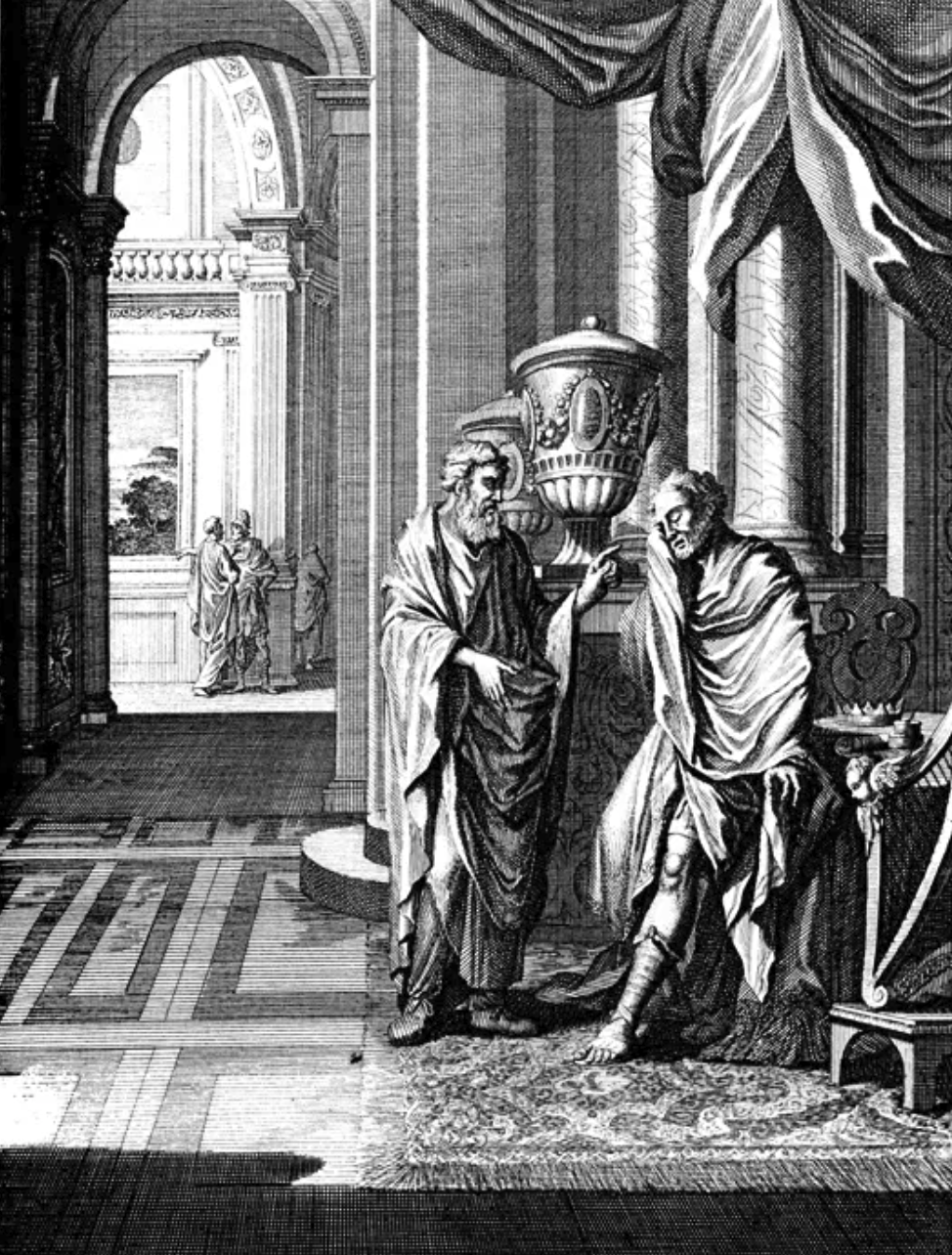
Nathan Rebukes David for His Adultery, Published in 1712,
Copper Engraving, Caspar Luiken (1672-1708)

Reading: 2 Samuel 11:26-12:13a

Hovak Najarian

After Bathsheba’s husband, Uriah, was sent into battle to be killed, King David “brought his widow, [Bathsheba] to his house and she became his wife, and bore him a son.”  This displeased the Lord and the Prophet Nathan was sent to visit David.

Upon his arrival at David’s palace, Nathan set up his rebuke with a story about two men: one very rich and the other very poor.  The poor man had only a ewe  he raised from the time it was a small lamb.  Like pets that become part of a family, his ewe was dear to him and loved by his children.  Nathan noted, “It was like daughter to him.”  The rich man lacked nothing and had large flocks of sheep and herds.  When he was visited by a traveler, he did not want to give up a single sheep from his own flocks so he took the lone sheep of the poor man to provide dinner for his visitor.  The wealthy man used his position to take advantage of the poor one.

When David heard this story he was furious.  He said “As the Lord lives the man who has done this deserves to die …because he did this thing and because he had no pity.”  Nathan said to David “You are that man.”  Nathan reminded David that he had “murdered Uriah the Hittite with the sword of the Ammonites and stole his wife.  When faced with the truth, David was remorseful and confessed “I have sinned against the Lord.”  He listened as Nathan told him what the sad consequences of his actions would be.

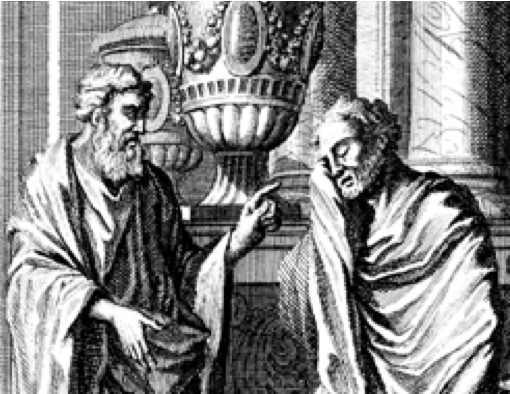
In Caspar’s engraving, David is crownless and his head is downcast.  He is standing slump-shouldered as Nathan points his finger at him in a scene reminiscent of a Greek tragedy.
Though Caspar Luiken lived during the early Baroque period, the architectural setting of this engraving gives it a classical quality.  Ornate aspects of the print are limited to primarily the drapery, robes, carpet and the two covered storage vessels.  In keeping with what was standard practice for an artist of this era, a strong light source defines the folds of the robes and fills the space with high contrasts.  Caspar also demonstrates his kill in creating an illusion of pictorial depth.  Through an accurate use of linear perspective, our attention is taken back to a brightly lit space and then a window takes us back even farther into a distant landscape.

At the time Caspar Luiken was born, Amsterdam was still aglow from its golden age of art and commerce.  During those years it was the wealthiest city in Europe and an important center for the arts.   His father, Jan Luiken, was a very successful illustrator and publisher.  This was a time before photographs were known; a time when highly skilled engravers such as Jan and his son Caspar filled a need for images that were used in publications.  Caspar learned engraving from his father and it was hoped he would carry on the family business but after working with him initially, he went to Germany to be on his own.  Six years later he returned to help support his father financially but then he died at the age of thirty-six.  A book of Caspar’s engravings of Old Testament events, including Nathan Rebukes David for his Adultery, was published posthumously.

Hovak Najarian © 2012, revised 2024

Art note

A brief description of the engraving process is given in the note following the Art Commentary: “David Playing the Harp before Saul | Art for B Proper 7.”

Art on the Tenth Sunday after Pentecost, Proper 12B

It happened, late one afternoon when David rose from his couch and was walking about on the roof of the king’s house, that he saw from the roof a woman bathing; the woman was very beautiful.

Bathsheba at Her Bath, oil on canvas, 1636-37, Artemisia Gentileschi, 1593-1656

Reading: 2 Samuel 11:1-15

Commentary by Hovak Najarian
 

 Bathsheba at Her Bath is one of several versions of this subject painted by Artemisia Gentileschi.  In each of them the focus is primarily on Bathsheba with King David observing her from a distance.  

In this scene, Bathsheba is relaxed and seems to be interested only in her grooming.   She, and the two women assisting her in the foreground, are occupied with details associated with her bath and there is no indication they are aware of being watched by King David.

While Bathsheba was at home in Jerusalem, her husband, Uriah, was serving in King David’s army in a war with the Ammonites.  David remained in Jerusalem during this war and everyday activities on the home front continued.  On the day Bathsheba was bathing she was in an open-air walled area where she would not be noticed by people at street level but David was at a higher vantage point and could see her.

In Artemisia’s painting, Bathsheba’s bath is almost complete.  She is combing her long hair while an attendant is wiping her legs.  Another attendant is braiding a portion of her hair and in the background at the upper left, King David is looking at her from a balcony of his Venetian styled palace (He is being shielded from the sun by an attendant with a parasol).  Though David is a minor figure in this composition, he is a major player in the events that followed.

Detail (enlarged), David observing Bathsheba.

 David was struck by Bathsheba’s beauty and desired to be with her.  He sent word for her to come to his palace and this resulted in an inappropriate relationship.  Bathsheba became pregnant.  In order for David to make it seem like he was not the father of the expected child, Uriah was called back from his military duties to spend time with his wife.  Uriah, a highly disciplined military man, however, did not go to his wife.   This did not turn out as David hoped so Uriah was sent back to the battlefield and placed in the thick of action where he would be killed.  After Uriah’s death, David married Bathsheba but the child that was conceived, died. 


In early paintings of Bathsheba, she was portrayed as an innocent victim of King David.   The biblical account indicates David, in his position of power, took advantage of her.  By the seventeenth century, however, it was suggested Bathsheba was flattered by the attention she received and might have been a willing participant … even a temptress.  This second interpretation seems to have grown out of fantasy; there is no factual information to support it. 


After the concept of art and artist was established in the fifteenth century, the making of art became a trade.  Artists established workshops and sought commissions from wealthy patrons and the Church.  In these artist’s workshops the men in a family often worked alongside their father, whereas young women were expected to pursue domestic skills.  Unlike traditional roles of women in her time, however, Artemisia apprenticed in the workshop of her well-known father, Orazio, and acquired the skills and insights that enabled her to establish a career in a field dominated by men.  In subject matter, she often turned to events in the Bible in which women played important roles or performed heroic deeds.

Hovak Najarian © 2024

Art note

When Artemisia was young, her mother died and she, along with her brothers, joined her father in his art workshop.  She was more serious about art than her brothers and wanted to learn all she could from her father, Orazio.  
Her father, like many artists who settled in Rome at that time, was influenced by Caravaggio and Artemisia also took an early interest in Caravaggio’s work.  She did not limit herself to portraits and flowers (subjects expected of women who painted) but often took on subjects with emotional content.   Although she was very gifted and recognized as such among other artists of her time, women artists tended to be overlooked by art historians and it was not until around mid-twentieth century that she began to be recognized for her achievements.

More: Artemisia Gentileschi (Wikipedia)

Image

Wikimedia Commons

Art on the Eighth Sunday after Pentecost, Proper 10B

David and all the house of Israel were dancing before the LORD with all their might, with songs and lyres and harps and tambourines and castanets and cymbals. 2 Samuel 6:5

David Dancing Before the Ark, Gouache on Board, c. 1896-1902,
James Jacques Joseph Tissot, 1836-1902

Reading: 2 Samuel 6:1-5, 12b-19

Commentary by Hovak Najarian
 

James Tissot’s David Dancing Before the Ark illustrates a joyous occasion as the Ark of the Covenant is being transported to Jerusalem.  When imagining how this procession might be depicted, perhaps Tissot’s thoughts turned to Psalm 150;  “Praise him with timbrel and dance.”  “Praise him upon the loud cymbals … and high sounding cymbals.”

When the ark was being moved from Baale-juda, it was placed initially on an oxen-drawn cart but Tissot has given us a scene from the second segment of the journey.   At this time the ark is being supported by poles on the shoulders of four men from the tribe of Levi [Levites were the only ones allowed to carry the ark.]  Though the men carrying the ark are surrounded by festivity, they themselves are serious in their solemn responsibility.  [When it was being moved, the ark was always covered in a blue cloth; it is unclear why Tissot chose to use pink.] 

In this painting, Tissot has placed David with his back to us at center stage.  He is wearing an ephod (a Jewish priestly vestment) and dancing energetically. To the left of David is a woman in an elaborate dress with “high sounding” cymbals, and on the right, two women in festive dresses are dancing as they play timbrels (a tambourine-like instrument).  Crowds surround the ark as they travel with David to Jerusalem.  Many in the background are waving palm fronds.

The back story of this painting began at the time David was crowned King of Israel. The Philistines had captured the ark earlier but then returned it. After its return, it was kept in the house of Abinadab for twenty years. It was David’s belief the ark should be in Jerusalem, the city he chose to be the new capital of Israel, and he set out with a large group of supporters to the house of Abinadab to transport it. In preparation for the journey, a cart – to be drawn by oxen – was built and the ark was placed on it. There was dancing and praises as the procession to Jerusalem was underway.

Abinadab’s two sons, Uzzah and Ahio attended the cart as the journey proceeded but the festivity ended abruptly when an ox slipped and it seemed the ark was going to fall.  Uzzah reached out instinctively to steady the ark but touching it was against the wishes of God and he was struck dead immediately. This angered and saddened David.  Uzzah was trying simply to protect the ark and God’s punishment seemed unfair.  The journey was halted for three months until David came to terms with Uzzah’s death.  For the remainder of the journey, the ark was carried on poles.  Tissot’s painting illustrates the second segment of this journey.  

When Tissot became older, he took a deeper interest in his faith and the people of the Bible became his primary subject matter.  He first focused on the life of Christ and then after completing a large series, he began painting subjects from the Old Testament.  In these biblical paintings, Tissot strived for authenticity and visited Egypt, Arab countries, and the Holy Land on three occasions.  While there he sketched and took notes.  He believed the manner of dress in rural areas of these lands would have remained similar to the way they were in biblical times.

Hovak Najarian © 2024

Art note

The medium, gouache, was used by Tissot for a series of paintings depicting events in the life of Christ.   He followed this with a series of events in the Hebrew Bible.  Many of these works may be seen at the Jewish Museum (events from the Hebrew Bible) and the Brooklyn Museum (events from the life of Christ).  Both museums are in New York City.   The medium “gouache” — pronounced g’wash (and does not rhyme with ouch)—is an opaque watercolor.  A watercolor, however, is composed of transparencies whereas gouache has a white pigment added, thus making all colors opaque.  Gouaches produce a soft effect and do have the intensity of colors that we see usually in oil paints and acrylics.

Images

David Dancing Before the Ark on The Jewish Museum website

Ark Brought to Jerusalem on The Bible Hub website

Art on the Seventh Sunday after Pentecost, Proper 9B

So all the elders of Israel came to the king at Hebron; and King David made a covenant with them at Hebron before the LORD, and they anointed David king over Israel. 2 Samuel 5:3

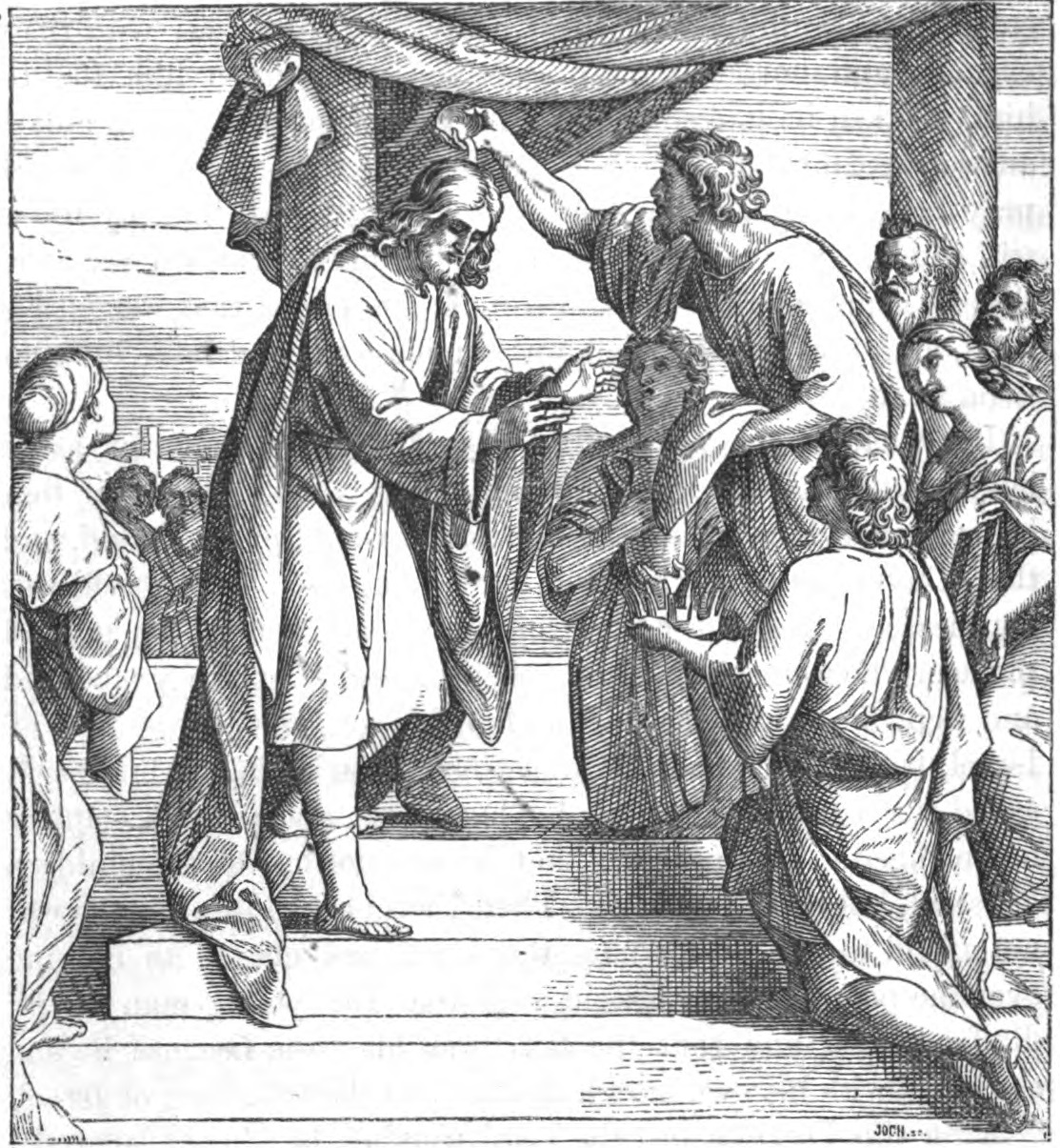
David Crowned King of Israel, wood engraving, c.1860, Julius Schnorr von Carolsfeld, 1794-1872

Reading: 2 Samuel 5:1-5, 9-10

Commentary by Hovak Najarian
 

After David was crowned King of Judah and reigned for seven years, all of the tribes of Israel met with him and said, “We are your own flesh and blood.  In the past, while Saul was king over us, you were the one who led Israel on their military campaigns.  And the Lord said to you, ‘You will shepherd my people Israel, and you will become their ruler’” David then “made a covenant with them at Hebron before the Lord, and they anointed David king over Israel.”


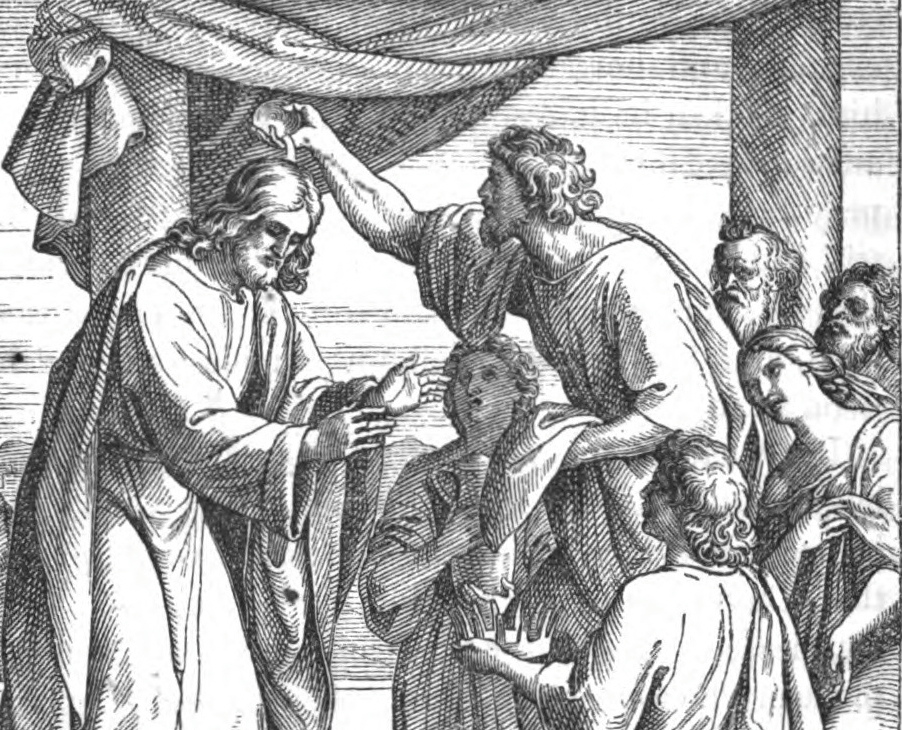
 Julius Schnorr von Carolsfeld’s engraving, David Crowned King of Israel depicts an elder pouring oil on David’s head while another is kneeling and holding a crown.  David leans forward slightly as he is being anointed.  He is looking at the crown and his hands are open as though he is acknowledging and accepting the confidence that is being placed in him.


Carolsfeld presents the moment of crowning as a tableau with David at the center.  Almost all attention of the participants on stage is directed toward him.  After we glance at the overall composition of this engraving, we tend to go back and enter the scene from the left.  From there, the woman at the far left guides us visually to the place above David’s head where oil is being poured.  Her gaze is fixed on the procedure.  In life, when we see a person’s eyes fixed in a particular direction, our tendency is to look to see what has engaged their attention.  This impulse is carried over as we look at subject matter in art.  In Carolsfeld’s engraving, almost everyone participating in the ceremony is focused on the anointment.


When we look at shapes, associations come to mind and we project meaning onto them (not always on a conscious level).  A pyramid or triangular shape with its broad base gives us a sense of stability, of being secure and on solid ground.  Von Carolsfeld has staged the scene of David’s crowning on a stepped-pyramid base, and the central figures move upward from there to continue a triangular grouping with the apex at the point where oil is being poured.  Secondary figures witnessing the crowning are on the sides and behind them in the background.  Their facial expressions seem filled with emotion and awe.  Above them is a drapery, the eighteenth century all-purpose filler of pictorial space and the “go to” backdrop of drama.  The clothes of the participants provide an abundance of opportunities for von Carolsfeld, to display his technical skills in the creation of light and shadow effects. 


Illustrations enhanced the text of handmade books during medieval times and after printing became mechanized at mid-fifteenth century, they added enrichment to texts through engravings.  As the work of artists continued to become specialized, those who created pictures for books became known as illustrators.  The art of illustrators was not regarded to be as important as that of painters, but engravers filled a need and they were assured steady work.

German artist von Carolsfeld lived in Italy for ten years and while there he became an admirer of High Renaissance painting.  Upon his return to Germany, he had a very successful career as a painter but also produced work in other media.  David Crowned King of Israel is one of over two hundred wood engravings created by von Carolsfeld for a Picture Bible

Hovak Najarian © 2018

Art & Music

More about the lithograph process:
Osmar Schindler’s image of David and Goliath is a lithograph [litho: stone, graph: drawing (drawing on stone)].  The process is based on oil and water not mixing.  When making a lithograph, a drawing is made with a greasy crayon on a flattened smooth-surfaced limestone.  The surface is treated with a weak acid solution which rolls off the  crayon drawing and covers the unmarked areas of the stone.   After the drawing is removed with a solvent, the surface is made wet.  Water clings to the treated surface but not to where the drawing was made (and removed).  When the stone is inked with a large roller, the ink is rejected by the watered surface and clings only to where there was once a drawing.  Paper is placed over the inked stone and it is run through a press.  When the paper is pulled off the stone, the image (once a drawing on the stone) is now on the paper (in reverse).  Multiple prints may be made by this process.  If color is to be used, a separate stone is used for each color.  Artists may color a lithograph by hand after it has been printed. ~Hovak Najarian

For more art and art commentary search the Art & Music Category or use Hovak Najarian as your search term.

Image

    Wikimedia Commons

    See also “julius schnorr von carolsfeld bible illustrations” (Google search)

    Art on the Fifth Sunday after Pentecost, Proper 7B

    The Philistine said to David, “Am I a dog, that you come to me with sticks?” 1 Samuel 17:43

    David and Goliath, lithograph, c 1883, Osmar Schindler, 1867-1927 

    Reading: 1 Samuel 17: (1a, 4-11, 19-23), 32-49

    Commentary by Hovak Najarian

    When the elders of Israel went to Samuel to demand that he appoint a king, it was argued they would need one to protect them from their enemies. Samuel was not convinced that Israel required a king but after arguments, Saul was anointed.


      Among Israel’s enemies were the Philistines whose army had gathered at the Valley of Elah to confront Saul’s forces.  During this stand-off a huge warrior named Goliath (reported to be nine feet, nine inches tall) came forward from the Philistine camp with taunts.  He challenged the Israelites to send someone to fight him.  The nation of the victor, he said, would rule over the other.  King Saul was a tall man with experience in battle but he would have been no match for this Philistine giant.


    Meanwhile, David, the youngest son of Jesse, was sent by his father to take food to his brothers who were serving in Saul’s army.  When David saw Goliath and heard his taunts, he said he would fight him.  He had killed wild beasts while protecting his sheep and was very accurate with his sling.  There was neither fear in David nor a need to wear burdensome armor. When Goliath saw he was being approached by an armor-less boy with a shepherd’s staff and sling, he was both surprised and amused.  He said “Am I a dog that you come to me with sticks?” David, however, quickly dispatched the giant with a stone hurled from his sling. The stone penetrated Goliath’s unprotected forehead and he fell.  David then used Goliath’s own sword to behead him.


    Osmar Schindler’s colored lithograph, David and Goliath, depicts the self-assured giant standing with his head back in laughter at the sight of David.  The men in the Philistine army behind him were anticipating a show-down between two warriors and they too must have wondered what was going on with the appearance of David.  In his right hand Goliath is holding a spear and his left hand is resting easily on his waist.  He did not take David seriously.  Even his shield-bearer is standing aside and leaving him not fully protected.  Goliath’s thoughts were perhaps “Are you kidding?  What is this?”    


    Regardless of size differences, David was not intimidated.  Before going out to confront Goliath, he told Saul, “The Lord who saved me from the paw of the lion and the paw of the bear will save me from the hand of the Philistine.”  In the foreground, David has both feet planted firmly on a boulder as he looks at Goliath.  He is ready and in a moment the stone placed in his sling’s pouch will be swung and released to put an end to Goliath. 


    There are many paintings and drawings of David’s encounter with Goliath.  They range from Sunday School cartoons to gory images of Goliath being beheaded or David holding up Goliath’s severed head.  David is well represented also in sculpture.  Two of the most noted sculptures of David are Donatello’s David (with Goliath’s head at his feet) and Michelangelo’s David (holding a sling over his left shoulder).

    David slays Goliath
    Michelangelo, fresco, Sistine Chapel
    Donatello, David, bronze, Bargello National Museum
    Michelangelo, David, Galleria dell’ Accademia

    Hovak Najarian © 2024

    Art & Music

    More about the lithograph process:
    Osmar Schindler’s image of David and Goliath is a lithograph [litho: stone, graph: drawing (drawing on stone)].  The process is based on oil and water not mixing.  When making a lithograph, a drawing is made with a greasy crayon on a flattened smooth-surfaced limestone.  The surface is treated with a weak acid solution which rolls off the  crayon drawing and covers the unmarked areas of the stone.   After the drawing is removed with a solvent, the surface is made wet.  Water clings to the treated surface but not to where the drawing was made (and removed).  When the stone is inked with a large roller, the ink is rejected by the watered surface and clings only to where there was once a drawing.  Paper is placed over the inked stone and it is run through a press.  When the paper is pulled off the stone, the image (once a drawing on the stone) is now on the paper (in reverse).  Multiple prints may be made by this process.  If color is to be used, a separate stone is used for each color.  Artists may color a lithograph by hand after it has been printed. ~Hovak Najarian

    For more art and art commentary search the Art & Music Category or use Hovak Najarian as your search term.

    Images

    Third Sunday after Pentecost, Year B

    “We are determined to have a king over us, so that we also may be like other nations and that our king may govern us and go out before us and fight our battles.” 1 Samuel 8:19b-20

    Israel Demands a King, engraving, 1778, J. Winter, active 18th century.
    This engraving was published in The Bible and its Story, 1909, Edited by Charles Horne and Julius Brewer.

    Reading: 1 Samuel 8:4-11, (12-15), 16-20, (11:14-15)

    Commentary by Hovak Najarian

    When the prophet Samuel was advanced in years the Israelites began to worry about their future.  Who would be their leader and how would they be able to deal with their enemies?  The elders went to Samuel with their concerns and said “You are old and your sons do not follow your ways, appoint for us a king to govern us, like other nations.”  Samuel was displeased that they asked for a king.  When he prayed, God instructed him to listen to the people, but also to warn them solemnly about what they could expect if they were to bed given a king.  Samuel warned the elders to be careful about what they wished but they would have none of it and said, “No… we are determined to have a king…


     Winter’s Israel Demands a King (detail above) the figures are placed in an open courtyard and strong opposing opinions are suggested by a face-off between Samuel and the elders.  Samuel, a slightly hunched over old man, is at the left.  He has assumed a solid stance and is pointing forcefully with both index fingers as he states his opposition to Israel having a king.  To the right an animated spokesperson for the elders is leaning forward as he argues forcefully to make a point.  He seems ready to interrupt Samuel at any moment.  The gestures of the elders are exaggerated for effect and their claw-like hands are emphasized.  A young man standing behind Samuel seems to be taken aback by the demanding elders.  Have they no respect … how could they talk to Samuel like that?    After listening, praying, and explaining what it would be like to have a king, Samuel followed the people’s wishes and anointed a king.


    J. Winter, Israel Demands a King (full engraving)  

    In medieval art, illustrations were added to enhance the text of gospel books.  Often subjects were events in the life of Jesus, Mary, his mother and the Apostles, and Old Testament kings, prophets and events in other’s lives were illustrated.  Illustrations also presented artists with an opportunity to venture into less-depicted subjects but sometimes these did not have visual impact.  An engraving of Samuel arguing with elders could not compete with the drama of Moses and the Israelites crossing the Red Sea or Elijah ascending to heaven in a fiery horse drawn cart.  When a subject lacked action an artist was challenged to generate interest by staging the subject in a dramatic way.  This could engage a viewer and describe a work’s subject but often these were not enough.  The arrangement of figures in Winter’s Israel Demands a King requires knowledge of the biblical text in order to understand the subject being depicted.

    At mid-fifteenth century the printing press was invented and by the end of the century, books were being published.  Instead of hand-painted illustrations as in gospel books, art in the form of engravings, could be inked and printed with the text.  Engravings continued to be popular even after the halftone (a photo-mechanical process) was introduced in the late nineteenth century.

    Hovak Najarian © 2024

    Art & Music

    For more art and art commentary search the Art & Music Category or use Hovak Najarian as your search term

    The Holy Trinity

    There are times when neither words nor pictures are adequate to express the depths of mystery.

    Commentary by Hovak Najarian

    Trinity with Three Faces via Wikimedia Commons

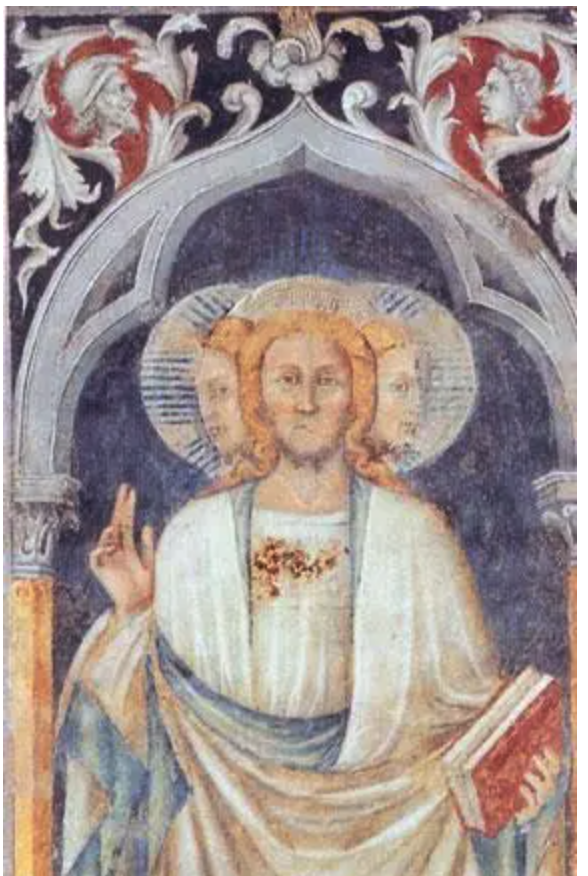
     Trinity with Three Faces, Fresco, c.1400, Antonio da Atri, c.1350-1433

     The much-quoted statement, “A picture is worth a thousand words,” is true in some instances but not all. A picture cannot represent adequately images such as those that come to mind in the words of the Twenty-third Psalm or the Sermon on the Mount. Art may at times clarify ideas that cannot be expressed by other means but there are times when neither words nor pictures are adequate. A challenge facing early Christian artists was how to create visual images that could communicate concepts found in their faith. A concept such as the Trinity was difficult to explain through art or with words.

    In the early Church, there were questions about how (or if) a depiction of God should (or could) be made and if so, what would the image be? God was depicted ultimately as a bearded father figure (possibly derived from the description, “ancient of days” mentioned in the Book of Daniel). A lamb represented Jesus and a dove represented the Holy Spirit. As long as members of the Godhead were depicted as separate entities, artists did not have to deal with the problem of creating an image that represented all three.


    The three figures that appeared before Abraham in the Book of Genesis were portrayed as the Trinity but they were shown as separate individuals.  By placing them adjacent to each other they were seen as a visual unit.  Official use of this form of Trinity was ended by the Pope in the eighteenth century but it continued in places such as the American Southwest.

    Retablo of the Trinity
    Retablo of the Trinity from an altarpiece of a mission church, New Mexico, USA

     Another attempt to depict the Trinity is found in the Basilica of Santa Maria Assunta in Atri, Italy.  Antonio da Atri’s fresco, “Trinity with Three Faces,” shows Christ standing and facing the viewer.  His right arm is raised in a blessing and his left hand is holding a book.  To depict Christ as part of the Trinity, Antonio has given the figure one body but three faces.  Right and left profiles have been added to Jesus’ head with radiating lines emanating from the halos.  As a setting for this composition, Antonio framed his Trinity image in a Late Gothic arch and decorative elements.

    Multi-headed divinities existed in other religions and although a three-faced Trinity such as Antonio’s fresco was accepted by the Roman Catholic hierarchy, it was ridiculed by Protestants.  It was called the “Catholic Cerberus.”  [In Greek mythology, Cerberus was the three-headed dog that guarded the gates of Hades.]  As a consequence, in the sixteenth century, the Pope ended the use of the three-faced Trinity but the image remained in remote regions.  Pope Innocent XII went further in the seventeenth century and ordered them all to be destroyed.  The three-faced Trinity at the Basilica of Atri survived because it was not in sight.  It, and other frescos at the Basilica, had been covered with plaster for fear their surfaces might in some way contribute to the spread of the bubonic plague.

    Hovak Najarian © 2013

    Note: links to the artwork were updated on May 25, 2024; the content was lightly edited. Find additional images of the Trinity with Three Faces using Google Search.

    Image: Antonio da Atri, Wikimedia Commons; upload of Retablo of the Trinity, ca. 1936, Watercolor, colored pencil, and graphite on Paper [This is a copy from an altarpiece], E. Elizabeth Boyd, 1903-1974.

    The Ascension of Christ

    We believe … Jesus ascended into heaven and is seated at the right hand of the Father. (Nicene Creed)

    Commentary by Hovak Najarian                                                                                        

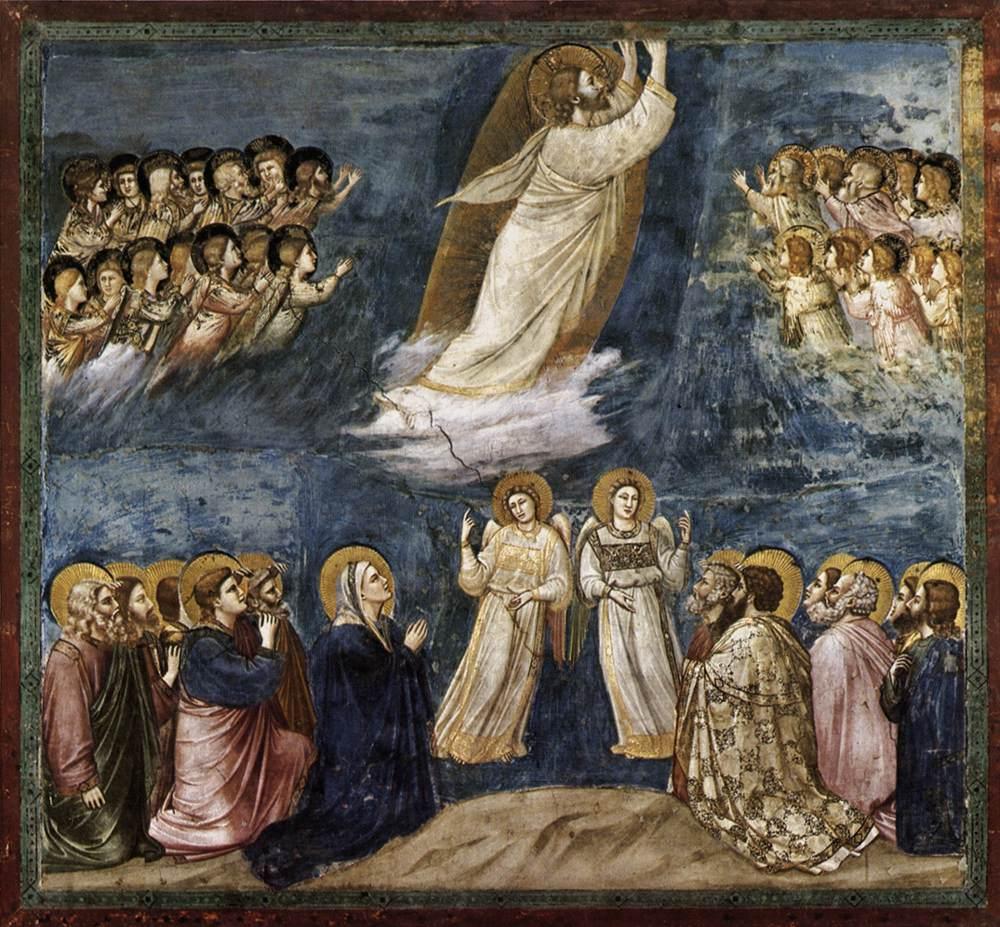
     After the resurrection, Christ’s last appearance to the disciples was at his ascension.  He blessed the disciples and then “withdrew and was carried up into heaven.”   A description of the ascension in Acts of the Apostles adds, “while they [the disciples] beheld, he was taken up; and a cloud received him out of their sight.  And while they looked steadfastly toward heaven as he went up, behold, two men [portrayed usually as angels] stood by them in white apparel; [They] said ‘Ye men of Galilee, why stand ye gazing up into heaven?  This same Jesus … shall so come in like manner as we have seen him go into heaven.’”   (Acts 1:9-11)

    The Ascension, Rabbula Gospel, 6th century. (Wikimedia Commons)

    The illustration of Christ’s ascension in the Rabbula Gospel Book shows the disciples standing at the lower half of the illumination looking up at Jesus.  Two men in white robes are talking to them and pointing upward.  At center foreground, Mary is raising her arms but is not looking upward.  Instead, she is looking out at the person that would be reading the gospel book.  In the upper half, Jesus is surrounded by an aureola (a body halo) with angels assisting him skyward.

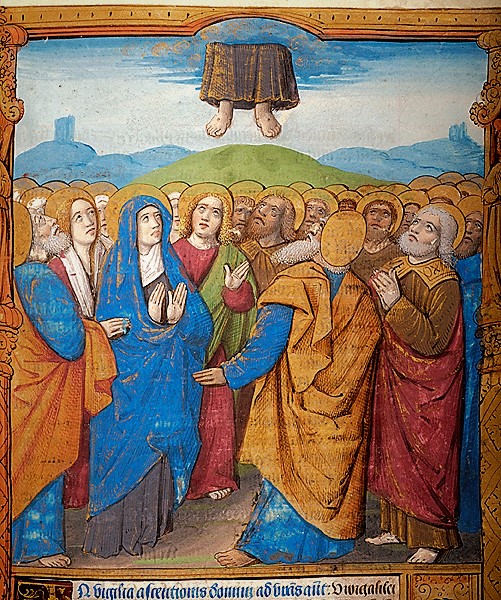
    Ascension from a Breviary, French, c. 1506-1516. Source: “Iconography of the Ascension, Part III of IV — The Disappearing Feet” on Ad Imaginem Dei

    Paintings of Christ’s ascension were based also on the statement, “he was taken up; and a cloud received him out of their sight.”   In these paintings, Jesus is ascending into a cloud with only a lower portion showing.   He is leaving pictorial space into the space beyond the painting.

    [When a person in a painting is seen from the back, the placement of a halo presents a problem.  Note the halo on the disciple wearing a yellow mantle (right foreground).]

    The Ascension of Christ, fresco, 13-4-1206, Giotto, 1275-1337

               Giotto, The Ascension of Christ (Wikimedia Commons)

    The Ascension of Christ by Giotto contains echoes of the work of other artists.   Like the illustration in the Rabbula Gospel, Giotto’s disciples and Mary are in the foreground.  Here, however, they are kneeling and their attention is focused on the two centrally located men in white apparel.  These men – depicted with wings and assumed to be angels – are floating above the ground pointing to the sky and talking to the disciples and Mary.  Jesus is above them and portrayed in greater size than the other figures.

    As in other paintings of the ascension, Christ is surrounded by a golden mandorla  –  the term is from the Italian word for almond which it resembles in shape – but unlike many illustrations, he is not looking down, and Giotto’s angels are not assisting in his ascent.  Instead, Jesus is already above the cloud that received him and is being greeted by a chorus of angels with arms raised in praise.  Christ in this fresco is in profile and as he ascends heavenward, his hands have entered partially into the space beyond the painting itself.

    Hovak Najarian © 2024

    I shall not want

    “…I shall not want.” In what ways is this true for you?

    Welcome!

    On Wednesday, April 17, 2024, we explored Psalm 23 for the voice of the Spirit. Our handout included commentaries on the other appointed texts from the Acts of the Apostles (Acts 4:5-12), the First Letter of John (1 John 3:16-24), and the Gospel according to John (John 10:11-18).

    Here is yet another brief look at Psalm 23. The first verse of the Psalm invites us to trust deeply.

    From a commentary on Psalm 23

    The psalm has been composed as the exposition of its opening line. The line makes a positive and a negative statement. The positive statement relates the LORD and the psalmist through the metaphor “shepherd.” That metaphorical statement, broadly enough understood, controls the imagery of the whole. The negative statement is a self-description of the psalmist. It uses the word “lack” (NRSV, “want”) in an absolute sense; the transitive verb is given no object. The psalmist lists what he does not lack in the rest of the psalm. […]

    To say “The LORD is my shepherd” invokes all the richness of this theological and political background as well as the pastoral. The metaphor is not restricted to associations with what actual shepherds did; it is informed by what the LORD has done and what kings were supposed to do. One does not have to shift to images of guide and host to account for the whole poem. “Shepherd” understood against its usage in Israel accounts for the whole. The statement is a confession. It declares commitment and trust. It also has a polemical thrust against human rulers and divine powers. The psalm entrusts the support, guidance, and protection of life only and alone to the one whose name is the LORD.

    The body of the psalm completes the sentence, “I do not lack.…” It does not leave those who say it to fill it out with what they want out of their own subjective wills. It has its own agenda of what the LORD does to fulfill one’s needs. The very personal syntax of the opening confession is maintained in the recitation of “what the LORD (he/you) does for me.” The items in the recitation can be read and understood in relation to three areas. First, what the LORD does draws on what is prayed for in the prayers for help. Second, it reflects the song of thanksgiving with its report of salvation and accompanying festivities, except here the account tells what the LORD does, not what the LORD has done in the past. Third, the recitation is at points connected with the language of Israel’s testimony to its salvation in the exodus.

    Excerpted from, James Luther Mays, Psalms, Interpretation, a Bible Commentary for Teaching and Preaching (Louisville, KY: John Knox Press, 1994), 117–118.

    divider line

    Most Wednesday mornings a group of us gather online to explore the readings that will be used in worship the following Sunday. Our handout features readings, commentaries, and notes for the Fourth Sunday of Easter (April 21, 2024) in Year B of the Revised Common Lectionary. Please: View or download the handout we used to guide our discussion and tune our hearts to the Spirit.

    View the Revised Common Lectionary readings appointed for Sunday, April 21, 2024, on the Revised Common Lectionary site curated by the Vanderbilt Divinity Library.

    Please come back to this site throughout the week in order to keep learning.

    divider line

    Be well. Do good. Pay attention. Keep learning.

    Image: ChurchArt Pro

    Be gracious to me, and hear my prayer

    Psalm 4 on the Third Sunday of Easter

    Welcome!

    Most Wednesday mornings a group of us gather online to explore the readings that will be used in worship the following Sunday. Our handout features readings, commentaries, and notes for the Third Sunday of Easter (April 14, 2024) in Year B of the Revised Common Lectionary.

    On Wednesday, April 10, 2024, we explored Psalm 4 for the voice of the Spirit. Our handout included commentaries on the other appointed texts from the Acts of the Apostles (Acts 3:12-19), the First Letter of John (1 John 3:1-7), and the Gospel according to Luke (Luke 24:36b-48).

    From a commentary on Psalm 4

    Whether in the brightness of daytime or the gloom of night, there are times when the believer is caught somewhere between the mercy of God and merciless humans, somewhere between the God of love and the vile hatred of humanity, somewhere between the tranquility of trusting God and the trappings of human treachery. With a thorough reading of the Psalms from beginning to end, one could easily come to the conclusion that life is full of enemies, tribulations, and hardships. In fact, one could readily conclude that enemies, tribulations, sickness, and hardship go hand in hand with living. This seems to be one of the core truths the psalmists talk about. While these painful realities may not define all of human experience, they certainly seem to be at the heart of all human existence.

    Far too often we mistakenly understand what should lead us to praise and what should lead us to feel blessed in terms of the absence of hardship and adversaries. Blessing, as this psalmist will conclude, is about having the full confidence in God in the midst of the inevitable realities of hardship and enemies. To nurture a faith or practice a spirituality that does not recognize or acknowledge adversity and adversaries is to live in a different world from the world of the psalmists. It is to live in a world removed from reality. The psalmists lived in the real world, and they called out to the God they found in the midst of the real world.

    Perhaps it is because of the complexity of human relationships that we are driven to seek God’s answer to our prayers. According to verse 2, honor suffers shame, and mortals love vain words and seek after lies. We pray to God because there is no false communication with God (at least on God’s behalf). With God, we have authentic communion and sincere communication.

    Psalm 4 confirms some of the things we assert about God.

    • God answers prayer.
    • God gives (breathing) room in human suffering.
    • God is gracious.
    • God is the source of our safety.
    Gary V. Simpson, “Pastoral Perspective on Psalm 4” in Feasting on the Word: Preaching the Revised Common Lectionary: Year B, ed. David L. Bartlett and Barbara Brown Taylor, vol. 2 (Louisville, KY; London: Westminster John Knox Press, 2008), 414-416

    View or download the handout we used to guide our discussion and tune our hearts to the Spirit.

    View the Revised Common Lectionary readings appointed for Sunday, April 14, 2024, on the Revised Common Lectionary site curated by the Vanderbilt Divinity Library.

    Be well. Do good. Pay attention. Keep learning.

    Please come back to this site throughout the week in order to keep learning.

    Image: ChurchArt Pro