What have you learned by “seeing” the Gospel?

Several weeks ago Hovak talked about the Good Shepherd (Tiffany) Window that fascinated him growing up. Grace Episcopal Church in Port Orange, FL has maintained the window over the years. We are awaiting some pictures of the 2 Tiffany Windows in their original church. As if our conversation was overheard this article appeared recently in the Episcopal News Service:

[Diocese of Southern Ohio] Four rare Tiffany stained glass windows have a new home: the Cincinnati Art Museum will unveil them this month as part of a new and permanent exhibit.The windows, badly in need of repair and conservation, were removed in 2010 from the former St. Michaels & All Angels church in urban Cincinnati and sold to the art museum. Proceeds supported the founding of a community ministry that is now housed at the Avondale facility. Gabriel’s Place seeks to encourage community-based enterprise. The urban center operates a community garden and kitchen, as well as a hoop house that provides fish and fresh produce for local businesses and residents.

via New life, light for Tiffany windows.

Read the whole article to find “Poor Man’s Bible.” Again, to reinforce what we have said, and part of the reason for our posts in the Art & Music category we read:

“While colored glass dates to ancient times, stained glass as a form of art and storytelling became prominent in the Middle Ages. A largely illiterate population could learn about the stories of the Bible from the illustrations in the stained glass windows. Some have called these windows the “Poor Man’s Bible,” because they, along with carvings, paintings and mosaics, could translate the narratives of the Bible to a population that couldn’t read.”

Again, your are invited to read the whole article, including this instructional piece: New life, light for Tiffany windows.

Your comments are always welcome. Have you ever seen a Tiffany Window up-close? Do you have a sculpture, carving, painting, or mosaic that has sustained or inspired your faith? Please share.

Ready for a word order meditation?

The words are familiar: “The Lord is my shepherd ….” I have recited this Psalm many times with the dying, with the bereaved, with those struggling to find the strength to move on, or the strength to face a fear-filled future.

I have been with agitated men and women of a certain age, robbed of mental acuity by illness or injury, and watched calm wash over them and through them, watched peace come to them as I recited the words of Psalm 23.

But, change the word order and you will have the heart of our conversation in the Sunday Morning Forum as it gathers at 9:00 am on Sunday, April 29, 2012.

The Lord is my shepherd … . Ah, peace, strength, and …

IS the Lord my shepherd …? Ah. Wait. What? How dare you suggest …

In the readings appointed for Sunday we hear:

The Lord is my Shepherd … (Psalm 23:1)

We know love by this, that he laid down his life for us … (1 John 3:16)

Jesus said, “I am the good shepherd.The good shepherd lays down his life for the sheep….” (John 10:11)

Look through the ups and downs of your life.

  • In what ways have these words of scripture been true for you?
  • When have these words been part of your prayers?
  • Are you ready to risk sharing a bit of your history with the group.
  • IS the Lord your shepherd?
  • What has this come to mean for you?
  • Have you always been secure in this knowledge?
  • Have you ever been secure in this knowledge?

Telling our stories of encounter with the Risen Lord, the Good Shepherd, is a fulfillment of our Baptismal Covenant to “proclaim by word … the Good News of God in Christ.”

I invite you to leave a comment, even a story, here. Let your words open the mystery and meaning of speaking this way about God and our relationship with God.

Unless I see the marks « Unfolding Light

“Unless I see the mark of the nails in his hands,and put my finger in the mark of the nailsand my hand in his side, I will not believe.” —John 20.25

Just before we leave the Second Week of Easter let us take one more look at Thomas. Steve Garnaas-Holmes is a United Methodist minister who writes daily. I am grateful for his insights and his willingness to share.

Here, I have excerpted his meditation  “Unless I see the marks.” You will want to read the entire meditation (more than once). It has opened my eyes to see Thomas in a different light.

Oh, Thomas was no doubter.…

”Oh, more, not less than all the rest,
Thomas believed in love, and how it bled. …

He didn’t ask to see his smiling face,
[his] famous, radiant eyes;
he didn’t hope to see him break the bread
the way he always did.
No, he asked to see his wounds,
the marks of love, the wounds of one
who weeps with those who weep,
who has walked with us through the valley
of the shadow of death.

Oh, Thomas, I’m with you: …

Read the entire meditation: Unless I see the marks « Unfolding Light.

What good is that plastic bottle? You might be surprised.

Episcopal Public Policy Network (EPPN) shared this article via Twitter. From Development Marketplace comes news of community building, gaining hope, and caring for the environment. Plastic bottles, as you will see, can do more than take up space in a landfill.

Building with plastic bottles

“In the Philippines and Guatemala, local groups have taken the mantra ‘Reduce, Re-use, Recycle’ to a whole new level.” See for yourself: Transforming Plastic Bottles into Classrooms

______________
Image: First Bottle School in Asia 

Michael Phillip Martinez

Two years ago, March 23 at 8 in the morning, Michael collapsed while unloading food at our outreach center. By 11 he was in a coma and remained so till death on the 26th. The burst aneurism had shredded his aorta; nothing could be done.

We had known Michael for a few years and for over a year he had been a dedicated client-volunteer typically giving 16+ hours a week. He had at first come to help in relocating the outreach center and stayed to help buy, handle, sort, bag, and distribute food. He returned one morning a week to mop and clean while I did data.

After his death we came to know how little we knew of Michael; probably things we could have known or surmised but in the focus of work never got around to.

Two loom large. Michael was homeless and without medical care.

Not that Michael was at all forthcoming. He had, he said, been renting a small trailer in 1000 Palms but at some point switched, he said, to a rented room. After his death we found the ‘room’ in 1000 Palms, actually a few shelves of Michael’s boxed belongings in a residence that had been converted into a machine shop. Michael was renting storage. Medically, in his mid 50s, overweight, with a bad diet, he fit the same profile that had landed me a triple bypass a decade earlier.

Could we have guessed his homelessness? Read the signs of him preparing food to take with him or ‘showering’ with a garden hose out back?  Could we have urged him to explore housing alternatives just as we were doing for other clients weekly? Could we have curtailed his physical activity on our behalf in light of his obvious risk status, and knowing that, have recommended medical alternatives? Maybe. Probably. Sure.

But my remembrance here is not what we could (should) have done. My remembrance it that we missed it. When we are admonished to ‘love one another as I have loved you’ we can’t just wait for the opportunity to show itself. We must seek it out with our eyes and ears open and be willing to read between the lines. Then, hopefully, action will follow.

Let us help you meet an artist and his work

Note: These comments are prepared and shared with you so that you can meet Dieric Bouts (artist) and his subject The Meeting of Abraham and Melchizedek, a detail of his altarpiece triptych in Sint-Pieterskerk, Leuven The Meeting of Abraham and Melchizedek is part of an altarpiece by Dieric Bouts (c.1415 -1475).  Although Bouts, The Elder (his sons also were painters) was Dutch, his career and artistic reputation was established in Flanders (now Belgium) where he lived and worked.  His triptych (trip-tik) for St. Peter’s Church in Leuven is regarded to be one of his finest paintings. A triptych (from the Greek: tri – meaning “three,” plus ptyche – the word for “fold”) is a three-paneled altarpiece found notably in churches from the Middle Ages through the Renaissance.  Early triptychs were relief carvings in wood or ivory but egg tempera became the favored medium of painters during the thirteenth and fourteenth century.  Egg tempera offered a wide range of colors but by the fifteenth century it, too, was being replaced as oils became the medium of choice.  Oil paints offered ease of application and with it a greater range of effects could be achieved.  Dieric Bouts worked in oils on wood panels. In a triptych, the outer panels are usually half the size of the middle panel and are attached with hinges so they can be folded like shutters.  A typical triptych has a familiar Biblical scene in the large center panel while the side panels provide a supporting cast of figures or related stories.  The side panels may also include the donor(s) as part of a tableau.  When the outer panels are folded their reverse sides become the front of the triptych and they also are carved or painted usually in keeping with the overall theme.

Click the image to view the entire Triptych

In the center panel, Bouts’ principal subject in the triptych at Leuven is the Last Supper.  The two outer panels – each containing two paintings one above the other – are Biblical scenes from Old Testament events in which the provision of bread was interpreted as prefiguring the Last Supper.

The left hand panel: The upper painting of the left panel depicts the Meeting of Abraham and Melchizedek when Melchizedek offers bread and wine to Abraham as he returns from battle.  Below that painting is the Feast of the Passover in which unleavened bread will be eaten.

The center panel:  Christ is the focus of attention with his face just above the exact center of the triptych.  He and his disciples are seated at a table and are about to break bread and participate in the communion.  The architectural setting is gothic in style.

The right hand panel: The upper painting of the right panel is The Gathering of Manna.  Manna is described as a bread-like tasting substance provided by the Lord.  The painting below it is Elijah in the Desert.  Bread is given to Elijah by an angel.

In Bouts’ triptych, the four Old Testament stories in which bread plays a role are intended to communicate visually the message of a connection between the stories and the Last Supper. Additional Notes:

As is found often in Gothic and Renaissance painting, the clothing and architectural styles in the Meeting of Abraham and Melchizedek are not in keeping with the time period being depicted.  The men are dressed in the manner of Europeans of the fifteenth century, and the architecture in the distance is not of Biblical times but rather typical of the time in which Bouts lived.  It even includes a gothic church.

Developments in the art of Europe varied from place to place and often it is difficult to give a name to designate a style.  Historians may refer to the style of fifteenth century Northern Europe as “Late Gothic” whereas the art of Italy during that same time period may be referred to as “Early Renaissance.”

A painting consists of pigment, a surface, and a medium.  Pigments are derived from many sources, ranging from earth colors to organic material.  A surface may be anything as long as it is compatible, or can be coated to make it compatible, with the type of paints that are being used.  The medium is a binder that mixes with the pigments to hold the fine particles together and to bond it to the surface that is being used.  Egg yolk is the medium in egg tempera; linseed or other oils are used in oil paints.

______________ © 2012 Hovak Najarian

“The Crucifixion”

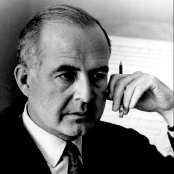
Samuel Barber  (1910-1981) was a highly versatile composer known for his two operatic works (Vanessa and Antony and Cleopatra), along with his many works for orchestra, strings, piano, and voice. Of his compositions for voice and piano, perhaps his best known and most loved is his collection of Hermit Songs. The Hermit Songs is a setting of semi-reverent, semi-crass texts written by Irish monks between the 8th and 13th centuries. The cycle was commissioned by the Elizabeth Sprague Coolidge Foundation in 1953. That same year, it was premiered at The Library of Congress by soprano Leontyne Price. Barber accompanied.

Of the ten Hermit Songs, the most poignant to me has always been “The Crucifixion.” (Listen once, and you’ll understand exactly why.)

Given that we are just over halfway through Lent, it seems appropriate to share it today. The text reads as follows:

At the cry of the first bird
They began to crucify thee, O Swan.
Never shall lament cease because of that.
It was like the parting of day from night.
Ah, sore was the suffering borne
By the body of Mary’s son.
But sorer still to Him was the grief
Which for His sake came upon His mother.
–Translation by Howard Mumford Jones

Expanding and refining our vision

Earlier this month I introduced you to Hovak Najarian who will expand our vision as we view Stan’s offerings in art each week. Not only will Hovak expand our vision but he will offer an experienced and educated eye to help us refine our vision as we enter the world of art. On the Third Sunday in Lent Stan directed our eyes to Rembrandt’s painting of Christ driving the Money-Changers out of the Temple. Hovak presents this additional information to help us into the art. ~dan

Comments on Rembrandt’s Christ Driving the Money-Changers from the Temple by Hovak Najarian

Rembrandt’s painting, Christ Driving the Money-Changers from the Temple was painted only a year after his earliest dated work but it already shows his interest and ability to create paintings of emotional depth.  Like his teacher, Pieter Lastman, Rembrandt was particularly interested in faces and in “Money-Changers,” each face, figure, and gesture is a focal point of deep expression.

The art of the Italian Renaissance grew out of a rebirth of classicism (the art of the Greeks in particular). The Greek gods were sculpted with idealized human proportions and this idealization and refinement carried over into Renaissance painting and into the works commissioned by the Roman Catholic Church and wealthy families.  The art of Protestant Northern Europe of the seventeenth century, however, did not reflect the classic ideal and their paintings were less likely to be of Mary and child, the crucifixion, or one of the saints. Their figures were more like everyday people, not idealized images.

Dutch businesses thrived during Rembrandts time and he earned a very good income from painting portraits of his patrons.  Rembrandt also painted Biblical subjects of deep emotional content. There is realism in the faces of the people in “Money-Changers.” They are not men with classic profiles set in place for a lovely picture.  The money-changers’ faces show furrowed brows, mouths agape, and surprised reactions as Jesus moves into action. Jesus is not centrally located in the scene as is often the case but rather he is at the upper left side as though he just entered the scene and caused the money-changers to scramble.  He is not a handsome man with a sweet beatific expression.  He looks tough, serious, and his eyes are focused and intense.  The money-changers seem like real people in a real situation; the painting does not give the effect of a scene that is staged.

The facial expressions and sense of activity of the figures seen in Rembrandt’s earlier paintings gradually changed in focus as he became older.  Instead of movement, his figures tend to remain still with a sense of heavy emotional weight and feeling concentrated in facial expressions.

______________
© 2012 Hovak Najarian

We are brothers and sisters…

ONE Episcopalian buys a brick
Another EPISCOPALIAN finds hope

With the entire Episcopal Church—brothers and sisters in Christ, though separated by thousands of miles—the people of St. Margaret’s are giving to help in the rebuilding of Haiti. In particular we are giving to assist in the rebuilding of the cathedral in Port-au-Prince. Our Presiding Bishop, Katherine Jefferts Schori gives us perspective:

The Episcopal Church as a whole is partnering to help the Diocese of Haiti rebuild the cathedral complex in Port-au-Prince. Before the earthquake, that complex included not only the cathedral with its world famous murals (three have been conserved), but a music school and philharmonic orchestral, a vocational school, a convent, and diocesan offices. Partnerships have helped to provide necessary infrastructure for strategizing and planning the redevelopment work. Read her complete statement.

Bishop Jean Zaché Duracin of the Diocese of Haiti narrates a powerful video about the conditions in Haiti, images of rebuilding, and offers his thoughts and reflections on the second anniversary: WE ARE ONE

Easter Hymn Post–“The Old Rugged Cross”

may have mentioned this before, but I love hymns. The texts possess a richness that is, in my opinion, difficult to find in any other genre, with the exception of the art song. This holds true for “The Old Rugged Cross.”

To be honest, I’ve never heard “The Old Rugged Cross” sung in an Episcopal church…or in any church other than the tiny Baptist church I attended as a very young child. And when we sang it, my friend, it didn’t have to be Easter. “The Old Rugged Cross” was appropriate on Christmas Eve, the Fourth of July, Mother’s Day, and any other day you can think of. Or at least that’s how it seemed to me.

So, given my early acquaintance with the hymn, I’ve never really given much thought as to who wrote it or why, but I’m glad that I started doing a little digging. It is difficult to get solid information on the hymn because most of the stories are passed down by word of mouth or presented on personal websites. However, here’s what I’ve found: The hymn was written by an itinerant Methodist minister named George Bennard (1873-1958) in 1913.

Image

While on his route through the northern states, he began meditating on Christ’s suffering on the cross. He is reputed to have written, “I saw the Christ of the cross as if I were seeing John 3:16 leave the printed page, take form, and act out the meaning of redemption.” (1)

When he arrived home to his apartment in Albion, Michigan, he began setting text to a tune he had already composed. One story goes that he only had the phrase “On a hill far away stood an old rugged cross” until he was harassed by some teens during a service. According to the story, after that incident, the rest of the words came to him. The composition process did not happen quickly, and he spent the next few months revising the text and asking for input from friends and colleagues.

In 1913, the hymn was debuted at the First Methodist Episcopal Church of Pokagon, Michigan. Four members of the choir sang, accompanied by piano and violin. His friends, Rev. and Mrs. Leroy Bostwick, paid to have the hymn printed.

The song grew in popularity and became well-loved throughout the northern states. In 1915, two years after its debut, evangelist Billy Sunday and his song leader Homer Rodeheaver bought the rights to the song for $500, and its popularity grew nation-wide thanks to Billy Sunday’s tent revivals.

Bennard died in 1958 after writing several more hymns and spending his adult life ministering to others. Because he sold the rights to “The Old Rugged Cross” so soon after its composition, he never became wealthy from the song.

When I’ve heard the hymn, it’s usually been in a slow, gospel style like this. However, there are also jazz renditions, instrumental blues covers, and, of course, Elvis.

The melody and the style might not be everyone’s cup of tea, but the words truly are timeless. And, like I learned at that little Baptist church, appropriate all year long.

On a hill far away stood an old rugged cross
The emblem of suffering and shame
And I love that old cross
Where the dearest and best
For a world of lost sinners was slain

Chorus:
So I’ll cherish the old rugged cross
‘Til my trophies at last I lay down
I will cling to the old rugged cross
And exchange it someday for a crown

Oh, that old rugged cross so despised by the world
Has a wondrous attraction for me
For the dear Lamb of God left His glory above
To  bear it to dark Calvary

In that old rugged cross, stained with blood so divine
A wondrous beauty I see
For ’twas on that old cross Jesus suffered and died
To pardon and sanctify me

To the old rugged cross I will ever be true
Its shame and reproach gladly bear
Then He’ll call me someday to His home far away
Where His glory forever I’ll share.

Sources:
http://www.lectionary.org/HymnStories/The%20Old%20Rugged%20Cross.htm (1)
http://www.the-oldruggedcross.org/history.htm
http://www.albionmich.com/history/histor_notebook/R980413.shtml