Information, reflection, questions, opinions and study helps for one or more of the readings appointed for the Sundays and Major Feasts of Year A in the Revised Common Lectionary used by the Episcopal Church.
John 20:18 Mary Magdalene went and announced to the disciples, “I have seen the Lord”; and she told them that he had said these things to her.
UNKNOWN MASTER, Italian (active mid-14th century in Rimini) Crucifixion with Saints and Noli Me Tangere around 1350 Tempera and gold on wood, 56 x 38 cm Pinacoteca, Vatican Click image for more information.
Romans 8:6 To set the mind on the flesh is death, but to set the mind on the Spirit is life and peace.
SCHÖN, Erhard
(b. ca. 1491, Nürnberg, d. 1542, Nürnberg)
The Six Excellent Spiritual Gifts
c. 1535
Woodcut
Germanisches Nationalmuseum, Nuremberg Click image for more information.
1 Samuel 16:13 Then Samuel took the horn of oil, and anointed him in the presence of his brothers; and the spirit of the LORD came mightily upon David from that day forward.
ANGELICO, Fra
(b. ca. 1400, Vicchio nell Mugello, d. 1455, Roma)
King David Playing a Psaltery
c. 1430
Pen and brown ink and purple wash on vellum, 197 x 179 mm
British Museum, London Click image for more information.
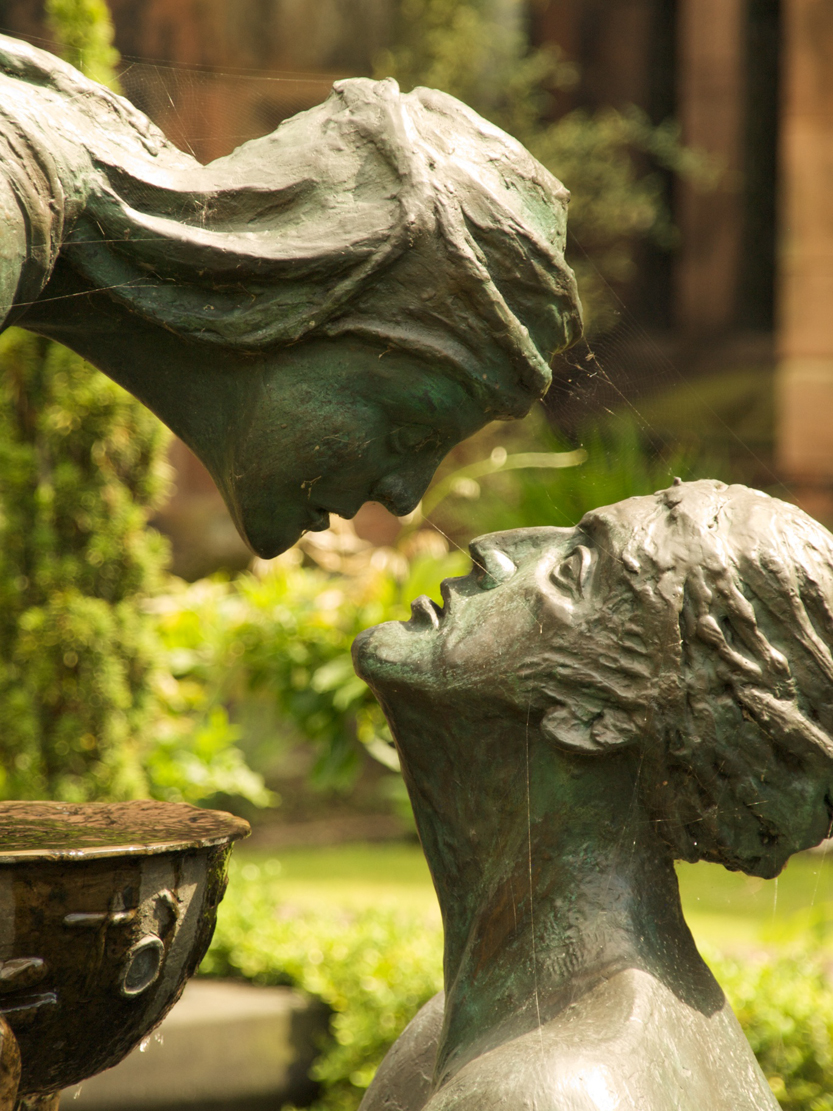
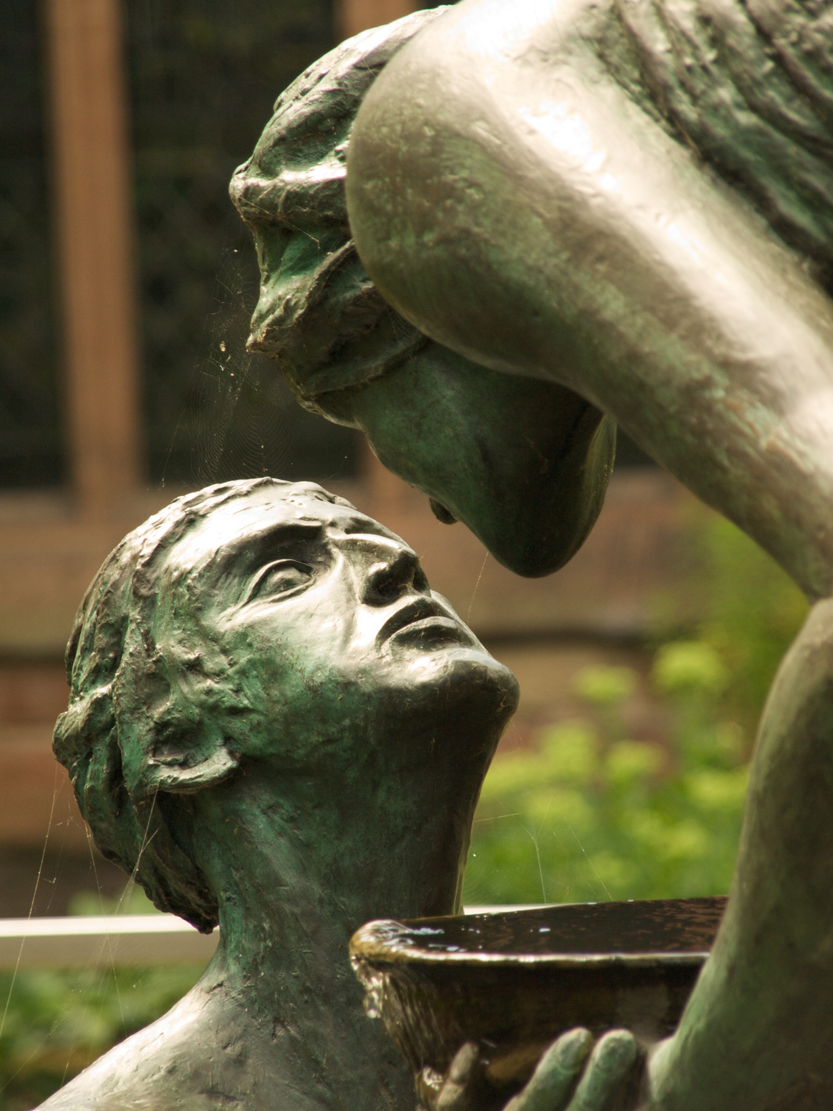
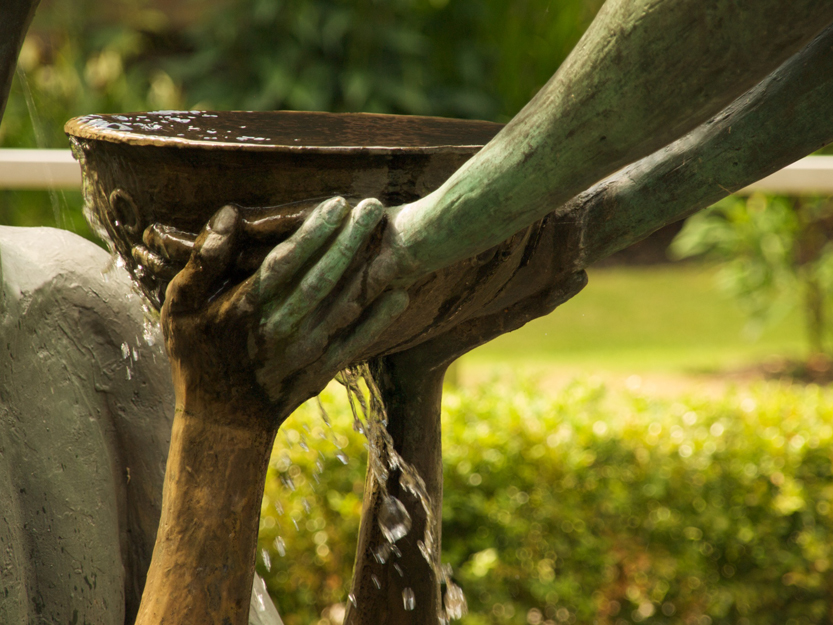
John 4:7 A Samaritan woman came to draw water, and Jesus said to her, “Give me a drink.”
Broadbent, Stephen, 1961- Christ and the Samaritan Woman Sculpture, freestanding, metal Chester Cathedral Chester GB Click image for more information.
Detail Views
Thanks Hovak.
After over two years of highly informative commentary, Hovak Najarian finds he needs more time for his primary calling. He is, after all, an artist first and that takes time.
We have left the door open in hopes that he will share his thoughts from time to time.
Also, his work remains on the blog (search tags for ‘Hovak Najarian’) and we are in the process of re-indexing his comments and will link to them in future as appropriate.
Again, Thanks Hovak.
Stan
I add my thanks to Stan’s. In the last two years I have learned more about art than I have in my previous 62 years. It has been a joy to read Hovak’s commentaries on the art selected for each Sunday. His commentaries have helped me understand better the way art can lead a person into a deeper faith and how a talented human can use art to express the faith within. I have come to appreciate how art through the centuries has both informed the faith and shaped the faith. I see with new eyes
Hovak, with a grateful heart I pray that God will bless ‘the work of your hands’ as you pursue your art; may God bless your every endeavor. Dan Rondeau
I encourage you to offer your thanks to Hovak in person, by card, or even on our blog (use the comment section of this Sunday’s post to offer your thanksgiving; Stan and I will make sure it is delivered). ~dan rondeau
John 3:1-2a Now there was a Pharisee named Nicodemus, a leader of the Jews. He came to Jesus by night…
Tanner, Henry Ossawa, 1859-1937 Nicodemus and Jesus on a Rooftop Painting 1899 Pennsylvania Academy of the Fine Arts Philadelphia, PA Click image for more information.
Commentary by Hovak Najarian
Nicodemus and Jesus on a Rooftop, Oil on Canvas, 1899, Henry Ossawa Tanner, 1859-1937
When America was a young nation, it looked to Europe for its fine arts and a person pursuing a career in painting went there to study. In the eighteenth century, Benjamin West studied in Italy, settled in London, and became the president of the Royal Academy of Art. In the nineteenth century, artist James Whistler also worked in England. Lengthy stays in Europe became almost a rite of passage in the twentieth century as American artists sought to absorb European culture and become part of revolutionary developments. When poet and art collector, Gertrude Stein was asked why she left Oakland, California, she said, “Because there was no there, there.” The hub of activity in the arts was Paris.
In addition to studying art, there were other factors that would lead a person to Paris. Opportunities for women and people of color in the arts were limited in America. Mary Cassatt went to Paris in the nineteenth century and remained there for a successful career. Henry Tanner, an African American, also made Paris his home.
Tanner’s father, a Bishop in the African Methodist Episcopal Church, moved his family from Pittsburgh, Pennsylvania to Philadelphia where his children would have better schools. An eduction in the liberal arts led Henry to develop a love of painting and he enrolled in the Pennsylvania Academy of Fine Arts. His instructor, Thomas Eakins, was one of America’s finest artists but after a visit to France in 1891, Tanner decided to leave America and live in Paris. At the time Tanner arrived in Paris, the art world was undergoing a revolution. Many of the Impressionists were still living. The Post-Impressionists and the Synbolists opened the way for developments beyond Impressionism and their work would influence painters throughout the twentieth century. Tanner learned from these developments and the mood established by the colors, spatial relationships, shadows, and figures in his “Nicodemus and Jesus on a Rooftop (shown here) indicates he was well aware of modernist trends. Tanner was mindful of the importance of his subject and created a sense that a serious conversation was taking place in a private, almost secret, meeting. While planning his composition, it is likely that Tanner recalled his father’s stories of how his ancestors in slavery had to worship in secret. The time Jesus and Nicodemus met was at night but Tanner chose to interpret it as a rooftop meeting at dusk. The sky is a blue-gray an the colors are muted. [In the Near and Middle East, rooftops were places to meet and socialize in the evening. During summer nights it was a place to sleep.]
Nicodemus, a ruler and a Pharisee, came to learn more about Jesus’ message. We see him as a white-bearded man sitting at the left with his hands on his knees. He is leaning forward slightly as though he is trying to comprehend what Jesus is saying; responses to his questions bring further questions from him. Jesus is sitting across from him on a parapet a few feet away. His eyes are fixed on Nicodemus as he gestures while he speaks. Tanner’s painting gives us a sense that we are witnessing this meeting. Unlike Medieval times when a biblical event was often given a local setting, Tanner’s setting is in the Near East as it might have been in the time of Jesus; turn of the century Paris is not the setting for this painting.
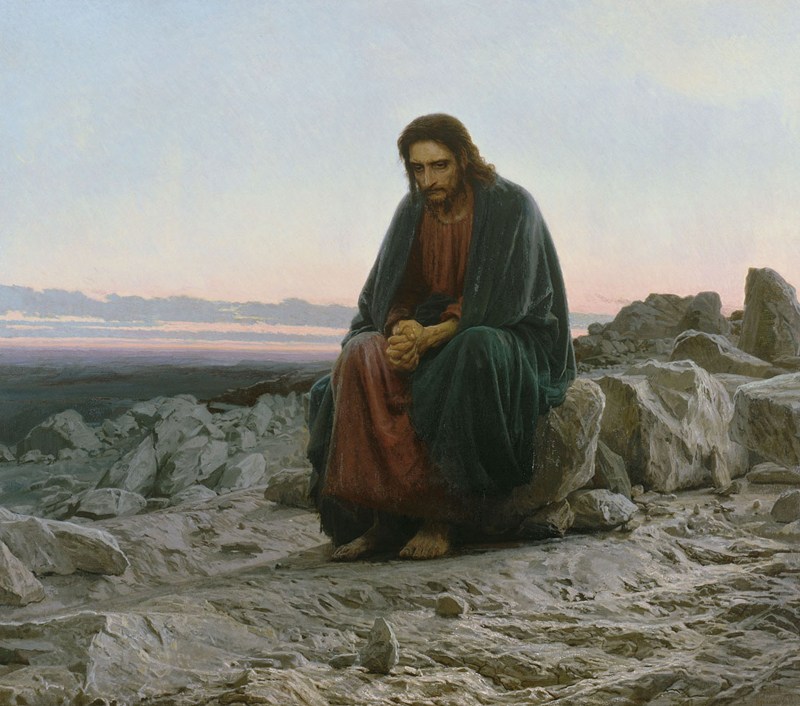
Matthew 4:1 Then Jesus was led up by the Spirit into the wilderness to be tempted by the devil.
Kramskoĭ, Ivan Nikolaevich, 1837-1887 Christ in the Desert Painting 1872 Gosudarstvennai︠a︡ Tretʹi︠a︡kovskai︠a︡ galerei︠a︡ Moscow Click image for more information.
Commentary by Hovak Najarian
Christ in the Desert, Oil on Canvas, 1872, Ivan Nikolaevich Kramskoi, 1837-1887
During the Renaissance of the fifteenth century, intellectuals believed that some subjects in art were of a higher order than others. “History painting” was judged to be the most difficult and at the highest level. In a broad interpretation of the term, these were paintings that told a story; the category included biblical and historical subjects as well as allegorical and mythological scenes. In history paintings, the figures in them interacted in settings that required an artist to have mastery of all aspects of painting. Ranked below history painting was full figure portraiture (a portrait in the form of a bust was a step lower). Ivan Nikolaevich Kramskoi (also spelled, Kramskoy) was not a painter of historic battles or mythical events, and his work was not in keeping with new trends in European painting.
Kramskoi lived in Russia at a time when France had become the center of the art world. In Paris, his contemporaries the Impressionists were changing the emphasis of painting with studies of natural light, color, and the landscape. Kramskoi was neither a history painter nor part of the Impressionist movement; he painted portraits, in a studio and his colors tended to be monochromatic. Yet, his portraits were of exceptional quality. He had an ability to imbue a sitter’s facial expression with details that gave insights into a person’s mood and character. “Christ in the Desert,” shown here, was not painted for an art-minded Parisian gallery-goer whose interest was in seeing the latest developments in the art world. Kramskoi shows us Christ in deep thought and introspection at a time before being tempted.
After his baptism, Jesus “…was led up by the Spirit into the wilderness to be tempted by the devil.” In this painting, Christ is isolated from all human and cultural contacts as he sits alone among the hard, bare, and colorless stones. He remained in this desolate place without food for forty days and was unimaginably hungry. When Satan determined Christ would be vulnerable, he came to tempt him, saying: “If you are the Son of God, command these stones to become loaves of bread.” Christ turned him away, replying: “It is written, ‘Man shall not live by bread alone, but by every word that proceeds from the mouth of God.’”
In describing this painting, novelist Ivan Goncharov wrote, “…there is nothing festive, heroic, victorious [about the figure in the painting] – the future fate of the world and all livings is concealed in that miserable, small being, in pauper appearance, under the rags, in humble simplicity, inseparable with true majesty and force.”
MURILLO, Bartolomé Esteban (b. 1617, Sevilla, d. 1682, Sevilla The Young Beggar c. 1645 Oil on canvas, 134 x 100 cm Musée du Louvre, Paris Click image for more information.
During the seventeenth century the Spanish Empire was on the decline and there was great disparity between the wealthy and the poor. The wealthy noble class neither worked nor was required to pay taxes and the poor were in desperate need. Although the government was mismanaged it was supported by silver from mines in South America and wealth from other foreign lands. Foreign possessions and occupied lands however required attention and resources were squandered on wars. Yet, regardless of these conditions, the visual arts flourished.
Bartolomé Murillo and his contemporary, Diego Velazquez, were both natives of Seville. Velazquez became the court painter for Philip IV and worked in Madrid; he is regarded now to be the greatest painter of the Spanish baroque period. Murillo remained mostly in Seville and yet in his lifetime he was far better known than Velazquez. His work was admired throughout Europe.
Murillo built a reputation painting altarpieces but early in his career he began painting the orphaned homeless children who begged and foraged to survive. Disease was widespread among them and many died from the plague (several of Murillo’s children also died in the plague). “The Young Beggar,” (also known as, “The Louse-Ridden Boy”) shown here, was the first of Murillo’s urchin paintings. Murillo’s parents both died when he was a young boy and he identified with the difficult life of street children. He helped with charitable work through his association with the Franciscans.
“The Young Beggar” depicts a boy in patched, torn rags and dirty bare feet sitting alone in a sheltered area. He has just finished eating a lunch of apples and shrimp and now is examining himself in an effort to get rid of lice. Today, this may seem like an odd subject for a painting but it was a reality of the times. Grooming often was depicted in seventeenth century genre paintings, especially in the Netherlands and Flanders where the relationship of hygiene to health was recognized. In Dutch paintings the cleaning of lice also was symbolic of the cleansing of sin and it is thought this painting may have been commissioned by a Dutch or Flemish merchant living in Seville.
[Apart from the pesky insects, the term louse has entered our language with additional meanings. We say a contemptible person is a “louse” and we use the term also for something that is mishandled and not up to par; “It was loused up” or “That is lousy.”]
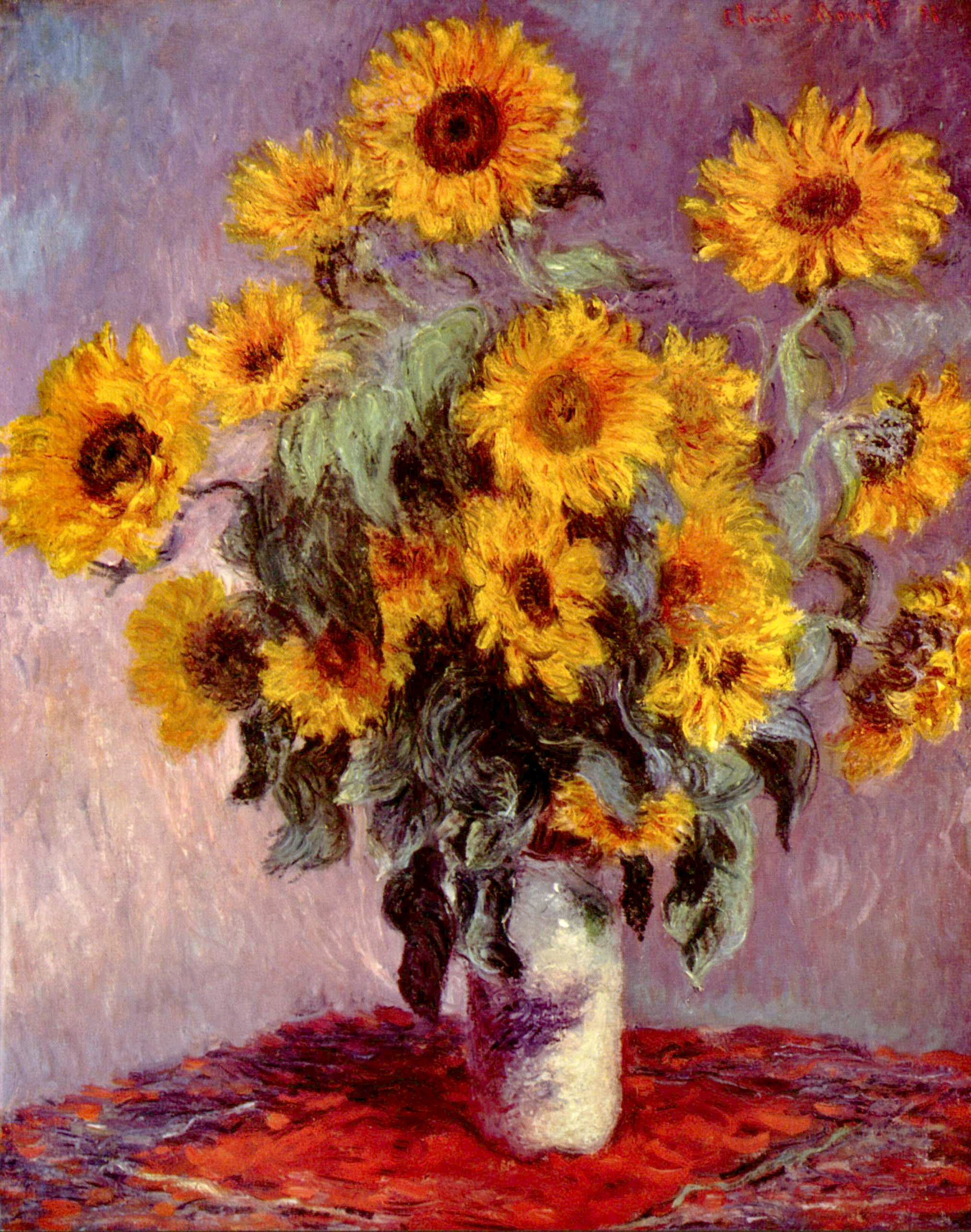
Sunflowers, Oil on Canvas, 1881, Claude Monet, 1840-1926
During the nineteenth century when Claude Monet, Auguste Renoir, and other artists in France went to the Fontainebleau Forest to paint in the open air (plein air painting), they discovered that sunlight causes subtle and constant changes in the colors we see. They observed that changes in the atmosphere and seasons affected colors as well. Further, they realized there was not a right and wrong color for the trees, sky, or water. “Reality” was a passing moment and they tried to record the colors as they appeared. Upon a return to Paris, other painters joined them in exploring the effects of light and they held an exhibition together in 1874. When the critic Louis Vauxcelles saw the title of a Monet painting, “Impression, Sunrise,” he clung to the word “Impression” and declared derogatorily that the artists were “Impressionists.” He did not understand what the artists were attempting and neither did the public. “Impressionism” became accepted as the style’s name but even today misconceptions continue. Many believe an impressionist painting is an artist’s obscure impression of a subject. It is not.
“Sunflowers,” shown here, was at the Impressionists’ exhibition of 1882. Of particular note is how Monet painted the area around the flowers. It is treated as an integral part of the painting, not a leftover to be filled in after the flowers were completed. Instead of regarding the “air” around the flowers to be “negative space,” Monet unified the painting’s surface with brushstrokes and colors that are interacting visually with the sunflowers.
Sunflowers are native to North America and were cultivated for food by Native Americans. Spanish explorers introduced them to Europe and by the 1830s its oil was being processed for commercial use. It was the Russian Orthodox Church, however, that set into motion the large industry of sunflower oil production we have today. The Church listed foods that were to be avoided during Lent; included were butter and lard. Sunflower seed oil was new, overlooked by the Church, and failed to be listed. Its widespread use during Lent helped make it enormously popular and in great demand.
Its sun-like shape and color gave the sunflower its name and its almost universal positive associations have made it a favorite subject of painters and designers. Today, sunflower motifs are seen regularly in designs that enrich our homes and when they are presented as gifts they become an unspoken sign of warmth, love, and appreciation.
[It is a myth that sunflowers turn to follow the sun throughout the day. Buds face the sun but after flowers develop, they remain in one direction; east.]
Isaiah 58:7 Is it not to share your bread with the hungry, and bring the homeless poor into your house; when you see the naked, to cover them, and not to hide yourself from your own kin?
Timothy P. Schmalz “Jesus the Homeless” contemporary bronze sculpture Canada
Art that was favored by the upper social class of Europe in the early nineteenth century had roots in classicism and romanticism. Paintings did not depict the life of farmers who were hunched over day after day working in the fields or the coal miners who lived and worked in hopeless conditions in Belgium. A few artists, known as “Realists” painted the lives of the poor but today, despite an awareness of poverty and homelessness throughout the world, the subject is seldom seen in the visual arts. The displaced victims of war are mentioned in the media occasionally but in wealthy nations the homeless are likely to be discussed as a “problem.” When people see them they tend to avoid eye contact and walk around them at a distance. It is easier to say the homeless are to blame for their own misfortune when no contact is made and their circumstances are not known.
One of the roles of sculpture throughout history has been to create an image that will represent the interests and values of a society. Sculpture often is intended to elicit such things as patriotism, nationalism, and religious fervor. It may be commissioned by governments to celebrate war heroes, leaders, events, or it may be simply enrichment to surroundings. The poor and homeless are not likely to be seen in sculpture intended to represent a group’s self image.
Sculpting monuments and memorials has been part of Timothy Schmalz’ life’s work and he has filled many commissions for churches. In general, his sculpture does not stir controversy. An exception is, “Jesus the Homeless” (shown above). This piece was the result of a direct personal experience and it differs in style and content from his usual work. On a winter’s day while in the City of Toronto, Canada, he saw a homeless man wrapped in a sleeping bag on the sidewalk while crowds passed by. It was the Christmas season and passersby were focused on their immediate priorities; the man on the sidewalk was ignored. When Schmalz saw the homeless man, Jesus’ words written in Matthew came to mind: “…I was hungry and you gave me no food, I was thirsty and you gave me no drink, I was a stranger and you did not welcome me, sick and in prison and you did not visit me.” “…as you did not to one of the least of these, you did not to me.” (Mathew 25:31-46). Schmalz developed this scene into a provocative image of a homeless Jesus. Instead of being in a sleeping bag on the sidewalk, the man was placed under a blanket on a bench. At first glance, the sculpture does not seem to represent any specific person but then, as we see the uncovered feet, we notice the wounds from a nail that pierced them during crucifixion.





 Hear what the Spirit is saying