The Ascension of Christ

We believe … Jesus ascended into heaven and is seated at the right hand of the Father. (Nicene Creed)

Commentary by Hovak Najarian                                                                                        

 After the resurrection, Christ’s last appearance to the disciples was at his ascension.  He blessed the disciples and then “withdrew and was carried up into heaven.”   A description of the ascension in Acts of the Apostles adds, “while they [the disciples] beheld, he was taken up; and a cloud received him out of their sight.  And while they looked steadfastly toward heaven as he went up, behold, two men [portrayed usually as angels] stood by them in white apparel; [They] said ‘Ye men of Galilee, why stand ye gazing up into heaven?  This same Jesus … shall so come in like manner as we have seen him go into heaven.’”   (Acts 1:9-11)

The Ascension, Rabbula Gospel, 6th century. (Wikimedia Commons)

The illustration of Christ’s ascension in the Rabbula Gospel Book shows the disciples standing at the lower half of the illumination looking up at Jesus.  Two men in white robes are talking to them and pointing upward.  At center foreground, Mary is raising her arms but is not looking upward.  Instead, she is looking out at the person that would be reading the gospel book.  In the upper half, Jesus is surrounded by an aureola (a body halo) with angels assisting him skyward.
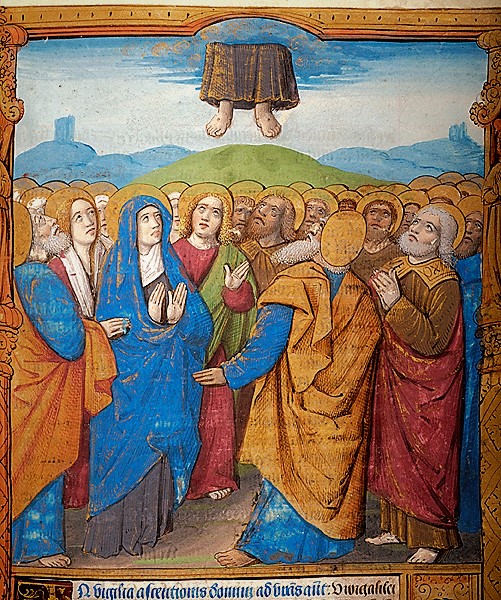
Ascension from a Breviary, French, c. 1506-1516. Source: “Iconography of the Ascension, Part III of IV — The Disappearing Feet” on Ad Imaginem Dei

Paintings of Christ’s ascension were based also on the statement, “he was taken up; and a cloud received him out of their sight.”   In these paintings, Jesus is ascending into a cloud with only a lower portion showing.   He is leaving pictorial space into the space beyond the painting.

[When a person in a painting is seen from the back, the placement of a halo presents a problem.  Note the halo on the disciple wearing a yellow mantle (right foreground).]

The Ascension of Christ, fresco, 13-4-1206, Giotto, 1275-1337
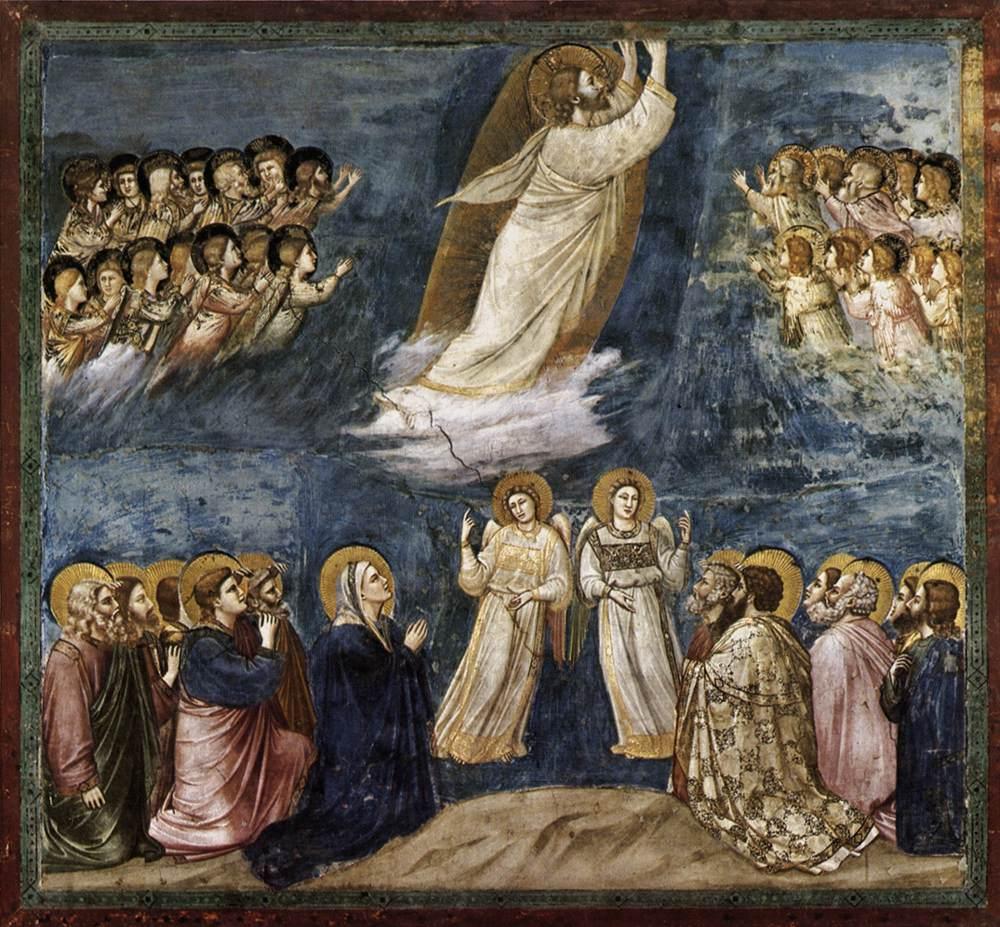
           Giotto, The Ascension of Christ (Wikimedia Commons)

The Ascension of Christ by Giotto contains echoes of the work of other artists.   Like the illustration in the Rabbula Gospel, Giotto’s disciples and Mary are in the foreground.  Here, however, they are kneeling and their attention is focused on the two centrally located men in white apparel.  These men – depicted with wings and assumed to be angels – are floating above the ground pointing to the sky and talking to the disciples and Mary.  Jesus is above them and portrayed in greater size than the other figures.

As in other paintings of the ascension, Christ is surrounded by a golden mandorla  –  the term is from the Italian word for almond which it resembles in shape – but unlike many illustrations, he is not looking down, and Giotto’s angels are not assisting in his ascent.  Instead, Jesus is already above the cloud that received him and is being greeted by a chorus of angels with arms raised in praise.  Christ in this fresco is in profile and as he ascends heavenward, his hands have entered partially into the space beyond the painting itself.

Hovak Najarian © 2024
Christ the King Sunday, Year A

We ask Jesus, “when did we see you”? His response is unequivocal.

Welcome!

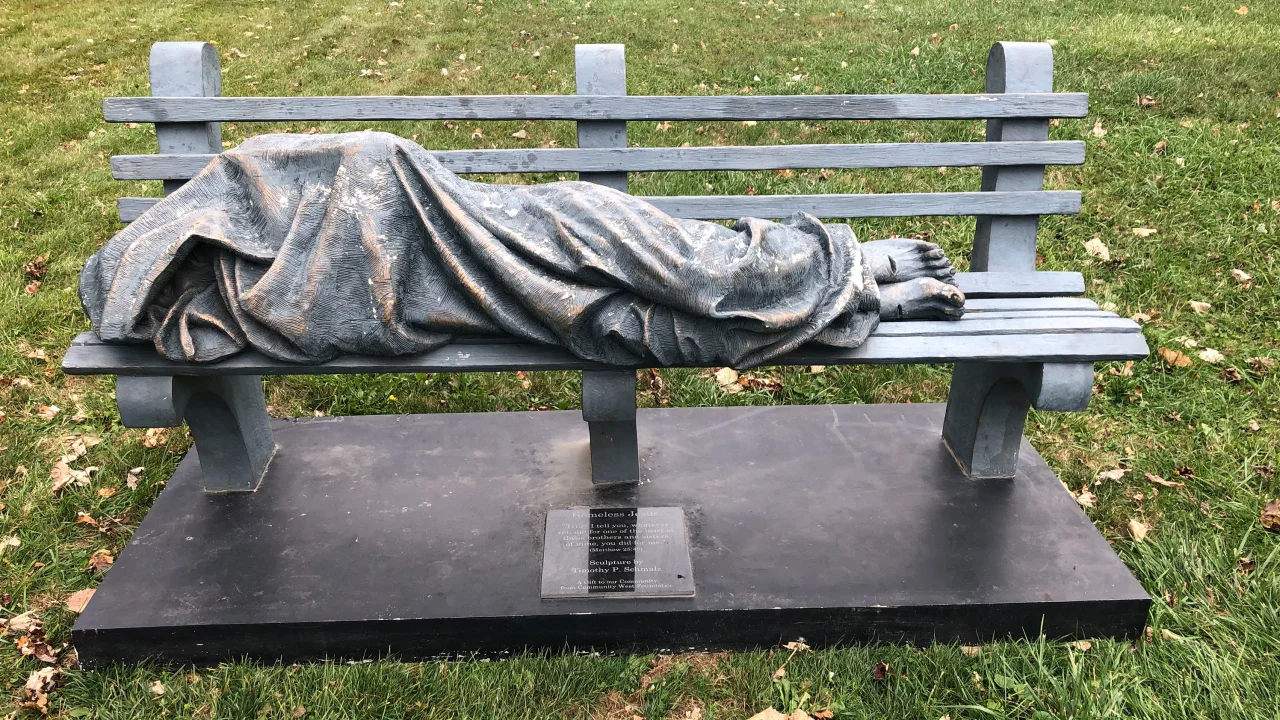
“Homeless Jesus” outside St. Barnabas Episcopal Church in Bay Village, OH

“You did it to me” commentary on Mark 25:31-46

So many of us, in our devotional and ecclesiastical lives, long to “see Jesus.”  And rightly so.  We pray for an experience of Jesus’s presence.  We yearn to feel him close.  We sing hymns, recite creeds, hear sermons, and attend Bible studies — all in the hope of seeing and knowing Jesus in a deeper and more meaningful way.

Of course, there is nothing wrong with these practices — unless they keep us at comfortable arm’s length from where Jesus actually is.  Unless they lead us to believe that the work of justice and compassion is somehow secondary to the “real” business of Christianity.  The real business of Christianity is bending the knee to Jesus.  And where is Jesus?  Jesus is in the least and the lost and the broken and the wounded.  Jesus is in the un-pretty places.  In the bodies we don’t discuss in polite company.  In the faces we don’t smile at.  In the parts of town we speed by.

It’s not that we earn our way to majestic King Jesus by caring for the vulnerable.  It is that majestic King Jesus, by his own choice and volition, has stooped and surrendered in such a way that he IS the vulnerable.  There’s no other way to get to him.  Period.

Debbie Thomas Lectionary Essay “You Did It To Me” on Journey with Jesus webzine; posted November 15, 2020

Please make the time to read the entire essay by Debie Thomas as you consider the meaning of Christ the King this week.

View the Revised Common Lectionary readings appointed for Sunday, November 26, 2023 on the Revised Common Lectionary site curated by the Vanderbilt Divinity Library.

Be well. Do good. Pay attention. Keep learning.

Please come back to this site throughout the week in order to keep learning.

Image: CNN

Pentecost +12, Proper 15A

Joseph’s story is a reminder to take the long view of events.

Welcome!

Each Wednesday morning a group of us gather online to explore the readings to be used in worship the following Sunday. Our handout features readings, commentaries, and notes for the Twelfth Sunday After Pentecost (August 20, 2023) in Year A of the Revised Common Lectionary.

This past Wednesday, August 16, 2023, we explored the readings from Genesis 45:1-15 and Romans 11:1-2a, 29-32 for the voice of the Spirit. Our handout included commentaries on the other appointed texts from the Psalms (Psalm 133 ) and the Gospel according to Matthew (Matthew 15:(10-20), 21-28).

From the commentary on Genesis 45:1-15

Matt Skinner has a new book out on Acts, subtitled Catching Up with the Spirit. In it he makes a helpful remark regarding what he thinks is often an assumption at play, “that God’s ‘activity’ in the world is like a puppeteer pulling strings.” It’s different for him, it seems. “It’s easier for me,” he notes, “to look back on situations, after the fact, and wonder. With the help of hindsight, I might perceive ways in which I was open or closed to God’s presence.”

This is the power of Joseph’s final confession: that though none of what has happened to him over the course of his life is what he’d have chosen it to be, he can yet now see that God has set him up to preserve life.

Joseph’s whole story” by Liz Goodman in The Christian Century, February 18, 2022. 

You are invited to view or download the handout we used to guide our discussion and tune our hearts to the Spirit.

View the Revised Common Lectionary readings appointed for Sunday, August 20, 2023 on the Revised Common Lectionary site curated by the Vanderbilt Divinity Library.

Be well. Do good. Pay attention. Keep learning.

View or download the Handout for Proper 15, Year A.

I Am Your Brother Joseph from the Ad Imaginem Dei blog curated by Margaret M. Duffy. This post explores the story of Joseph revealing his true identity to his brothers. See Genesis 45.

Please come back to this site throughout the week in order to keep learning.

Image: ChurchArt Pro

Remembering Saint Matthew

Updated June 9, 2023

As Jesus went on from there, he saw a man named Matthew sitting at the tax booth. “Follow me,” he said to him. And he got up and followed him.

Matthew 9:9

Note: This was originally posted on September 13, 2013. It is updated and reposted here. The call of Matthew is part of the Gospel reading for Proper 5A (June 11, 2023).

The Church remembers Saint Matthew every year on September 21. This year a new layer was added to this remembrance. In an interview with Pope Francis posted and printed on September 19th, the Pope talked about his own calling:

Pope Francis continues his reflection and says, jumping to another topic: “I do not know Rome well. I know a few things. These include the Basilica of St. Mary Major; I always used to go there. I know St. Mary Major, St. Peter’s…but when I had to come to Rome, I always stayed in [the neighborhood of] Via della Scrofa. From there I often visited the Church of St. Louis of France, and I went there to contemplate the painting of ‘The Calling of St. Matthew,’ by Caravaggio. “That finger of Jesus, pointing at Matthew. That’s me. I feel like him. Like Matthew.”

The Calling of Matthew by Caravaggio

Here the pope becomes determined, as if he had finally found the image he was looking for: “It is the gesture of Matthew that strikes me: he holds on to his money as if to say, ‘No, not me! No, this money is mine.’ Here, this is me, a sinner on whom the Lord has turned his gaze. And this is what I said when they asked me if I would accept my election as pontiff.” Then the pope whispers in Latin: “I am a sinner, but I trust in the infinite mercy and patience of our Lord Jesus Christ, and I accept in a spirit of penance.”

Read A Big Heart Open to God, the interview with Pope Francis posted online by America Magazine.

Saint Matthew – Tax Man, Apostle, Evangelist, Martyr on the Blog Ad Imaginem Dei curated by Margaret M Duffy. This post from 2016 uses centuries of art to explore the life of Saint Matthew.

From the Web Gallery of Art:
Caravaggio: The Calling of Saint Matthew 1599-1600
Oil on canvas, 322 x 340 cm
Contarelli Chapel, San Luigi dei Francesi, Rome