The Ascension of Christ

We believe … Jesus ascended into heaven and is seated at the right hand of the Father. (Nicene Creed)

Commentary by Hovak Najarian                                                                                        

 After the resurrection, Christ’s last appearance to the disciples was at his ascension.  He blessed the disciples and then “withdrew and was carried up into heaven.”   A description of the ascension in Acts of the Apostles adds, “while they [the disciples] beheld, he was taken up; and a cloud received him out of their sight.  And while they looked steadfastly toward heaven as he went up, behold, two men [portrayed usually as angels] stood by them in white apparel; [They] said ‘Ye men of Galilee, why stand ye gazing up into heaven?  This same Jesus … shall so come in like manner as we have seen him go into heaven.’”   (Acts 1:9-11)

The Ascension, Rabbula Gospel, 6th century. (Wikimedia Commons)

The illustration of Christ’s ascension in the Rabbula Gospel Book shows the disciples standing at the lower half of the illumination looking up at Jesus.  Two men in white robes are talking to them and pointing upward.  At center foreground, Mary is raising her arms but is not looking upward.  Instead, she is looking out at the person that would be reading the gospel book.  In the upper half, Jesus is surrounded by an aureola (a body halo) with angels assisting him skyward.
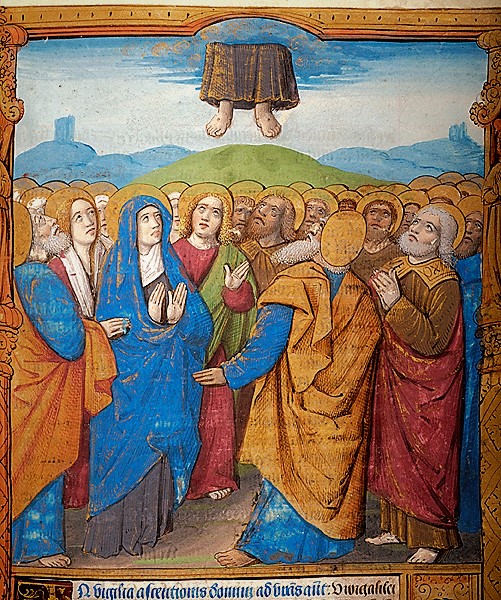
Ascension from a Breviary, French, c. 1506-1516. Source: “Iconography of the Ascension, Part III of IV — The Disappearing Feet” on Ad Imaginem Dei

Paintings of Christ’s ascension were based also on the statement, “he was taken up; and a cloud received him out of their sight.”   In these paintings, Jesus is ascending into a cloud with only a lower portion showing.   He is leaving pictorial space into the space beyond the painting.

[When a person in a painting is seen from the back, the placement of a halo presents a problem.  Note the halo on the disciple wearing a yellow mantle (right foreground).]

The Ascension of Christ, fresco, 13-4-1206, Giotto, 1275-1337
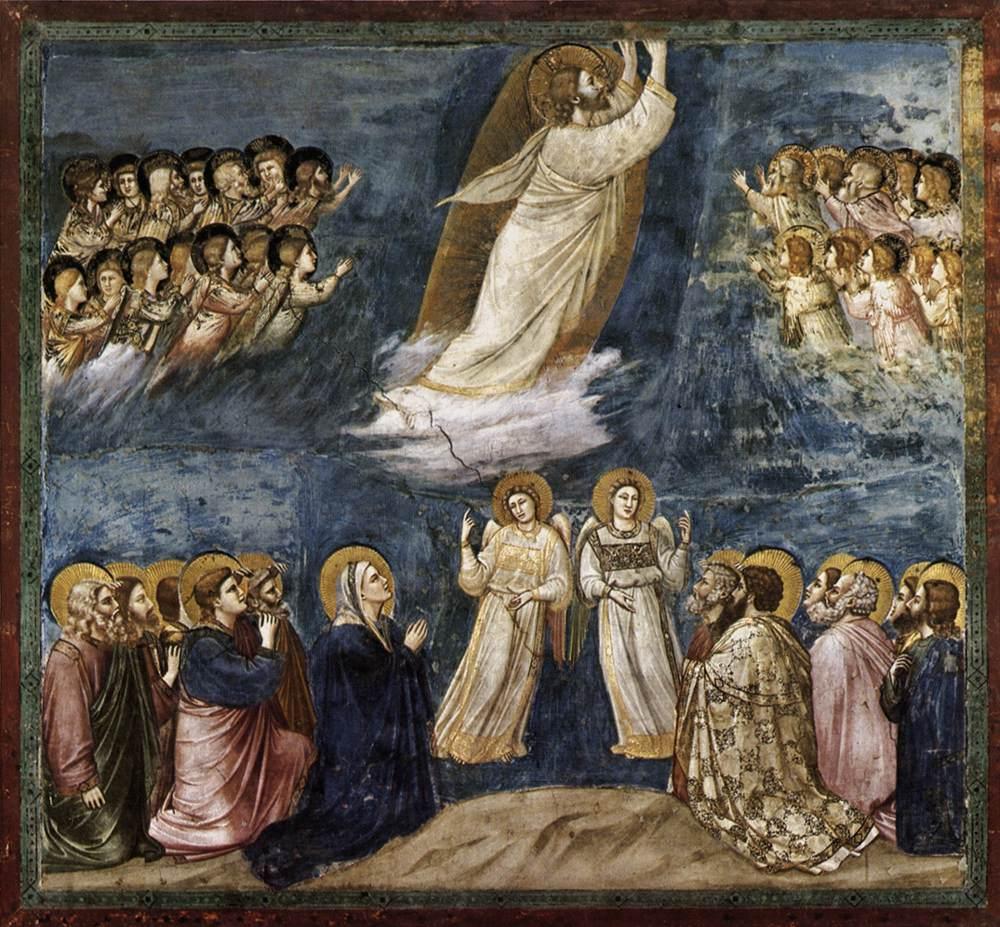
           Giotto, The Ascension of Christ (Wikimedia Commons)

The Ascension of Christ by Giotto contains echoes of the work of other artists.   Like the illustration in the Rabbula Gospel, Giotto’s disciples and Mary are in the foreground.  Here, however, they are kneeling and their attention is focused on the two centrally located men in white apparel.  These men – depicted with wings and assumed to be angels – are floating above the ground pointing to the sky and talking to the disciples and Mary.  Jesus is above them and portrayed in greater size than the other figures.

As in other paintings of the ascension, Christ is surrounded by a golden mandorla  –  the term is from the Italian word for almond which it resembles in shape – but unlike many illustrations, he is not looking down, and Giotto’s angels are not assisting in his ascent.  Instead, Jesus is already above the cloud that received him and is being greeted by a chorus of angels with arms raised in praise.  Christ in this fresco is in profile and as he ascends heavenward, his hands have entered partially into the space beyond the painting itself.

Hovak Najarian © 2024
Ascension Day

Wind in the Chimes: the Ascension is about presence

The Ascension of Christ (Ascension Day)

The occasion on which the risen Christ is taken into heaven after appearing to his followers for forty days (Acts 1:1-11, Mk 16:19). The Ascension marks the conclusion of Jesus’ post-resurrection appearances. It is the final elevation of his human nature to divine glory and the near presence of God. The Ascension is affirmed by the Nicene and Apostles’ Creeds. The Ascension is celebrated on Ascension Day, the Thursday that is the fortieth day of the Easter season. It is a principal feast of the church year in the Episcopal Church. Reference: “Ascension” in An Episcopal Dictionary of the Church

A Homily on the Feast of the Ascension

… the ascension is about presence, not absence. Jesus has not left us. Rather Christ has filled us. —Michael K. Marsh

An invitation: Hear what the Spirit is saying, in this homily “Feast of the Ascension” by Michael K. Marsh posted to Interrupting the Silence on May 21, 2009.

More

  • The Collect: an Anglican/Episcopal Treasure. From the “Foreward” to The Collects of Thomas Cranmer edited by C. Frederick Barbee and Paul F. M. Zahl. This essay provides historical and liturgical background to this type of liturgical prayer.
  • A Pattern for Prayer by John D. Witvliet posted on Religion Online. The author believes the study of ancient liturgical materials facilitates special insight.  He discusses at length the understanding which lies in the structures and patterns of early collects and similar prayers, for preparing such prayers challenges us to draw on nearly the whole range of theological themes and motifs.

About Wind in the Chimes

Wind in the Chimes (renaming and reintroduction of Wind Chimes, 7/21/20)

Wind Chimes: September 25 2012 (an introduction)

“He ascended into heaven…”

Visualizing the Ascension of Jesus.

While Jesus was going and [the apostles] were gazing up toward heaven, suddenly two men in white robes stood by them. They said, “Men of Galilee, why do you stand looking up toward heaven? This Jesus, who has been taken up from you into heaven, will come in the same way as you saw him go into heaven.” Acts 1:10-11 NRSV

Master of the Rabbula Gospels, The Ascension, 586

The Ascension of Christ, illumination on parchment, 6th century,
Master of the Rabbula Gospels.

Commentary by Hovak Najarian

During the sixth century, artists were approximately eight hundred years away from being able to create pictorial depth through linear perspective. In addition to technical limitations, artists faced decisions about how Jesus would be depicted and how angels would fly. How would a person’s inner light be represented? Creating a composition required decisions as well; how was it to be organized?

Pictorial depth in, The Ascension of Christ, an illuminated Syriac Gospel Book, is limited. The figures are standing at ground level like relief sculpture and the composition is balanced in bilateral symmetry. The right and left side of the painting balance each other equally and Mary with a halo and blue robe is at the center. Her arms are uplifted in prayer. Byzantine royalty often wore blue robes and by the sixth century, the color blue, representing heavenly grace among other symbolic associations, had been adopted as the color by which Mary, “Queen of Heaven,” would be identified. Uplifted arms while in prayer was a gesture used by early Christians and continues today in some Pentecostal and charismatic churches. Except for the angels and Mary, most of the figures are looking upward at Jesus.

As Christ was ascending, two men in white robes appeared. Each is depicted as an angel with wings and a halo. Angels in the Bible were not assigned wings but artists reasoned they would need them in order to fly. The angel on the left of Mary is looking at Paul (identified by a long dark beard and bald forehead) and is pointing upward at the ascending Jesus. Paul was not a follower of Jesus at the time of the ascension but was brought in by way of, “artist’s license.” The angel on the right is talking to the white-bearded Peter. They, and the others, are being told Jesus “…will come in the same way as you saw him go into heaven.”

In the sixth century, Christ’s ascension was depicted in various ways; one was not to have his body in the picture at all. Only his feet and the hem of his robe would be shown as he entered clouds above. Sometimes only his feet remained in the picture. In another approach, Jesus would move upward by climbing a mountain.

In his journey heavenward, Jesus is surrounded usually by a glowing light or is encompassed, as here, by a full body halo known as a mandorla. In the above depiction, two angels are holding the mandorla to assist Jesus in his ascent while two other angels are moving upward bearing crowns. Jesus is standing within the mandorla with his hand raised in a final blessing to those who have gathered below. The biblical account of Ezekiel ascending to heaven on a chariot was familiar to people at this time and, as seen here, a depiction of the ascension in early Christian art often included chariot wheels beneath the mandorla.

Hovak Najarian © 2017

Ascension | Art for A Easter 7

Acts 1:6-14 When the apostles had come together, they asked Jesus, “Lord, is this the time when you will restore the kingdom to Israel?” He replied, “It is not for you to know the times or periods that the Father has set by his own authority. But you will receive power when the Holy Spirit has come upon you; and you will be my witnesses in Jerusalem, in all Judea and Samaria, and to the ends of the earth.” When he had said this, as they were watching, he was lifted up, and a cloud took him out of their sight

Ascension
MOSAIC ARTIST, Italian
(active 1175-1200 in Venice)
Crossing (Ascension) cupola
1175-1200
Mosaic
Basilica di San Marco, Venice
Click image for more information.

The Apostles’ Creed

Listen to the Apostles’ Creed sung by a choir of Tongan youth in the Uniting Church Sydney Australia.

What is the Apostles’ Creed?

The Apostles’ Creed is the ancient creed of Baptism, it is used in the Church’s daily worship to recall our Baptismal Covenant.

An Outline of the Faith: The Book of Common Prayer, p. 852

The Apostles’ Creed

I believe in God, the Father almighty,
creator of heaven and earth.
I believe in Jesus Christ, his only Son, our Lord.
He was conceived by the power of the Holy Spirit
and born of the Virgin Mary.
He suffered under Pontius Pilate,
was crucified, died, and was buried.
He descended to the dead.
On the third day he rose again.
He ascended into heaven,
and is seated at the right hand of the Father.
He will come again to judge the living and the dead.
I believe in the Holy Spirit,
the holy catholic Church,
the communion of saints,
the forgiveness of sins,
the resurrection of the body,
and the life everlasting. Amen.

For further reading and reflection

The Symbolum Apostolorum was developed between the second and ninth centuries. It is the most popular creed used in worship by Western Christians. Its central doctrines are those of the Trinity and God the Creator. It has been called the Creed of Creeds.
Legend has it that the Apostles wrote this creed on the tenth day after Christ’s ascension into heaven. That is not the case, though the name stuck. However, each of the doctrines found in the creed can be traced to statements current in the apostolic period. The earliest written version of the creed is perhaps the Interrogatory Creed of Hippolytus (ca. A.D. 215). The current form is first found in the writings of Caesarius of Arles (d 542).
The creed was apparently used as a summary of Christian doctrine for baptismal candidates in the churches of Rome. Hence it is also known as The Roman Symbol. As in Hippolytus’ version it was given in question and answer format with the baptismal candidates answering in the affirmative that they believed each statement.

Source: http://www.creeds.net/ancient/apostles.htm

Note: the link will take you to a page devoted to the Apostles’ Creed including additional links to the text of the creed in Latin and Greek, historical notes and much more

A Pentecost: Art for readings 06/12/2011

GIOTTO di Bondone
Click to open Web Gallery of Art Artist Biography

Scenes from the Life of Christ: Pentecost
1304-06
Fresco, 200 x 185 cm
Click to open Web Gallery of Art display page.
 Click on their image to enlarge/fit page etc.

Cappella Scrovegni (Arena Chapel), Padua
Click to open Web Gallery of Art location/setting information.

A Easter7: Art for readings 06/05/2011

GIOTTO di Bondone
Click to open Web Gallery of Art Artist Biography

Scenes from the Life of Christ: Ascension
1304-06
Fresco, 200 x 185 cm
Click to open Web Gallery of Art display page.
 Click on their image to enlarge/fit page etc.

Cappella Scrovegni (Arena Chapel), Padua
Click to open Web Gallery of Art location/setting information.