Third Sunday after Pentecost, Year B

“We are determined to have a king over us, so that we also may be like other nations and that our king may govern us and go out before us and fight our battles.” 1 Samuel 8:19b-20

Israel Demands a King, engraving, 1778, J. Winter, active 18th century.
This engraving was published in The Bible and its Story, 1909, Edited by Charles Horne and Julius Brewer.

Reading: 1 Samuel 8:4-11, (12-15), 16-20, (11:14-15)

Commentary by Hovak Najarian

When the prophet Samuel was advanced in years the Israelites began to worry about their future.  Who would be their leader and how would they be able to deal with their enemies?  The elders went to Samuel with their concerns and said “You are old and your sons do not follow your ways, appoint for us a king to govern us, like other nations.”  Samuel was displeased that they asked for a king.  When he prayed, God instructed him to listen to the people, but also to warn them solemnly about what they could expect if they were to bed given a king.  Samuel warned the elders to be careful about what they wished but they would have none of it and said, “No… we are determined to have a king…


 Winter’s Israel Demands a King (detail above) the figures are placed in an open courtyard and strong opposing opinions are suggested by a face-off between Samuel and the elders.  Samuel, a slightly hunched over old man, is at the left.  He has assumed a solid stance and is pointing forcefully with both index fingers as he states his opposition to Israel having a king.  To the right an animated spokesperson for the elders is leaning forward as he argues forcefully to make a point.  He seems ready to interrupt Samuel at any moment.  The gestures of the elders are exaggerated for effect and their claw-like hands are emphasized.  A young man standing behind Samuel seems to be taken aback by the demanding elders.  Have they no respect … how could they talk to Samuel like that?    After listening, praying, and explaining what it would be like to have a king, Samuel followed the people’s wishes and anointed a king.


J. Winter, Israel Demands a King (full engraving)  

In medieval art, illustrations were added to enhance the text of gospel books.  Often subjects were events in the life of Jesus, Mary, his mother and the Apostles, and Old Testament kings, prophets and events in other’s lives were illustrated.  Illustrations also presented artists with an opportunity to venture into less-depicted subjects but sometimes these did not have visual impact.  An engraving of Samuel arguing with elders could not compete with the drama of Moses and the Israelites crossing the Red Sea or Elijah ascending to heaven in a fiery horse drawn cart.  When a subject lacked action an artist was challenged to generate interest by staging the subject in a dramatic way.  This could engage a viewer and describe a work’s subject but often these were not enough.  The arrangement of figures in Winter’s Israel Demands a King requires knowledge of the biblical text in order to understand the subject being depicted.

At mid-fifteenth century the printing press was invented and by the end of the century, books were being published.  Instead of hand-painted illustrations as in gospel books, art in the form of engravings, could be inked and printed with the text.  Engravings continued to be popular even after the halftone (a photo-mechanical process) was introduced in the late nineteenth century.

Hovak Najarian © 2024

Art & Music

For more art and art commentary search the Art & Music Category or use Hovak Najarian as your search term
The Angel of Death and the First Passover | Art for Proper 18A

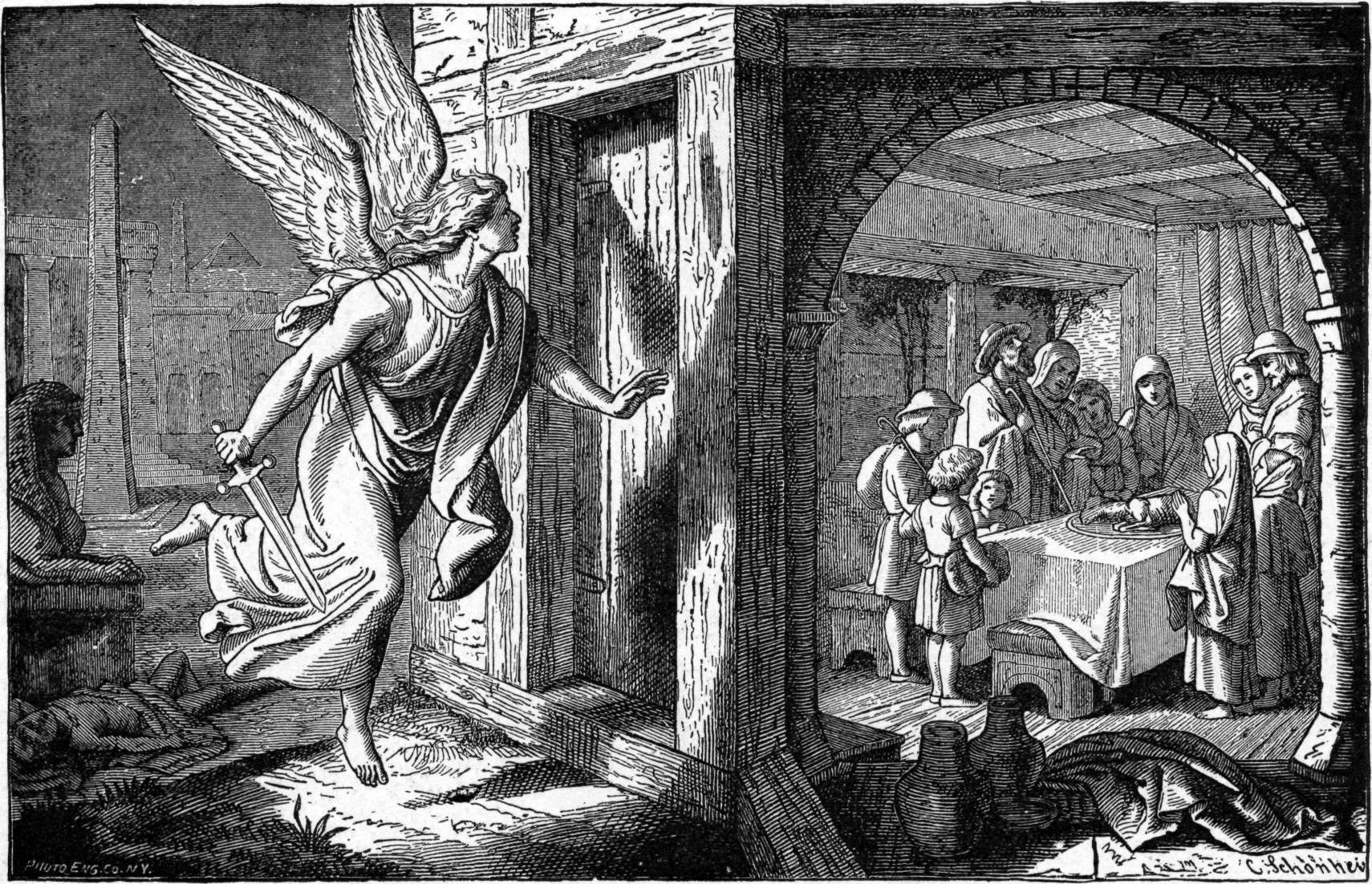
The Angel of Death and the First Passover, was one of four hundred illustrations in Charles Foster’s book, Bible Pictures, and What They Teach Us (1914)

The Angel of Death and the First Passover

The Angel of Death and the First Passover,
engraving, c. 1897, C. Schonhew, 19th century

Commentary by Hovak Najarian

When the time came for the Israelites to leave Egypt and be free from slavery, Moses and Aaron were told about the Passover. God gave them specific instructions with regard to what the people of Israel were to do. A lamb was to be killed, prepared, and then eaten. Blood from the lamb was to be placed on the lintel and door posts of each home. If doors were not marked, the firstborn child and animal of the home would be struck down. C. Schonhew’s engraving depicts the angel of death casting an ominous shadow as it glances at a door to see if it has been marked. Within the home, a Hebrew family is preparing to partake of the Passover meal.

In this engraving, we are attracted first to the activity of an angel patterned after a classical goddess. If she were without wings, had a bow and quiver, and in a wooded area, she could pass easily for the Roman goddess, Diana. To the left, a sphinx seems to be observing the angel as it passes by with sword in hand. The dead figure near its base indicates the person’s doorway was not marked. In addition to the sphinx, references to Egypt are in the background. An obelisk and a wall with marks suggesting hieroglyphics inform us of the culture in which the Passover took place. The tip of a pyramid is beyond the wall.

To the right of the angel is a less active scene. Through an arched opening we see a family gathered solemnly around a table. A tray with a roasted lamb is in the center and the head of the family is leading them in their first Passover meal. They seem to be unaware that the angel of death is passing by their home at the very moment. In order to present separate activities simultaneously, Schonhew divided the engraving into two contrasting areas. On the left, the angel is in motion. There is a sense of urgency about her movements and she is surrounded by dramatic lighting. In contrast, figures on the right are standing still with heads bowed.

The architecture of the interior is in keeping with the exterior but in order to present a direct view of the family, Schonhew departed from two point perspective by aligning the arched wall with the picture plane. This frames the scene and separates it to focus attention on the family. At first glance it may seem we are viewing the interior through a “picture window” but plate glass was not available until the seventeenth century. During the time of Moses, windows would have been simple openings in the wall with no glass.

Note: The Angel of Death and the First Passover, was one of four hundred illustrations in Charles Foster’s book, Bible Pictures, and What They Teach Us (1914). Many of the artists responsible for the work published in Foster’s book were not identified. Schonhew’s name is known only because he signed the above work. Efforts to locate biographical information about Schonhew have not been successful.

Hovak Najarian © 2017

Be well. Do good. Pay attention. Keep learning.

David Playing the Harp before Saul, 1530, Engraving, Lucas van Leyden (1494-1533). In a note attached to this post, Hovak describes the process of engraving.