The Ascension of Christ

We believe … Jesus ascended into heaven and is seated at the right hand of the Father. (Nicene Creed)

Commentary by Hovak Najarian                                                                                        

 After the resurrection, Christ’s last appearance to the disciples was at his ascension.  He blessed the disciples and then “withdrew and was carried up into heaven.”   A description of the ascension in Acts of the Apostles adds, “while they [the disciples] beheld, he was taken up; and a cloud received him out of their sight.  And while they looked steadfastly toward heaven as he went up, behold, two men [portrayed usually as angels] stood by them in white apparel; [They] said ‘Ye men of Galilee, why stand ye gazing up into heaven?  This same Jesus … shall so come in like manner as we have seen him go into heaven.’”   (Acts 1:9-11)

The Ascension, Rabbula Gospel, 6th century. (Wikimedia Commons)

The illustration of Christ’s ascension in the Rabbula Gospel Book shows the disciples standing at the lower half of the illumination looking up at Jesus.  Two men in white robes are talking to them and pointing upward.  At center foreground, Mary is raising her arms but is not looking upward.  Instead, she is looking out at the person that would be reading the gospel book.  In the upper half, Jesus is surrounded by an aureola (a body halo) with angels assisting him skyward.
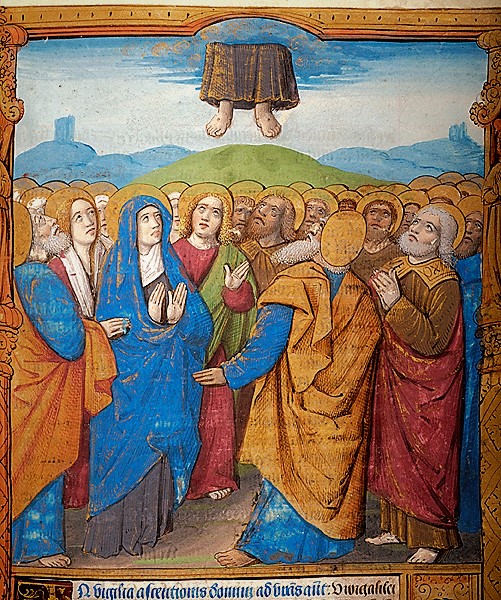
Ascension from a Breviary, French, c. 1506-1516. Source: “Iconography of the Ascension, Part III of IV — The Disappearing Feet” on Ad Imaginem Dei

Paintings of Christ’s ascension were based also on the statement, “he was taken up; and a cloud received him out of their sight.”   In these paintings, Jesus is ascending into a cloud with only a lower portion showing.   He is leaving pictorial space into the space beyond the painting.

[When a person in a painting is seen from the back, the placement of a halo presents a problem.  Note the halo on the disciple wearing a yellow mantle (right foreground).]

The Ascension of Christ, fresco, 13-4-1206, Giotto, 1275-1337
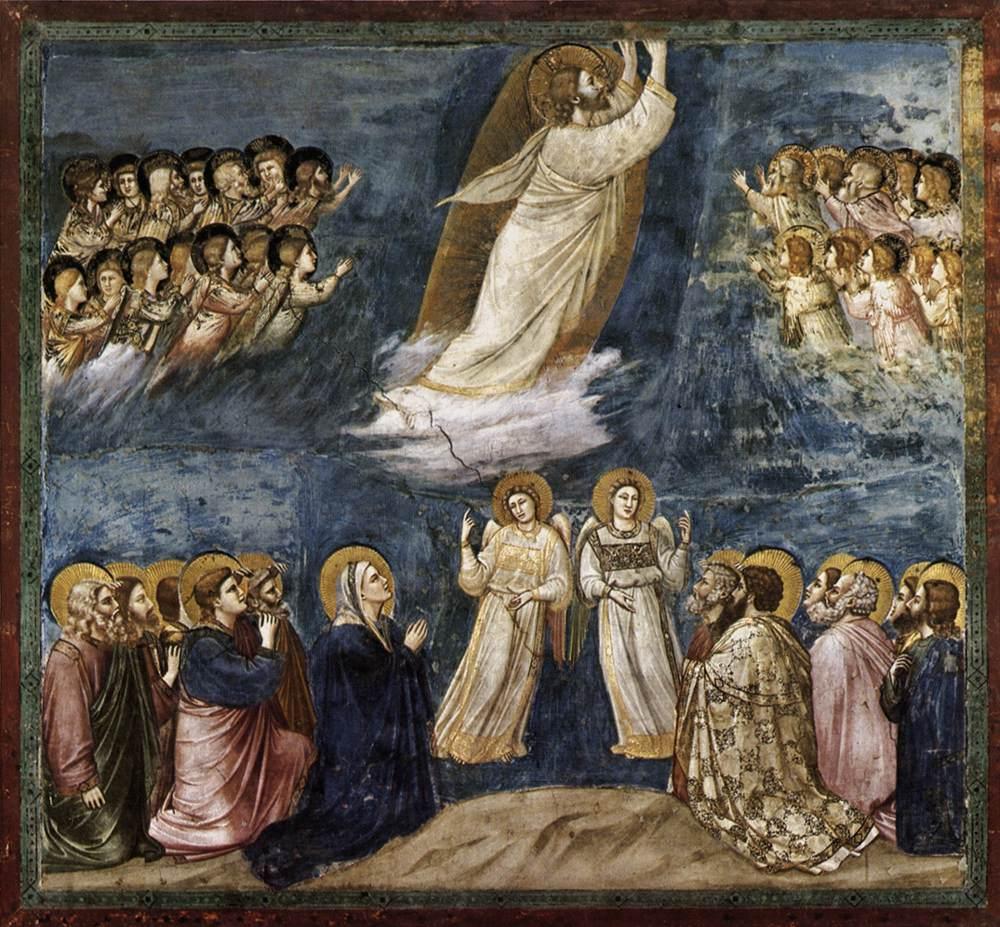
           Giotto, The Ascension of Christ (Wikimedia Commons)

The Ascension of Christ by Giotto contains echoes of the work of other artists.   Like the illustration in the Rabbula Gospel, Giotto’s disciples and Mary are in the foreground.  Here, however, they are kneeling and their attention is focused on the two centrally located men in white apparel.  These men – depicted with wings and assumed to be angels – are floating above the ground pointing to the sky and talking to the disciples and Mary.  Jesus is above them and portrayed in greater size than the other figures.

As in other paintings of the ascension, Christ is surrounded by a golden mandorla  –  the term is from the Italian word for almond which it resembles in shape – but unlike many illustrations, he is not looking down, and Giotto’s angels are not assisting in his ascent.  Instead, Jesus is already above the cloud that received him and is being greeted by a chorus of angels with arms raised in praise.  Christ in this fresco is in profile and as he ascends heavenward, his hands have entered partially into the space beyond the painting itself.

Hovak Najarian © 2024

Elijah on the Fire-cart | Art for Proper 8C

Elijah on the Fire-cart
Giotto
Elijah on the Fire-cart (on the decorative band)
1304-06
Fresco
Cappella Scrovegni (Arena Chapel), Padua
Click image for more information.

Cappella Scrovegni (Arena Chapel), Padua

Commentary by Hovak Najarian

Elijah on the Fire-Cart (within a decorative band), Fresco, c.1304-06, Giotto di Bondone, c.1266-1337

When image makers created icons and illuminated manuscripts for Byzantine Churches, their efforts were toward projecting a spiritual realm; they were not trying to depict the familiar world of our daily experiences. In Italy during the late thirteenth century, however, changes were taking place; interest in earthly matters and the physical world was leading the way to the Renaissance. Art gave visual form to this changing world and Giotto (JOT toe) played a key role in the advancement of painting. Early in his career, he worked with Cimabue who was shifting away from Byzantine art but Giotto broke from it even further. He depicted biblical subjects with gestures and expressions of real people in a natural world.

Very early in the fourteenth century, Giotto received a commission to paint frescos in the Scrovegni (The Arena) Chapel in Padua. The cycle of paintings depicts events in the life of Mary’s parents, the life of Christ, and the Last Judgment. These paintings fill the entire walls of the Chapel and are divided by wide borders that simulate marble mosaic patterns. Within the borders are images of saints, prophets, and Old Testament figures that are related in subject to the paintings adjacent to them. The image of “Elijah on the Fire-Cart” – painted in a quatrefoil within the border – is not a dramatic presentation; the chariot and horses are not engulfed totally in flames but the plumes of fire and overall red coloration of both the horse and cart indicates it is definitely afire. A whirlwind is not indicated but drama was not Giotto’s intent. The placement of Elijah is in accordance with a custom of showing parallels between Old and New Testament events. As a person progresses forward in the Chapel the small painting of Elijah’s ascension inside the border will be seen just before seeing, “Ascension of Christ” to its immediate right. “Elijah and the Fire-Cart” serves only as a small tie-in within the border.

Note

The Scrovegni Chapel: The wealthy Enrico Scrovegni purchased land for a palace and private chapel at the site of a former Roman amphitheatre known as the “Arena.” Hence, the chapel is known as “The Arena Chapel.”

Quatrefoil: In the fourteenth and fifteen century, circles and squares were regarded to be perfect shapes. A “quatrefoil” (meaning four leaves) is a framework made of four circles of equal diameter arranged so they all overlap equally in the center. When the overlapping lines of the circles are removed, the space it creates serves as a frame for decorative additions to architecture. Giotto’s “Elijah in the Fire-Cart” is painted in a quatrefoil.

Space Probe: Haley’s Comet passed by the earth in the year 1301. Three years later when Giotto painted the “Adoration of the Magi” in the Arena Chapel, he used an image of the comet as the star of Bethlehem. In 1986, when the European Space Agency launched sensors to examine the nucleus of Haley’s Comet, they saw it fitting to name the probe, “Giotto.”

Hovak Najarian © 2013

B Epiphany 3, Art for Readings for January 22, 2012

GIOTTO di Bondone
(b. 1267, Vespignano, d. 1337, Firenze)
Click to open Web Gallery of Art Artist Biography and to explore other works by this artist.

Jonah Swallowed up by the Whale (on the decorative band)
1304-06
Fresco
Cappella Scrovegni (Arena Chapel), Padua
Click to open Web Gallery of Art display page. Click on their image to enlarge/fit page etc.

Humorous detail from the Cappella Scrovegni (Arena Chapel), Padua
Click to explore this impressive interior.