Trinity Sunday, Year B

The grace of the Lord Jesus Christ, the love of God, and the communion of the Holy Spirit be with all of you. 2 Cor 13:13 NRSVue

Welcome!

Along the way I read—and remember now—Marcus Borg’s observation that credo, “I believe,” is probably better rendered, “I give my heart to.”

Everything we say in the Nicene Creed is about giving our heart to God who we experience as one God, Father, Son, and Holy Spirit.

Enter into our Nicene Creed as an expression of trust born of love:

WE GIVE OUR HEARTS TO one God, the Father, the Almighty, maker of heaven and earth, of all that is, seen and unseen.

WE GIVE OUR HEARTS TO one Lord, Jesus Christ, the only Son of God, eternally begotten of the Father, God from God, Light from Light, true God from true God, begotten, not made, of one Being with the Father. Through him all things were made.

WE GIVE OUR HEARTS TO THE ONE WHO, For us and for our salvation, came down from heaven: by the power of the Holy Spirit he became incarnate from the Virgin Mary, and was made man. WHO, For our sake was crucified under Pontius Pilate; he suffered death and was buried.

WE GIVE OUR HEARTS TO THE ONE WHO, On the third day rose again in accordance with the Scriptures; WHO ascended into heaven and is seated at the right hand of the Father. WHO will come again in glory to judge the living and the dead, and WHOSE kingdom will have no end.

WE GIVE OUR HEARTS TO the Holy Spirit, the Lord, the giver of life, who proceeds from the Father and the Son. With the Father and the Son he is worshiped and glorified. He has spoken through the Prophets.

WE GIVE OUR HEARTS TO THE one holy catholic and apostolic Church. We acknowledge one baptism for the forgiveness of sins. We look for the resurrection of the dead, and the life of the world to come. Amen.

On Wednesday, May 22, 2024, we* read through the scriptures appointed for Trinity Sunday, Year B. We spent the most time on the reading and learning from the letter to the Romans (Chapter 8, verses 12-17)

To whom do you give your heart?

A further thought on the Mystery of the Trinity

Gregory Nazianzen wrote:

“There was the true light, which enlightens everyone who comes into the world” (John 1:9)—the Father.

“There was the true light, which enlightens everyone who comes into the world”—the Son.

“There was the true light, which enlightens everyone who comes into the world”—the other Paraclete (John 14:16, 26).

“Was” and “was” and “was,” but one thing was; “light” and “light” and “light,” but one light and one God. This is what David too imagined long ago when he said, “In your light we shall see light” (Psalm 36:10 [36:9]).

And now we have both seen and proclaimed the concise and simple theology of the Trinity: out of light (the Father) we comprehend light (the Son) in light (the Spirit).

Source: Christopher A. Beeley, Leading God’s People: Wisdom from the Early Church for Today (Grand Rapids, MI; Cambridge: William B. Eerdmans Publishing Company, 2012), 99–100.

Christopher Beeley is the Walter H. Gray Associate Professor of Anglican Studies and Patristics [Yale Macmillan Center]. He teaches early Christian theology and history and modern Anglican tradition. He is an Episcopal priest.

divider line

*Most Wednesday mornings a group of us gather online to explore the readings that will be used in worship the following Sunday. This week’s handout features readings, commentaries, and notes for Trinity Sunday (May 26, 2024) in Year B of the Revised Common Lectionary. Please: View or download the handout we used to guide our discussion and tune our hearts to the Spirit.

View the Revised Common Lectionary readings appointed for Trinity Sunday, May 26, 2024, on the Revised Common Lectionary site curated by the Vanderbilt Divinity Library.

Please return to this site throughout the week to keep learning.

divider line

More thoughts on Trinity Sunday

Be well. Do good. Pay attention. Keep learning.

The Holy Trinity

There are times when neither words nor pictures are adequate to express the depths of mystery.

Commentary by Hovak Najarian

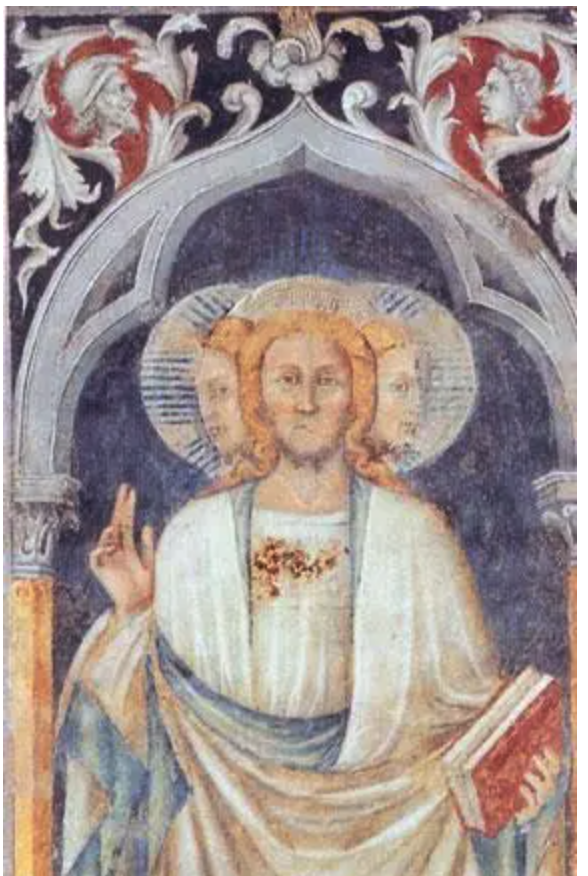
Trinity with Three Faces via Wikimedia Commons

 Trinity with Three Faces, Fresco, c.1400, Antonio da Atri, c.1350-1433

 The much-quoted statement, “A picture is worth a thousand words,” is true in some instances but not all. A picture cannot represent adequately images such as those that come to mind in the words of the Twenty-third Psalm or the Sermon on the Mount. Art may at times clarify ideas that cannot be expressed by other means but there are times when neither words nor pictures are adequate. A challenge facing early Christian artists was how to create visual images that could communicate concepts found in their faith. A concept such as the Trinity was difficult to explain through art or with words.

In the early Church, there were questions about how (or if) a depiction of God should (or could) be made and if so, what would the image be? God was depicted ultimately as a bearded father figure (possibly derived from the description, “ancient of days” mentioned in the Book of Daniel). A lamb represented Jesus and a dove represented the Holy Spirit. As long as members of the Godhead were depicted as separate entities, artists did not have to deal with the problem of creating an image that represented all three.


The three figures that appeared before Abraham in the Book of Genesis were portrayed as the Trinity but they were shown as separate individuals.  By placing them adjacent to each other they were seen as a visual unit.  Official use of this form of Trinity was ended by the Pope in the eighteenth century but it continued in places such as the American Southwest.

Retablo of the Trinity
Retablo of the Trinity from an altarpiece of a mission church, New Mexico, USA

 Another attempt to depict the Trinity is found in the Basilica of Santa Maria Assunta in Atri, Italy.  Antonio da Atri’s fresco, “Trinity with Three Faces,” shows Christ standing and facing the viewer.  His right arm is raised in a blessing and his left hand is holding a book.  To depict Christ as part of the Trinity, Antonio has given the figure one body but three faces.  Right and left profiles have been added to Jesus’ head with radiating lines emanating from the halos.  As a setting for this composition, Antonio framed his Trinity image in a Late Gothic arch and decorative elements.

Multi-headed divinities existed in other religions and although a three-faced Trinity such as Antonio’s fresco was accepted by the Roman Catholic hierarchy, it was ridiculed by Protestants.  It was called the “Catholic Cerberus.”  [In Greek mythology, Cerberus was the three-headed dog that guarded the gates of Hades.]  As a consequence, in the sixteenth century, the Pope ended the use of the three-faced Trinity but the image remained in remote regions.  Pope Innocent XII went further in the seventeenth century and ordered them all to be destroyed.  The three-faced Trinity at the Basilica of Atri survived because it was not in sight.  It, and other frescos at the Basilica, had been covered with plaster for fear their surfaces might in some way contribute to the spread of the bubonic plague.

Hovak Najarian © 2013

Note: links to the artwork were updated on May 25, 2024; the content was lightly edited. Find additional images of the Trinity with Three Faces using Google Search.

Image: Antonio da Atri, Wikimedia Commons; upload of Retablo of the Trinity, ca. 1936, Watercolor, colored pencil, and graphite on Paper [This is a copy from an altarpiece], E. Elizabeth Boyd, 1903-1974.

Holy Trinity | Art for A Trinity

2 Corinthians 13:13
The grace of the Lord Jesus Christ, the love of God, and the communion of the Holy Spirit be with all of you.

Holy Trinity
Rublev, Andreĭ, Saint, d. ca. 1430
Holy Trinity
Painting, panel
1400
Gosudarstvennai︠a︡ Tretʹi︠a︡kovskai︠a︡ galerei︠a︡
Moscow
Russia
Click image for more information.