Christ the King Sunday, Year A

We ask Jesus, “when did we see you”? His response is unequivocal.

Welcome!

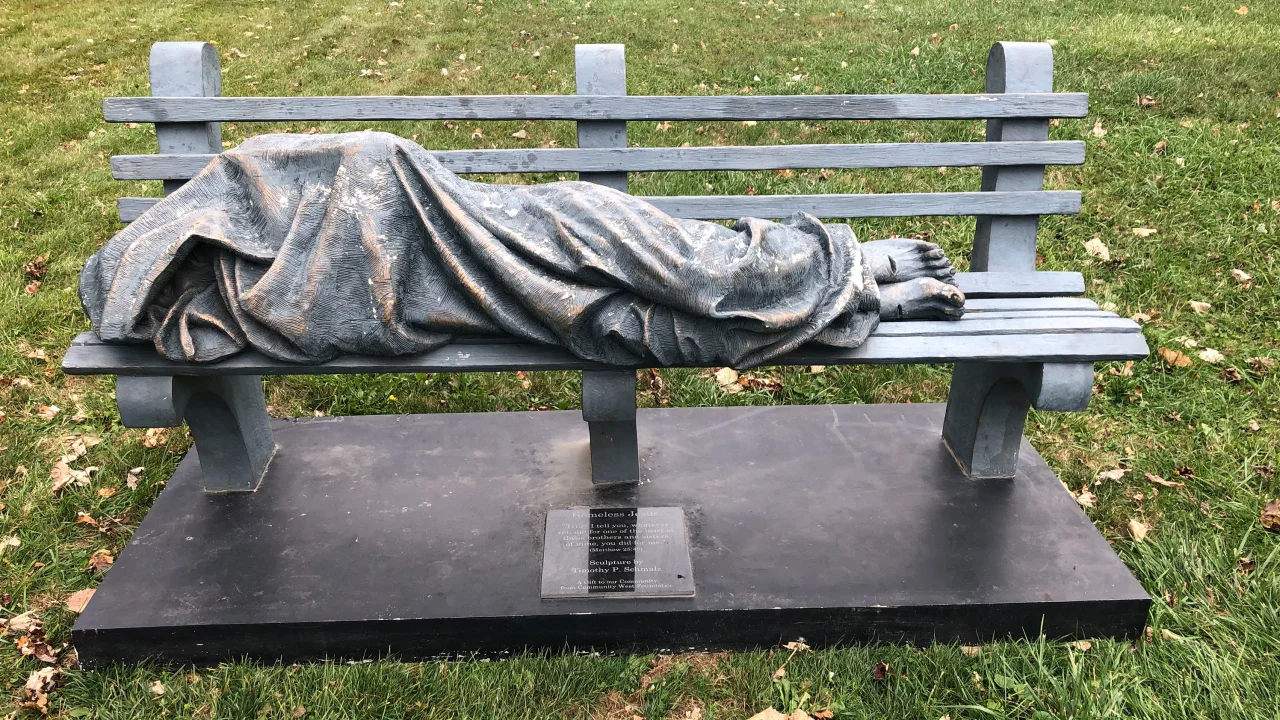
“Homeless Jesus” outside St. Barnabas Episcopal Church in Bay Village, OH

“You did it to me” commentary on Mark 25:31-46

So many of us, in our devotional and ecclesiastical lives, long to “see Jesus.”  And rightly so.  We pray for an experience of Jesus’s presence.  We yearn to feel him close.  We sing hymns, recite creeds, hear sermons, and attend Bible studies — all in the hope of seeing and knowing Jesus in a deeper and more meaningful way.

Of course, there is nothing wrong with these practices — unless they keep us at comfortable arm’s length from where Jesus actually is.  Unless they lead us to believe that the work of justice and compassion is somehow secondary to the “real” business of Christianity.  The real business of Christianity is bending the knee to Jesus.  And where is Jesus?  Jesus is in the least and the lost and the broken and the wounded.  Jesus is in the un-pretty places.  In the bodies we don’t discuss in polite company.  In the faces we don’t smile at.  In the parts of town we speed by.

It’s not that we earn our way to majestic King Jesus by caring for the vulnerable.  It is that majestic King Jesus, by his own choice and volition, has stooped and surrendered in such a way that he IS the vulnerable.  There’s no other way to get to him.  Period.

Debbie Thomas Lectionary Essay “You Did It To Me” on Journey with Jesus webzine; posted November 15, 2020

Please make the time to read the entire essay by Debie Thomas as you consider the meaning of Christ the King this week.

View the Revised Common Lectionary readings appointed for Sunday, November 26, 2023 on the Revised Common Lectionary site curated by the Vanderbilt Divinity Library.

Be well. Do good. Pay attention. Keep learning.

Please come back to this site throughout the week in order to keep learning.

Image: CNN

Pentecost +12, Proper 15A

Joseph’s story is a reminder to take the long view of events.

Welcome!

Each Wednesday morning a group of us gather online to explore the readings to be used in worship the following Sunday. Our handout features readings, commentaries, and notes for the Twelfth Sunday After Pentecost (August 20, 2023) in Year A of the Revised Common Lectionary.

This past Wednesday, August 16, 2023, we explored the readings from Genesis 45:1-15 and Romans 11:1-2a, 29-32 for the voice of the Spirit. Our handout included commentaries on the other appointed texts from the Psalms (Psalm 133 ) and the Gospel according to Matthew (Matthew 15:(10-20), 21-28).

From the commentary on Genesis 45:1-15

Matt Skinner has a new book out on Acts, subtitled Catching Up with the Spirit. In it he makes a helpful remark regarding what he thinks is often an assumption at play, “that God’s ‘activity’ in the world is like a puppeteer pulling strings.” It’s different for him, it seems. “It’s easier for me,” he notes, “to look back on situations, after the fact, and wonder. With the help of hindsight, I might perceive ways in which I was open or closed to God’s presence.”

This is the power of Joseph’s final confession: that though none of what has happened to him over the course of his life is what he’d have chosen it to be, he can yet now see that God has set him up to preserve life.

Joseph’s whole story” by Liz Goodman in The Christian Century, February 18, 2022. 

You are invited to view or download the handout we used to guide our discussion and tune our hearts to the Spirit.

View the Revised Common Lectionary readings appointed for Sunday, August 20, 2023 on the Revised Common Lectionary site curated by the Vanderbilt Divinity Library.

Be well. Do good. Pay attention. Keep learning.

View or download the Handout for Proper 15, Year A.

I Am Your Brother Joseph from the Ad Imaginem Dei blog curated by Margaret M. Duffy. This post explores the story of Joseph revealing his true identity to his brothers. See Genesis 45.

Please come back to this site throughout the week in order to keep learning.

Image: ChurchArt Pro

Joseph Recognized by Brothers

Art for Epiphany +7C

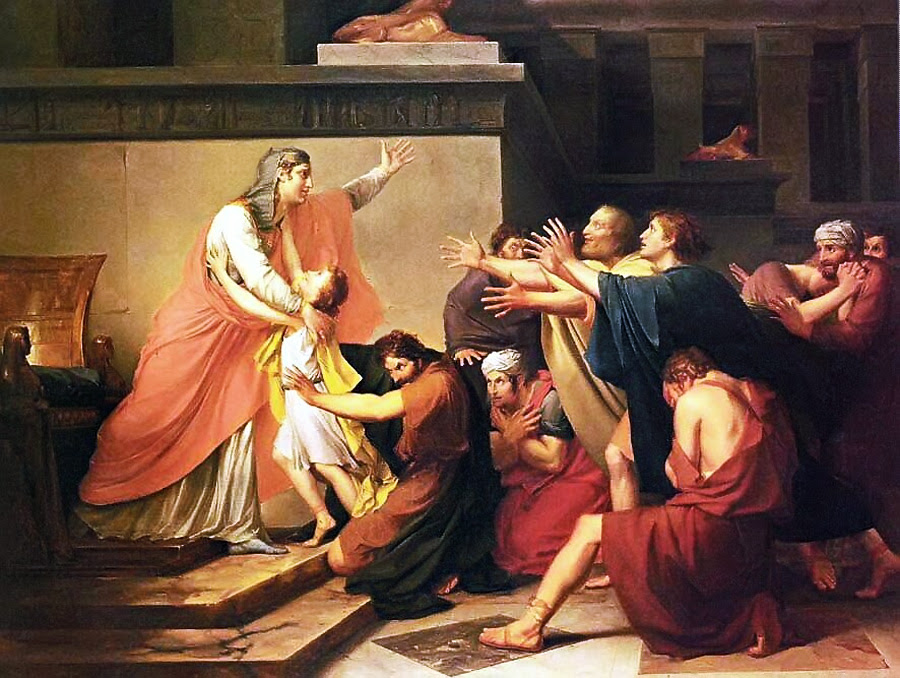
Joseph Recognized by Brothers, oil on canvas, c.1800,
Francois Gerard, 1770-1817.

Commentary by Hovak Najarian

Joseph was born at a time when his father, Jacob, was old and he became the favorite son. This favoritism caused resentment among his brothers. Negative feelings resulted also from a dream Joseph had that was interpreted to mean someday his brothers would bow down to him. Joseph was seventeen years old when he went to his brothers as they were tending sheep. When his brothers saw him coming they plotted to kill him but then instead, sold him as a slave to a passing merchant who was going to Egypt. In Egypt, Joseph interpreted Pharaoh’s dream which revealed there would be seven years of abundance followed by seven years of famine. With Joseph’s guidance, grain was stored during the time of abundance and Egypt was well prepared. When famine was experienced in Canaan, Joseph’s father sent his brothers to Egypt to purchase food. Unbeknownst to them, Joseph in the ensuing years had become a high Egyptian official and he was the one they would have to meet.

Francois Gerard’s painting, Joseph Recognized by Brothers, depicts the moment Joseph revealed his identity to his brothers. The brothers are shown displaying a range of emotions; some are kneeling and in body language seem to be exhibiting guilt and remorse for what they did. In contrast to this, two of the brothers and Joseph are reaching out to each other in joy. The brothers at the far right are staying back and holding each other. Perhaps they are fearful of what Joseph might do. The young boy reaching and looking up at Joseph is likely a nephew who came with his father. Joseph places his hand gently on the child’s shoulder.

In 1663, France initiated the Prix de Rome which gave artists (and later, musicians and architects) an opportunity to study in Italy. The purpose of this award was to put promising artists in contact with Roman culture and the masters of the Italian Renaissance. One outcome of this was a trend toward classicism in French art.

In the late 1700s after years of turmoil, the French Revolution overthrew King Louis XVI and Napoleon Bonaparte took charge ultimately as 1st Consul. Classicism in art suited Napoleon perfectly and he appointed Jacques Louis David, an avid classicist, to be the head of the French Academy of art. David’s art promoted what Napoleon favored; discipline, honor, sacrifice strength of character, and devotion of one’s efforts to the state.

Though classicism was sanctioned by the state, the concept of romanticism was always present in art and Napoleon’s campaign in Egypt (1798-1801) generated great interest in Egyptology. It set off fashion fads in both France and England and piqued the interest of painters as well. Francois Gerard’s Joseph Recognized by Brothers was painted during the time of Napoleon’s Egyptian military venture.

Gerard studied under David and elements of classicism in the painting of Joseph and his brothers are apparent in their robes. Gerard’s nod to this scene’s Egyptian location is brought in by Joseph’s headdress and the sphinxes on the arms of Joseph’s chair and the background building. Were it not for these details and its title, this painting might be taken for an illustration of a Greek tragedy.

Winning the Prize of Rome was coveted, difficult, and highly competitive. Gerard’s teacher Jacques Louis David was rejected three times and considered suicide before receiving the award on his fourth attempt. [In later years Eduard Degas and Maurice Ravel were rejected.] Gerard, too, was rejected but because of his mother’s death, he was unable to complete a painting to submit to the jury the following year. After that, he fell into poverty but recovered to gain success and acclaim through portraiture. Napoleon commissioned paintings from him and then after he fell from power, Gerard became the court painter of Louis XVIII.

Hovak Najarian © 2019

Be well. Do good. Pay attention. Keep learning.

A Proper 15 Art for Readings August 14, 2011

Joseph Recounting His Dreams,
early 1640s
reed pen and brown ink with brown wash,
heightened with white, on laid paper
overall: 17.3 x 22.4 cm (6 13/16 x 8 13/16 in.)
Woodner Collection
1991.182.12
Not on View
Click to open National Gallery of Art display page.
Click on their image to enlarge/fit page etc.

Christ and the Canaanite Woman,
about 1650
Pen and brown ink, brown wash,
corrected with white bodycolor
7 7/8 x 11 in.
83.GG.199
Click to open Getty Museum display page.
 Click on their image to enlarge/fit page etc.

Rembrandt van Rijn (artist)
Dutch, 1606 – 1669
Click to open National Gallery of Art Artist Biography, Bibliography, Related works, After works and to explore other works by this artist.

YOSEF

After reading Everett Fox’s excellent introduction from “The Five Books of Moses”, this time on Joseph, I can’t help but regret how quickly our lectionary must move, as we consider only two excerpts in two weeks – betrayal and reconciliation. O well, we can still read the whole account for ourselves.

YOSEF

(Genesis  37-50)

THE STORIES  ABOUT THE LAST PATRIARCH FORM A COHERENT WHOLE, LEADING SOME to dub it a “novella.” It stands well on its own, although it has been consciously and artfully woven together into both the Yaakov cycle and the entire book.

Initially the  tale is one of family emotions, and it is in fact extreme emotions which give  it a distinctive flavor. All the major characters are painfully expressive of  their feelings, from the doting father to the spoiled son, from the malicious brothers to the lustful wife of Potifar, from the nostalgic adult Yosef (Joseph) to the grief-stricken old Yaakov (Jacob). It is only through the subconscious medium of dreams, in three sets, that we are made to realize that a higher plan is at work which will supersede the destructive force of these emotions.

For this is a story of how “ill” -with all its connotations of fate, evil, and disaster is changed to good. Despite the constant threat of death to Yosef, to the Egyptians, and to Binyamin (Benjamin), the hidden, optimistic thrust of the story is “life,” a word that appears in various guises throughout. Even “face,” the key word of the Yaakov cycle which often meant something negative, is here given a kinder meaning, as the resolution to Yaakov’s life.

A major subtheme of the plot is the struggle for power between Re’uven  (Ruben) and Yehuda (Judah).
Its resolution has implications that are as much tribal as personal, for the tribe of Yehuda later became the historical force in ancient Israel as the seat of the monarchy.

Although many details of the narrative confirm Egyptian practices, those practices actually
reflect an Egypt considerably later than the period of the Patriarchs (Redford). Of interest also is the prominence of the number five in the story, a detail that is unexplained but that gives some unity to the various sections of text.

In many ways  the Yosef material repeats elements in the Yaakov traditions. A long list could be compiled, but let us at least mention here sibling hatred, exile of the hero, foreign names, love and hate, dreams, and deception-even so detailed as to duplicate the use of a goat-kid. But its focusing on a classic rags-to-riches plot, with the addition of a moralistic theme, make the Yosef story a distinctive and always popular tale, accessible in a way that the more difficult stories of the first three parts of Genesis are not.

Everett Fox,
The Five Books of Moses: A New English Translation with Commentary and Notes
(New York: Schocken Books, 1995).

http://www.clarku.edu/departments/foreign/facultybio.cfm?id=365