In all this Job did not sin with his lips.

Wind in the Chimes: Despite losing everything, Job moves forward with questions and integrity.

What are we to understand about suffering?

Here is one answer from the Introduction to the Book of Job in the Jewish Study Bible:

THE BOOK OF JOB AS WE HAVE IT makes three main points, which are interrelated. The first, most obvious point is that human suffering is not necessarily deserved; that is, though in some cases we may bring our own suffering about by, for instance, neglecting our health or engaging in risky behavior—or, from a religious perspective, by our sin or immorality—the real problem with suffering comes with the many cases in which someone’s pain, sorrow, or distress are clearly unrelated to anything they have done or failed to do. This point is the one that Job argues most forcibly against his friends. Those friends, who are concerned to safeguard the goodness of the LORD (seen as the cause of all things, good or bad), argue the contrary view: that if a person suffers, the suffering must somehow be deserved. This leads to the second point. The claim that all suffering is deserved will inevitably persuade those who hold that view to falsify either the character of the sufferer or the character of the LORD. Thus, Job’s friends argue that Job is a sinner, deserving of his punishment, while Job claims that the LORD has acted unfairly and is indifferent to human suffering. The third point, however, is the most theologically difficult and gives the book its sense of profundity and at the same time its inconclusive conclusion: There is no way of understanding the meaning of suffering. That is, in the LORD’s argument, the reasons for suffering—if there are any—are simply beyond human comprehension.

Mayer Gruber, “Job: Introduction and Annotations ( בויא ),” in The Jewish Study Bible, ed. Adele Berlin and Marc Zvi Brettler (New York: Oxford University Press, 2004), 1499–1500.

More

Book of Job Summary: A Complete Animated Overview produced and curated by BibleProject

BibleProject YouTube Channel

About Wind in the Chimes

Wind in the Chimes (renaming and reintroduction of Wind Chimes, 7/21/20)

Wind Chimes: September 25 2012 (an introduction)

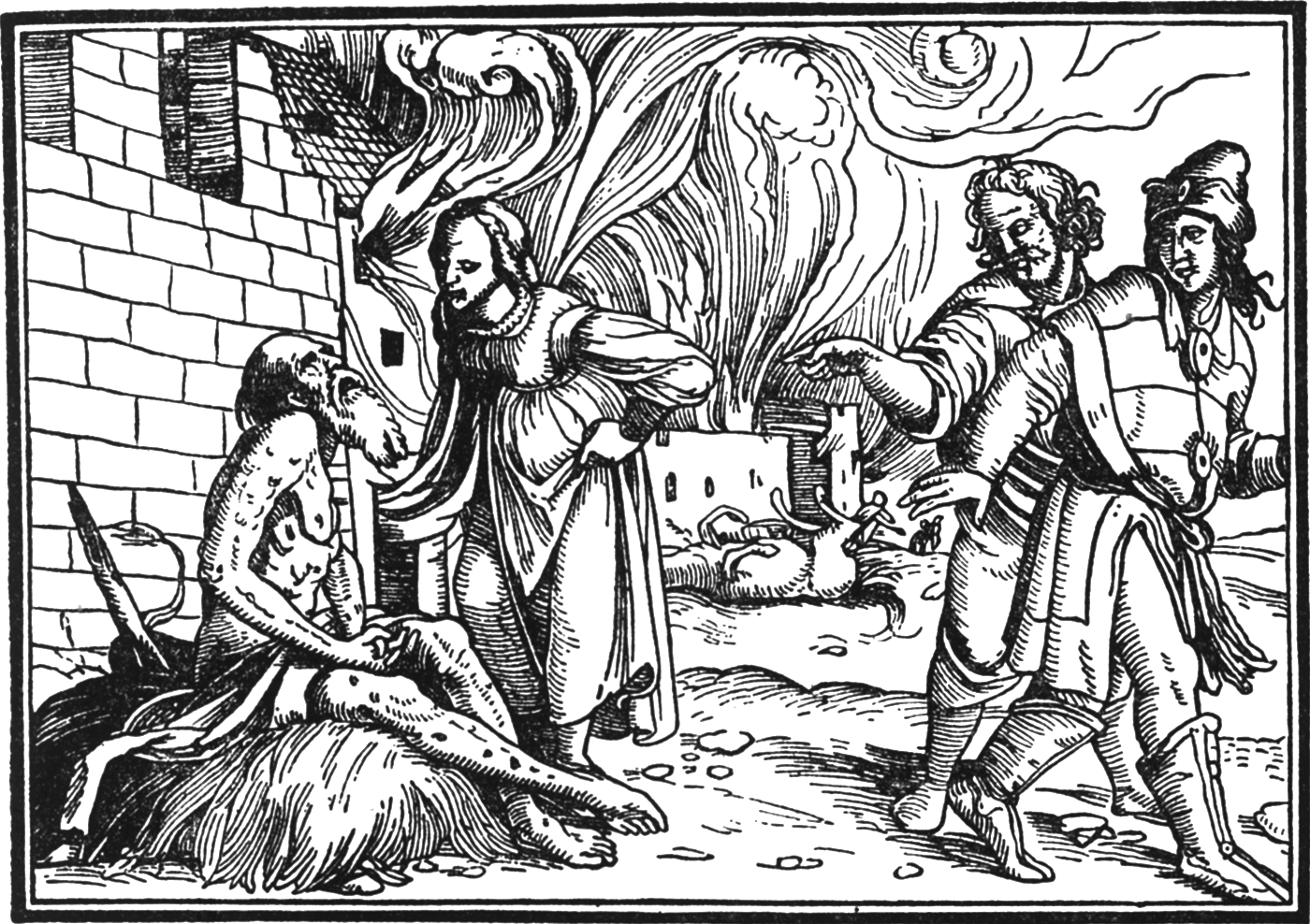
Image: Job Rebuketh His Wife (Job 2:9-10) in Hans Holbein, Holbein’s Bible Woodcuts. Sylvan Press; New York, NY, 1947; 2009.
In what (or in whom) do you trust?

Wind in the Chimes: In a moment of decision where do you put your trust?

Psalm 20:7

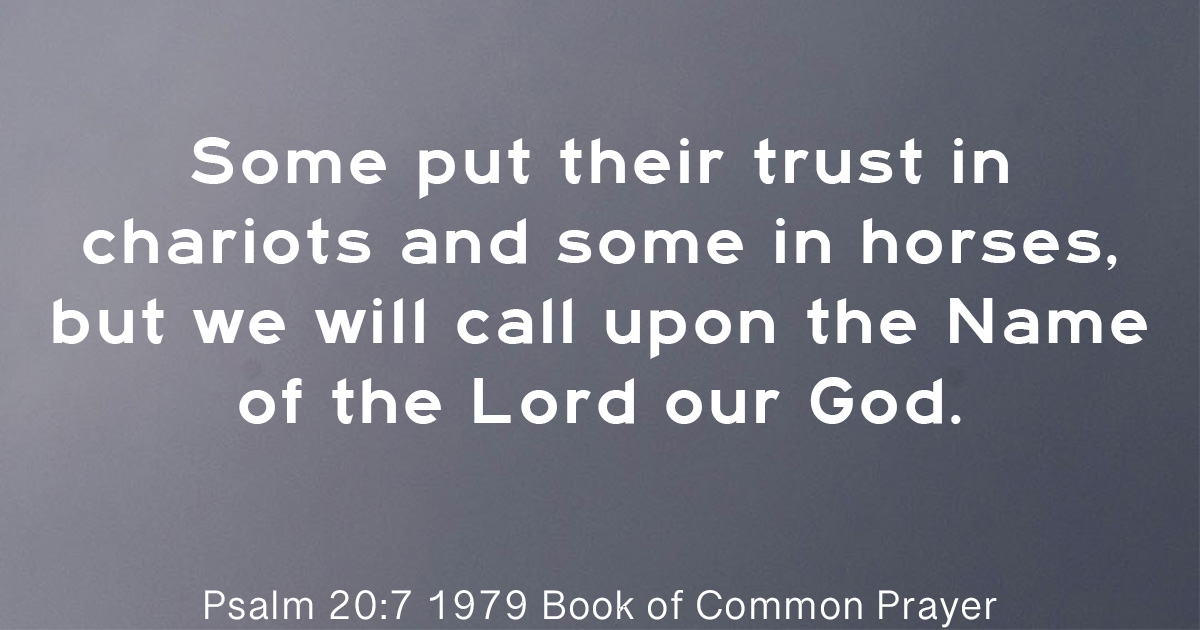
Some put their trust in chariots and some in horses, but we will call upon the Name of the Lord our God.

Psalm 20:7 (The Book of Common Prayer, 1979: Psalter)

Our sacred text is living and dynamic. New understandings about God and about God’s people continue to emerge. These understandings continue to expand with each new experience—of individuals and communities—and new questions and understandings are born in the answering.

In our moment(s) of crisis “trust in chariots and horses” could be read as trust in wealth, material goods, political power, physical power, and strength, or in clever manipulation of law and order. The text asserts that in our ancestor’s moment of crisis they “will call upon the Name of the Lord our God.”

This text asks you and me—in our moment of need or crisis: in what (or in whom) do you trust? As we work out our individual answers and join others in a similar journey, I hope we can assert with the Psalmist that “WE will call upon the Name of the Lord our God”

About Wind in the Chimes

Wind in the Chimes (renaming and reintroduction of Wind Chimes, 7/21/20)

Wind Chimes: September 25 2012 (an introduction)

O wonder of wonders

Wind in the Chimes: Prayer as responding to God with or without words

O wonder of wonders! when I think of the union of my soul with you, O God! You make my soul flow out of herself in joyful ecstasy, for nothing but you can content her. A spring of divine love surges over my soul, sweeping her out of herself into you, O God, her original source.

Meister Eckhart in Michael Counsell, 2000 Years of Prayer (Kindle Locations 3361-3362). Church Publishing Inc.. Kindle Edition.

See also

The goal of prayer: Intimacy with God

Exploring a Life of Prayer by Jane E. Vennard posted to Religion Online

About Wind in the Chimes

Wind in the Chimes (renaming and reintroduction of Wind Chimes, 7/21/20)

Wind Chimes: September 25 2012 (an introduction)

The goal of prayer: intimacy with God

Wind in the Chimes: A brief meditation about prayer changing the one who prays

I pray because …

In a scene from Shadowlands, a film based on the life of C.S. Lewis, Lewis has returned to Oxford from London, where he has just been married to Joy Gresham, an American woman, in a private Episcopal ceremony performed at her hospital bedside. She is dying from cancer, and, through the struggle with her illness, she and Lewis have been discovering the depth of their love for each other. 

As Lewis arrives at the college where he teaches, he is met by Harry Harrington, an Episcopal priest, who asks what news there is. Lewis, hesitates; then, deciding to speak of the marriage and not the cancer, he says, “Ah, good news, I think, Harry. Yes, good news.” 

Harrington, not aware of the marriage and thinking that Lewis is referring to Joy’s medical situation, replies, “I know how hard you’ve been praying…Now, God is answering your prayer.” 

“That’s not why I pray, Harry,” Lewis responds. “I pray because I can’t help myself. I pray because I’m helpless. I pray because the need flows out of me all the time, waking and sleeping. It doesn’t change God—it changes me.” 

It doesn’t change God; it changes me. Prayer is not a message scribbled on a note, jammed into a bottle and tossed into the sea in hopes that it will wash up someday on God’s shoreline. Prayer is communion with God. We speak to God, but God touches, embraces, shapes and changes us. Whether we pray for rain or pray for sunshine, our prayer is answered, because in the act of praying we receive the gift we really seek—intimacy with God. 

Source: Thomas G. Long, Whispering the Lyrics: Sermons for Lent and Easter, Lima, OH: CSS Publishing Co., 1995 quoted in Pulpit Resource, January, February, March, 1998 p. 30

More

Prayer is responding to God, by thought and by deeds, with or without words.

1979 (Episcopal) Book of Common Prayer, 856

About Wind in the Chimes

Wind in the Chimes (renaming and reintroduction of Wind Chimes, 7/21/20)

Wind Chimes: September 25, 2012 (an introduction)

A Prayer in the midst of trouble

Wind in the Chimes: To whom do you turn in the midst of trouble?

Prayer and Peace in a single verse

Trouble, danger, chaos, upset, frustration: whatever you call it, it can happen in just a moment or last years. From moment to moment in a day, day by day in a week, week by week in a month, month by month in a year, we may experience “trouble.”

In the midst of trouble, the Psalmist is our guide: that is the point to turn with heartfelt trust (like the Psalmist) and declare, “you [my God, my Lord] preserve me against the wrath of my enemies; you stretch out your hand, and your right hand delivers me.” You are not alone in the midst of trouble.

Trust these words. Let your God walk with you, love you, and deliver you. God’s Peace is yours, always, in the midst of trouble.

About Wind in the Chimes

Wind in the Chimes (renaming and reintroduction of Wind Chimes, 7/21/20)

Wind Chimes: September 25 2012 (an introduction)

A Memorial Day Prayer

Wind in the Chimes: We remember those whose graves are marked and those whose passing is commemorated in our hearts

Sacrifices remembered with grateful hearts

Jesus, Prince of Peace, we remember before you with grateful hearts the men and women of our country who in the day of decision ventured much for the liberties we now enjoy and especially we remember with gratitude those men and women who have laid down their lives in the service of our country.

Grant—to those whose graves are marked in hallowed grounds and to those whose passing is commemorated in our hearts—your mercy and the light of your presence.

And give, O Lord, to the people of our country a zeal for justice and the strength of forbearance, that we may use our liberty in accordance with your gracious will. As you know us and love us, hear our prayer.

Adapted from the Book of Common Prayer: Thanksgiving for Heroic Service (839); Collect for the Nation (258)

More

About Wind in the Chimes

Wind in the Chimes (renaming and reintroduction of Wind Chimes, 7/21/20)

Wind Chimes: September 25 2012 (an introduction)

Trinity Sunday, Year B

Wind in the Chimes: The Sunday after the Day of Pentecost is Trinity Sunday

Trinity Sunday (May 26, 2024)

Feast that celebrates “the one and equal glory” of Father, Son, and Holy Spirit, “in Trinity of Persons and in Unity of Being” (BCP, p. 380). It is celebrated on the first Sunday after Pentecost. Trinity Sunday is one of the seven principal feasts of the church year (BCP, p. 15). The proper readings and collect for Trinity Sunday are used only on the feast, not on the weekdays following. The numbered proper which corresponds most closely to the date of Trinity Sunday is used (BCP, p. 228). The BCP also provides the proper “Of the Holy Trinity” for optional use at other times, subject to the rules of the calendar of the church year (see BCP, pp. 251, 927). The Hymnal 1982 presents ten hymns in a section on The Holy Trinity (Hymns 362-371), including “Holy, holy, holy! Lord God Almighty!” (Hymn 362), “Come, thou almighty King” (Hymn 365), and “Holy Father, great Creator” (Hymn 368).

Celebration of Trinity Sunday was approved for the western church by Pope John XXII in 1334. This feast is associated with Thomas Becket (c. 1118-1170), who was consecrated bishop on Trinity Sunday, 1162. His martyrdom may have influenced the popularity of the feast in England and the custom of naming the remaining Sundays of the church year “Sundays after Trinity.” The Sarum Missal and editions of the Prayer Book through the 1928 BCP named these Sundays the Sundays after Trinity. The 1979 BCP identifies this portion of the church year as the season after Pentecost, and names these Sundays the Sundays after Pentecost (see BCP, p. 32).

Reference: “Trinity Sunday” in An Episcopal Dictionary of the Church

About Wind in the Chimes

Wind in the Chimes (renaming and reintroduction of Wind Chimes, 7/21/20)

Wind Chimes: September 25 2012 (an introduction)

The Day of Pentecost, Year B

Divided tongues, as of fire, appeared among them, and a tongue rested on each of them. All of them were filled with the Holy Spirit… (Acts 2:3-4)

Welcome!

What does Pentecost mean to you? How have you experienced the gift of the Holy Spirit breathing life into you, guiding your thinking and choosing, and enlivening your day-to-day activity?

On Wednesday, May 15, 2024, we* explored Acts 2:1-21, the account of the events on the Day of Pentecost.

Pause, remember, acknowledge, and even celebrate, the presence of the Holy Spirit “the Lord, the giver of life” in you.

From a commentary on Acts 2:1-21

The language of the Pentecost experience, with its images of “wind,” “spirit,” and being “filled” with the Spirit or the “breath” of life, is reminiscent of God’s initial creative activity (Gen. 1:2; 2:7). Here, however, the emphasis is not so much on creation or God’s works in history as on direct contact with the Spirit of God, who is now filling the world in a new way. The roll call of nations and languages points to the universality of the Spirit’s work for the whole world. God’s Spirit is the divine energy that now enables an eternal life to be real for those on whom God’s Spirit is poured and in whom the Spirit dwells (cf. Rom. 5:5).

Even more, linking the Pentecost events with the prophetic word about “last days” (Acts 2:17) points forward to the ultimate consummation of God’s reign in a “new heaven and new earth” (Rev. 21:1).

Source: Donald K. Mckim, “Theological Perspective on Acts 2:1‒21,” in Feasting on the Word: Preaching the Revised Common Lectionary: Year B, ed. David L. Bartlett and Barbara Brown Taylor, vol. 3 (Louisville, KY: Westminster John Knox Press, 2009), 2.

Donald K. McKim is the Executive Editor of Theology and Reference, Westminster John Knox Press, Germantown, Tennessee.

divider line

*Most Wednesday mornings a group of us gather online to explore the readings that will be used in worship the following Sunday. This week’s handout features readings, commentaries, and notes for the Day of Pentecost (May 19, 2024) in Year B of the Revised Common Lectionary. Please: View or download the handout we used to guide our discussion and tune our hearts to the Spirit.

View the Revised Common Lectionary readings appointed for Pentecost, Sunday, May 19, 2024, on the Revised Common Lectionary site curated by the Vanderbilt Divinity Library.

Please return to this site throughout the week to keep learning.

divider line

More about Pentecost

Be well. Do good. Pay attention. Keep learning.

Pentecost, Year B

Wind in the Chimes: our prayer and why we celebrate this day

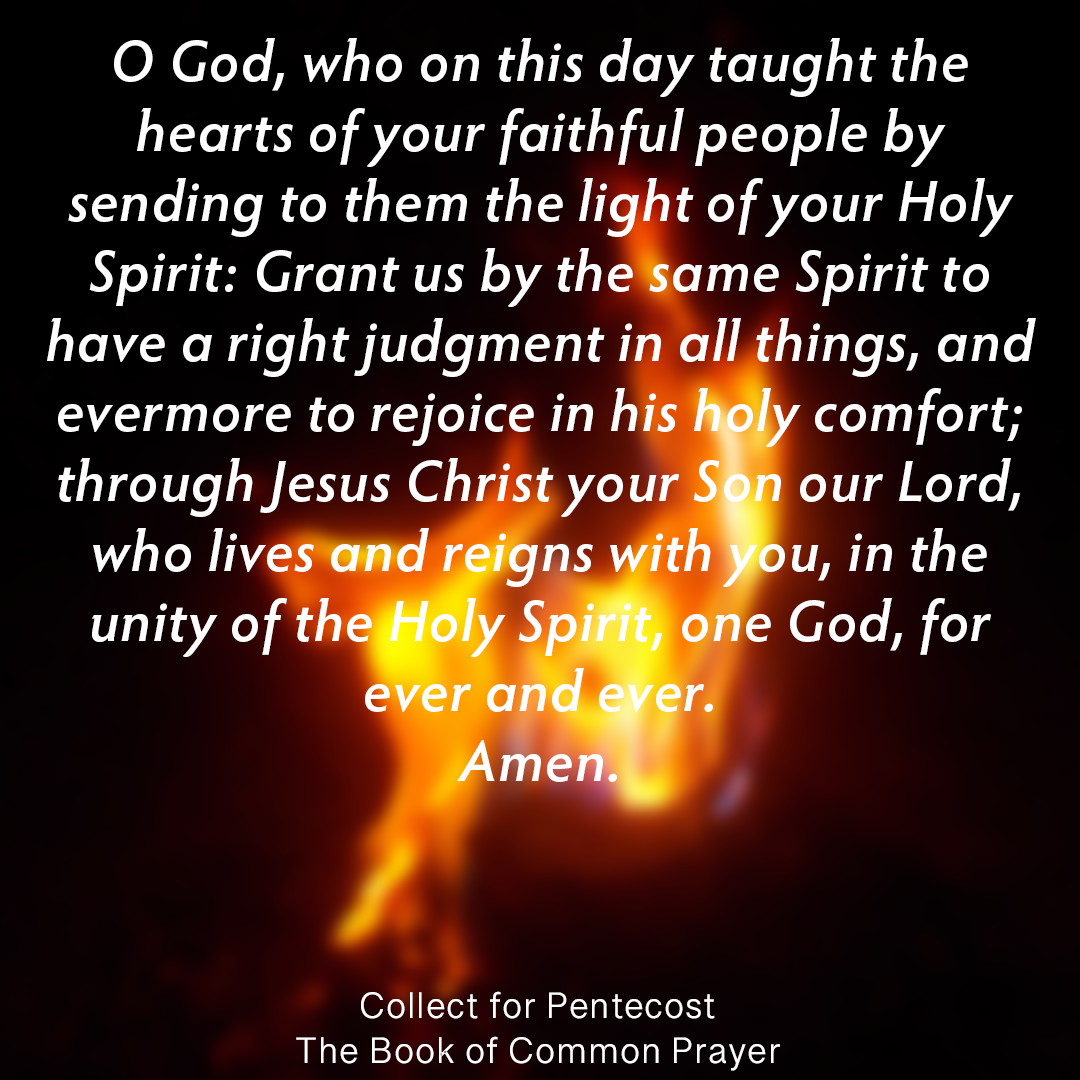
Collect for Pentecost

Pentecost

The term means “the fiftieth day.” It is used in both the OT and the NT. In the OT it refers to a feast of seven weeks known as the Feast of Weeks. It was apparently an agricultural event that focused on the harvesting of first fruits. Josephus referred to Pentecost as the fiftieth day after the first day of Passover. The term is used in the NT to refer to the coming of the Spirit on the day of Pentecost (Acts 2:1), shortly after Jesus’ death, resurrection, and ascension. Christians came to understand the meaning of Pentecost in terms of the gift of the Spirit. The Pentecost event was the fulfillment of a promise which Jesus gave concerning the return of the Holy Spirit. The speaking in tongues, which was a major effect of having received the Spirit, is interpreted by some to symbolize the church’s worldwide preaching. In the Christian tradition, Pentecost is now the seventh Sunday after Easter. It emphasizes that the church is understood as the body of Christ which is drawn together and given life by the Holy Spirit. Some understand Pentecost to be the origin and sending out of the church into the world. The Day of Pentecost is one of the seven principal feasts of the church year in the Episcopal Church (BCP, p. 15). The Day of Pentecost is identified by the BCP as one of the feasts that is “especially appropriate” for baptism (p. 312). The liturgical color for the feast is red. Pentecost has also been known as Whitsun or Whitsunday, a corruption of “White Sunday.” This term reflects the custom by which those who were baptized at the Vigil of Pentecost would wear their white baptismal garments to church on the Day of Pentecost. The BCP provides directions for observance of a Vigil of Pentecost, which begins with the Service of Light (p. 227). The Hymnal 1982 provides a variety of hymns for Pentecost (Hymns 223-230) and the Holy Spirit (Hymns 500-516).Reference: “Ascension” in An Episcopal Dictionary of the Church

Pentecost in 2 Minutes

More

  • The Collect: an Anglican/Episcopal Treasure. From the “Foreward” to The Collects of Thomas Cranmer edited by C. Frederick Barbee and Paul F. M. Zahl. This essay provides historical and liturgical background to this type of liturgical prayer.
  • A Pattern for Prayer by John D. Witvliet posted on Religion Online. The author believes the study of ancient liturgical materials facilitates special insight.  He discusses at length the understanding which lies in the structures and patterns of early collects and similar prayers, for preparing such prayers challenges us to draw on nearly the whole range of theological themes and motifs.

About Wind in the Chimes

Wind in the Chimes (renaming and reintroduction of Wind Chimes, 7/21/20)

Wind Chimes: September 25 2012 (an introduction)

A prayer after the Ascension

Wind in the Chimes: a prayer on the Seventh Sunday of Easter to be strengthened

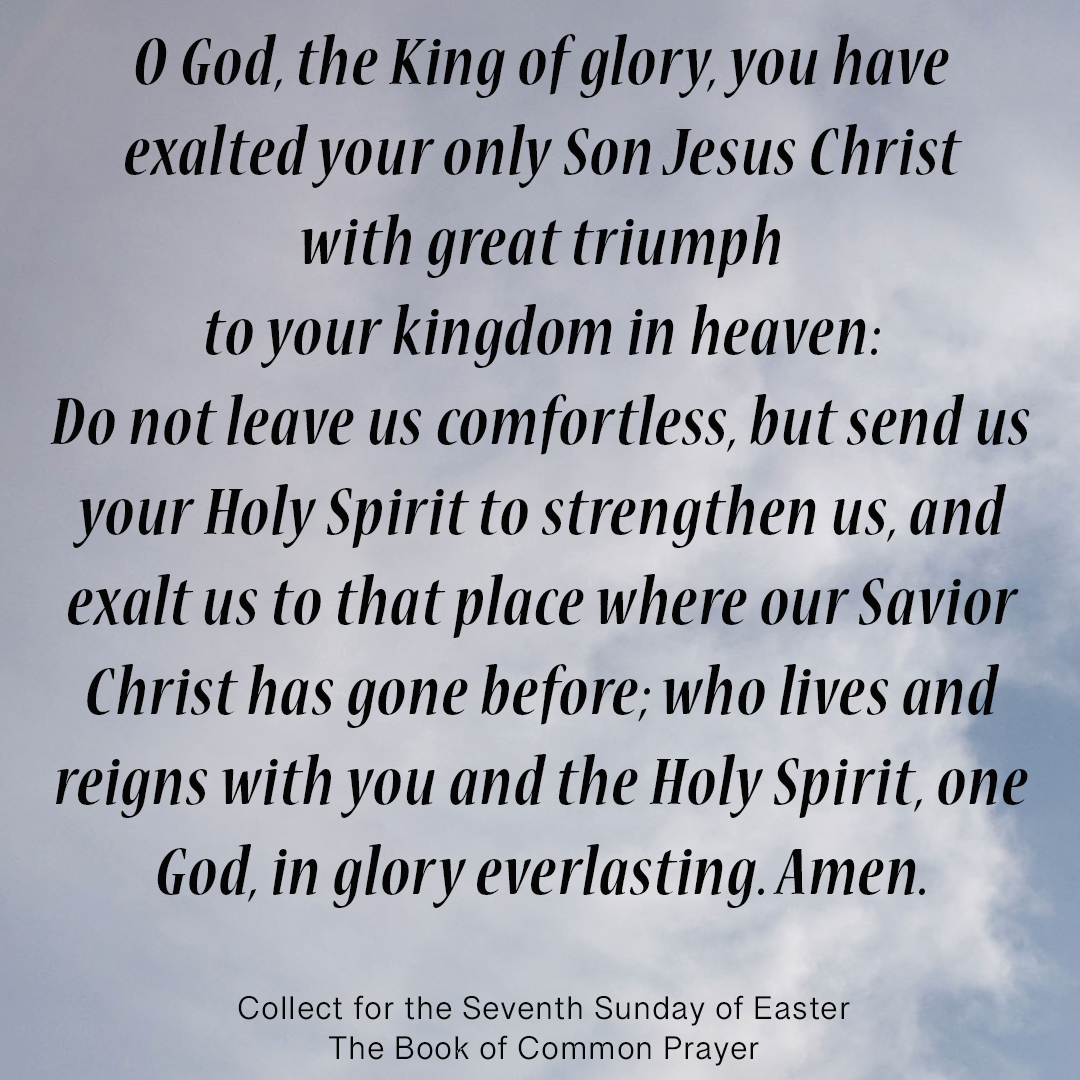
O God, the King of glory … do not leave us comfortless

On the Seventh Sunday of Easter, we first ask that our God not leave us comfortless. Then we ask for the Holy Spirit to strengthen and exalt us.

Marion Hatchett in his book, Commentary on the American Prayer Book, (New York: The Seabury Press, 1981) tells us that Thomas Cranmer (the author of the precursor of this prayer in English) “translated the word ‘orphans’ [from a more ancient prayer in Latin] with a weaker term ‘comfortless,’ which is used here in what is now an archaic meaning, ‘without strength,’… as well as ‘without consolation.'”

In this week as we prepare to remember and celebrate the coming of the Holy Spirit at Pentecost, consider how the Spirit has strengthened you in your faith journey. In what moments of your journey have you relied upon the strength of the Spirit to sustain you?

Likewise, what experiences in your faith journey have led you to trust that God, the King of glory, is even now exalting us, exalting you, “to that place where our Savior Christ has gone before?”

More

  • The Collect: an Anglican/Episcopal Treasure. From the “Foreward” to The Collects of Thomas Cranmer edited by C. Frederick Barbee and Paul F. M. Zahl. This essay provides historical and liturgical background to this type of liturgical prayer.
  • A Pattern for Prayer by John D. Witvliet posted on Religion Online. The author believes the study of ancient liturgical materials facilitates special insight.  He discusses at length the understanding which lies in the structures and patterns of early collects and similar prayers, for preparing such prayers challenges us to draw on nearly the whole range of theological themes and motifs.

About Wind in the Chimes

Wind in the Chimes (renaming and reintroduction of Wind Chimes, 7/21/20)

Wind Chimes: September 25 2012 (an introduction)