The Holy Trinity

There are times when neither words nor pictures are adequate to express the depths of mystery.

Commentary by Hovak Najarian

Trinity with Three Faces via Wikimedia Commons

 Trinity with Three Faces, Fresco, c.1400, Antonio da Atri, c.1350-1433

 The much-quoted statement, “A picture is worth a thousand words,” is true in some instances but not all. A picture cannot represent adequately images such as those that come to mind in the words of the Twenty-third Psalm or the Sermon on the Mount. Art may at times clarify ideas that cannot be expressed by other means but there are times when neither words nor pictures are adequate. A challenge facing early Christian artists was how to create visual images that could communicate concepts found in their faith. A concept such as the Trinity was difficult to explain through art or with words.

In the early Church, there were questions about how (or if) a depiction of God should (or could) be made and if so, what would the image be? God was depicted ultimately as a bearded father figure (possibly derived from the description, “ancient of days” mentioned in the Book of Daniel). A lamb represented Jesus and a dove represented the Holy Spirit. As long as members of the Godhead were depicted as separate entities, artists did not have to deal with the problem of creating an image that represented all three.


The three figures that appeared before Abraham in the Book of Genesis were portrayed as the Trinity but they were shown as separate individuals.  By placing them adjacent to each other they were seen as a visual unit.  Official use of this form of Trinity was ended by the Pope in the eighteenth century but it continued in places such as the American Southwest.

Retablo of the Trinity
Retablo of the Trinity from an altarpiece of a mission church, New Mexico, USA

 Another attempt to depict the Trinity is found in the Basilica of Santa Maria Assunta in Atri, Italy.  Antonio da Atri’s fresco, “Trinity with Three Faces,” shows Christ standing and facing the viewer.  His right arm is raised in a blessing and his left hand is holding a book.  To depict Christ as part of the Trinity, Antonio has given the figure one body but three faces.  Right and left profiles have been added to Jesus’ head with radiating lines emanating from the halos.  As a setting for this composition, Antonio framed his Trinity image in a Late Gothic arch and decorative elements.
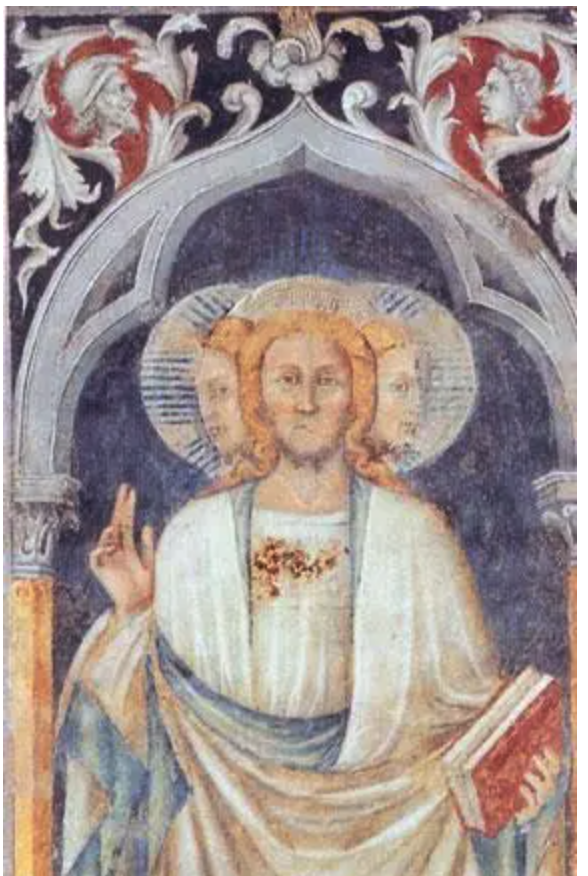
Multi-headed divinities existed in other religions and although a three-faced Trinity such as Antonio’s fresco was accepted by the Roman Catholic hierarchy, it was ridiculed by Protestants.  It was called the “Catholic Cerberus.”  [In Greek mythology, Cerberus was the three-headed dog that guarded the gates of Hades.]  As a consequence, in the sixteenth century, the Pope ended the use of the three-faced Trinity but the image remained in remote regions.  Pope Innocent XII went further in the seventeenth century and ordered them all to be destroyed.  The three-faced Trinity at the Basilica of Atri survived because it was not in sight.  It, and other frescos at the Basilica, had been covered with plaster for fear their surfaces might in some way contribute to the spread of the bubonic plague.

Hovak Najarian © 2013

Note: links to the artwork were updated on May 25, 2024; the content was lightly edited. Find additional images of the Trinity with Three Faces using Google Search.

Image: Antonio da Atri, Wikimedia Commons; upload of Retablo of the Trinity, ca. 1936, Watercolor, colored pencil, and graphite on Paper [This is a copy from an altarpiece], E. Elizabeth Boyd, 1903-1974.

Ready for a word order meditation?

The words are familiar: “The Lord is my shepherd ….” I have recited this Psalm many times with the dying, with the bereaved, with those struggling to find the strength to move on, or the strength to face a fear-filled future.

I have been with agitated men and women of a certain age, robbed of mental acuity by illness or injury, and watched calm wash over them and through them, watched peace come to them as I recited the words of Psalm 23.

But, change the word order and you will have the heart of our conversation in the Sunday Morning Forum as it gathers at 9:00 am on Sunday, April 29, 2012.

The Lord is my shepherd … . Ah, peace, strength, and …

IS the Lord my shepherd …? Ah. Wait. What? How dare you suggest …

In the readings appointed for Sunday we hear:

The Lord is my Shepherd … (Psalm 23:1)

We know love by this, that he laid down his life for us … (1 John 3:16)

Jesus said, “I am the good shepherd.The good shepherd lays down his life for the sheep….” (John 10:11)

Look through the ups and downs of your life.

  • In what ways have these words of scripture been true for you?
  • When have these words been part of your prayers?
  • Are you ready to risk sharing a bit of your history with the group.
  • IS the Lord your shepherd?
  • What has this come to mean for you?
  • Have you always been secure in this knowledge?
  • Have you ever been secure in this knowledge?

Telling our stories of encounter with the Risen Lord, the Good Shepherd, is a fulfillment of our Baptismal Covenant to “proclaim by word … the Good News of God in Christ.”

I invite you to leave a comment, even a story, here. Let your words open the mystery and meaning of speaking this way about God and our relationship with God.

Remembering artists

Things are not all so comprehensible and expressible as one would mostly have us believe; most events are inexpressible, taking place in a realm which no word has ever entered, and more inexpressible than all else are works of art, mysterious existences, the life of which, while ours passes away, endures. —Rainer Maria Rilke from Letters to a Young Poet.

On August 5th the Episcopal Church remembers Albrecht Dürer. Matthias Grünewald, Lucas Cranach the Elder, Artists.In doing so the Church commemorates all artists and the celebrates and give thanks for the role of art in forming faith and encouraging faith. I tend to be a “visual learner.” Seeing is, for me, the key to learning. As I think about art in the church I am amazed by how much of my faith is informed by what I have seen.

Pictures in story books and illustrated bibles, mass produced plaster and plastic statues, rosaries with beads of all kinds, crucifixes (I grew up Roman Catholic) with poorly formed bodies or bodies gruesome and bloody (but modestly clothed) in their depiction of death, and so on. The art was all around me; I was learning something, (most of which is still being “unlearned”), but mostly this art was simply “background noise,” static. My entry into mystery was unexpected and unforgettable. Having arrived in Rome to continue studies and seminary formation, a group of us were taken from the airport in Rome to the Piazza San Pietro and then into the basilica.

The proportions of the building were certainly awesome but the moment of mystery came as we moved to Michelangelo’s Pietà. In the blink of an eye I was moved from tourist looking at art treasures in a big church to a man in the presence of a profound mystery of life and death, of sorrow and hope, of brutal reality and fragile tenderness. I had forgotten to breathe, I was looking through eyes filled with tears. How did this happen? What just happened? How can stone have such power? How can a “mere mortal” find such power and mystery and beauty in a hunk of quarried marble?

Since that day I have continued to learn. I continue to seek out such beauty and mystery. In my own feeble way I have enjoyed opening my heart to the mysteries seen by the artist and shared with us. I am proud that our church chooses to remember all artists as we commemorate these artists. I hope that you have your own story to tell about the art that has whisked you from this world into realms unexpected, mysterious, and transformative. Please do leave your story here. Leave a comment, start a conversation.

We have selected one work from each of the artists commemorated by the church and will post them here with additional links and more information. Perhaps you would share some of your favorite works by these artists. Perhaps you will share links to your favorites. Keep the conversation going. Thanks.