Blessed be the God and Father of our Lord Jesus Christ, who has blessed us in Christ with every spiritual blessing in the heavenly places… Ephesians 1:3
Welcome!
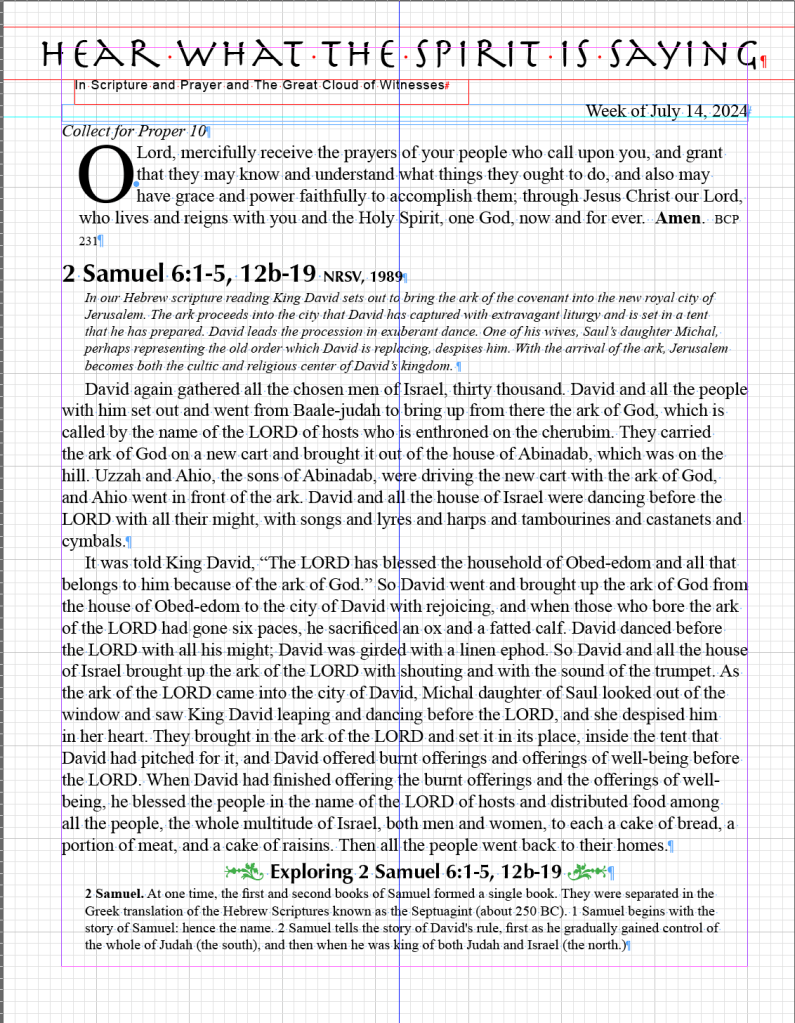
The readings on Sunday, July 14, 2024 (Proper 10B) continue the story of David as he moves the Ark of the Covenant to the City of David (Jerusalem). Psalm 24 gives praise to God and celebrates the King. In worship we start to read the Letter to the Ephesians as the Apostle sets out his vision of life in Christ. The Gospel of Mark tells the story of the death of John the Baptist.
We* had a long discussion on Psalm 24. The essay we read posed two questions we pass along to you:
How often do we approach worship, not with God in mind, but the week we have had?
How many times do we leave worship worried, not if we have worshiped God, but if we have been spiritually fed?
View or download the handout we used in our Wednesday morning forum:
Click the image to view or download our study guide
*Most Wednesday mornings a group of us gather online to explore the readings that will be used in worship the following Sunday. This week’s handout features readings, commentaries, and notes for the Eighth Sunday after Pentecost (July 14, 2024) in Year B of the Revised Common Lectionary. Please: View or download the handoutwe used to guide our discussion and tune our hearts to the Spirit.
Out of the depths I cry to you, O Lord. Lord, hear my voice! Let your ears be attentive to the voice of my supplications! Psalm 130:1-2
Welcome!
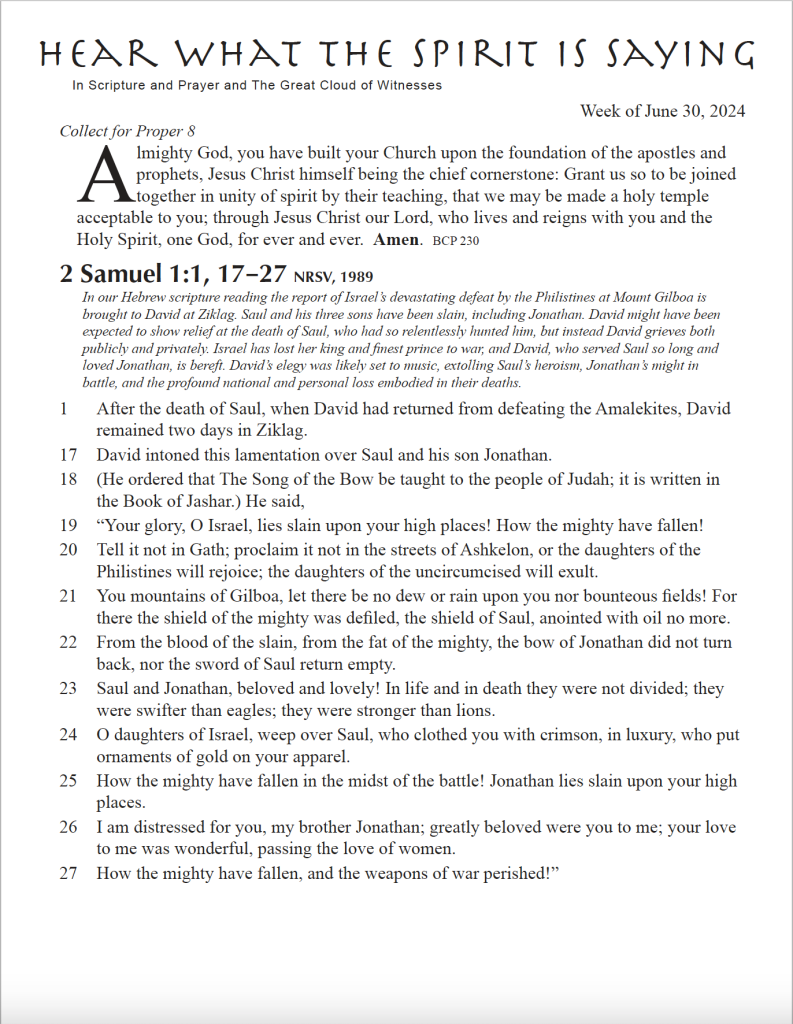
The readings on Sunday, June 30, 2024 (Proper 8B) continue the story of David after the death of King Saul. Psalm 130 is a cry for attention and help and a confident expression that the Lord hears and will answer. There is a patient and hope-filled waiting.
Read Psalm 130 from the Tanakh. Listen carefully. In this translation, which words speak most clearly to your heart? What difference do these words make to you? To those you love?
Psalm 130:1–8 (Tanakh)
1A song of ascents. Out of the depths I call You, O Lord.
2O Lord, listen to my cry; let Your ears be attentive to my plea for mercy.
3If You keep account of sins, O Lord, Lord, who will survive?
4Yours is the power to forgive so that You may be held in awe.
5I look to the Lord; I look to Him; I await His word.
6I am more eager for the Lord than watchmen for the morning, watchmen for the morning.
7O Israel, wait for the Lord; for with the Lord is steadfast love and great power to redeem.
8It is He who will redeem Israel from all their iniquities.
View or download the handout we used in our Wednesday morning forum:
Click the image to view or download our study guide
*Most Wednesday mornings a group of us gather online to explore the readings that will be used in worship the following Sunday. This week’s handout features readings, commentaries, and notes for the Sixth Sunday after Pentecost (June 30, 2024) in Year B of the Revised Common Lectionary. Please: View or download the handoutwe used to guide our discussion and tune our hearts to the Spirit.
“O Lord, make us have perpetual love and reverence for your holy Name, for you never fail to help and govern those whom you have set upon the sure foundation of your loving-kindness…. ” Collect of the Day
Welcome!
The readings from Sunday, June 23, 2024 (Proper 7B) featured the story of David and Goliath. The verses from Psalm 9 came from a heart and a community that, through experience, trusted God in even the most difficult moments of life. Our* discussion focused on the Psalm. You are invited to join the Psalmist in lifting your heart to God.
Click image to view or download our study guide
*Most Wednesday mornings a group of us gather online to explore the readings that will be used in worship the following Sunday. This week’s handout features readings, commentaries, and notes for the Fifth Sunday after Pentecost (June 23, 2024) in Year B of the Revised Common Lectionary. Please: View or download the handoutwe used to guide our discussion and tune our hearts to the Spirit.
Wind in the Chimes: In a moment of decision where do you put your trust?
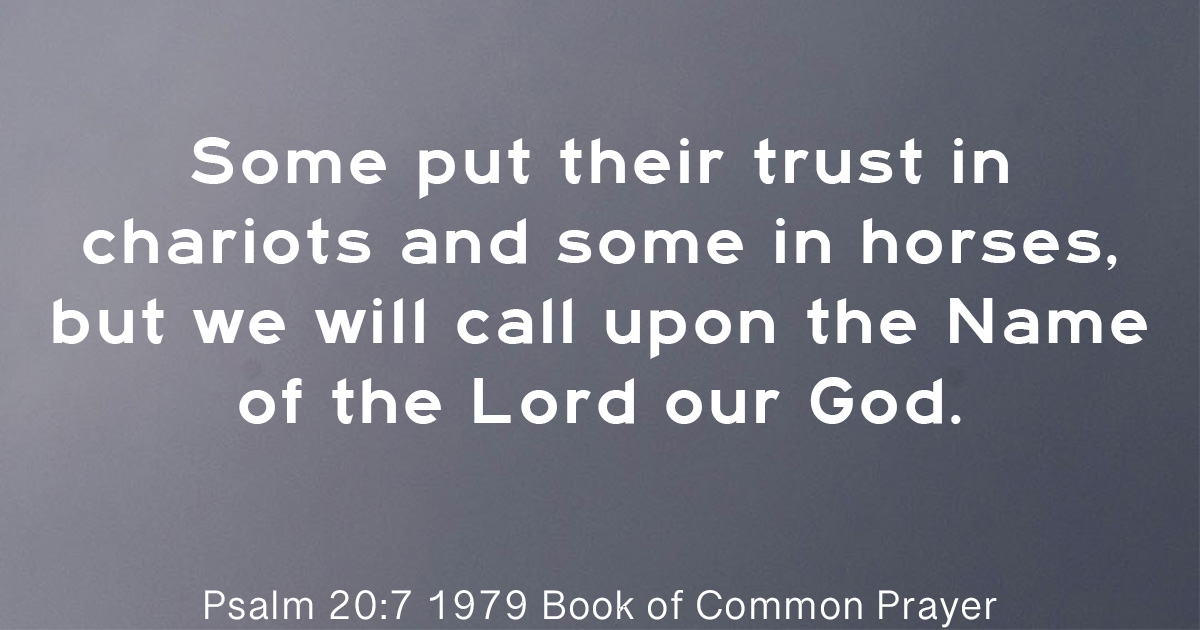
Psalm 20:7
Some put their trust in chariots and some in horses, but we will call upon the Name of the Lord our God.
Psalm 20:7 (The Book of Common Prayer, 1979: Psalter)
Our sacred text is living and dynamic. New understandings about God and about God’s people continue to emerge. These understandings continue to expand with each new experience—of individuals and communities—and new questions and understandings are born in the answering.
In our moment(s) of crisis “trust in chariots and horses” could be read as trust in wealth, material goods, political power, physical power, and strength, or in clever manipulation of law and order. The text asserts that in our ancestor’s moment of crisis they “will call upon the Name of the Lord our God.”
This text asks you and me—in our moment of need or crisis: in what (or in whom) do you trust? As we work out our individual answers and join others in a similar journey, I hope we can assert with the Psalmist that “WE will call upon the Name of the Lord our God”
About Wind in the Chimes
Wind in the Chimes (renaming and reintroduction of Wind Chimes, 7/21/20)
Wind in the Chimes: Prayer as responding to God with or without words
O wonder of wonders! when I think of the union of my soul with you, O God! You make my soul flow out of herself in joyful ecstasy, for nothing but you can content her. A spring of divine love surges over my soul, sweeping her out of herself into you, O God, her original source.
Wind in the Chimes: A brief meditation about prayer changing the one who prays
I pray because …
In a scene from Shadowlands, a film based on the life of C.S. Lewis, Lewis has returned to Oxford from London, where he has just been married to Joy Gresham, an American woman, in a private Episcopal ceremony performed at her hospital bedside. She is dying from cancer, and, through the struggle with her illness, she and Lewis have been discovering the depth of their love for each other.
As Lewis arrives at the college where he teaches, he is met by Harry Harrington, an Episcopal priest, who asks what news there is. Lewis, hesitates; then, deciding to speak of the marriage and not the cancer, he says, “Ah, good news, I think, Harry. Yes, good news.”
Harrington, not aware of the marriage and thinking that Lewis is referring to Joy’s medical situation, replies, “I know how hard you’ve been praying…Now, God is answering your prayer.”
“That’s not why I pray, Harry,” Lewis responds. “I pray because I can’t help myself. I pray because I’m helpless. I pray because the need flows out of me all the time, waking and sleeping. It doesn’t change God—it changes me.”
It doesn’t change God; it changes me. Prayer is not a message scribbled on a note, jammed into a bottle and tossed into the sea in hopes that it will wash up someday on God’s shoreline. Prayer is communion with God. We speak to God, but God touches, embraces, shapes and changes us. Whether we pray for rain or pray for sunshine, our prayer is answered, because in the act of praying we receive the gift we really seek—intimacy with God.
Source: Thomas G. Long, Whispering the Lyrics: Sermons for Lent and Easter, Lima, OH: CSS Publishing Co., 1995 quoted in Pulpit Resource, January, February, March, 1998 p. 30
More
Prayer is responding to God, by thought and by deeds, with or without words.
1979 (Episcopal) Book of Common Prayer, 856
About Wind in the Chimes
Wind in the Chimes (renaming and reintroduction of Wind Chimes, 7/21/20)
Wind in the Chimes: To whom do you turn in the midst of trouble?
Prayer and Peace in a single verse
Trouble, danger, chaos, upset, frustration: whatever you call it, it can happen in just a moment or last years. From moment to moment in a day, day by day in a week, week by week in a month, month by month in a year, we may experience “trouble.”
In the midst of trouble, the Psalmist is our guide: that is the point to turn with heartfelt trust (like the Psalmist) and declare, “you [my God, my Lord] preserve me against the wrath of my enemies; you stretch out your hand, and your right hand delivers me.” You are not alone in the midst of trouble.
Trust these words. Let your God walk with you, love you, and deliver you. God’s Peace is yours, always, in the midst of trouble.
About Wind in the Chimes
Wind in the Chimes (renaming and reintroduction of Wind Chimes, 7/21/20)
I give you thanks, O LORD, with my whole heart; before the gods I sing your praise… Psalm 138:1 (NRSV)
Welcome!
Psalm 138 (NRSVue) gives thanks and speaks powerfully to the majesty and humility of the God who loves us. Sometimes it helps to hear more than one translation of the ancient text to discover new dimensions of our relationship with God.
Here is Psalm 138 from the New Jerusalem Bible:
1I thank you, Yahweh, with all my heart, for you have listened to the cry I uttered. In the presence of angels I sing to you,
2I bow down before your holy Temple. I praise your name for your faithful love and your constancy; your promises surpass even your fame.
3You heard me on the day when I called, and you gave new strength to my heart.
4All the kings of the earth give thanks to you, Yahweh, when they hear the promises you make;
5they sing of Yahweh’s ways, ‘Great is the glory of Yahweh!’
6Sublime as he is, Yahweh looks on the humble, the proud he picks out from afar.
7Though I live surrounded by trouble you give me life—to my enemies’ fury! You stretch out your right hand and save me,
8Yahweh will do all things for me. Yahweh, your faithful love endures for ever, do not abandon what you have made.
Here is Psalm 138 from the Tanakh:
1Of David. I praise You with all my heart, sing a hymn to You before the divine beings;
2I bow toward Your holy temple and praise Your name for Your steadfast love and faithfulness, because You have exalted Your name, Your word, above all.
3When I called, You answered me, You inspired me with courage.
4All the kings of the earth shall praise You, O Lord, for they have heard the words You spoke.
5They shall sing of the ways of the Lord, “Great is the majesty of the Lord!”
6High though the Lord is, He sees the lowly; lofty, He perceives from afar.
7Though I walk among enemies, You preserve me in the face of my foes; You extend Your hand; with Your right hand You deliver me.
8The Lord will settle accounts for me. O Lord, Your steadfast love is eternal; do not forsake the work of Your hands.
As always, our sacred text (in its various English translations) questions us even as we speak, listen to, and hear the words:
Throughout the day, how often do you pause and give thanks? How often is thanksgiving done with all your heart? How might you experience or describe a half-hearted thanksgiving? A whole-hearted thanksgiving? (v. 1)
In verse 1 the Psalmist sings before “gods” (NRSV), “angels” (NJB), or “divine beings” (Tanakh). Which translation speaks to your heart? Why is that? Close your eyes, picture and feel and hear yourself singing your thanksgiving in such hallowed company. Well?
In the NRSVue verse 3 reads: “On the day I called, you answered me; “you increased my strength of soul.” The NJB translates God’s answer as “you gave new strength to my heart.” The Tanakh translates God’s answer as “You inspired me with courage.” Again, which translation speaks to your heart and why is that?
With these few examples from verses 1 and 3, I encourage you to allow the text (in various translations) to question you. Become quiet. Hear what the Spirit is saying to you. Hear how the Spirit—in the sacred text—both questions and encourages you.
*Most Wednesday mornings a group of us gather online to explore the readings that will be used in worship the following Sunday. This week’s handout features readings, commentaries, and notes for the Third Sunday after Pentecost (June 9, 2024) in Year B of the Revised Common Lectionary. Please: View or download the handoutwe used to guide our discussion and tune our hearts to the Spirit.
Wind in the Chimes: We remember those whose graves are marked and those whose passing is commemorated in our hearts
Sacrifices remembered with grateful hearts
Jesus, Prince of Peace, we remember before you with grateful hearts the men and women of our country who in the day of decision ventured much for the liberties we now enjoy and especially we remember with gratitude those men and women who have laid down their lives in the service of our country.
Grant—to those whose graves are marked in hallowed grounds and to those whose passing is commemorated in our hearts—your mercy and the light of your presence.
And give, O Lord, to the people of our country a zeal for justice and the strength of forbearance, that we may use our liberty in accordance with your gracious will. As you know us and love us, hear our prayer.
Adapted from the Book of Common Prayer: Thanksgiving for Heroic Service (839); Collect for the Nation (258)
Wind in the Chimes: The Sunday after the Day of Pentecost is Trinity Sunday
Trinity Sunday (May 26, 2024)
Feast that celebrates “the one and equal glory” of Father, Son, and Holy Spirit, “in Trinity of Persons and in Unity of Being” (BCP, p. 380). It is celebrated on the first Sunday after Pentecost. Trinity Sunday is one of the seven principal feasts of the church year (BCP, p. 15). The proper readings and collect for Trinity Sunday are used only on the feast, not on the weekdays following. The numbered proper which corresponds most closely to the date of Trinity Sunday is used (BCP, p. 228). The BCP also provides the proper “Of the Holy Trinity” for optional use at other times, subject to the rules of the calendar of the church year (see BCP, pp. 251, 927). The Hymnal 1982 presents ten hymns in a section on The Holy Trinity (Hymns 362-371), including “Holy, holy, holy! Lord God Almighty!” (Hymn 362), “Come, thou almighty King” (Hymn 365), and “Holy Father, great Creator” (Hymn 368).
Celebration of Trinity Sunday was approved for the western church by Pope John XXII in 1334. This feast is associated with Thomas Becket (c. 1118-1170), who was consecrated bishop on Trinity Sunday, 1162. His martyrdom may have influenced the popularity of the feast in England and the custom of naming the remaining Sundays of the church year “Sundays after Trinity.” The Sarum Missal and editions of the Prayer Book through the 1928 BCP named these Sundays the Sundays after Trinity. The 1979 BCP identifies this portion of the church year as the season after Pentecost, and names these Sundays the Sundays after Pentecost (see BCP, p. 32).








 Hear what the Spirit is saying