Month: March 2012

Christ’s Entry into Jerusalem, woodcut (1508-1510), Albrecht Durer (1471-1528)
Commentary by Hovak Najarian
Related post ‘Palm Sunday, April 1,2012’
When Albrecht Durer was a young boy in Nuremberg,Germany his skills were apparent and his father, a goldsmith, took him into his workshop for training. As a youth, Durer continued his training by apprenticing with a master engraver and then followed by traveling to other European countries. His first visit to Italy was in the mid 1490s but nine years later he returned in order to immerse himself in creative work. In Italy, a rebirth had been underway throughout the fifteenth century and during an extended stay in Venice (from 1505-1507) he made a thorough study of not only art but also the intellectual ideas that led to the Renaissance. In his life, Durer enjoyed a well deserved reputation as a painter but it was through the unrivaled quality of his woodcuts and metal engravings that his reputation as a Northern Renaissance artist spread throughout Europe.
Christ’s Entry into Jerusalem is from a series of woodcuts known as the Small Passion (the prints are quite small in scale). Durer started the thirty-seven prints not long after his return to Germany from Italy; he completed them in 1510 and then published them as a book in 1511. The dates of some of the plates (wood blocks) indicate Christ’s Entry into Jerusalem was the first of this series. In his original concept, the Passion was to be the only subject of the prints but after completing them, he decided to add six more prints beginning with Adam and Eve. This changed the emphasis from the Passion to mankind’s woes and our salvation through Christ.
In Christ’s Entry into Jerusalem, Jesus is the central figure and is the focus of attention as He rides toward the gate of the city. The crowd that surrounds him is in a subordinate role; they are the supporting cast to the drama. As Christ is approaching the gate, an old man is placing a cloak on the ground before him. Another man is holding a palm frond. In ancient Rome, a frond symbolized victory and in Christian art it came to be associated with martyrs and a triumph over death. The palm tree in the background symbolizes the promise of immortality (because its fronds are always green).
Halos in Christian art are intended to suggest radiant light around the heads of saints and heavenly beings, but they have not always been depicted in the familiar circular form. Sometimes God the Father is given a triangular halo signifying the trinity. A living person, such as a donor, may be shown with a square halo to indicate they are not one of the saints. Christ is the only one given a cruciform halo in reference to his death on the cross. In “Christ’s Entry,” Durer does not use a circular halo but instead shows Christ’s head surrounded by an intense light with rays extending out beyond the glow.
Note:
Making prints from a raised surface (relief print) is a very ancient graphic process in which an image is drawn on a flat block of wood and then everything but the image itself is carved to be slightly below the surface. When ink is rolled across a prepared block the carved areas, being below the surface, receive no ink; these areas will remain white on the print. When a piece of paper is placed over the block and it is run through a press or pressed by hand, the ink is pulled from the surface of the block, transferring a reversed image onto the paper.
Many prints can be made from a prepared plate. Often an artist plans for a limited edition and destroys the plate after a series has been printed. Copyright laws were not in place during Durer’s time and many copies of his woodcuts were made. Some of his plates still exist.
Albrecht Durer signed his plates with a stylized letter “A” and a “D” in the lower space of the “A.” In “Christ’s Entry,” it is likely you noticed the “D” is reversed. In most instances, Durer reversed his initials on the plate itself in order that it could be read correctly after the print was pulled. It may have been one of his assistants who did the carving in Christ’s Entry into Jerusalem.
______________
© 2012 Hovak Najarian
Michael Phillip Martinez
Two years ago, March 23 at 8 in the morning, Michael collapsed while unloading food at our outreach center. By 11 he was in a coma and remained so till death on the 26th. The burst aneurism had shredded his aorta; nothing could be done.
We had known Michael for a few years and for over a year he had been a dedicated client-volunteer typically giving 16+ hours a week. He had at first come to help in relocating the outreach center and stayed to help buy, handle, sort, bag, and distribute food. He returned one morning a week to mop and clean while I did data.
After his death we came to know how little we knew of Michael; probably things we could have known or surmised but in the focus of work never got around to.
Two loom large. Michael was homeless and without medical care.
Not that Michael was at all forthcoming. He had, he said, been renting a small trailer in 1000 Palms but at some point switched, he said, to a rented room. After his death we found the ‘room’ in 1000 Palms, actually a few shelves of Michael’s boxed belongings in a residence that had been converted into a machine shop. Michael was renting storage. Medically, in his mid 50s, overweight, with a bad diet, he fit the same profile that had landed me a triple bypass a decade earlier.
Could we have guessed his homelessness? Read the signs of him preparing food to take with him or ‘showering’ with a garden hose out back? Could we have urged him to explore housing alternatives just as we were doing for other clients weekly? Could we have curtailed his physical activity on our behalf in light of his obvious risk status, and knowing that, have recommended medical alternatives? Maybe. Probably. Sure.
But my remembrance here is not what we could (should) have done. My remembrance it that we missed it. When we are admonished to ‘love one another as I have loved you’ we can’t just wait for the opportunity to show itself. We must seek it out with our eyes and ears open and be willing to read between the lines. Then, hopefully, action will follow.
Let us help you meet an artist and his work
Note: These comments are prepared and shared with you so that you can meet Dieric Bouts (artist) and his subject The Meeting of Abraham and Melchizedek, a detail of his altarpiece triptych in Sint-Pieterskerk, Leuven The Meeting of Abraham and Melchizedek is part of an altarpiece by Dieric Bouts (c.1415 -1475). Although Bouts, The Elder (his sons also were painters) was Dutch, his career and artistic reputation was established in Flanders (now Belgium) where he lived and worked. His triptych (trip-tik) for St. Peter’s Church in Leuven is regarded to be one of his finest paintings. A triptych (from the Greek: tri – meaning “three,” plus ptyche – the word for “fold”) is a three-paneled altarpiece found notably in churches from the Middle Ages through the Renaissance. Early triptychs were relief carvings in wood or ivory but egg tempera became the favored medium of painters during the thirteenth and fourteenth century. Egg tempera offered a wide range of colors but by the fifteenth century it, too, was being replaced as oils became the medium of choice. Oil paints offered ease of application and with it a greater range of effects could be achieved. Dieric Bouts worked in oils on wood panels. In a triptych, the outer panels are usually half the size of the middle panel and are attached with hinges so they can be folded like shutters. A typical triptych has a familiar Biblical scene in the large center panel while the side panels provide a supporting cast of figures or related stories. The side panels may also include the donor(s) as part of a tableau. When the outer panels are folded their reverse sides become the front of the triptych and they also are carved or painted usually in keeping with the overall theme.
 Click the image to view the entire Triptych
In the center panel, Bouts’ principal subject in the triptych at Leuven is the Last Supper. The two outer panels – each containing two paintings one above the other – are Biblical scenes from Old Testament events in which the provision of bread was interpreted as prefiguring the Last Supper.
The left hand panel: The upper painting of the left panel depicts the Meeting of Abraham and Melchizedek when Melchizedek offers bread and wine to Abraham as he returns from battle. Below that painting is the Feast of the Passover in which unleavened bread will be eaten.
The center panel: Christ is the focus of attention with his face just above the exact center of the triptych. He and his disciples are seated at a table and are about to break bread and participate in the communion. The architectural setting is gothic in style.
The right hand panel: The upper painting of the right panel is The Gathering of Manna. Manna is described as a bread-like tasting substance provided by the Lord. The painting below it is Elijah in the Desert. Bread is given to Elijah by an angel.
In Bouts’ triptych, the four Old Testament stories in which bread plays a role are intended to communicate visually the message of a connection between the stories and the Last Supper. Additional Notes:
As is found often in Gothic and Renaissance painting, the clothing and architectural styles in the Meeting of Abraham and Melchizedek are not in keeping with the time period being depicted. The men are dressed in the manner of Europeans of the fifteenth century, and the architecture in the distance is not of Biblical times but rather typical of the time in which Bouts lived. It even includes a gothic church.
Developments in the art of Europe varied from place to place and often it is difficult to give a name to designate a style. Historians may refer to the style of fifteenth century Northern Europe as “Late Gothic” whereas the art of Italy during that same time period may be referred to as “Early Renaissance.”
A painting consists of pigment, a surface, and a medium. Pigments are derived from many sources, ranging from earth colors to organic material. A surface may be anything as long as it is compatible, or can be coated to make it compatible, with the type of paints that are being used. The medium is a binder that mixes with the pigments to hold the fine particles together and to bond it to the surface that is being used. Egg yolk is the medium in egg tempera; linseed or other oils are used in oil paints.
______________ © 2012 Hovak Najarian
The Feast Of The Annunciation, March 25 (celebrated March 26, 2012)


Separated, misidentified and now united by scholarship.
Annunciation, oil on panel (1570-71), Giorgio Vasari (1511-1574)
by Hovak NajarianDuring the High Renaissance of the late fifteenth century, men such as Leonardo da Vinci and Michelangelo had what seemed to be unlimited skills. The term Renaissance man is used even today to designate a person with knowledge and impressive skills in several disciplines. Although Giorgio Vasari was born in the early sixteenth century and missed being a part of the High Renaissance he was a person with a wide range of interests and skills. In that respect he was very much like the generation before him. Today, however, he is remembered primarily for his architecture and the biographies he wrote about Italian artists; his paintings have lost favor.
The art between the High Renaissance and the Baroque period – starting near the end of the sixteenth century – is not clearly defined; for lack of a better term, historians have called it “Mannerism.” Artists of this period painted in a variety of styles; some of it expanding on or “in the manner” of Renaissance ideas and others tending toward an anti-classicism. Often there would be exaggerated perspective, dramatic lighting, and an absence of the statuesque poses that were part of Renaissance painting. Vasari’s Annunciation was painted during the latter part of the Mannerist period and like the work of Raphael, his figures are classical both in the carefully delineated contours and in their faces. Yet, Mary’s pose and that of the angel Gabriel are in keeping with the theatrical presentation found in Mannerist painting.
In Vasari’s preparatory ink and wash study we can see he modified his original idea when he made his painting. In the study, Mary is at a reading table (at the bottom center of the drawing) with her finger on a book and there is surprise on her face as though this is the moment when she looked up and realized she had a visitor. In the painting, the book has been shifted out of the way to a stand on the far left side (Mary’s right side) and her extended left hand is now simply making a graceful gesture. Her face is slightly downward and her eyes are downcast to indicate she is within herself in this serene moment. In both the study and the painting, her right hand is on her heart. Gabriel is hovering nearby with arms folded. In his hand he is holding a lily, the symbol of purity.
Symbols were used widely in the art of ancient cultures and many of them were carried over into Christianity. Halos (or a comparable glow) and wings were incorporated into Christian art as early as the third century. The Bible does not say angels had wings but artists added them; now they are standard identifying features. Unlike the large gold-leafed halos of the fourteenth century, Vasari’s Mary is given a delicate transparent circle. She is dressed in the colors blue and red; both are muted in tone. Blue represents heavenly grace and red symbolizes the Holy Spirit. In paintings, Mary often is dressed in blue. Gabriel is clothed in yellow and white; yellow represents light and white represents purity, innocence, and virginity.
In Christian art, figures in a painting often exist in a different reality where the source of illumination is not sunlight or artificial light but rather a light that emanates from a holy figure such as Christ. In Vasari’s Annunciation, the light source is the dove representing the Holy Spirit.
Vasari worked consistently for wealthy patrons and a painting such as the Annunciation was not made for working class people. Like much of the art of the High Renaissance and the Mannerist period, it was painted to be “fine art” for a sophisticated audience.
______________
© 2012 Hovak Najarian
B Lent 5, Art for Readings for March 25, 2012

“The Crucifixion”
Samuel Barber (1910-1981) was a highly versatile composer known for his two operatic works (Vanessa and Antony and Cleopatra), along with his many works for orchestra, strings, piano, and voice. Of his compositions for voice and piano, perhaps his best known and most loved is his collection of Hermit Songs. The Hermit Songs is a setting of semi-reverent, semi-crass texts written by Irish monks between the 8th and 13th centuries. The cycle was commissioned by the Elizabeth Sprague Coolidge Foundation in 1953. That same year, it was premiered at The Library of Congress by soprano Leontyne Price. Barber accompanied.
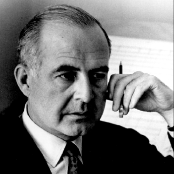
Of the ten Hermit Songs, the most poignant to me has always been “The Crucifixion.” (Listen once, and you’ll understand exactly why.)
Given that we are just over halfway through Lent, it seems appropriate to share it today. The text reads as follows:
At the cry of the first bird
They began to crucify thee, O Swan.
Never shall lament cease because of that.
It was like the parting of day from night.
Ah, sore was the suffering borne
By the body of Mary’s son.
But sorer still to Him was the grief
Which for His sake came upon His mother.
–Translation by Howard Mumford Jones
The mural and the fresco
Editor’s Note: Hovak Najarian, Art History Professor Emeritus from College of the Desert, will begin to help us understand the art that informs our faith and understand the faith that informs our art. In our lectionary on Sunday we read from Numbers 21:4-9. Michelangelo’s fresco the Brazen Serpent, from the ceiling of the Sistine Chapel, opens up this scene from the Exodus. Enjoy the art, enjoy this background to the art. Keep learning.
Become more familiar with often encountered terms:
Mural: A mural is a large work of art that is usually created directly on a large architectural surface. The murals on the ceiling of the Sistine Chapel often are referred to as “ceiling frescos” because the fresco process was used to paint them. In the same manner, critics often refer to an oil painting simply by its medium, “oil,” but all paintings are not oils and all murals are not frescos The terms mural and fresco are not synonymous. Mural identifies a work’s category (the type of work that it is) and fresco refers to its medium (the material that is used to make it).
Fresco: In the fresco process, an artist paints directly on wet plaster with water based pigments. Before painting begins, a plasterer covers an area of a wall (or ceiling) according to an estimate of how much the artist believes can be painted before the plaster sets. While the plaster is still moist, the pigment is absorbed into its surface and when it is set the pigment becomes an integral part of it. The pigment is not on the wall or ceiling, it is within its surface.
If a plastered area has set before it can be painted it is no longer capable of absorbing pigment and must be chipped off. A fresh area of plaster is spread on the wall before work continues. The removal of plaster is done along a contour of a figure in order that a seam is not apparent. This procedure is repeated until the mural is completed. It is a time consuming and messy process and is seldom used now unless a particular effect is desired. Michelangelo worked on the ceiling frescos of the Sistine Chapel from 1508 to 1512 AD.
Sistine Chapel: This chapel is named “Sistine” because it was Pope Sixtus who had it restored in the latter part of the fifteenth century.
______________
© 2012 Hovak Najarian
B Lent 4, Art for Readings for March 18, 2012

Expanding and refining our vision
Earlier this month I introduced you to Hovak Najarian who will expand our vision as we view Stan’s offerings in art each week. Not only will Hovak expand our vision but he will offer an experienced and educated eye to help us refine our vision as we enter the world of art. On the Third Sunday in Lent Stan directed our eyes to Rembrandt’s painting of Christ driving the Money-Changers out of the Temple. Hovak presents this additional information to help us into the art. ~dan
Comments on Rembrandt’s Christ Driving the Money-Changers from the Temple by Hovak Najarian
Rembrandt’s painting, Christ Driving the Money-Changers from the Temple was painted only a year after his earliest dated work but it already shows his interest and ability to create paintings of emotional depth. Like his teacher, Pieter Lastman, Rembrandt was particularly interested in faces and in “Money-Changers,” each face, figure, and gesture is a focal point of deep expression.
The art of the Italian Renaissance grew out of a rebirth of classicism (the art of the Greeks in particular). The Greek gods were sculpted with idealized human proportions and this idealization and refinement carried over into Renaissance painting and into the works commissioned by the Roman Catholic Church and wealthy families. The art of Protestant Northern Europe of the seventeenth century, however, did not reflect the classic ideal and their paintings were less likely to be of Mary and child, the crucifixion, or one of the saints. Their figures were more like everyday people, not idealized images.
Dutch businesses thrived during Rembrandts time and he earned a very good income from painting portraits of his patrons. Rembrandt also painted Biblical subjects of deep emotional content. There is realism in the faces of the people in “Money-Changers.” They are not men with classic profiles set in place for a lovely picture. The money-changers’ faces show furrowed brows, mouths agape, and surprised reactions as Jesus moves into action. Jesus is not centrally located in the scene as is often the case but rather he is at the upper left side as though he just entered the scene and caused the money-changers to scramble. He is not a handsome man with a sweet beatific expression. He looks tough, serious, and his eyes are focused and intense. The money-changers seem like real people in a real situation; the painting does not give the effect of a scene that is staged.
The facial expressions and sense of activity of the figures seen in Rembrandt’s earlier paintings gradually changed in focus as he became older. Instead of movement, his figures tend to remain still with a sense of heavy emotional weight and feeling concentrated in facial expressions.
______________
© 2012 Hovak Najarian
 Hear what the Spirit is saying