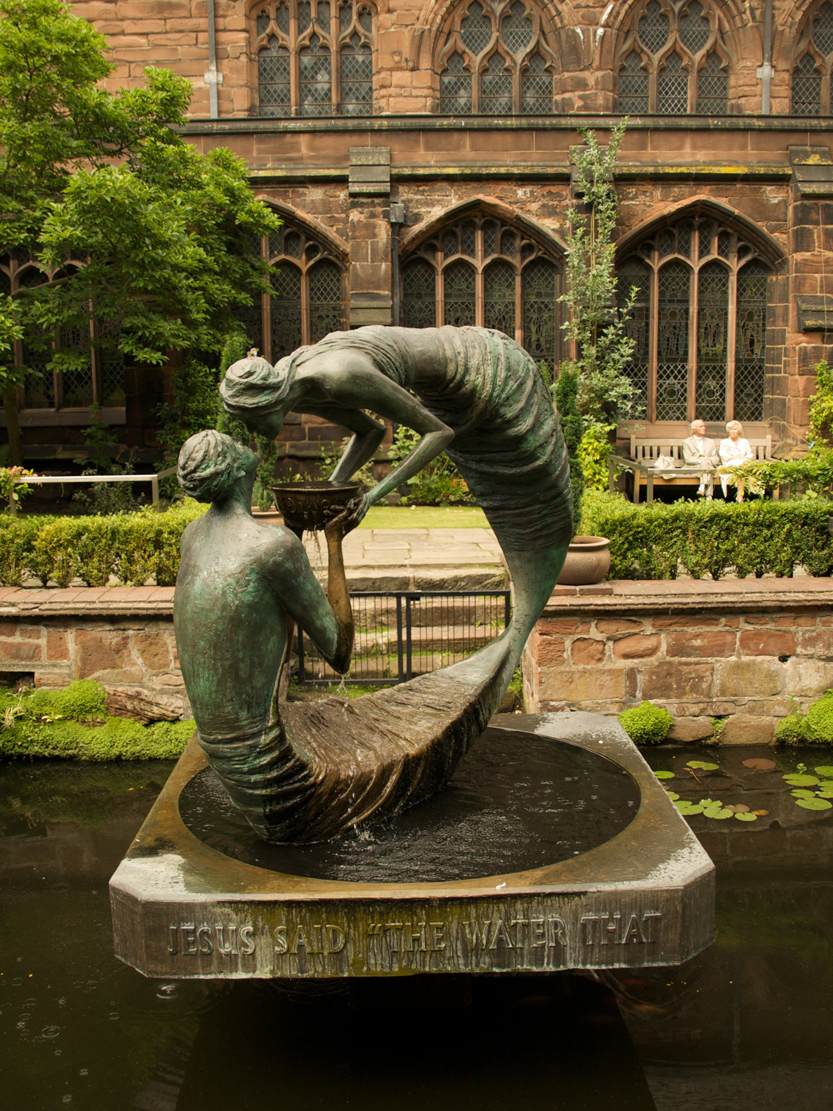
When Jesus passed through Samaria (John 4.3-42) he stopped at Jacob’s Well in Sychar, a well that the patriarch Jacob had left to his son Joseph. Sitting by the well to rest, the Lord asked a Samaritan woman who came to the well to draw water to give him a drink. The request violated cultural taboos — a man speaking privately with a woman, and a Jew speaking to a Samaritan — anticipating the theological insight of Galatians 3:28. Their brief encounter is one of notable theological depth in which Jesus makes the first of several important “I am” statements in John’s Gospel. The Samaritan woman had been married five times and was living with a man to whom she was not married. Whether this was through her own fault or due to unfortunate circumstances beyond her control the text does not indicate. However, she has the distinct honor of being the first person to whom Jesus reveals his Messianic title and the first person to preach the gospel that Jesus is the Christ.
While unnamed in the Johannine text, Orthodox Christian tradition has it that the woman was baptized by the Apostles on the first Pentecost and given the name Photini, “the enlightened one” (Svetlana, in the Russian Church). Celebrated in the Orthodox Church as an Evangelist, “Equal to the Apostles,” a significant hagiography developed around her. She, her sisters, and her children are said to have been cruelly tortured and martyred at the command of the emperor Nero.
Over the centuries many churches have been built at the site of Jacob’s Well, where Jesus held discourse with the Samaritan woman; the present church building within Bir Ya’qub Monastery was built in 1893 by order of the Greek Orthodox Patriarch of Jerusalem and consecrated to St. Photini.
O Almighty God, whose most blessed Son revealed to the Samaritan woman that He is indeed the Christ, the Savior of the World; grant us to drink of the well that springs up to everlasting life that we may worship you in spirit and in truth through your Son, Jesus Christ our Lord. Amen.
As fighting and violence escalate in Ukraine Ashley McKinless and James Martin, SJ, explore our inclination to pray, or not, in this moment. What is the point to utter prayers in the face of such an event? The essay is a thoughtful and honest exploration of prayer as a response to current events and I commend it to you: Praying for peace in Ukraine (America Magazine website)
Most of the symbols of the 12 Apostles include a depiction of the instrument of their martyrdom.
Matthias is named only once in the Acts of the Apostles (Acts 1:21-26). The rest of his story is obscure and sometimes fanciful in the Christian tradition. Nonetheless, it is important to note that he apparently fit Peter’s requirements that to become an apostle with the remaining 11 the man should “have accompanied us (the apostles) during all the time that the Lord Jesus went in and out among us, beginning from the baptism of John until the day when he was taken up from us—one of these men must become with us a witness to his resurrection” Acts 1:21-22A
After acknowledging the hand of God in selecting and blessing Matthias to be an apostle, we ask that we—the people of God—may always be guided and governed by faithful and true pastors.
What role do we play in supporting and encouraging and caring for the faithful and true pastors by whom we are guided and governed as God answers our prayer?
The Collect for the Commemoration
Almighty God, who in the place of Judas chose your faithful servant Matthias to be numbered among the Twelve: Grant that your Church, being delivered from false apostles, may always be guided and governed by faithful and true pastors; through Jesus Christ our Lord, who lives and reigns with you, in the unity of the Holy Spirit, one God, now and for ever. Amen.
Learn more
In the nine days of waiting between Jesus’ Ascension and the Day of Pentecost, the disciples remained together in prayer. During this time, Peter reminded them that the defection and death of Judas had left the fellowship of the Twelve with a vacancy. The Acts of the Apostles records Peter’s proposal that “one of the men who have accompanied us during all the time that the Lord Jesus went in and out among us, beginning from the baptism of John until the day when he was taken up from us—one of these men must become with us a witness to his resurrection” (Acts 1:21–22). Two men were nominated, Joseph called Barsabbas who was surnamed Justus, and Matthias. After prayer, the disciples cast lots, and the lot fell to Matthias, who was then enrolled with the eleven. (See Acts 1:21-26)
Scripture does not relate anything further about Matthias, but gives him as an example to Christians of one whose faithful companionship with Jesus qualifies him to be a suitable witness to the resurrection, and whose service is unheralded and unsung.
There are, however, several early Christian accounts of his mission and ministry, such as the second century text The Acts of Andrew and Matthias in Cannibal City. According to this account, immediately after the selection of Matthias, the apostles cast lots to determine which of them would take responsibility for which part of the world, and the unlucky Matthias was dispatched to a city of cannibals! Although an unabashedly fictionalized account, it is nevertheless an inspiring tale that shows Matthias being dealt the worst possible lot, and yet nevertheless responding to his call with equanimity, competence, and grace, which are the same qualities we see reflected in the canonical account that is given by Scripture.
Saint Matthias The Apostle in Lesser Feasts and Fasts, Revision 2018
Lots in the Ancient World
Ancient peoples used lot-casting as a form of cleromancy—a type of divination in which the random outcome was believed to reflect divine will. Ancients commonly used small stones labeled to reflect the possible outcomes of the decision (Lindblom, “Lot-casting,” 168). The Bible contains no description of the specific procedure for casting lots, undoubtedly due to the commonplace nature of the practice. Based on etymology, Kitz suggests the Israelites likely placed marked stones into a container, which was then shaken in such a way as to “cast” out a deciding stone (Kitz, “Terminology,” 207–14). Hittite and Akkadian texts also indicate that the casting of stones was used to determine an oracular answer to a series of questions (Kitz, “Urim and Thumim,” 401–10).
Usage in the New Testament
The New Testament contains few references to the use of lots. However, the attested uses reflect the Hebrew mindset regarding divine involvement with the decision:
Zechariah was chosen by lot for a rotation in the temple service (Luke 1:9)
Peter used lots and prayer to determine a replacement for Judas (Acts 1:15–26).
Soldiers cast lots to divide Jesus’ garments after His crucifixion (John 19:24). This is perhaps the most secular use of lots in the Bible.
Source: Rob Fleenor, “Lots,” in The Lexham Bible Dictionary, ed. John D. Barry et al. (Bellingham, WA: Lexham Press, 2016).
Matthias (Great Cloud of Witnesses website curated by The Rev. Ken Howard)
In the Collect for this Commemoration, we praise God for giving us a servant who is described as holy and gentle. And we praise God for giving this holy and gentle servant “boldness to confess Jesus Christ as King and Savior, and steadfastness to die for his faith.”
We ask for the grace to follow the example of Polycarp which will include sharing the cup of Christ (sorrow and suffering) and rising to eternal life. The prayer invites us to examine our actions (do they reveal us as one who serves, one who is seeking holiness, one who is gentle in a not-so-gentle world) and our trust in God no matter the circumstances (for there are many ways to “share the cup of Christ” short of martyrdom). What do you hear the Spirit saying to you?
The Collect for the Commemoration
O God, the maker of heaven and earth, you gave your venerable servant, the holy and gentle Polycarp, boldness to confess Jesus Christ as King and Savior, and steadfastness to die for his faith: Give us grace, following his example, to share the cup of Christ and rise to eternal life; through Jesus Christ our Lord, who lives and reigns with you and the Holy Spirit, one God, now and for ever. Amen.
Learn more
Polycarp was one of the leaders of the Church who carried on the tradition of the apostles through the troubled period of Gnostic heresies in the second century. According to Irenaeus, who had known him in his early youth, Polycarp was a pupil of John, “the disciple of the Lord,” and had been appointed a bishop by “apostles in Asia.”
[…] Polycarp was burned at the stake. Before his ordeal, he is reported to have looked up to heaven, and to have prayed: “Lord God Almighty, Father of your beloved and blessed child Jesus Christ, through whom we have received knowledge of you, God of angels and hosts and all creation, and of the whole race of the upright who live in your presence, I bless you that you have thought me worthy of this day and hour, to be numbered among the martyrs and share in the cup of Christ, for resurrection to eternal life, for soul and body in the incorruptibility of the Holy Spirit. Among them may I be accepted before you today, as a rich and acceptable sacrifice just as you, the faithful and true God, have prepared and foreshown and brought about. For this reason and for all things I praise you, I bless you, I glorify you, through the eternal heavenly high priest Jesus Christ, your beloved child, through whom be glory to you, with him and the Holy Spirit, now and for the ages to come. Amen.”
Joseph was born at a time when his father, Jacob, was old and he became the favorite son. This favoritism caused resentment among his brothers. Negative feelings resulted also from a dream Joseph had that was interpreted to mean someday his brothers would bow down to him. Joseph was seventeen years old when he went to his brothers as they were tending sheep. When his brothers saw him coming they plotted to kill him but then instead, sold him as a slave to a passing merchant who was going to Egypt. In Egypt, Joseph interpreted Pharaoh’s dream which revealed there would be seven years of abundance followed by seven years of famine. With Joseph’s guidance, grain was stored during the time of abundance and Egypt was well prepared. When famine was experienced in Canaan, Joseph’s father sent his brothers to Egypt to purchase food. Unbeknownst to them, Joseph in the ensuing years had become a high Egyptian official and he was the one they would have to meet.
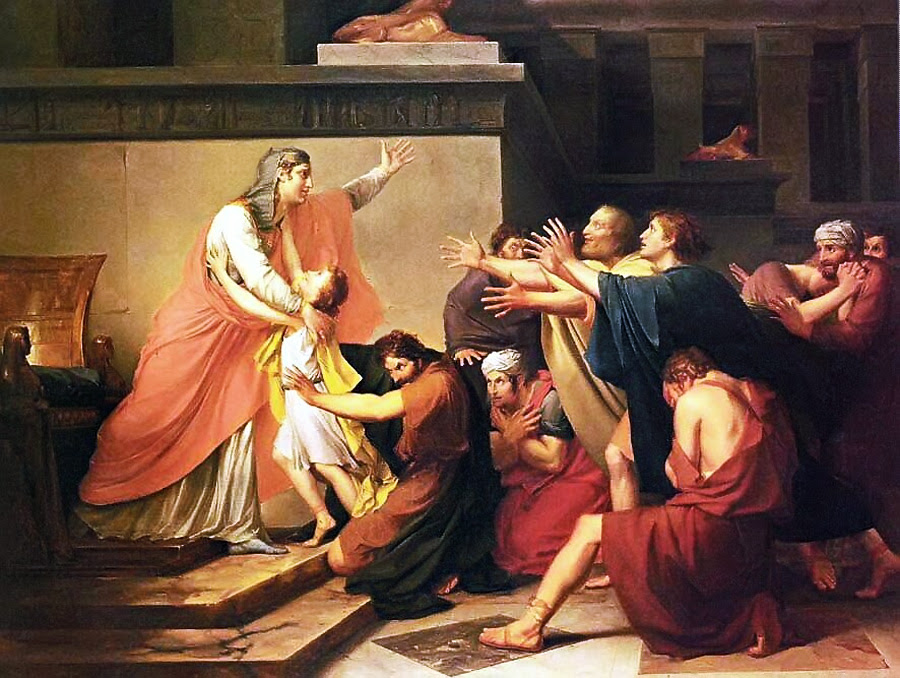
Francois Gerard’s painting, Joseph Recognized by Brothers, depicts the moment Joseph revealed his identity to his brothers. The brothers are shown displaying a range of emotions; some are kneeling and in body language seem to be exhibiting guilt and remorse for what they did. In contrast to this, two of the brothers and Joseph are reaching out to each other in joy. The brothers at the far right are staying back and holding each other. Perhaps they are fearful of what Joseph might do. The young boy reaching and looking up at Joseph is likely a nephew who came with his father. Joseph places his hand gently on the child’s shoulder.
In 1663, France initiated the Prix de Rome which gave artists (and later, musicians and architects) an opportunity to study in Italy. The purpose of this award was to put promising artists in contact with Roman culture and the masters of the Italian Renaissance. One outcome of this was a trend toward classicism in French art.
In the late 1700s after years of turmoil, the French Revolution overthrew King Louis XVI and Napoleon Bonaparte took charge ultimately as 1st Consul. Classicism in art suited Napoleon perfectly and he appointed Jacques Louis David, an avid classicist, to be the head of the French Academy of art. David’s art promoted what Napoleon favored; discipline, honor, sacrifice strength of character, and devotion of one’s efforts to the state.
Though classicism was sanctioned by the state, the concept of romanticism was always present in art and Napoleon’s campaign in Egypt (1798-1801) generated great interest in Egyptology. It set off fashion fads in both France and England and piqued the interest of painters as well. Francois Gerard’s Joseph Recognized by Brothers was painted during the time of Napoleon’s Egyptian military venture.
Gerard studied under David and elements of classicism in the painting of Joseph and his brothers are apparent in their robes. Gerard’s nod to this scene’s Egyptian location is brought in by Joseph’s headdress and the sphinxes on the arms of Joseph’s chair and the background building. Were it not for these details and its title, this painting might be taken for an illustration of a Greek tragedy.
Winning the Prize of Rome was coveted, difficult, and highly competitive. Gerard’s teacher Jacques Louis David was rejected three times and considered suicide before receiving the award on his fourth attempt. [In later years Eduard Degas and Maurice Ravel were rejected.] Gerard, too, was rejected but because of his mother’s death, he was unable to complete a painting to submit to the jury the following year. After that, he fell into poverty but recovered to gain success and acclaim through portraiture. Napoleon commissioned paintings from him and then after he fell from power, Gerard became the court painter of Louis XVIII.
Joseph an entry in the Encyclopedia of the Bible (on Bible Gateway). “The contents of this encyclopedia derive from a previously published work known as The Zondervan Pictorial Encyclopedia of the Bible, 5 Volume Set.”
The stories of Genesis 12-50 a short video presentation (~8 minutes) by the BibleProject ( around 5:20 into the video the story of Joseph is presented).
Put your trust in the Lord and do good; dwell in the land and feed on its riches. –Psalm 37:3
Welcome. Our handout features the readings for the Seventh Sunday after the Epiphany (Feb. 20 in 2022) in Year C of our Lectionary.
Forgiveness is a prominent theme of the Gospel passage this week. I invite you to explore The Work of Forgiveness a Lectionary Essay by Debie Thomas on the Journey with Jesus webzine.
If forgiveness isn’t denial or a detour, if forgiveness isn’t quick — then what is it? What is Jesus asking of us when he invites us to love, bless, pray, give, lend, do good, withhold judgment, extend mercy, and turn the other cheek?
Check out, too, what our Church remembers about Saint Matthias The Apostle and Photini, The Samaritan Woman (at the Well). She is widely honored in the Orthodox traditions and our Episcopal Church joins them in commemorating her. Through this week, read the stories of others who studied, prayed and worked for God’s glory. Let their stories invite you to do the same.
Pay attention. Keep learning.
View or download the Handout for Epiphany +7C including short biographies for Saint Matthias The Apostle and Photini, The Samaritan Woman (at the Well).
If forgiveness isn’t denial or a detour, if forgiveness isn’t quick — then what is it? What is Jesus asking of us when he invites us to love, bless, pray, give, lend, do good, withhold judgment, extend mercy, and turn the other cheek?
A timely meditation by Debie Thomas, one of my favorite teachers, on a favorite website, Journey with Jesus. Here, Debie examines Jesus’ teaching we will hear on Sunday, February 20, 2022, from Luke 6:27-38.
She pays particular attention to “the rising tide of rage and meanness in our Covid-weary culture” and confesses that the readings appointed for Sunday cause her some discomfort. Why? She answers: “Because the readings are about forgiveness. They are about the work of forgiveness, and the challenges they pose to our ‘shove or be shoved’ culture are daunting.”
I encourage you to read her essay. I encourage you to take to heart her exploration of Jesus’ teaching and, as you follow Jesus, please engage in the work of forgiveness.
In the Collect for this Commemoration, we remember Martin Luther as one raised up by God to “reform and renew [God’s] Church in the light of [God’s] word.”
In your life who embodies these qualities today? What contemporary of yours do you see as raised up by God to effect reformation and renewal in the Church in the light of God’s word? I pray there is such a person for you. I pray that you may be the one to embody these things for others.
The Collect for the Commemoration
O God, our refuge and our strength: You raised up your servant Martin Luther to reform and renew your Church in the light of your word. Defend and purify the Church in our own day and grant that, through faith, we may boldly proclaim the riches of your grace which you have made known in Jesus Christ our Savior, who with you and the Holy Spirit, lives and reigns, one God, now and for ever. Amen.
… grant that, through faith, we may boldly proclaim the riches of your grace which you have made known in Jesus Christ our Savior
Collect for the Commemoration of Martin Luther
Learn more
Martin Luther was born November 10, 1483. His intellectual abilities were evident early, and his father planned a career for him in law. Luther’s real interest lay elsewhere, however, and in 1505 he entered the local Augustinian monastery. He was ordained a priest April 3, 1507.
In October 1512 Luther received his doctorate in theology, and shortly afterward he was installed as a professor of biblical studies at the University of Wittenberg. … On the eve of All Saints’ Day, October 31, 1517, he posted on the door of the castle church in Wittenberg the notice of an academic debate on indulgences, listing 95 theses for discussion. As the effects of the theses became evident, the Pope called upon the Augustinian order to discipline their member. After a series of meetings, political maneuvers, and attempts at reconciliation, Luther, at a meeting with the papal legate in 1518, refused to recant.
Luther was excommunicated on January 3, 1521. [… In safety at Wartburg] Luther translated the New Testament into German and began the translation of the Old Testament. He then turned his attention to the organization of worship and education. He introduced congregational singing of hymns, composing many himself, and issued model orders of services. He published his large and small catechisms for instruction in the faith. During the years from 1522 to his death, Luther wrote a prodigious quantity of books, letters, sermons and tracts. Luther died on February 18, 1546.
Remembering the martyrdom of Janani Luwum—a 20th-century martyr no less—do you hear what we ask of God? “Grant us” we pray “to be so inspired by his witness that we make no peace with oppression but live as those who are sealed with the cross of Christ, who died and rose again….”
A bold intercession for ourselves and all who follow the Way of Love. May we have the heart to listen to God’s response and the courage to accept God’s grace to live as one “sealed with the cross of Christ” and confident that we, too, shall not be conquered by death but live with Christ who died and rose again.
The Collect for the Commemoration
O God, whose Son the Good Shepherd laid down his life for the sheep: We give you thanks for your faithful shepherd Janani Luwum, who after his Savior’s example, gave up his life for the people of Uganda. Grant us to be so inspired by his witness that we make no peace with oppression, but live as those who are sealed with the cross of Christ, who died and rose again, and now lives and reigns with you and the Holy Spirit, one God, for ever and ever. Amen.
Learn more
In 1969 Luwum became Bishop of Northern Uganda, where he was a faithful visitor to his parishes as well as a growing influence at international gatherings of the Anglican Communion. In 1974 he was elected Archbishop of the Church of Uganda, Rwanda, Burundi, and Boga-Zaire.
Luwum’s new position brought him into direct contact and eventual confrontation with the Ugandan military dictator, Idi Amin, as the Archbishop sought to protect his people from the brutality of Amin’s regime. In August of 1976 Makerere University was sacked by government troops. With Archbishop Luwum as their chair, the Christian leaders of the country drafted a strong memorandum of protest against officially sanctioned rape and murder.
In early February 1977 the Archbishop’s residence was searched for arms by government security forces. On February 16 President Amin summoned Luwum to his palace. He went there, accompanied by the other Anglican bishops and by the Roman Catholic cardinal archbishop and a senior leader of the Muslim community. After being accused of complicity in a plot to murder the President, most of the clerics were allowed to leave. However, Archbishop Luwum was ordered to remain behind. As his companions departed, Luwum said, “They are going to kill me. I am not afraid.” He was never seen alive again. The following day the government announced that he had been killed in an automobile accident while resisting arrest. Only after some weeks had passed was his bullet-riddled body released to his family for burial.
In prayer to “Mighty God” we recognize and confess that Bishop Quintard “persevered to reconcile the divisions among the people of his time.” We ask that today our Church (the People of God) “may ever be one, that it may be a refuge for all.” It will take the effort of each one to make this so. Today, what will you do to reconcile divisions and make the People of God a refuge for all?
The Collect for the Commemoration
Mighty God, we bless your Name for the example of your bishop Charles Todd Quintard, who persevered to reconcile the divisions among the people of his time: Grant, we pray, that your Church may ever be one, that it may be a refuge for all, for the honor of your Name; through Jesus Christ, who with you and the Holy Spirit lives and reigns, one God, for ever and ever. Amen. Amen.
Learn more
Charles Todd Quintard was the second bishop of the Diocese of Tennessee and the first Vice Chancellor of The University of the South at Sewanee.
Quintard was born in 1824 in Stamford, Connecticut. In 1847 he received the degree of Doctor of Medicine from the Medical College of New York University and worked at New York’s Bellevue Hospital. After a brief episode of practicing medicine in Athens, Georgia, Quintard became the professor of anatomy and physiology at Memphis Medical College and an editor of the Memphis Medical Reporter. In 1848, Quintard married Katherine Isabella Hand, a native of Roswell, Georgia, and together they were the parents of three children.
[…] During the Civil War, Quintard played dual roles in the Confederate Army as both chaplain and surgeon. Following the war, he was instrumental in bringing together the previously divided factions and extending the reach of the Episcopal Church, particularly among African Americans.
Bishop Quintard was a strong advocate of education at every level and played a major role in the establishment of schools. Perhaps his greatest accomplishment was the rebuilding of the University of the South at Sewanee after its destruction during the Civil War. He made several successful trips to England to raise the funds to secure the future of the University. From February 1867 to July 1872, Quintard served as the reconstituted University’s first Vice Chancellor. Quintard believed that a great Episcopal university was essential, not just to the church in Tennessee and the southeast, but to the whole church, and thus devoted much of his ministry to Sewanee.






 Hear what the Spirit is saying