Why there is no healing without grief

william-adolphe_bouguereau_281825-190529_-_the_day_of_the_dead_28185929
“The Day of the Dead” William-Adolphe Bouguereau [Public domain], via Wikimedia Commons
In this article from The Conversation, author Timothy Beal comments on our contemporary American scene while hearing, and calling attention to, the Spirit in the prophets of the Hebrew scriptures. As the title suggests the scriptures point to healing following grieving. ~Fr. Dan

Timothy Beal, Case Western Reserve University

For many women, people of color, LGBTQ people, Muslims and immigrants, the victory of Donald Trump seems to have endorsed discrimination against them. Acts of hatred against minorities are surfacing even more brazenly.

College campuses are reporting increasing numbers of incidents of election-related harassment and intimidation. Three days after the election, I saw a “Black Lives Matter” banner on a church wall in Denver splattered with bright red paint.

Many of us feel tremendous grief over what appears to be the end of a certain idea of American democracy. Amidst such pain and loss, many are also desperate for healing. Politicians on all sides are declaring, as Trump himself did on Nov. 9, that “it is time for America to bind the wounds of division.”

The desire to begin healing is certainly understandable. But before we can even begin to hope for healing, we need to grieve. As a scholar and teacher, I explore the many fascinating ways in which biblical images, words and even the idea of the Bible help people make meaning in their lives.

To be sure, there is a lot in the Bible about healing. But there is at least as much about grieving. The biblical tradition emphasizes the importance of grieving before moving toward healing.

To grieve is to embrace the reality of pain and loss.

The wounds are real

For many, following the elections, faith in the idea of American democracy has died. Cultural historian Neil Gabler’s “Farewell, America,” published two days after the election, expresses powerfully this sense of the end of faith in America:

“America died on Nov. 8, 2016, not with a bang or a whimper, but at its own hand via electoral suicide…Whatever place we now live in is not the same place it was on Nov. 7. No matter how the rest of the world looked at us on Nov. 7, they will now look at us differently.”

Indeed, irrespective of who got elected, the presidential race itself exposed mortal wounds on our body politic. We are not who we thought we were.

As the way to healing, pastors and religious leaders, including Anne Graham Lotz, daughter of evangelists Billy and Ruth Graham, are calling for prayer and repentance:

“When God’s people will pray with a humble heart, repenting of our sins, then God promises He will hear our prayer; He will forgive our sin and the third element is that He will heal our land.”

What do our traditions tell us?

Healing is not possible without grieving. The biblical tradition offers an invitation to sit with sadness before reaching for hope and healing. It does not simply allow for grief – it privileges it.

It dwells uncomfortably long in the valleys of loss and despair, refusing to ascend too quickly onto horizons of hope.

The Hebrew Scriptures, in fact, possess a rich vocabulary of grief. Behind the words “grief” and “grieve,” as I found in my research, there are 13 different Hebrew words with connotations ranging from physical injury, to sickness, to mourning, to rage, to agitation, to sighing, to tottering unsteadily to and fro. The most common expressions involve a mix of emotional and physical pain in the face of loss.

Angel of Grief monument in the Hill family plot in Glenwood Cemetery in Houston, Texas.
Mike Schaffner, CC BY-NC-ND

This privileging of grief over and before any hope of healing is powerfully expressed in the words of the Hebrew biblical prophets. As theologian Walter Brueggemann shows in his book “Reality, Grief, Hope,” the biblical prophets were not, as we often assume, predictors of the future.

Rather they were poets who, like poets today, offered alternative ways of seeing things – that is, to the way the empire (in their case ancient Israel or Judah) wanted people to see things. The prophet confronted ancient Israel’s imperial ideology of special blessing and national exceptionalism with the realities of exploitation and violence upon which its prosperity was gotten.

Addressing an audience that was in total denial that there were any serious problems in their society, the prophet gave voice to the realities of injustice, and grieved the pain and loss that was the result. They confronted the people’s denial with grief.

The prophetic imagination

Consider these words from the prophet Amos, who addressed the prosperous of northern Israel during the eighth century B.C.:

   Alas for those who are at ease in Zion, 
   and for those who feel secure on Mount Samaria, 
   the notables of the first of the nations ...
   Alas for those who lie on beds of ivory,
   and lounge on their couches ...
   but are not grieved over the ruin of Joseph!
   Therefore they shall now be the first to go into exile,
   and the revelry of the loungers shall pass away.

Simultaneously pronouncing judgment for their exploitation of the poor and grief over their imminent downfall, the prophet cries out in horror for those who recline in denial of their ill-gotten prosperity and “are not grieved” (from the Hebrew word “chalah,” “made sick”) at the ruin all around.

Though they are guilty, Amos nonetheless laments that they “shall now be the first to go into exile” as a result. The prophet pronounces judgment from the inside, inviting “us” to look at ourselves, to stare at the wounds, to live into the pain, not as a path to healing but as reality in and of itself.

The crux of this “prophetic imagination” is grief. Then, and only then, is it even possible for the prophet to confront the despair of the empire in ruins with hope for the possibility of healing and restoration.

Grief as activism

I am sympathetic with those who feel driven to do something, indeed to resist despair and renew the struggle for justice. As the black feminist lawyer Florynce Kennedy famously said,

“Don’t agonize. Organize.”

A ‘Black Lives Matter’ banner on a church wall in Denver splattered with bright red paint.
Timothy Beal, CC BY

But what if grief is a kind of activism? What if one of the most subversive acts right now is to give voice to our grief? To refuse to “move on”? Such grief denies denial its power to look away in desperate pursuit of healing. Just as there is no peace without justice, there is no healing without grief.

The day of Donald Trump’s election was also the anniversary of both Kristallnacht – the pogrom in 1938, when Nazi soldiers and German citizens attacked and killed many Jews and destroyed Jewish businesses, schools, and hospitals – and the fall of the Berlin Wall in 1989.

This coincidence reminds us that we together have the capacity for both atrocious horror and miraculous liberation. Even now. The difference may lie as much in how we grieve as in how we heal.

The Conversation

Timothy Beal, Professor of Religion and Chair of the Department of Religious Studies, Case Western Reserve University

This article was originally published on The Conversation. Read the original article.

“Welcome the Needy”

VATICAN CITY (RNS) Pope Francis called for greater compassion for refugees and marginalized people less than a week after President Trump ordered a temporary immigration ban from seven predominantly Muslim countries.

In a video of the pontiff’s prayer intentions for February, the pope does not specifically refer to the president or his policies but emphasizes his concern about large numbers of people who he says are being marginalized and forgotten on the fringes of society.

“Don’t abandon them,” the pope says in the video, which features men and women comforting a homeless man on the street.

“Pray with me for all those who are afflicted, especially the poor, refugees and marginalized, so they may be welcomed and find comfort in our communities.”

Read the entire post

Mercy

… for I was hungry and you gave me food, I was thirsty and you gave me something to drink, I was a stranger and you welcomed me, I was naked and you gave me clothing, I was sick and you took care of me, I was in prison and you visited me.…  Matthew 25:35-36

Caravaggio's Seven Acts of Mercy

A Caravaggio masterpiece on mercy calls to Pope Francis across the centuries

Begin quote

(RNS) If Pope Francis wanted a single image to illustrate the special Year of Mercy that is the current focus of his ministry and, indeed, the theme at the heart of his pontificate, he could do no better than choosing an underappreciated masterpiece by the thrilling Italian artist known as Caravaggio.

In fact, the 400-year-old canvas, an altarpiece in a Naples church titled “The Seven Acts of Mercy,” may represent the perfect combination of the man — or, rather, two men — and the moment: a brilliant painter with a scurrilous reputation who was striving for redemption, and a popular pontiff struggling to make the church more welcoming to outcasts.end-quote-black-71by52

Why does this painting call across the centuries?

I invite you to read the entire essay posted by Religion News Service on March 30, 2016 and learn more about Caravaggio, this remarkable painting, the theme of mercy, and how this painting (and Caravaggio himself) calls us to act with mercy and live with hope. ~Fr. Dan

Keep learning

We are all Syrian. We are all Muslim.

This was an email letter sent to members of the Episcopal Diocese of San Diego on January 29, 2017 and posted the same day to the Diocesan Facebook Page


Logo for Episcopal Diocese of San DiegoDear Sisters and Brothers in Christ,
 

The last nine days have been a disquieting and dizzying display of presidential action in Mr. Trump’s first days in office. It is difficult for us to find focus as he occupies the media space railing about the size of the inauguration crowd and making unsubstantiated claims regarding voter fraud. From a public policy perspective, there is much to worry about: news blackouts from federal departments, possible trade wars, and comments about illegal torture to name a few.


However, Friday’s executive order to halt immigration from seven Muslim countries, including the suspension of refugees from war-ravaged Syria, is an affront to our sense of fairness and equity. Indeed, the president even stated that our nation would give preferential treatment to Christians over Muslims, thereby invoking a religious standard for entry that is anathema to our national creed. Fanning the fears of 9/11 and ISIS, the president wants us to believe that we will be safer because we change who we are as a people who welcome the immigrant and the refugee. But we are the nation of the Marshall Plan, Famine Relief and Tsunami recovery. Our dark chapters of the last century include Franklin Roosevelt’s executive order 9066, which interred Japanese Americans because of their ethnicity. This is too eerily familiar. Surely we have learned from our past and discovered the better angels of our nature.

Please read all of the Bishop’s letter

After presidential power shifts, Episcopalians ask: How should we pray?

Book of Common Prayer page 359

Episcopal News Service (ENS) posted “After presidential power shifts, Episcopalians ask: How should we pray” on January 23, 2017. It had the subtitle “Debating purpose, intention of praying for Donald Trump in church.” As internet posts go, this is a long post. It presents reasoned answers for both “yes” and “no.” What follows are a few quotes from the article. I encourage you to read the entire article here.
~Fr. Dan

Read quotes from the article

Welcome to the Jesus Movement

Evangelism, Episcopal Church InitiativeThis is the Bulletin Insert for Sunday, January 29, 2017 (Epiphany 4A). Each week the Episcopal Church posts a Bulletin Insert online for sharing in all the churches.

The insert posted here announces Episcopal Church Revival Meetings in 2017-18. Imagine that! Read on. ~Fr. Dan

Begin quoteThe Episcopal Church is working with diocesan teams to organize a series of Episcopal Revivals in 2017 and 2018, six major events that promise to stir and renew hearts for Jesus, to equip Episcopalians as evangelists, and to welcome people who aren’t part of a church to join the Jesus Movement.

“I love the surprised response when people hear we’re organizing Episcopal Revivals,” said the Rev. Canon Stephanie Spellers, the presiding bishop’s canon for evangelism, reconciliation and stewardship of creation. “Why wouldn’t we? A revival is a movement of the Spirit among the people of God, a concrete sign that we want to share God’s love out loud with each other and with new people. That sounds like the Jesus Movement.”

Read on, there’s more

Collect: Conversion of Saint Paul the Apostle (Jan 25)

I just posted this to “Wind in the Pines,” our companion blog on WordPress. May we always be ready, like Saul/Paul, to listen for God … ~Fr. Dan

Daniel Rondeau's avatarWind in the Pines

Today, because many of you will not have access to this material, I quote in its entirety the description of this commemoration in Lesser Feasts and Fasts 2006. ~Fr. Dan

Begin quote

Paul, or Saul as he was known until he became a Christian, was a Roman citizen, born at Tarsus, in present-day Turkey. He was brought up as an orthodox Jew, studying in Jerusalem for a time under Gamaliel, the most famous rabbi of the day. Describing himself, he said, “I am an Israelite, a descendant of Abraham, a member of the tribe of Benjamin” (Romans 11:1).

A few years after the death of Jesus, Saul came in contact with the new Christian movement, and became one of the most fanatical of those who were determined to stamp out this “dangerous heresy.” Saul witnessed the stoning of Stephen. He was on the way to Damascus to lead in…

View original post 367 more words

First Woman Priest in the Anglican Communion: Li Tim-Oi’s Story

We first posted this on 24 Jan. 2012. We share it once again and invite you to view the Interactive timeline of the history of women’s ordination posted by the Episcopal Church (Digital Network) ~Fr. Dan

Daniel Rondeau's avatarHear what the Spirit is saying


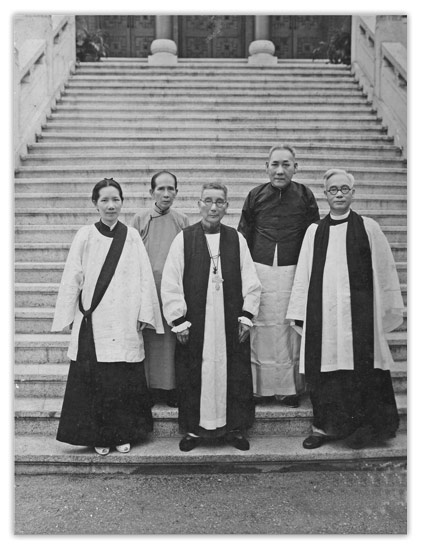
Li Tim-Oi, her mother, Bishop Mok, her father, Archdeacon Lee Kow Yan after her ordination as Deacon by Bishop R 0 Hall at St John’s Cathedral HK. Ascension Day 22 May 1941
Photo from Li Tim-Oi Story


Today (Jan, 24) the Episcopal Church commemorates Florence Li Tim-Oi: the first woman priest in the Anglican Communion (ordained on 25 January 1944). I encourage you to read her story:

At her birth in Hong Kong on 5 May 1907 Li Tim-Oi’s father called her “Much Beloved” because he valued her as a daughter even if others prefered sons.

Read the rest of her story: Litim-Oi | Li Tim-Oi’s Story.

The Li Tim-Oi Foundation was established in 1994. The Foundation funds It takes ONE woman: “It takes ONE woman sums up the story and aim of the LI TIM-OI FOUNDATION – founded in memory of the first Anglican woman priest…

View original post 42 more words

Many Sightings of Hope

This essay, by Martin E. Marty, was originally posted on January 2, 2017 on “Sightings: Religion in Public Life” by The Martin Marty Center for the Advanced Study of Religion

For more than a year I engaged in the visual and oral analog to “fasting.” Fasters discipline themselves not to eat. I chose not to comment on the election campaigns. A digital word-search will find no mention in 50 Monday Sightings of any presidential candidate or party. The choice was an implicit protest against or retreat from the grossness, waste, distortion, and distraction in what elections have become. Now the bad year of 2016 is past, and it is time to join everyone else in the sighting-and-commentary professions and to re-emerge actively.

What struck me all year was the sense and sight of extreme despair on many fronts, accompanied by some new notices of the meaning and potential of hope. The headline of a column by fellow Chicagoan Neil Steinberg was “The Necessity of Hope.” The column began with a quotation from Michelle Obama: “Now we’re feeling what not having hope feels like.” It ended: “Hopelessness is not an option. Hope is a tool, a hammer. Never let it go. You’re going to need it.”

This paralleled the long holiday essay in The Economist on “The agony of hope,” which focused on President Obama, who had written at book length on “hope,” and who kept embodying and exemplifying it against all odds, as the story recalled. The article traces the President’s career and evidences of his outlook through his bad recent year, in which he had no choice but to act and speak. Conclusion: he had to do the best he could. “Sometimes it was all he could do. The possibilities seem shrunken. After its collision with history, so might hope itself.”

You’ll want to keep reading…

Calling Disciples | Art for A Epiphany 3

This was originally posted in 2014. Enjoy it again.

stanleyhirsch's avatarHear what the Spirit is saying

Matthew 4:18,21 As he walked by the Sea of Galilee, he saw two brothers, Simon, who is called Peter, and Andrew his brother… As he went from there, he saw two other brothers, James son of Zebedee and his brother John…

Commentary by Hovak Najarian

Calling Disciples, mixed media, 2001, He Qi (b. 20th Century)

During the latter part of the nineteenth century, the industrial revolution with its engineering and technological marvels was becoming part of life and there was a sense the world had entered a modern age. Being “modern” became a self-congratulatory state of mind that continued well beyond the first half of the twentieth century. Around 1970, it was proclaimed the term “modern” no longer applied to how we perceived ourselves. We were in the “Post Modern” age. Today, “Modernism” is a designated time period that started in the mid 1930s and continued to the mid 1960s…

View original post 382 more words


