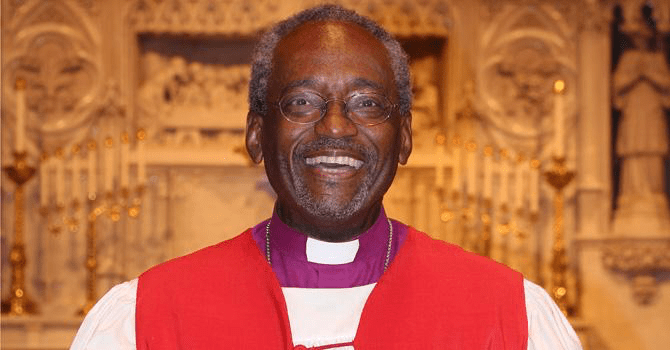
Statement of Episcopal Church Presiding Bishop Curry regarding prayers for the President

Presiding Bishop Michael Curry

The following is a statement from Presiding Bishop and Primate Michael B. Curry via the Public Affairs Office of the Episcopal Church

 

Begin quoteThis past week, Barack H. Obama, the 44th President of the United States, in the tradition of Presidents dating back to George Washington, gave his farewell address to the nation. Next week Donald J. Trump, in the same tradition of this country, will take the oath of office and be inaugurated as the 45th President.

We recognize that this election has been contentious, and the Episcopal Church, like our nation, has expressed a diversity of views, some of which have been born in deep pain.

There has been much discussion, and some controversy, about the appropriateness of the Washington National Cathedral hosting the Inaugural Prayer Service this year, and of church choirs singing at inaugural events.

Underneath the variety of questions and concerns are some basic Christian questions about prayer: when I pray for our leaders, why am I doing so?  Should I pray for a leader I disagree with? When I pray what do I think I am accomplishing?

On one level these questions seem inconsequential and innocuous. But real prayer is not innocuous. It is powerful. That question can become poignant and even painful as it is for many in this moment, given that some of the values that many of us heard expressed over the past year have seemed to be in contradiction to deeply-held Christian convictions of love, compassion, and human dignity.

So, should we pray for the President?

– Please keep reading!

Archbishop of Canterbury to express remorse over Reformation violence | Religion News Service

CANTERBURY, England (RNS) The archbishop of Canterbury, Justin Welby, is expected to issue a statement this week apologizing for the violence that followed the Protestant Reformation 500 years ago.

The statement, according to news accounts, will express remorse that the (Protestant) Church of England carried out so many acts of violence — including burning Roman Catholics at the stake.

It will also urge believers to ask for forgiveness for atrocities that happened on both sides during the Reformation and for greater unity between Catholic and Protestant churches today.

The publication of Martin Luther’s 95 Theses on Oct. 31, 1517, is traditionally considered the birth of the Reformation that split Western Christianity into Catholic and Protestant. Celebrations throughout the world will mark the 500th anniversary this year.

Welby’s statement is due to come a month before members of the Church of England’s General Synod discuss the commemoration.

Catholics and Protestants will gather at Lambeth Palace — Welby’s London home — to express remorse and pray for Christian unity.

Although the physical atrocities against Catholics took place during the reigns of Henry VIII, Elizabeth I and Edward VI, Catholics (and Jews) were not allowed to vote, sit in Parliament or attend universities until the middle of the 19th century.

Originally posted by Trevor Grundy on Religion News Service 1/17/17: Archbishop of Canterbury to express remorse over Reformation violence

Unity prayers to recall the Reformation and celebrate reconciliation

Martin Luther
Martin Luther’s act of nailing his 95 Theses to the door of Castle Church in Wittenberg gave birth to the Reformation. In this 500th anniversary year, the Week of Prayer for Christian Unity will reflect on the Reformation and ongoing reconciliation.

[WCC] The Week of Prayer for Christian Unity, celebrated worldwide from 18-25 January, will be hosted this year by the Council of Christian Churches in Germany (Arbeitsgemeinschaft Christlicher Kirchen in Deutschland / ACK). As 2017 marks the commemoration of the Reformation, the week of prayer will reflect on the legacy of the Reformation and the current spirit of reconciliation in Christ.

“For Christians in Germany and all over the world, the theme Reconciliation – The Love of Christ Compels Us (2 Corinthians 5:14-20) can be considered both a calling and an opportunity for reconciliation”, the Revd Dr Odair Pedroso Mateus, World Council of Churches (WCC) director of Faith and Order, said, “a chance to break historical walls that separate churches and congregations from each other, during times that require healing and recovering hope”. Continue reading “Unity prayers to recall the Reformation and celebrate reconciliation”

Networking Hope. Let your light shine.

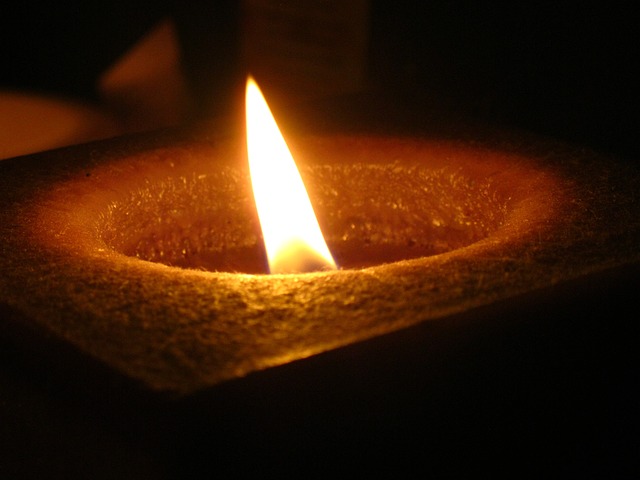
A candle shining in the darkEarlier I posted a link to an essay by the Rev. Dr. Rachel Marsh about having hope in 2017. Among her “four (hope-giving) things” was this:

Transformational change takes place when individual actions are networked

Often we feel despondent because it feels like our small actions are too small, that they are meaningless. But research shows that although individual changes may not lead to transformational change, networking these individual actions CAN make a difference. This is where social media can be a blessing: a small action on one side of the world can inspire groups of people to take action elsewhere. The effect is multiplied and so my small action gains significance, affirmation and inspires me to do more. —Why I have hope for 2017

Today, via the Christian Science Monitor, I found this sign of hope: From a former sex slave to a climate poet: five unsung heroes of 2016. The article highlights the work of 5 individuals in places most of us will never visit. We know of their work because of the internet/social media.

May those doing similar work, may we who are able to support them by prayer, solidarity, and financial resources, continue to network in hope and courage, and for the common good. ~Fr. Dan

For further reading (keep learning)

Bethlehem shrine’s treasures being restored

Our present moment is, of course, greatly enriched by remembering and honoring our past. Today I am grateful for the work being done in the Church of the Nativity in Bethlehem. ~Fr. Dan

ROME (RNS) It is revered by different Christian sects and draws more than a million visitors to the Holy Land every year, making it the biggest tourist attraction in the Palestinian territories.

The Church of the Nativity, built by Roman Emperor Constantine in the fourth century, sits in Bethlehem above what’s believed to be the birthplace of Jesus in one of the most politically divisive regions of the world.

The church is administered jointly by Greek Orthodox, Syriac Orthodox, Roman Catholic and Armenian Apostolic authorities, and all have monastic communities there.

Since 2013, Italian experts from the art restoration firm Piacenti SpA have been working with the Palestinian government to overcome cultural and religious differences and forge ahead with an ambitious restoration expected to cost $15 million (14 million euros) when completed.

Read the entire post here: Bethlehem shrine’s treasures being restored | Religion News Service

The Sinless One to Jordan Came

An icon of the Baptism of our Lord

“The sinless one to Jordan came”
Hymnal 1982 #120
Words: G. B. Timms (b. 1910), alt.
Music: Solemnis haec festivitas, melody from Graduale, 1685;
harm. Arthur Hutchings (b. 1906)

This is a hymn used in worship on the Sunday we celebrated the Baptism of our Lord. Shared in our (almost) weekly newsletter “On the Way.” ~Fr. Dan

Llandaff Cathedral Choir

Icon: Deacon Mathew Garrett


Archaeologist Says the Bible’s King Hezekiah Is Real

An interesting read for those whose study of the Bible includes the archeology of the ancient world, modern archeological science and methods, and current politics. Read the entire essay as you “keep learning”

From the Daily Beast, 12/03/15:

A recent find from Israel
A clay imprint, known as a bulla, which was unearthed from excavations near Jerusalem’s Old City

Israeli archeologists have discovered a mark from a seal of the biblical King Hezekiah—and the discovery is being touted in some circles as proof of the authenticity of the biblical record.

The small circular inscription was found as part of excavations of a refuse dump at the foot of the southern wall that surrounds Jerusalem’s Old City. The clay imprint, known to archeologists as a bulla, contains ancient Hebrew script and a symbol of a two-winged sun.

In the end, the discovery of the bulla may tell us as much about the politics of the present as it does the archeology of the past.

According to the Bible, Hezekiah ruled around 700 B.C. and, along with King Josiah, was one of the few good kings dedicated to eliminating idolatry. 2 Kings 18:5 implies that he was without equal: “there was no one like him among all the kings of Judah, either before him or after him.”

Read the entire essay here


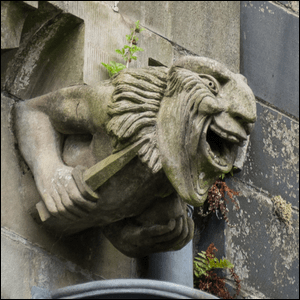
The Most Critical Feature Of A Gargoyle Is That It Is?

Think you know the answer? Click through to see if you’re right!

Source: The Most Critical Feature Of A Gargoyle Is That It Is?

What a homeless man taught me on Christmas morning

The original post appeared on The Messy Middle, January 4, 2017

When we truly “seek and serve Christ in all persons,” (see the Book of Common Prayer, 305) when we behave in a way that reveals we truly “love our neighbor as ourselves,” we open ourselves to the Christ meeting us and teaching us in ways we never expected. This is a story to make that point for you and me.

Continue reading “What a homeless man taught me on Christmas morning”

Bulletin Insert: Epiphany 1(A)

Every week the Episcopal Church offers a Bulletin Insert (online and as a PDF). This is from the Bulletin Insert for Sunday, January 8, 2017 (The Baptism of our Lord). ~Fr. Dan

The Feast of the Baptism of Our Lord is celebrated each year on the Sunday following the Feast of the Epiphany on January 6. The event of Christ’s baptism is recorded in all four gospel accounts:

  • Mark 1:9-11
  • Luke 3:21-22
  • John 1:29-34
  • Matthew 3:13-17

Read more here: Bulletin Insert: Epiphany 1(A)

For further reading