Author: stanleyhirsch

A Proper 21 Art for Readings September 25, 2011

A Proper 20 Art for Readings September 18, 2011

A Proper 19 Art for Readings September 11, 2011

A Proper 18 Art for Readings September 4, 2011

It’s easy to spot the Jews – they’re in the pointy hats. Although widely used in a variety of works, this is not just an artistic convention. Follow the links below to explore the wearing of the Judenhut. sch
Proper 17A: Art for Track 1 Readings
A different presentation of Moses and the Burning Bush. Original post updated 8/28/20
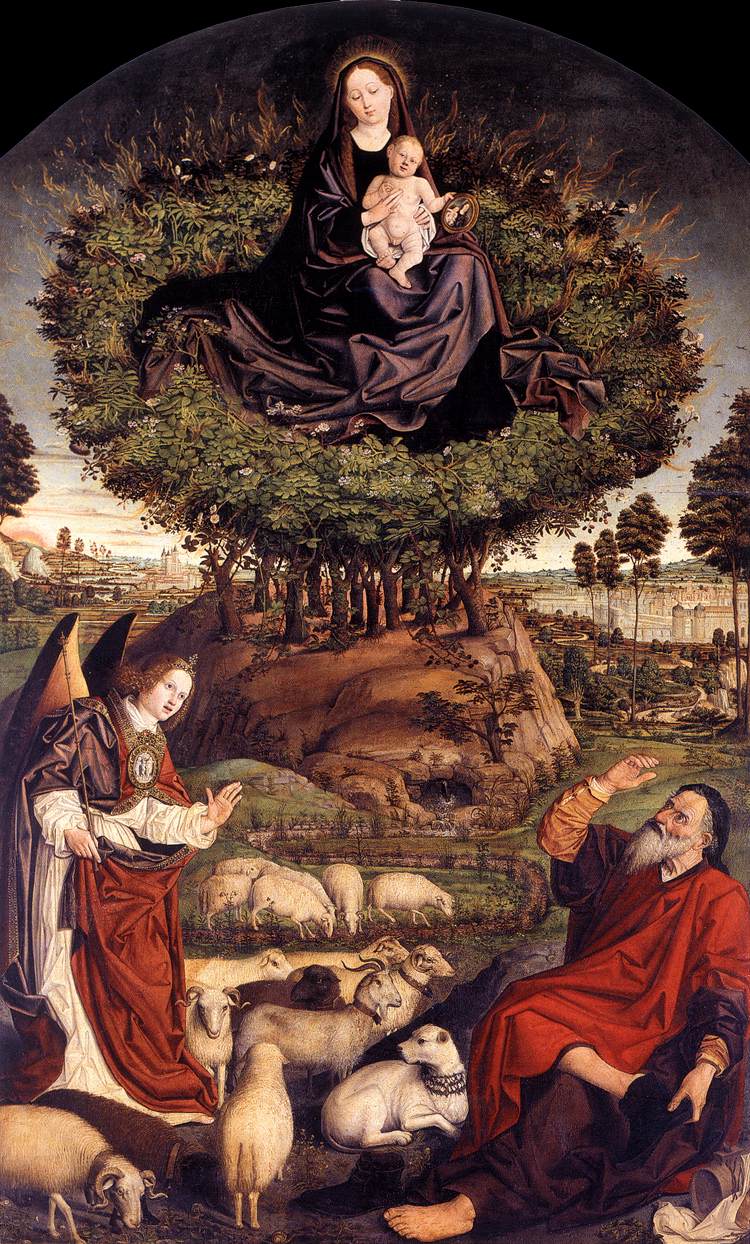
The Burning Bush
1476
Wood, 410 x 305 cm
Cathedrale Saint Sauveur, Aix-en-Provence
FROMENT, Nicolas
(b. ca. 1435, Uzes, d. ca. 1486, Avignon)Barcelona)
Click to open Web Gallery of Art display page.
Exodus 3:1-15 is one of the readings appointed for Proper 17A (Continuous Narrative). Here is an interesting depiction of that moment.
What is going on here? Mary standing in for God? Well not exactly—the infant Jesus represents God in the burning bush. Why Mary?
Welcome to typological and allegorical interpretation where Mary represents many ideas and connections. Notice the little mirror held by Jesus. Perhaps Mary, sometimes known as “the reflection of the Church” or “the reflection of faith,” brings our witness to this foundational story of God acting for justice and order in our lives.
A Proper 16 Art for Readings August 21, 2011

A Proper 15 Art for Readings August 14, 2011


YOSEF
After reading Everett Fox’s excellent introduction from “The Five Books of Moses”, this time on Joseph, I can’t help but regret how quickly our lectionary must move, as we consider only two excerpts in two weeks – betrayal and reconciliation. O well, we can still read the whole account for ourselves.
YOSEF
(Genesis 37-50)
THE STORIES ABOUT THE LAST PATRIARCH FORM A COHERENT WHOLE, LEADING SOME to dub it a “novella.” It stands well on its own, although it has been consciously and artfully woven together into both the Yaakov cycle and the entire book.
Initially the tale is one of family emotions, and it is in fact extreme emotions which give it a distinctive flavor. All the major characters are painfully expressive of their feelings, from the doting father to the spoiled son, from the malicious brothers to the lustful wife of Potifar, from the nostalgic adult Yosef (Joseph) to the grief-stricken old Yaakov (Jacob). It is only through the subconscious medium of dreams, in three sets, that we are made to realize that a higher plan is at work which will supersede the destructive force of these emotions.
For this is a story of how “ill” -with all its connotations of fate, evil, and disaster is changed to good. Despite the constant threat of death to Yosef, to the Egyptians, and to Binyamin (Benjamin), the hidden, optimistic thrust of the story is “life,” a word that appears in various guises throughout. Even “face,” the key word of the Yaakov cycle which often meant something negative, is here given a kinder meaning, as the resolution to Yaakov’s life.
A major subtheme of the plot is the struggle for power between Re’uven (Ruben) and Yehuda (Judah).
Its resolution has implications that are as much tribal as personal, for the tribe of Yehuda later became the historical force in ancient Israel as the seat of the monarchy.
Although many details of the narrative confirm Egyptian practices, those practices actually
reflect an Egypt considerably later than the period of the Patriarchs (Redford). Of interest also is the prominence of the number five in the story, a detail that is unexplained but that gives some unity to the various sections of text.
In many ways the Yosef material repeats elements in the Yaakov traditions. A long list could be compiled, but let us at least mention here sibling hatred, exile of the hero, foreign names, love and hate, dreams, and deception-even so detailed as to duplicate the use of a goat-kid. But its focusing on a classic rags-to-riches plot, with the addition of a moralistic theme, make the Yosef story a distinctive and always popular tale, accessible in a way that the more difficult stories of the first three parts of Genesis are not.
Everett Fox,
The Five Books of Moses: A New English Translation with Commentary and Notes
(New York: Schocken Books, 1995).
http://www.clarku.edu/departments/foreign/facultybio.cfm?id=365
Dream Vision, Albrecht Dürer, August 5

While Dürer is well known for his woodcuts and naturalistic watercolor I thought this work particularly interesting because of our recent class discussion of dreams and because it’s not that often we have the artists explanation with the painting.
 Hear what the Spirit is saying