Bobby McFerrin: Sharing the gift of music

Bobby McFerrin on Religion & Ethics Newsweekly

Bobby McFerrin is interviewed on the PBS show Religion & Ethics Newsweekly today (5/24/13). He talks about music and faith and spirituality. The video clip lasts just over 8 minutes and I found it inspirational (and hope you will, too). Click the image to go to the video interview.

Some insights from the interview:

[Music] elicits so many emotions. Have you ever listened to a piece of music and for some reason that you don’t, you just can’t understand, you simply burst into tears? Music has a way of communicating in a way that language does not. It can go past language.

I love the Scriptures. I still read the Bible through, you know, over and over and over again. Because you always find things there, you know, that you hadn’t seen before. I could read the same verse 1,000 times, but the 1,001st time I read it I’ll find something in it that I hadn’t seen before.

Kim Lawton, Interviewer, “McFerrin says he believes God speaks through his music. But he says that doesn’t make him unique.”

God doesn’t speak through me and not through you for some reason. He speaks to everyone, and we in turn can open up our mouths, or open up our hands, or our minds or whatever, our professions, and let God speak through us to other people. My father used to say, “The Lord has entrusted me with a talent. It’s not my gift. The Lord has entrusted me with a talent,” and I absolutely feel that way, that He’s given me this gift to share with other people to uplift hearts.

Read the entire interview here
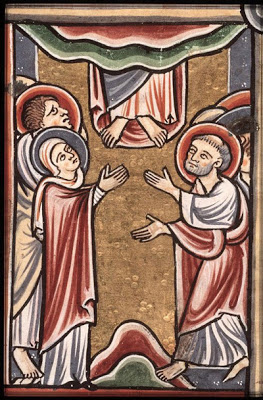
Hail Thee, Festival Day

Spirit of life and of pow’r, // Now flow in us, fount of our being, // Light that enlightens us all, // Life that in all may abide.

In many churches, including Episcopal churches, the Day of Pentecost is a day to sing “Hail Thee, Festival Day” with joy and thanksgiving. The hymn is often used on Easter, the Feast of the Ascension, and Pentecost. Here is a version shared on Pentecost.

Want to know more about the hymn? Check out Hymnary.org for more on this hymn. See also, History of Hymns curated by Discipleship Ministries of the United Methodist Church.

Do you have a favorite “Pentecost Hymn”? Let us know in the Comment section.

Ascension Day

Today we share a post: ST JOSEPH’S ABBEY, SPENCER MA: Ascension Day.

It is a quick read to make you think on this mysterious and marvelous day.

Art and wonder

An insight into why we post art and music and why art and music are an important part of our Sunday Morning Forum:

The purpose of art is the gradual, lifelong construction
of a state of wonder and serenity.

Glenn Gould, pianist

From the Word for the Day (5/7/13) posted by Gratefulness.org

“My Shepherd Will Supply My Need”

I was reminded of this adaptation of the 23rd Psalm the other day and wanted to share. What a beautiful thing to remember.

(arranged by Mack Wilberg)

My Shepherd will supply my need:
Jehovah is His Name;
In pastures fresh He makes me feed,
Beside the living stream.
He brings my wandering spirit back
When I forsake His ways,
And leads me, for His mercy’s sake,
In paths of truth and grace.

When I walk through the shades of death
Thy presence is my stay;
One word of Thy supporting breath
Drives all my fears away.
Thy hand, in sight of all my foes,
Doth still my table spread;
My cup with blessings overflows,
Thine oil anoints my head.

The sure provisions of my God
Attend me all my days;
O may Thy house be my abode,
And all my work be praise.
There would I find a settled rest,
While others go and come;
No more a stranger, nor a guest,
But like a child at home.
–Isaac Watts (1674-1748)

Give My Heart

A well-spoken testimony to Christina Rossetti and a wonderful lead in to both the reading from Acts and the words of Jesus in the Gospel appointed for tomorrow (4/28/13, the Fifth Sunday of Easter in Year C) — “By this everyone will know that you are my disciples, if you have love for one another.” ~dan rondeau

The Lord is my shepherd

Here is a different ‘listen’ to a favorite Psalm. Dedicated to his mother, Bobby McFerrin takes poetic license in this setting of Psalm 23. Click the link to discover more: The Lord is my shepherd.

via The Lord is my shepherd.

Incredulity of St Thomas | Art for Easter 2

Incredulity of St Thomas
1572
Oil on panel
Santa Croce, Florence
VASARI, Giorgio
(b. 1511, Arezzo, d. 1574, Firenze)
Click image for more information.

______________
Commentary by Hovak Najarian

Incredulity of St. Thomas, Oil on Panel, 1572, Giorgio Vasari, 1511-1574

The High Renaissance took place in the last quarter of the fifteenth century and continued into the early part of the sixteenth century. By the time Giorgio Vasari was nine years old, however, many of the noted artists were no longer living. The exceptions were Titian and Michelangelo (who lived to be almost ninety years old). Renaissance advancements in art were now left to be sorted out by the next generation. Vasari regarded himself as part of the Renaissance; believing it continued until the death of Michelangelo (1564) and that he and his generation were part of it. In a broader sense he was correct but art historians today use the term “Mannerist” when referring to sixteenth century artists. Unlike artists of the prior century, it was not necessary for Mannerists to be pioneers in finding solutions to technical problems of art. Instead, they often used their abundant skills to emphasize style, dramatic effect, and virtuosity.

When Vasari was young, his precociousness was noted and he was selected to be schooled with members of the prominent Medici family; as an adult this contact was invaluable to his career. When Cosimo I de’ Medici funded changes at the Church of Santa Croce, Florence, he chose Vasari to be the architect and painter. Vasari painted scenes from Christ’s Passion – as well as events that followed – for the private chapels of the Church; the “Incredulity of Thomas” was painted for the Guidacci Chapel. Thomas, having said he would not believe Christ was resurrected until he himself saw the wounds on his hands and side, is shown with Jesus at a gathering with disciples. Vasari leads our attention immediately to center stage where Christ stands bare-chested with arms wide apart as though to say, “Go ahead, see for yourself.” Thomas examines the wound on Christ’s side as people rush out from a background door to also look. Angels have arrived and are floating above, and cherubs are on either side of the arch. The dramatic lighting and hand gestures of Christ and those in attendance add to the theatricality to this scene.

Note

Giorgio Vasari was immensely famous during his lifetime but now he is cited more often for his writings on the lives of artists. The necessity to rely on secondhand sources at times resulted in a few points of misinformation but on a whole, his work provides invaluable insights into the art and artists of his time.

When reference is made to the “High Renaissance” and the time period is elusive, it may help to know Christopher Columbus was a contemporary of Michelangelo, Raphael, and Leonardo. While they were making art, he was sailing. “In fourteen hundred ninety-two, Columbus sailed the ocean blue.”

Hovak Najarian © 2013

Songs for Holy Saturday

Surely He took up our pain and bore our suffering…He was pierced for our transgressions and crushed for our inequities; the punishment that brought us peace was on Him, and by His wounds, we are healed.   Isaiah 53:4-5


Songs for Maundy Thursday

“A new command I give you: Love one another. As I have loved you, so you must love one another. By this, everyone will know that you are my disciples, if you love one another.” John 13:34-35