Pentecost, Year B

Wind in the Chimes: our prayer and why we celebrate this day

Collect for Pentecost

Pentecost

The term means “the fiftieth day.” It is used in both the OT and the NT. In the OT it refers to a feast of seven weeks known as the Feast of Weeks. It was apparently an agricultural event that focused on the harvesting of first fruits. Josephus referred to Pentecost as the fiftieth day after the first day of Passover. The term is used in the NT to refer to the coming of the Spirit on the day of Pentecost (Acts 2:1), shortly after Jesus’ death, resurrection, and ascension. Christians came to understand the meaning of Pentecost in terms of the gift of the Spirit. The Pentecost event was the fulfillment of a promise which Jesus gave concerning the return of the Holy Spirit. The speaking in tongues, which was a major effect of having received the Spirit, is interpreted by some to symbolize the church’s worldwide preaching. In the Christian tradition, Pentecost is now the seventh Sunday after Easter. It emphasizes that the church is understood as the body of Christ which is drawn together and given life by the Holy Spirit. Some understand Pentecost to be the origin and sending out of the church into the world. The Day of Pentecost is one of the seven principal feasts of the church year in the Episcopal Church (BCP, p. 15). The Day of Pentecost is identified by the BCP as one of the feasts that is “especially appropriate” for baptism (p. 312). The liturgical color for the feast is red. Pentecost has also been known as Whitsun or Whitsunday, a corruption of “White Sunday.” This term reflects the custom by which those who were baptized at the Vigil of Pentecost would wear their white baptismal garments to church on the Day of Pentecost. The BCP provides directions for observance of a Vigil of Pentecost, which begins with the Service of Light (p. 227). The Hymnal 1982 provides a variety of hymns for Pentecost (Hymns 223-230) and the Holy Spirit (Hymns 500-516).Reference: “Ascension” in An Episcopal Dictionary of the Church

Pentecost in 2 Minutes

More

  • The Collect: an Anglican/Episcopal Treasure. From the “Foreward” to The Collects of Thomas Cranmer edited by C. Frederick Barbee and Paul F. M. Zahl. This essay provides historical and liturgical background to this type of liturgical prayer.
  • A Pattern for Prayer by John D. Witvliet posted on Religion Online. The author believes the study of ancient liturgical materials facilitates special insight.  He discusses at length the understanding which lies in the structures and patterns of early collects and similar prayers, for preparing such prayers challenges us to draw on nearly the whole range of theological themes and motifs.

About Wind in the Chimes

Wind in the Chimes (renaming and reintroduction of Wind Chimes, 7/21/20)

Wind Chimes: September 25 2012 (an introduction)
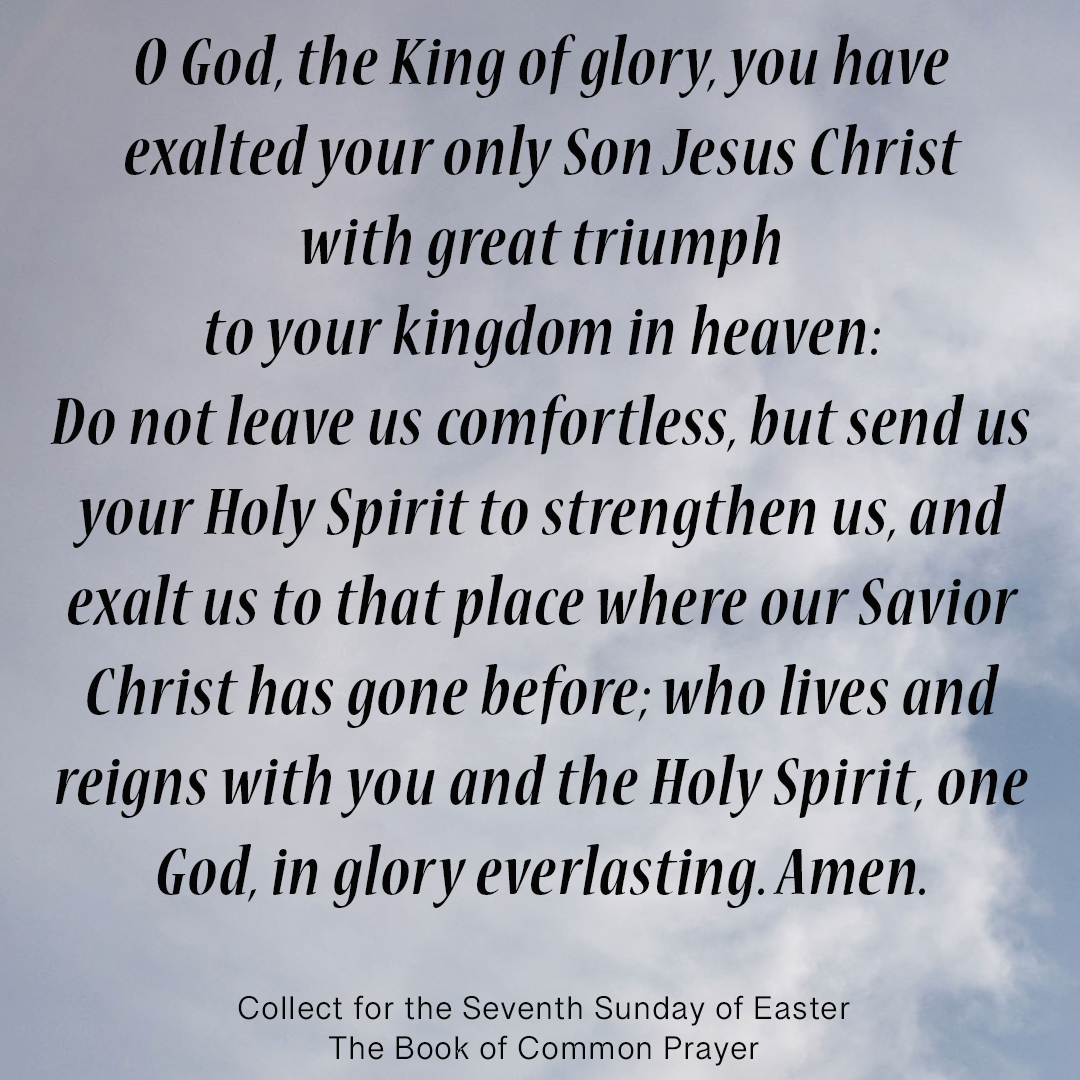
A prayer after the Ascension

Wind in the Chimes: a prayer on the Seventh Sunday of Easter to be strengthened

O God, the King of glory … do not leave us comfortless

On the Seventh Sunday of Easter, we first ask that our God not leave us comfortless. Then we ask for the Holy Spirit to strengthen and exalt us.

Marion Hatchett in his book, Commentary on the American Prayer Book, (New York: The Seabury Press, 1981) tells us that Thomas Cranmer (the author of the precursor of this prayer in English) “translated the word ‘orphans’ [from a more ancient prayer in Latin] with a weaker term ‘comfortless,’ which is used here in what is now an archaic meaning, ‘without strength,’… as well as ‘without consolation.'”

In this week as we prepare to remember and celebrate the coming of the Holy Spirit at Pentecost, consider how the Spirit has strengthened you in your faith journey. In what moments of your journey have you relied upon the strength of the Spirit to sustain you?

Likewise, what experiences in your faith journey have led you to trust that God, the King of glory, is even now exalting us, exalting you, “to that place where our Savior Christ has gone before?”

More

  • The Collect: an Anglican/Episcopal Treasure. From the “Foreward” to The Collects of Thomas Cranmer edited by C. Frederick Barbee and Paul F. M. Zahl. This essay provides historical and liturgical background to this type of liturgical prayer.
  • A Pattern for Prayer by John D. Witvliet posted on Religion Online. The author believes the study of ancient liturgical materials facilitates special insight.  He discusses at length the understanding which lies in the structures and patterns of early collects and similar prayers, for preparing such prayers challenges us to draw on nearly the whole range of theological themes and motifs.

About Wind in the Chimes

Wind in the Chimes (renaming and reintroduction of Wind Chimes, 7/21/20)

Wind Chimes: September 25 2012 (an introduction)
They proposed two, Joseph called Barsabbas, who was also known as Justus, and Matthias.…

Before the casting of lots: heartfelt prayer for God’s guidance (Acts 1:24-25)

… and the lot fell to Matthias

Acts of the Apostles 1:23, 26 NRSV

Welcome!

On Wednesday, May 8, 2024, we explored Acts 1:15-17, 21-26, the first reading appointed for the Seventh Sunday of Easter, Year B (May 12, 2024). Our handout included commentaries on the other appointed texts from the First Letter of John (1 John 5:9-13), the Psalms (Psalm 1), and the Gospel according to John (John 17:6-19).

In her commentary on the text from Acts—from a homiletical perspective—Barbara K. Lundblad highlights the two men put forward by the group gathered together after the Ascension but before the Day of Pentecost. We are asked to “acknowledge and celebrate the ordinary people who have carried the extraordinary gospel from one generation to the next.”

Pause, remember, acknowledge, and even celebrate, the ordinary people you have met in your faith journey who have shared the Good News of God in Christ with you.

From a commentary on Acts 1:15-17, 21-26

Matthias becomes part of the inner circle; the other loses the toss of the dice. Even his name seems to be in question: Joseph called Barsabbas, who was also known as Justus. The truth is that we know very little about either one of these men.

Their lack of renown is a wondrous reality. In the next chapter Peter stands with the eleven to preach his Pentecost sermon. That would mean that Matthias must have been there even though he is not named. Where was Justus? Perhaps he was there too, for the narrator tells us that all of them were filled with the Holy Spirit. …

Rather than being disappointed by having so little information, we can be grateful for the witness of those who are so little known. [The sermon this Sunday] can be a time to acknowledge and celebrate the ordinary people who have carried the extraordinary gospel from one generation to the next. Who is Justus in your faith journey?

Source: Barbara K. Lundblad, “Homiletical Perspective on Acts 1:15–17, 21–26,” in Feasting on the Word: Preaching the Revised Common Lectionary: Year B, ed. David L. Bartlett and Barbara Brown Taylor, vol. 2 (Louisville, KY; London: Westminster John Knox Press, 2008).

The Rev. Dr. Barbara K. Lundblad is the former Joe R. Engle Professor of Preaching Emerita at Union Theological Seminary.

divider line

Most Wednesday mornings a group of us gather online to explore the readings that will be used in worship the following Sunday. Our handout this week features readings, commentaries, and notes for the Seventh Sunday of Easter (May 12, 2024) in Year B of the Revised Common Lectionary. Please: View or download the handout we used to guide our discussion and tune our hearts to the Spirit.

View the Revised Common Lectionary readings appointed for Sunday, May 12, 2024, on the Revised Common Lectionary site curated by the Vanderbilt Divinity Library.

Please return to this site throughout the week to keep learning.

divider line

About casting lots

Be well. Do good. Pay attention. Keep learning.

The Ascension of Christ

We believe … Jesus ascended into heaven and is seated at the right hand of the Father. (Nicene Creed)

Commentary by Hovak Najarian                                                                                        

 After the resurrection, Christ’s last appearance to the disciples was at his ascension.  He blessed the disciples and then “withdrew and was carried up into heaven.”   A description of the ascension in Acts of the Apostles adds, “while they [the disciples] beheld, he was taken up; and a cloud received him out of their sight.  And while they looked steadfastly toward heaven as he went up, behold, two men [portrayed usually as angels] stood by them in white apparel; [They] said ‘Ye men of Galilee, why stand ye gazing up into heaven?  This same Jesus … shall so come in like manner as we have seen him go into heaven.’”   (Acts 1:9-11)

The Ascension, Rabbula Gospel, 6th century. (Wikimedia Commons)

The illustration of Christ’s ascension in the Rabbula Gospel Book shows the disciples standing at the lower half of the illumination looking up at Jesus.  Two men in white robes are talking to them and pointing upward.  At center foreground, Mary is raising her arms but is not looking upward.  Instead, she is looking out at the person that would be reading the gospel book.  In the upper half, Jesus is surrounded by an aureola (a body halo) with angels assisting him skyward.

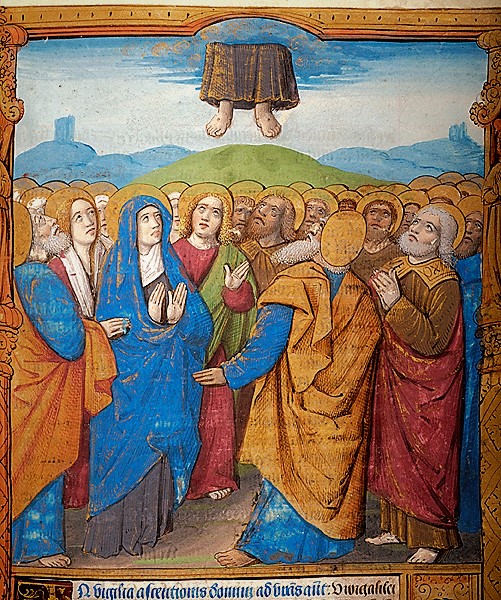
Ascension from a Breviary, French, c. 1506-1516. Source: “Iconography of the Ascension, Part III of IV — The Disappearing Feet” on Ad Imaginem Dei

Paintings of Christ’s ascension were based also on the statement, “he was taken up; and a cloud received him out of their sight.”   In these paintings, Jesus is ascending into a cloud with only a lower portion showing.   He is leaving pictorial space into the space beyond the painting.

[When a person in a painting is seen from the back, the placement of a halo presents a problem.  Note the halo on the disciple wearing a yellow mantle (right foreground).]

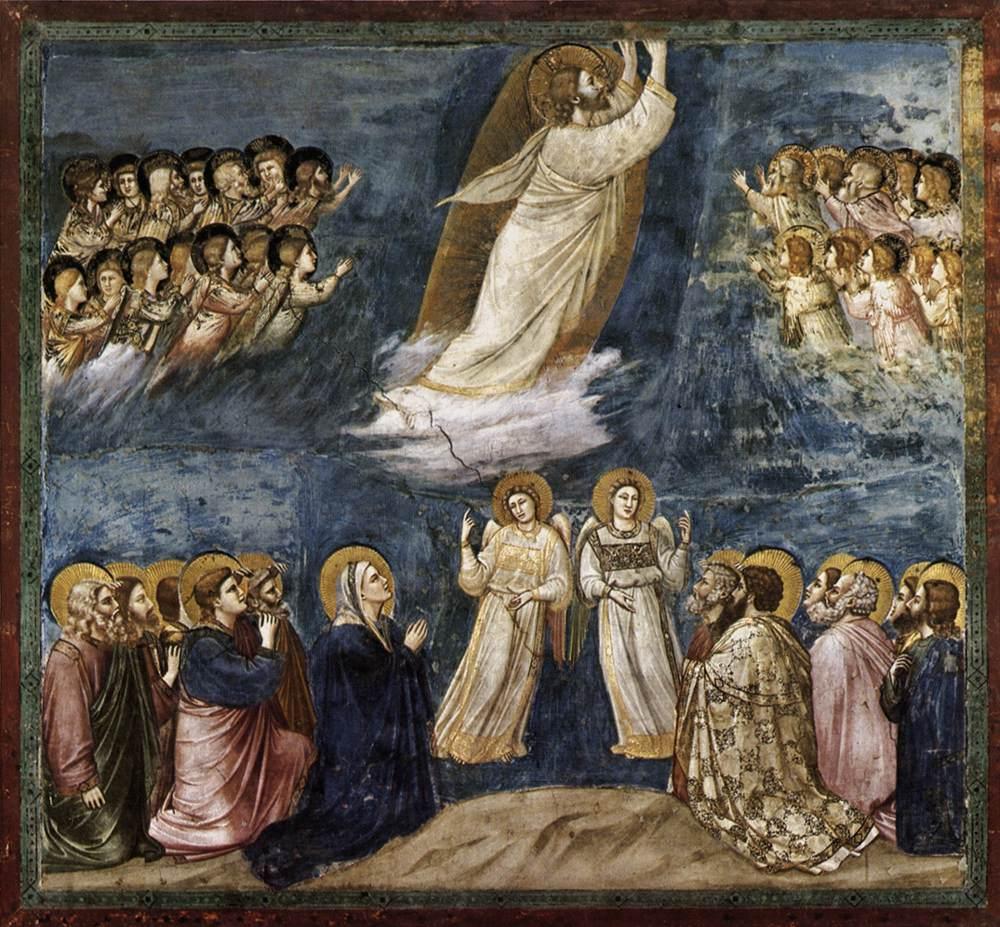
The Ascension of Christ, fresco, 13-4-1206, Giotto, 1275-1337

           Giotto, The Ascension of Christ (Wikimedia Commons)

The Ascension of Christ by Giotto contains echoes of the work of other artists.   Like the illustration in the Rabbula Gospel, Giotto’s disciples and Mary are in the foreground.  Here, however, they are kneeling and their attention is focused on the two centrally located men in white apparel.  These men – depicted with wings and assumed to be angels – are floating above the ground pointing to the sky and talking to the disciples and Mary.  Jesus is above them and portrayed in greater size than the other figures.

As in other paintings of the ascension, Christ is surrounded by a golden mandorla  –  the term is from the Italian word for almond which it resembles in shape – but unlike many illustrations, he is not looking down, and Giotto’s angels are not assisting in his ascent.  Instead, Jesus is already above the cloud that received him and is being greeted by a chorus of angels with arms raised in praise.  Christ in this fresco is in profile and as he ascends heavenward, his hands have entered partially into the space beyond the painting itself.

Hovak Najarian © 2024

Ascension Day

Wind in the Chimes: the Ascension is about presence

The Ascension of Christ (Ascension Day)

The occasion on which the risen Christ is taken into heaven after appearing to his followers for forty days (Acts 1:1-11, Mk 16:19). The Ascension marks the conclusion of Jesus’ post-resurrection appearances. It is the final elevation of his human nature to divine glory and the near presence of God. The Ascension is affirmed by the Nicene and Apostles’ Creeds. The Ascension is celebrated on Ascension Day, the Thursday that is the fortieth day of the Easter season. It is a principal feast of the church year in the Episcopal Church. Reference: “Ascension” in An Episcopal Dictionary of the Church

A Homily on the Feast of the Ascension

… the ascension is about presence, not absence. Jesus has not left us. Rather Christ has filled us. —Michael K. Marsh

An invitation: Hear what the Spirit is saying, in this homily “Feast of the Ascension” by Michael K. Marsh posted to Interrupting the Silence on May 21, 2009.

More

  • The Collect: an Anglican/Episcopal Treasure. From the “Foreward” to The Collects of Thomas Cranmer edited by C. Frederick Barbee and Paul F. M. Zahl. This essay provides historical and liturgical background to this type of liturgical prayer.
  • A Pattern for Prayer by John D. Witvliet posted on Religion Online. The author believes the study of ancient liturgical materials facilitates special insight.  He discusses at length the understanding which lies in the structures and patterns of early collects and similar prayers, for preparing such prayers challenges us to draw on nearly the whole range of theological themes and motifs.

About Wind in the Chimes

Wind in the Chimes (renaming and reintroduction of Wind Chimes, 7/21/20)

Wind Chimes: September 25 2012 (an introduction)

For the love of God is this …

Genuine faith is firmly connected with active love.

… that we obey his commandments.

1 John 5:3 NRSV

Welcome!

On Wednesday, May 1, 2024, we explored 1 John 5:1-6, the epistle pericope appointed for the Sixth Sunday of Easter, Year B (May 5, 2024). Our handout included commentaries on the other appointed texts from the Acts of the Apostles (Acts 10:44-48), the Psalms (Psalm 98), and the Gospel according to John (John 15:9-17).

From a commentary on 1 John 5:1-6

1 John reminds its readers that God’s commands are not burdensome. Here again we hear an echo of Jesus, who denounces the religious leaders for loading people down with “heavy burdens hard to bear” (Matthew 23:4). The Greek word that NRSV translates as “heavy” is barus, the same adjective translated as “burdensome” in 1 John 5:3. By contrast, Jesus says, “Come to me, all you that are weary and are carrying heavy burdens … For my yoke is easy, and my burden is light” (Matthew 11:28–30). Like Jesus, 1 John insists that God’s commands are not difficult. In essence, they consist in the call to love, “not in word or speech, but in truth and action” (1 John 3:18). Genuine faith, therefore, is firmly connected with active love.

Source: Commentary on 1 John 5:1-6 by Judith Jones posted May 10, 2015 to Working Preacher for Easter 6B

divider line

Most Wednesday mornings a group of us gather online to explore the readings that will be used in worship the following Sunday. Our handout features readings, commentaries, and notes for the Sixth Sunday of Easter (May 5, 2024) in Year B of the Revised Common Lectionary. Please: View or download the handout we used to guide our discussion and tune our hearts to the Spirit.

View the Revised Common Lectionary readings appointed for Sunday, May 5, 2024, on the Revised Common Lectionary site curated by the Vanderbilt Divinity Library.

Judith Jones is the Vicar, of St. Stephen & St. Luke by the Sea Episcopal Churches in Waldport, OR. More.

Please return to this site throughout the week to keep learning.

divider line

Be well. Do good. Pay attention. Keep learning.

Image: ChurchArt Pro

Pour into our hearts such love …

Wind in the Chimes: Letting our collective prayer interrogate and inspire us.

The Collect for the Sixth Sunday of Easter

O God, you have prepared for those who love you such good things as surpass our understanding: Pour into our hearts such love towards you, that we, loving you in all things and above all things, may obtain your promises, which exceed all that we can desire; through Jesus Christ our Lord, who lives and reigns with you and the Holy Spirit, one God, for ever and ever. Amen.

The Book of Common Prayer, 225

A few questions from our prayer

I invite you to read through this prayer and then use these prompts as you ponder, contemplate, or journal. Please let the beauty and power of our common prayer be nourishment and refreshment along the Way.

O God, you have prepared for those who love you such good things as surpass our understanding: 

  • What evidence do you have that this is true, a trustworthy statement? From your life experiences, name some of those who have trusted this statement and share that trust with you.

Pour into our hearts such love towards you, …  

  • “Pour into our hearts…” How many ways could God (who is love, 1 John 4:8) do this pouring? How many ways has love towards God filled your heart?

that we, loving you in all things and above all things,

  • Describe the challenges of living like this.

may obtain your promises, which exceed all that we can desire;

  • What “promises” (from God) do you most cherish? Most desire to be fulfilled? What promises arouse the most curiosity in you? Why do you suppose our prayer uses a plural (promises) form?

through Jesus Christ our Lord, who lives and reigns with you and the Holy Spirit, one God, for ever and ever. Amen.

  • As disciples of Christ, as believers, we trust that “Christian prayer is [a] response to God the Father, through Jesus Christ, in the power of the Holy Spirit.” from The Book of Common Prayer, p. 836

More

  • The Collect: an Anglican/Episcopal Treasure. From the “Foreward” to The Collects of Thomas Cranmer edited by C. Frederick Barbee and Paul F. M. Zahl. This essay provides historical and liturgical background to this type of liturgical prayer.
  • A Pattern for Prayer by John D. Witvliet posted on Religion Online. The author believes the study of ancient liturgical materials facilitates special insight.  He discusses at length the understanding which lies in the structures and patterns of early collects and similar prayers, for preparing such prayers challenges us to draw on nearly the whole range of theological themes and motifs.

About Wind in the Chimes

Wind in the Chimes (renaming and reintroduction of Wind Chimes, 7/21/20)

Wind Chimes: September 25 2012 (an introduction)

Prayer is love’s choice, always

Wind in the Chimes: A thought on loving one another, even in physical distress or infirmity

1 John 4:7–8 (NRSV)

7 Beloved, let us love one another, because love is from God; everyone who loves is born of God and knows God. 8 Whoever does not love does not know God, for God is love.

If I cannot work or rise from my chair or my bed, love remains to me; I can pray.

—George Congreve SSJE, 1835–1918 (Woodgate, 1956), in  Alan Wilkinson and Christopher Cocksworth, eds., An Anglican Companion: Words from the Heart of Faith (London: SPCK; Church House Publishing, 2001), 89.

About Wind in the Chimes

Wind in the Chimes (renaming and reintroduction of Wind Chimes, 7/21/20)

Wind Chimes: September 25 2012 (an introduction)
Let’s love one another

Beloved, since God loved us so much, we also ought to love one another. 1 John 4:11 NRSV

Welcome!

1 John 4:7

On Wednesday, April 24, 2024, we explored 1 John 4:7-21, the epistle pericope appointed for the Fifth Sunday of Easter, Year B. Our handout included commentaries on the other appointed texts from the Acts of the Apostles (Acts 8:26-40), the Psalms (Psalm 22:25-31), and the Gospel according to John (John 15:1-8).

From a commentary on 1 John 4:7-21

Tucked away in verse 7 is an even more sobering claim. We know God by seeing what God has done, but seeing is not enough. We know God in the fullest and most authentic sense only when the love of God flows through us. God is love; only the one who loves can know this love that is God. Love is not a concept, known abstractly. It is an action, lived concretely. It is not enough to remember Jesus’ self-sacrifice, to think about it, or even to be moved by it. We must live it. To know the God of love is to live the love of God.

Ronald Cole-Turner, “Theological Perspective on 1 John 4:7–21,” in Feasting on the Word: Preaching the Revised Common Lectionary: Year B, ed. David L. Bartlett and Barbara Brown Taylor, vol. 2 (Louisville, KY; London: Westminster John Knox Press, 2008), 468.

divider line

Most Wednesday mornings a group of us gather online to explore the readings that will be used in worship the following Sunday. Our handout features readings, commentaries, and notes for the Fifth Sunday of Easter (April 28, 2024) in Year B of the Revised Common Lectionary. Please: View or download the handout we used to guide our discussion and tune our hearts to the Spirit.

View the Revised Common Lectionary readings appointed for Sunday, April 28, 2024, on the Revised Common Lectionary site curated by the Vanderbilt Divinity Library.

Ronald Cole-Turner is the H. Parker Sharp Chair of Theology and Ethics, at Pittsburgh Theological Seminary, Pittsburgh, Pennsylvania. More.

Please return to this site throughout the week to keep learning.

divider line

Be well. Do good. Pay attention. Keep learning.

Image: ChurchArt Pro

Always thankful, always mindful

We are stewards of another’s creation

Prayer for the Stewardship of Creation

Earth Day: remembering that we are stewards of God’s creation; remembering, too, that we will need to give an accounting of our stewardship. This is more than a once-a-year pause to remember….