
Trinity Sunday, Year B

Wind in the Chimes: The Sunday after the Day of Pentecost is Trinity Sunday

Trinity Sunday (May 26, 2024)

Feast that celebrates “the one and equal glory” of Father, Son, and Holy Spirit, “in Trinity of Persons and in Unity of Being” (BCP, p. 380). It is celebrated on the first Sunday after Pentecost. Trinity Sunday is one of the seven principal feasts of the church year (BCP, p. 15). The proper readings and collect for Trinity Sunday are used only on the feast, not on the weekdays following. The numbered proper which corresponds most closely to the date of Trinity Sunday is used (BCP, p. 228). The BCP also provides the proper “Of the Holy Trinity” for optional use at other times, subject to the rules of the calendar of the church year (see BCP, pp. 251, 927). The Hymnal 1982 presents ten hymns in a section on The Holy Trinity (Hymns 362-371), including “Holy, holy, holy! Lord God Almighty!” (Hymn 362), “Come, thou almighty King” (Hymn 365), and “Holy Father, great Creator” (Hymn 368).

Celebration of Trinity Sunday was approved for the western church by Pope John XXII in 1334. This feast is associated with Thomas Becket (c. 1118-1170), who was consecrated bishop on Trinity Sunday, 1162. His martyrdom may have influenced the popularity of the feast in England and the custom of naming the remaining Sundays of the church year “Sundays after Trinity.” The Sarum Missal and editions of the Prayer Book through the 1928 BCP named these Sundays the Sundays after Trinity. The 1979 BCP identifies this portion of the church year as the season after Pentecost, and names these Sundays the Sundays after Pentecost (see BCP, p. 32).

Reference: “Trinity Sunday” in An Episcopal Dictionary of the Church

About Wind in the Chimes

Wind in the Chimes (renaming and reintroduction of Wind Chimes, 7/21/20)

Wind Chimes: September 25 2012 (an introduction)

The Day of Pentecost, Year B

Divided tongues, as of fire, appeared among them, and a tongue rested on each of them. All of them were filled with the Holy Spirit… (Acts 2:3-4)

Welcome!

What does Pentecost mean to you? How have you experienced the gift of the Holy Spirit breathing life into you, guiding your thinking and choosing, and enlivening your day-to-day activity?

On Wednesday, May 15, 2024, we* explored Acts 2:1-21, the account of the events on the Day of Pentecost.

Pause, remember, acknowledge, and even celebrate, the presence of the Holy Spirit “the Lord, the giver of life” in you.

From a commentary on Acts 2:1-21

The language of the Pentecost experience, with its images of “wind,” “spirit,” and being “filled” with the Spirit or the “breath” of life, is reminiscent of God’s initial creative activity (Gen. 1:2; 2:7). Here, however, the emphasis is not so much on creation or God’s works in history as on direct contact with the Spirit of God, who is now filling the world in a new way. The roll call of nations and languages points to the universality of the Spirit’s work for the whole world. God’s Spirit is the divine energy that now enables an eternal life to be real for those on whom God’s Spirit is poured and in whom the Spirit dwells (cf. Rom. 5:5).

Even more, linking the Pentecost events with the prophetic word about “last days” (Acts 2:17) points forward to the ultimate consummation of God’s reign in a “new heaven and new earth” (Rev. 21:1).

Source: Donald K. Mckim, “Theological Perspective on Acts 2:1‒21,” in Feasting on the Word: Preaching the Revised Common Lectionary: Year B, ed. David L. Bartlett and Barbara Brown Taylor, vol. 3 (Louisville, KY: Westminster John Knox Press, 2009), 2.

Donald K. McKim is the Executive Editor of Theology and Reference, Westminster John Knox Press, Germantown, Tennessee.

divider line

*Most Wednesday mornings a group of us gather online to explore the readings that will be used in worship the following Sunday. This week’s handout features readings, commentaries, and notes for the Day of Pentecost (May 19, 2024) in Year B of the Revised Common Lectionary. Please: View or download the handout we used to guide our discussion and tune our hearts to the Spirit.

View the Revised Common Lectionary readings appointed for Pentecost, Sunday, May 19, 2024, on the Revised Common Lectionary site curated by the Vanderbilt Divinity Library.

Please return to this site throughout the week to keep learning.

divider line

More about Pentecost

Be well. Do good. Pay attention. Keep learning.

Pentecost, Year B

Wind in the Chimes: our prayer and why we celebrate this day

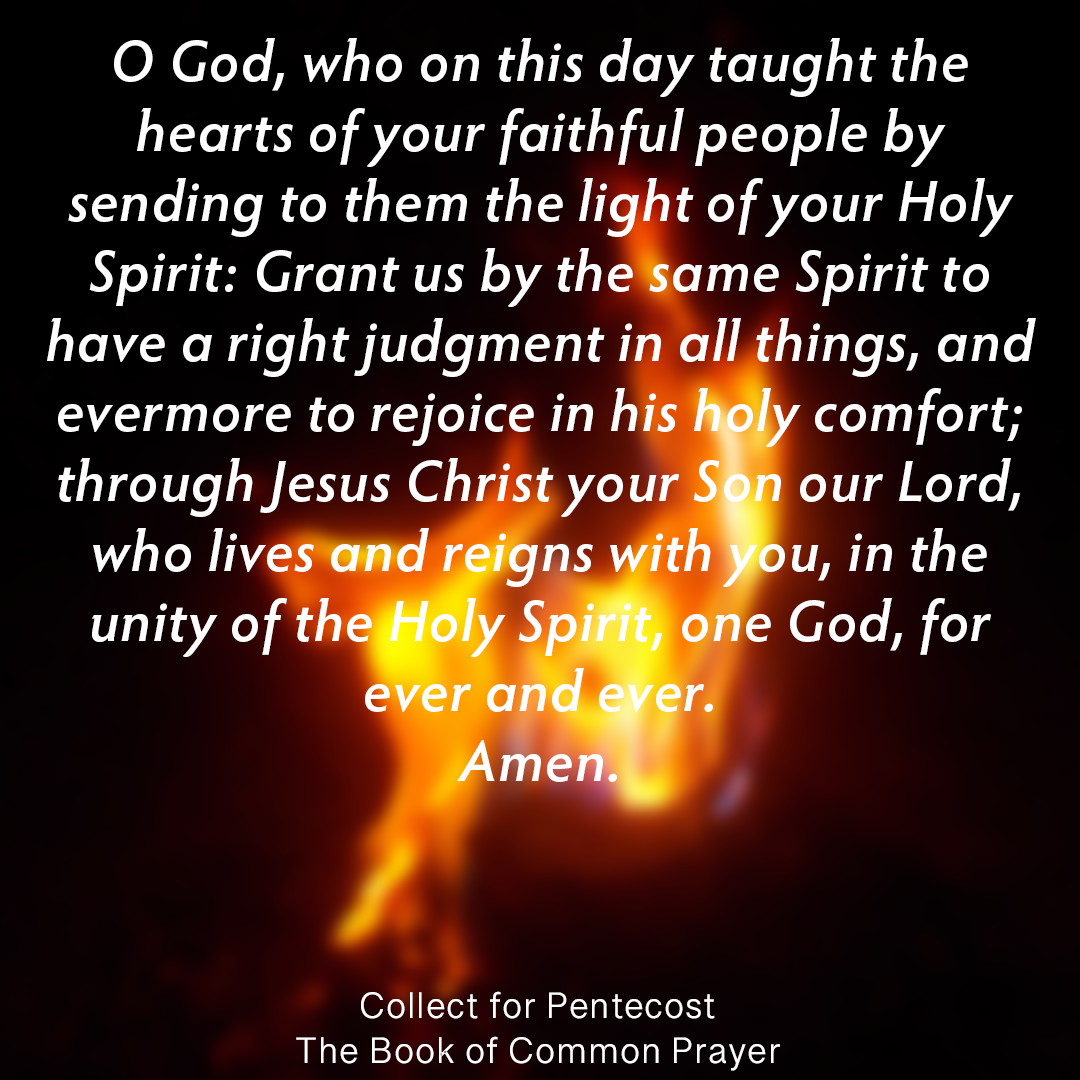
Collect for Pentecost

Pentecost

The term means “the fiftieth day.” It is used in both the OT and the NT. In the OT it refers to a feast of seven weeks known as the Feast of Weeks. It was apparently an agricultural event that focused on the harvesting of first fruits. Josephus referred to Pentecost as the fiftieth day after the first day of Passover. The term is used in the NT to refer to the coming of the Spirit on the day of Pentecost (Acts 2:1), shortly after Jesus’ death, resurrection, and ascension. Christians came to understand the meaning of Pentecost in terms of the gift of the Spirit. The Pentecost event was the fulfillment of a promise which Jesus gave concerning the return of the Holy Spirit. The speaking in tongues, which was a major effect of having received the Spirit, is interpreted by some to symbolize the church’s worldwide preaching. In the Christian tradition, Pentecost is now the seventh Sunday after Easter. It emphasizes that the church is understood as the body of Christ which is drawn together and given life by the Holy Spirit. Some understand Pentecost to be the origin and sending out of the church into the world. The Day of Pentecost is one of the seven principal feasts of the church year in the Episcopal Church (BCP, p. 15). The Day of Pentecost is identified by the BCP as one of the feasts that is “especially appropriate” for baptism (p. 312). The liturgical color for the feast is red. Pentecost has also been known as Whitsun or Whitsunday, a corruption of “White Sunday.” This term reflects the custom by which those who were baptized at the Vigil of Pentecost would wear their white baptismal garments to church on the Day of Pentecost. The BCP provides directions for observance of a Vigil of Pentecost, which begins with the Service of Light (p. 227). The Hymnal 1982 provides a variety of hymns for Pentecost (Hymns 223-230) and the Holy Spirit (Hymns 500-516).Reference: “Ascension” in An Episcopal Dictionary of the Church

Pentecost in 2 Minutes

More

  • The Collect: an Anglican/Episcopal Treasure. From the “Foreward” to The Collects of Thomas Cranmer edited by C. Frederick Barbee and Paul F. M. Zahl. This essay provides historical and liturgical background to this type of liturgical prayer.
  • A Pattern for Prayer by John D. Witvliet posted on Religion Online. The author believes the study of ancient liturgical materials facilitates special insight.  He discusses at length the understanding which lies in the structures and patterns of early collects and similar prayers, for preparing such prayers challenges us to draw on nearly the whole range of theological themes and motifs.

About Wind in the Chimes

Wind in the Chimes (renaming and reintroduction of Wind Chimes, 7/21/20)

Wind Chimes: September 25 2012 (an introduction)

They proposed two, Joseph called Barsabbas, who was also known as Justus, and Matthias.…

Before the casting of lots: heartfelt prayer for God’s guidance (Acts 1:24-25)

… and the lot fell to Matthias

Acts of the Apostles 1:23, 26 NRSV

Welcome!

On Wednesday, May 8, 2024, we explored Acts 1:15-17, 21-26, the first reading appointed for the Seventh Sunday of Easter, Year B (May 12, 2024). Our handout included commentaries on the other appointed texts from the First Letter of John (1 John 5:9-13), the Psalms (Psalm 1), and the Gospel according to John (John 17:6-19).

In her commentary on the text from Acts—from a homiletical perspective—Barbara K. Lundblad highlights the two men put forward by the group gathered together after the Ascension but before the Day of Pentecost. We are asked to “acknowledge and celebrate the ordinary people who have carried the extraordinary gospel from one generation to the next.”

Pause, remember, acknowledge, and even celebrate, the ordinary people you have met in your faith journey who have shared the Good News of God in Christ with you.

From a commentary on Acts 1:15-17, 21-26

Matthias becomes part of the inner circle; the other loses the toss of the dice. Even his name seems to be in question: Joseph called Barsabbas, who was also known as Justus. The truth is that we know very little about either one of these men.

Their lack of renown is a wondrous reality. In the next chapter Peter stands with the eleven to preach his Pentecost sermon. That would mean that Matthias must have been there even though he is not named. Where was Justus? Perhaps he was there too, for the narrator tells us that all of them were filled with the Holy Spirit. …

Rather than being disappointed by having so little information, we can be grateful for the witness of those who are so little known. [The sermon this Sunday] can be a time to acknowledge and celebrate the ordinary people who have carried the extraordinary gospel from one generation to the next. Who is Justus in your faith journey?

Source: Barbara K. Lundblad, “Homiletical Perspective on Acts 1:15–17, 21–26,” in Feasting on the Word: Preaching the Revised Common Lectionary: Year B, ed. David L. Bartlett and Barbara Brown Taylor, vol. 2 (Louisville, KY; London: Westminster John Knox Press, 2008).

The Rev. Dr. Barbara K. Lundblad is the former Joe R. Engle Professor of Preaching Emerita at Union Theological Seminary.

divider line

Most Wednesday mornings a group of us gather online to explore the readings that will be used in worship the following Sunday. Our handout this week features readings, commentaries, and notes for the Seventh Sunday of Easter (May 12, 2024) in Year B of the Revised Common Lectionary. Please: View or download the handout we used to guide our discussion and tune our hearts to the Spirit.

View the Revised Common Lectionary readings appointed for Sunday, May 12, 2024, on the Revised Common Lectionary site curated by the Vanderbilt Divinity Library.

Please return to this site throughout the week to keep learning.

divider line

About casting lots

Be well. Do good. Pay attention. Keep learning.

For the love of God is this …

Genuine faith is firmly connected with active love.

… that we obey his commandments.

1 John 5:3 NRSV

Welcome!

On Wednesday, May 1, 2024, we explored 1 John 5:1-6, the epistle pericope appointed for the Sixth Sunday of Easter, Year B (May 5, 2024). Our handout included commentaries on the other appointed texts from the Acts of the Apostles (Acts 10:44-48), the Psalms (Psalm 98), and the Gospel according to John (John 15:9-17).

From a commentary on 1 John 5:1-6

1 John reminds its readers that God’s commands are not burdensome. Here again we hear an echo of Jesus, who denounces the religious leaders for loading people down with “heavy burdens hard to bear” (Matthew 23:4). The Greek word that NRSV translates as “heavy” is barus, the same adjective translated as “burdensome” in 1 John 5:3. By contrast, Jesus says, “Come to me, all you that are weary and are carrying heavy burdens … For my yoke is easy, and my burden is light” (Matthew 11:28–30). Like Jesus, 1 John insists that God’s commands are not difficult. In essence, they consist in the call to love, “not in word or speech, but in truth and action” (1 John 3:18). Genuine faith, therefore, is firmly connected with active love.

Source: Commentary on 1 John 5:1-6 by Judith Jones posted May 10, 2015 to Working Preacher for Easter 6B

divider line

Most Wednesday mornings a group of us gather online to explore the readings that will be used in worship the following Sunday. Our handout features readings, commentaries, and notes for the Sixth Sunday of Easter (May 5, 2024) in Year B of the Revised Common Lectionary. Please: View or download the handout we used to guide our discussion and tune our hearts to the Spirit.

View the Revised Common Lectionary readings appointed for Sunday, May 5, 2024, on the Revised Common Lectionary site curated by the Vanderbilt Divinity Library.

Judith Jones is the Vicar, of St. Stephen & St. Luke by the Sea Episcopal Churches in Waldport, OR. More.

Please return to this site throughout the week to keep learning.

divider line

Be well. Do good. Pay attention. Keep learning.

Image: ChurchArt Pro

Let’s love one another

Beloved, since God loved us so much, we also ought to love one another. 1 John 4:11 NRSV

Welcome!

1 John 4:7

On Wednesday, April 24, 2024, we explored 1 John 4:7-21, the epistle pericope appointed for the Fifth Sunday of Easter, Year B. Our handout included commentaries on the other appointed texts from the Acts of the Apostles (Acts 8:26-40), the Psalms (Psalm 22:25-31), and the Gospel according to John (John 15:1-8).

From a commentary on 1 John 4:7-21

Tucked away in verse 7 is an even more sobering claim. We know God by seeing what God has done, but seeing is not enough. We know God in the fullest and most authentic sense only when the love of God flows through us. God is love; only the one who loves can know this love that is God. Love is not a concept, known abstractly. It is an action, lived concretely. It is not enough to remember Jesus’ self-sacrifice, to think about it, or even to be moved by it. We must live it. To know the God of love is to live the love of God.

Ronald Cole-Turner, “Theological Perspective on 1 John 4:7–21,” in Feasting on the Word: Preaching the Revised Common Lectionary: Year B, ed. David L. Bartlett and Barbara Brown Taylor, vol. 2 (Louisville, KY; London: Westminster John Knox Press, 2008), 468.

divider line

Most Wednesday mornings a group of us gather online to explore the readings that will be used in worship the following Sunday. Our handout features readings, commentaries, and notes for the Fifth Sunday of Easter (April 28, 2024) in Year B of the Revised Common Lectionary. Please: View or download the handout we used to guide our discussion and tune our hearts to the Spirit.

View the Revised Common Lectionary readings appointed for Sunday, April 28, 2024, on the Revised Common Lectionary site curated by the Vanderbilt Divinity Library.

Ronald Cole-Turner is the H. Parker Sharp Chair of Theology and Ethics, at Pittsburgh Theological Seminary, Pittsburgh, Pennsylvania. More.

Please return to this site throughout the week to keep learning.

divider line

Be well. Do good. Pay attention. Keep learning.

Image: ChurchArt Pro

We ought to lay down our lives for the brothers and sisters.

Wind in the Chimes: About selfless love

1 John 3:16

On the Fourth Sunday of Easter, Year B, all the readings lead us to see Jesus as the Good Shepherd. The qualities of the Good Shepherd were learned, taught, and lived by his disciples to all who would listen and receive the love of God in Jesus Christ. This Sunday the quality of living and acting from a selfless love is highlighted in 1 John 3:16-24

Ronald Cole-Turner opens up the words of 1 John 3:16:

Love is known in action. How do we know God’s love? It is through God’s action in sending Jesus Christ into the world, and through Christ’s action of laying down his life for us. The actions of God show us what God is like.

The same test applies to our love. How do others know what is in our heart? It is by our actions. Just as God’s love is known to us through the visible action of Christ, so our love is known to others through concrete actions that mirror Christ’s own. Christ lays down his life, and we are to lay down our lives. […]

For Christians, self-sacrifice should be ordinary, not extraordinary. We ought to lay down our lives, John writes, not intending to give a grand challenge for heroic Christian but an everyday commandment for ordinary Christians. The Christian life is a life laid down for others, a life built on self-sacrifice.

Sometimes self-sacrifice can mean physical death. […] More often, the stakes are lower. But the principle is the same. Laying down our lives, at its core, can mean any number of ways in which we lay aside our claim to own our lives. We lay down our lives when we put others first. We lay down our lives when we live for the good of others. We lay down our lives when we make time for others. To love others is to lay down our life for them. When we lay down the completely normal human desire to live for ourselves, and when instead we allow the love of God to reorient us toward the needs of others, we are laying down our lives.

Ronald Cole-Turner is the H. Parker Sharp Chair of Theology and Ethics, at Pittsburgh Theological Seminary, Pittsburgh, Pennsylvania. More.

More

  • A prayer used by Episcopalians: Heavenly Father, whose blessed Son came not to be served but to serve: Bless all who, following in his steps, give themselves to the service of others; that with wisdom, patience, and courage, they may minister in his Name to the suffering, the friendless, and the needy—for the love of him who laid down his life for us, your Son our Savior Jesus Christ, who lives and reigns with you and the Holy Spirit, one God, for ever and ever. Amen. [Book of Common Prayer p. 260 (A Collect for Social Service)]
  • A prayer suggested for caregivers from the Pocket Prayers Series: Give to my eyes light to see those in need. / Give to my heart compassion and understanding. / Give to my mind knowledge and wisdom. / Give to my hands skill and tenderness. / Give to my ears the ability to listen. / Give to me Lord strength for this selfless service and enable me to bring joy to the lives of those I serve. [Author unknown quoted in Trevor Lloyd, Pocket Prayers for Healing (Pocket Prayers Series). Church House Publishing. Kindle Edition.]
  • See also Philippians 2:5-11

About Wind in the Chimes

Wind in the Chimes (renaming and reintroduction of Wind Chimes, 7/21/20)

Wind Chimes: September 25 2012 (an introduction)
By what name did you do this?

Wind in the Chimes: About healing and our centuries-long trust in the Lord.

After healing a man lame from birth Peter begins to tell the story of Jesus and the healing power of Jesus. He is arrested and then questioned about the power or name that was used to heal the man. (Acts 3-4)

Peter makes a declaration to the authorities questioning him: “…if we are being questioned today because of a good deed done to someone who was sick and are being asked how this man has been healed, let it be known to all of you … that this man is standing before you in good health by the name of Jesus Christ of Nazareth … There is salvation in no one else, for there is no other name under heaven given among mortals by which we must be saved.” Acts 4:9-12

We continue to trust the words of Peter as recorded in Acts. We continue to trust the healing power of Jesus. This is how we believe (trust), this is how we pray:

The Almighty Lord, who is a strong tower to all who put their trust in him, to whom all things in heaven, on earth, and under the earth bow and obey: Be now and evermore your defense, and make you know and feel that the only Name under heaven given for health and salvation is the Name of our Lord Jesus Christ. Amen.

Book of Common Prayer pp. 456-457 (Ministration to the Sick)

More

  • See also Philippians 2:5-11
  • A prayer for trust by one who is ill: O God, the source of all health: So fill my heart with faith in your love, that with calm expectancy I may make room for your power to possess me, and gracefully accept your healing; through Jesus Christ our Lord. Amen. [Book of Common Prayer p. 461 (Trust in God)]
  • Healing must never be seen as an end in itself. Scripture teaches us that Jesus’ healings were a sign of the reign of God come near, of God’s marvelous power and presence among us. Healing is not merely the alleviation of affliction, but testimony to the wholeness and salvation God intends for us. [Enriching Our Worship 2, p. 16 (This is a book of supplemental liturgical materials used in The Episcopal Church.)]

About Wind in the Chimes

Wind in the Chimes (renaming and reintroduction of Wind Chimes, 7/21/20)

Wind Chimes: September 25 2012 (an introduction)
I shall not want

“…I shall not want.” In what ways is this true for you?

Welcome!

On Wednesday, April 17, 2024, we explored Psalm 23 for the voice of the Spirit. Our handout included commentaries on the other appointed texts from the Acts of the Apostles (Acts 4:5-12), the First Letter of John (1 John 3:16-24), and the Gospel according to John (John 10:11-18).

Here is yet another brief look at Psalm 23. The first verse of the Psalm invites us to trust deeply.

From a commentary on Psalm 23

The psalm has been composed as the exposition of its opening line. The line makes a positive and a negative statement. The positive statement relates the LORD and the psalmist through the metaphor “shepherd.” That metaphorical statement, broadly enough understood, controls the imagery of the whole. The negative statement is a self-description of the psalmist. It uses the word “lack” (NRSV, “want”) in an absolute sense; the transitive verb is given no object. The psalmist lists what he does not lack in the rest of the psalm. […]

To say “The LORD is my shepherd” invokes all the richness of this theological and political background as well as the pastoral. The metaphor is not restricted to associations with what actual shepherds did; it is informed by what the LORD has done and what kings were supposed to do. One does not have to shift to images of guide and host to account for the whole poem. “Shepherd” understood against its usage in Israel accounts for the whole. The statement is a confession. It declares commitment and trust. It also has a polemical thrust against human rulers and divine powers. The psalm entrusts the support, guidance, and protection of life only and alone to the one whose name is the LORD.

The body of the psalm completes the sentence, “I do not lack.…” It does not leave those who say it to fill it out with what they want out of their own subjective wills. It has its own agenda of what the LORD does to fulfill one’s needs. The very personal syntax of the opening confession is maintained in the recitation of “what the LORD (he/you) does for me.” The items in the recitation can be read and understood in relation to three areas. First, what the LORD does draws on what is prayed for in the prayers for help. Second, it reflects the song of thanksgiving with its report of salvation and accompanying festivities, except here the account tells what the LORD does, not what the LORD has done in the past. Third, the recitation is at points connected with the language of Israel’s testimony to its salvation in the exodus.

Excerpted from, James Luther Mays, Psalms, Interpretation, a Bible Commentary for Teaching and Preaching (Louisville, KY: John Knox Press, 1994), 117–118.

divider line

Most Wednesday mornings a group of us gather online to explore the readings that will be used in worship the following Sunday. Our handout features readings, commentaries, and notes for the Fourth Sunday of Easter (April 21, 2024) in Year B of the Revised Common Lectionary. Please: View or download the handout we used to guide our discussion and tune our hearts to the Spirit.

View the Revised Common Lectionary readings appointed for Sunday, April 21, 2024, on the Revised Common Lectionary site curated by the Vanderbilt Divinity Library.

Please come back to this site throughout the week in order to keep learning.

divider line

Be well. Do good. Pay attention. Keep learning.

Image: ChurchArt Pro

Be gracious to me, and hear my prayer

Psalm 4 on the Third Sunday of Easter

Welcome!

Most Wednesday mornings a group of us gather online to explore the readings that will be used in worship the following Sunday. Our handout features readings, commentaries, and notes for the Third Sunday of Easter (April 14, 2024) in Year B of the Revised Common Lectionary.

On Wednesday, April 10, 2024, we explored Psalm 4 for the voice of the Spirit. Our handout included commentaries on the other appointed texts from the Acts of the Apostles (Acts 3:12-19), the First Letter of John (1 John 3:1-7), and the Gospel according to Luke (Luke 24:36b-48).

From a commentary on Psalm 4

Whether in the brightness of daytime or the gloom of night, there are times when the believer is caught somewhere between the mercy of God and merciless humans, somewhere between the God of love and the vile hatred of humanity, somewhere between the tranquility of trusting God and the trappings of human treachery. With a thorough reading of the Psalms from beginning to end, one could easily come to the conclusion that life is full of enemies, tribulations, and hardships. In fact, one could readily conclude that enemies, tribulations, sickness, and hardship go hand in hand with living. This seems to be one of the core truths the psalmists talk about. While these painful realities may not define all of human experience, they certainly seem to be at the heart of all human existence.

Far too often we mistakenly understand what should lead us to praise and what should lead us to feel blessed in terms of the absence of hardship and adversaries. Blessing, as this psalmist will conclude, is about having the full confidence in God in the midst of the inevitable realities of hardship and enemies. To nurture a faith or practice a spirituality that does not recognize or acknowledge adversity and adversaries is to live in a different world from the world of the psalmists. It is to live in a world removed from reality. The psalmists lived in the real world, and they called out to the God they found in the midst of the real world.

Perhaps it is because of the complexity of human relationships that we are driven to seek God’s answer to our prayers. According to verse 2, honor suffers shame, and mortals love vain words and seek after lies. We pray to God because there is no false communication with God (at least on God’s behalf). With God, we have authentic communion and sincere communication.

Psalm 4 confirms some of the things we assert about God.

  • God answers prayer.
  • God gives (breathing) room in human suffering.
  • God is gracious.
  • God is the source of our safety.
Gary V. Simpson, “Pastoral Perspective on Psalm 4” in Feasting on the Word: Preaching the Revised Common Lectionary: Year B, ed. David L. Bartlett and Barbara Brown Taylor, vol. 2 (Louisville, KY; London: Westminster John Knox Press, 2008), 414-416

View or download the handout we used to guide our discussion and tune our hearts to the Spirit.

View the Revised Common Lectionary readings appointed for Sunday, April 14, 2024, on the Revised Common Lectionary site curated by the Vanderbilt Divinity Library.

Be well. Do good. Pay attention. Keep learning.

Please come back to this site throughout the week in order to keep learning.

Image: ChurchArt Pro