The Pentecost | Art for Pentecost C

The Pentecost
The Pentecost
1596-1600
Oil on canvas, 275 x 127 cm
Museo del Prado, MadridEl Greco,(b. 1541, Candia, d. 1614, Toledo)
Click image for more information.

______________

Commentary by Hovak Najarian
The Pentecost, Oil on Canvas, c.1600, El Greco, 1541-1614

Domenikos Theotokopoulos, a Greek native of Crete, first studied Byzantine art with the intention of becoming an icon painter. Crete was a Venetian colony at that time and at about age twenty Domenikos went to Venice to study the paintings of masters such as Titian. Following his stay in Venice, he worked and taught in Rome and then moved to Spain where he became known simply as El Greco (The Greek). Spain became his home for the remainder of his life and by the time “The Pentecost” was painted for an Augustinian seminary in Madrid, his style was dramatically different from his earlier work. In this late style, El Greco’s paintings have elements of expressionism and often are described as having a sense of mystery.

In Acts of the Apostles an account is given of the day of Pentecost when the twelve apostles, as well as Mary and people of many nationalities were gathered in one place. All at once the sound of a mighty rushing wind came from heaven and filled the room: “And there appeared to them tongues as of fire, distributed and resting on each one of them. And they were all filled with the Holy Spirit and began to speak in tongues, as the Spirit gave them utterance.” (Acts 2:2-4)

El Greco’s “Pentecost,” (now in the Prado Museum, Madrid) was painted to be an altarpiece. Its height above floor level would place the seminarians at the lower part of the painting and they would see the subject matter increase in complexity as their gaze moved upward toward Mary, the apostles, and the plumes of fire. A dove at the top of the painting represents the Holy Spirit; its wings are spread and the light that surrounds it is radiating downward over the gathering. The two men in the foreground at the bottom of a short flight of stairs have lifted their arms and are leaning back slightly in order to look at the dove. Mary (dressed in red and blue) is seated at the center of the painting with apostles gathered around her; two other women are included in the painting. The woman at Mary’s left shoulder is thought to be Mary Magdalene and the fourth person from the left side may be Martha. [Acts states that when the apostles prayed, they did so with “…women and Mary.”] El Greco also included himself in this painting. His face is second from the right; he is the man with a white beard who seems to be in deep thought and is not looking up toward the dove.
Although the term, “Expressionism,” did not come into use until the twentieth century, it is an apt term for El Greco’s late paintings. Expressionism is the result of an artist’s effort to project emotional intensity and inner feelings into a work. The figures in “The Pentecost” are not posing for a formal group portrait. They are an animated informal mix of people who in body language and facial expression are reacting individually, and yet they are part of the collective experience. They are responding with awe and excited emotional involvement as they take part in this miraculous event.

Hovak Najarian © 2013

The Delphic Sibyl | Art for Easter 7C

The Delphic Sibyl
The Delphic Sibyl
1509
Fresco, 350 x 380 cm
Cappella Sistina, Vatican
MICHELANGELO Buonarroti
(b. 1475, Caprese, d. 1564, Roma)
Click image for more information.

______________
Commentary by Hovak Najarian

The Delphic Sibyl (detail from the Sistine Chapel), fresco, 1509, Michelangelo, 1475-1564

In Greek mythology, Gaia (mother earth) assigned a very large serpent called Python to guard the shrine at Delphi; the shrine’s location was believed to be the navel of the earth. Apollo killed the serpent and claimed the shrine as his own. The serpent rotted and the place became known as Pytho (Greek: meaning “rot”). The prophetesses at Apollo’s shrine were called, “Pythia” and there was a prevalent belief that the spirit of the dead serpent, Python, was still there and spoke through them. In Acts (16:16), a fortune telling slave girl was described as having “…a spirit of Python.” This was to say she was like the prophetesses at Delphi.

In the ancient world, a sibyl (Greek: meaning “prophetess”) was a woman who was believed to have the ability to foretell the future. Sibyls were the subject of legends and myths, and stories about them varied. Their origins were obscure. The Delphic Sibyl was said to have been the daughter of an immortal nymph and a sea monster. Other sources say she was thought to be a sister or daughter of Apollo. She was known to make her prophecies in the precinct of Apollo but she was not the same as Pythia, the priestess at the oracle. Sibyls sometimes remained in a particular locale but others were known to wander from place to place and live in caves.

Among Christians, sibyls were regarded as pagans yet when their prophecies coincided with those of biblical prophets their words tended to be acknowledged. The belief that Jesus came for everyone – gentiles as well as Jews – led early Christians to interpret particular prophecies as signs, even when they were from non-Christian sources. Also, events that a non-believer might regard circumstantial were interpreted as part of God’s plan; e.g. Because Roman Emperor Augustus called for a census, Jesus was born in Bethlehem, as was prophesied. The Magi (pagan foreigners) brought gifts for the infant Jesus, thus supporting the belief that Christ came for everyone.

Among the sibyls, five of them made prophecies that were interpreted as having a connection to the coming of Christ. Michelangelo included these five among the prophets pictured on the ceiling of the Sistine Chapel. One of them, the youthful Delphic Sibyl, is holding the scroll on which her prophecy has been written and she has turned her head in what seems to be anticipation or expectation. Perhaps she is responding to a prophetic voice that will speak through her. Like the other sibyls, the Delphic Sibyl is placed in a painted architectural setting. Behind her on either side are caryatids; figures that serve as columns. A youth is directly behind her reading prophecies.

Sibyls may seem inappropriate among biblical images but their inclusion on the ceiling of the Sistine Chapel reflects the teaching that God works through many sources. The five sibyls on the ceiling represent a diverse geographic area. They are from Africa, Asia, Greece and Ionia.

Hovak Najarian © 2013

Giving voice to our Baptismal Covenant

Baptized with water and the SpiritWe live by our Baptismal Covenant (Book of Common Prayer 304-305). Among the questions and promises:
Will you strive for justice and peace among all people, and respect the dignity of every human being? (Our Response): I will, with God’s help.

On April 26, 2016 the bishops of North Carolina responded to recent legislation in North Carolina (HB2) that “overtly discriminates against LGBT people and goes further by cutting back on protection against discrimination for anyone in the state.” Their response comes as they fulfill their responsibilities as baptized persons and as bishops of the church. Here is the introduction to their letter. I encourage you to read their entire letter as you consider how you are to live into the promises you’ve made as a baptized person.

Dear brothers and sisters in Christ,

In our baptismal covenant, we commit “to strive for justice and peace among all people, and respect the dignity of every human being.” For many, this is the most difficult promise in the covenant, as it calls us to move beyond our differences, expectations, fears, prejudices and misunderstandings about other people and meet them where they are. At times, it means standing up in the world and speaking truth to power, knowing that there will be resistance. This promise takes us out of our comfort zone and into the uncharted territory of God’s grace.

In the highly polarized and political environment in which we live, we may be tempted to take sides on an issue or to back off entirely and be silent. But the issue of discrimination is not partisan, nor is it secular. The practice of discrimination by a state or institution limits, even prohibits, us from respecting the dignity of another human being. It inhibits our very capacity to care for one another and to work for the common good. This affects all people.

Read the entire letter here: North Carolina bishops issue statement regarding HB2 as reported by Episcopal News Service (ENS).

The Tree of Life | Art for Easter 6C

The Tree of Life
Gustav Klimt
The Tree of Life
1905
Click image for more information.

______________
Commentary by Hovak Najarian

The Tree of Life, Mixed Media, 1905, Gustav Klimt, 1862-1918

In the latter part of the nineteenth century, people often turned to nature as a relief from living conditions brought on by industrialization. In art, there was a rejection of nineteenth century “history painting” and during the last two decades of the century, and into the early part of the twentieth century, there was renewed interest in hand crafts and the decorative arts. Artists working in these areas tended to gravitate toward stylized curvilinear shapes and the undulating lines of nature. They also were attracted to exotic subjects with symbolic content. In Austria, Gustav Klimt was the leader of the Vienna Secession and in style his work was linked to “Art Nouveau.”

Humans throughout history and in many cultures have ascribed symbolic meaning to trees. The writer of Genesis tells us of trees in the Garden of Eden; among them the tree of life: “And out of the ground the Lord made to grow every tree that is pleasant to the sight and good for food, the tree of life also in the midst of the garden, and the tree of good and evil.” (Gen. 2:9). The tree of life is mentioned again in Revelation with a note that it bears twelve types of fruit and that its leaves are for the healing of nations (Rev. 22:1-2). Like trees we come into the world, grow according to our genetic plan, and encounter a world that may be both supportive and threatening. Klimt did not comment on any of his work but a variety of influences may be seen; these include motifs from sources such as Byzantine mosaics, and the arts of Egypt and Asia. Klimt’s “Tree of Life,” has its roots in a colorful mosaic-like soil suggesting earthly attractions that are there to be tapped. Its thick trunk spreads out into tendrils that fill the painting with Fibonacci spirals; spirals are known to represent the sun as well as the cycle of seasons and the cycles of life. Interspersed among the branches of the tree are rounded eye-like orbs and the eye(s) of Horus. A raven is waiting.

Standing on the left side of the painting is a youthful woman who is facing life and projecting her thoughts with the hope that her future will be fulfilled (symbolized by an embrace on the right side of the painting). Based on the images in “The Tree of Life,” we can surmise Klimt is saying this young woman’s experiences – and what she makes of them – will affect her journey as life unfolds. The spiraling branches suggest growth, progression, and life’s complexities. There will be earthly pleasures and watchful eyes; the Egyptian healing Eye of Horus is included several times among them. Yet death symbolized by a raven is perched on a branch and will be part of the journey as well. Experiences await us as we enter the labyrinth of branches life places before us. We make choices as we continue with hope.

Note

We often see the familiar Rx symbol displayed at pharmacies (the “R” is made with an extended leg that is crossed to make the “x”). Persuasive evidence suggests this symbol is derived from the Eye of Horus. Ancient Egyptians were known to wear amulets of the Eye of Horus in the belief it would help ensure good health.

Hovak Najarian © 2013

Remember

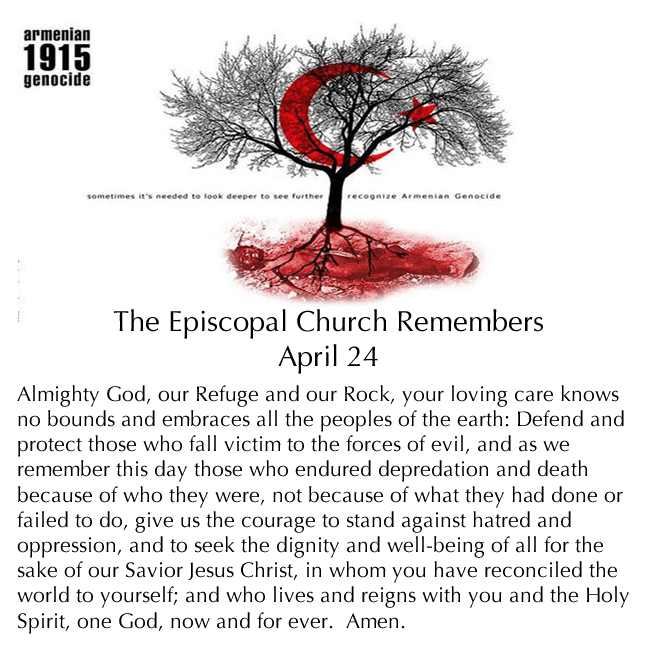
Remembering the Armenian Genocide

As you remember we direct you to a previous post: One Million Bones. Beyond remembering, the Spirit urges us to actions of healing and reconciliation and the promoting of a just peace throughout our world.

The Heavenly Jerusalem | Art for Easter 5C

The Heavenly Jerusalem
c. 1090
Fresco
San Pietro al Monte, Civate
ROMANESQUE PAINTER, Italian
(active 1090s in Lombardy)
Click image for more information.

______________
Commentary by Hovak Najarian

The Heavenly Jerusalem, Fresco, c. 1090-1100, Unknown Artist

In the Book of Revelation, John’s description of the Heavenly Jerusalem includes the following passages:

[The holy city Jerusalem] had a great, high wall with twelve gates, and at the gates twelve angels, and on the gates the names of the twelve tribes of the sons of Israel were inscribed. On the east three gates, on the north three gates, on the south three gates, and on the west three gates. (Rev. 21: 12-13)

[John was shown] the river of the water of life, bright as crystal, flowing from the throne of God and the Lamb through the middle of the street of the city, also, on either side of the river, the tree of life…(Rev. 22: 1-2)

John’s description of the “Heavenly Jerusalem” is illustrated in a primitive yet straightforward manner in a fresco painted by an unknown artist on the eastern vault of the Church of San Pietro al Monte (Saint Peter in the Mountain), Civate, Italy. The artist, following John’s words (cited above) depicts the four walls that surround the New Jerusalem. There are three arched gates on each of the four walls; they represent the twelve tribes of Israel and each contains an angel. The names of the tribes are written within the arch of the gates but because of faded color and damage to the fresco, only a few of the names are discernable.

In the center of the fresco, framed by the four walls is God, the focal point of attention. In accordance with his importance, God is depicted much larger in scale than anything else in the painting. He is sitting on a throne with a Lamb at his feet and a staff in his right hand. His left hand is holding an open book with the words “Qui sitit veniat” (Let him who thirsts come). Between God’s feet is the river of life flowing from the throne. It spreads out to become four rivers; thus indicating the Gospel is preached to every corner on earth. A tree of life is placed on either side of God.

In Italy during the eleventh and twelfth century, the Byzantine influence remained a factor in art. Several centuries more would pass before changes brought on by the Renaissance would take place.
Note

San Pietro al Monte is on a mountain about an hour’s climb upward from Civate, Italy. It is not certain why it was built in such an isolated place or the exact date it was constructed. The following is one of the legends: Lombardy King Desiderius built San Pietro as a result of a dream in which he was told if a church were to be built there, his son’s sight would be restored. After it was built, the king asked the pope for relics for the church. He was given the right arm of Peter and links from the chain that bound him.

Hovak Najarian © 2013

Healing of the Cripple and Raising of Tabatha | Art for Easter 4C

Healing of the Cripple and Raising of Tabatha
Healing of the Cripple and Raising of Tabatha (right view)
1426-27
Fresco, 255 x 162 cm (full fresco)
Cappella Brancacci, Santa Maria del Carmine, Florence
MASOLINO da Panicale
(b. 1383, Panicale, d. 1447, Firenze)
Click image for more information.

______________
Click here for the left view and for other works from the Cappella Brancacci.
Commentary by Hovak Najarian

Healing of the Cripple and Raising of Tabitha (right side), fresco, 1426-27, Masolino da Panicale, c.1383-1447

Painter Tommaso di Christoforo Fini was born in Panicale, Italy and called Masolino (Little Tommaso) – hence the name by which he is known: Masolino da Panicale.

Some aspects of Masolino’s life are unclear because another artist with a similar name was active during his lifetime. Even the artist and biographer Giorgio Vasari was inaccurate in details about him. According to Vasari, as a young man Masolino worked for Ghiberti. Yet, known facts indicate this information is likely to be incorrect. Also, because Masolino worked closely with Masaccio in the Brancacci Chapel, there are questions regarding correct attribution of some of his paintings. The fresco, “Healing of the Cripple and Raising of Tabitha,” however, is regarded to be the work of Masolino alone.

In the Acts of the Apostles an account is given of a time when Peter was in Lydda. He encountered a man who had been paralyzed for eight years and he said to him “Aeneas, Jesus Christ heals you. Rise up and make your bed.” (Acts 9:33-35). Aeneas was healed. Another account took place in Joppa where a woman named Tabitha had died; she had been a person “…full of good works and acts of charity.” Peter, being in nearby Lydda, was asked to go to her. He went, prayed, and said, “Tabitha rise!” She opened her eyes, saw Peter and then sat up (Acts 9:38-42). These events did not happen on the same day, not in the same town, and definitely not across the street from each other. Yet, Masolino combined the two stories in a single painting. He placed both miracles in an early fifteenth century Italian architectural setting in a pictorial space that was created by recently discovered linear perspective. On the left side of the painting, Peter is healing Aeneas and then on the right side (the portion shown above) Peter is across the street raising Tabitha from the dead. In the biblical account, Tabitha’s body was placed in an upper room. Masolino used artistic license and placed her conveniently at street level in a covered porch.

In Acts, both the Jewish name, Tabitha, and the Greek name, Dorcas, are given as the name of the woman who was raised from the dead. They both mean “gazelle.” The use of the two names for the same person suggests this Gospel was intended for Gentiles as well as Jews.

Note

Placing separate events in a single painting (as we see in the work by Masolino) is a compositional device used regularly by contemporary artists. If an artist today were to make an image using a photograph of Julia Child chopping onions and then were to combine the photo digitally with photographs taken at a later date while she was stirring beef stew or baking a cake, we would accept it as “composite information” about Julia. The terms “correct” or “incorrect” do not apply to this form of composition.

Hovak Najarian © 2013

Prayers to begin, but what is to follow?

2016-04 Lahore

April 4, 2016 [ACNS, by Gavin Drake] Around 200 Christians, Muslims and Hindus gathered yesterday (Sunday) at the site of last weekend’s horrific Easter Day bomb attack for a united act of solidarity and sympathy for the victims of the attack.

This weekend’s gathering at the Gulshan-e Iqbal Park began with a peaceful demonstration at 5.40 pm – the exact moment that last week’s blast occurred.

[…] Candles were lit and Christian, Muslim and Hindu religious leaders – including the Moderator of the Church of Pakistan, Bishop Samuel Azariah, joined hands as they prayed for the victims and their families.

Amongst the 200 people present were representatives from the Episcopal Church’s Diocese of Louisiana and the presbyterian Church of Scotland. The Church of Pakistan is a United Church. In addition to being a province of the Anglican Communion it is also a member of the World Council of Reformed Churches and the World Methodist Council. See: http://www.anglicannews.org/news/2016/04/multi-faith-vigil-for-lahore-easter-bomb-victims.aspx on Anglican News Service

As the article goes on read how the Archbishop of Canterbury was confronted with words asking for more than platitudes, no matter how compassionate. The Archbishop’s unnamed friend was asking for involvement.

What do you hear the Spirit saying?

Photo Credit: Diocese of Raiwind on Anglican News Service

The Conversion on the Way to Damascus | Art for Easter 3C

The Conversion on the Way to Damascus
1600-01
Oil on canvas, 230 x 175 cm
Cerasi Chapel, Santa Maria del Popolo, Rome
CARAVAGGIO
(b. 1571, Caravaggio, d. 1610, Porto Ercole)
Click image for more information.

______________
Commentary by Hovak Najarian

The Conversion on the Way to Damascus, Oil on Canvas, 1601, Caravaggio, 1571-1610

Like other artists who became known by the place of their origin, Michelangelo Merisi was called “Caravaggio,” the Italian city of his birth. After studying art in Milan, Caravaggio went to Rome at age twenty and, after three years of poverty, his fortune changed when a few of his paintings were bought by the influential Cardinal del Monte; this led to other important commissions.

During the Renaissance in Rome, heroic events were painted and subjects seemed to exist in a lofty idealized classical world – an “art” world. Artists of the century that followed painted in the “manner” of the Renaissance but seemed to lack a guiding direction; often virtuosity was substituted for substance. By the time Caravaggio went to Rome almost a hundred years had passed since the High Renaissance and he was neither smothered by its idealism nor enamored with the exaggerations of the Mannerists. Instead, he brought naturalism into his work. His models often were selected from earthy low life people of the streets and Caravaggio painted them as they were (dirty feet, fingernails, and all). Prettiness did not interest him.

Caravaggio’s “Conversion” depicts Paul as a young armored soldier who had been traveling by horseback on his way to persecute Christians in Damascus. The painting gives us the moment a blinding light struck Paul and caused him to fall to the ground. In this unusual arrangement of images, the upper portion of the painting is dominated by nothing more than the body of Paul’s horse. A companion, who is mostly in shadow, has a hand on its bridle. In the center are numerous legs; portions of which are highlighted by the intense light and Paul is at the very bottom lying helpless. When an artist is organizing a composition, the principal subject is placed usually in a prominent position but Caravaggio’s painting limits the physical space given to Paul. About two-thirds of the way down, a foreshortened Paul is flat on his back. His sword is off to one side, his helmet has fallen from his head and his arms are raised as though he is confused by the suddenness of what happened. Caravaggio’s use of extreme contrast keeps our attention in the foreground; there is no middle ground or background and we are not able to enter visually the dark areas of the painting. He keeps our focus directly on the event.
Note

Caravaggio’s genius was in identifying with his subjects and in having an ability to communicate the feelings they were experiencing.

In his personal life, Caravaggio was in constant trouble with authorities and was not a person you would want to meet. He was in arguments and brawls frequently, and after one of his fights the person he struck died. He fled from place to place but high regard for his art brought commissions and he painted masterpieces of dramatic impact even as he ran from the law.

Hovak Najarian © 2013

Incredulity of St. Thomas| Art for Easter 2C

John 20:26 A week later his disciples were again in the house, and Thomas was with them.

Incredulity of St Thomas
1572
Oil on panel
Santa Croce, Florence
VASARI, Giorgio
(b. 1511, Arezzo, d. 1574, Firenze)
Click image for more information.

______________
Commentary by Hovak Najarian

Incredulity of St. Thomas, Oil on Panel, 1572, Giorgio Vasari, 1511-1574

The High Renaissance took place in the last quarter of the fifteenth century and continued into the early part of the sixteenth century. By the time Giorgio Vasari was nine years old, however, many of the noted artists were no longer living. The exceptions were Titian and Michelangelo (who lived to be almost ninety years old). Renaissance advancements in art were now left to be sorted out by the next generation. Vasari regarded himself as part of the Renaissance; believing it continued until the death of Michelangelo (1564) and that he and his generation were part of it. In a broader sense he was correct but art historians today use the term “Mannerist” when referring to sixteenth century artists. Unlike artists of the prior century, it was not necessary for Mannerists to be pioneers in finding solutions to technical problems of art. Instead, they often used their abundant skills to emphasize style, dramatic effect, and virtuosity.

When Vasari was young, his precociousness was noted and he was selected to be schooled with members of the prominent Medici family; as an adult this contact was invaluable to his career. When Cosimo I de’ Medici funded changes at the Church of Santa Croce, Florence, he chose Vasari to be the architect and painter. Vasari painted scenes from Christ’s Passion – as well as events that followed – for the private chapels of the Church; the “Incredulity of Thomas” was painted for the Guidacci Chapel. Thomas, having said he would not believe Christ was resurrected until he himself saw the wounds on his hands and side, is shown with Jesus at a gathering with disciples. Vasari leads our attention immediately to center stage where Christ stands bare-chested with arms wide apart as though to say, “Go ahead, see for yourself.” Thomas examines the wound on Christ’s side as people rush out from a background door to also look. Angels have arrived and are floating above, and cherubs are on either side of the arch. The dramatic lighting and hand gestures of Christ and those in attendance add to the theatricality to this scene.

Note

Giorgio Vasari was immensely famous during his lifetime but now he is cited more often for his writings on the lives of artists. The necessity to rely on secondhand sources at times resulted in a few points of misinformation but on a whole, his work provides invaluable insights into the art and artists of his time.

When reference is made to the “High Renaissance” and the time period is elusive, it may help to know Christopher Columbus was a contemporary of Michelangelo, Raphael, and Leonardo. While they were making art, he was sailing. “In fourteen hundred ninety-two, Columbus sailed the ocean blue.”

Hovak Najarian © 2013