Information, reflection, questions, opinions and study helps for one or more of the readings appointed for the Sundays and Major Feasts of Year B in the Revised Common Lectionary used by the Episcopal Church.
Wind Chimes is being reborn as Wind in the Chimes.
In the time of the coronavirus it seems opportune to revisit and rename Wind Chimes—for a short time it was a regular feature of this Blog.
In the original post I wrote:
When a wind chime catches the wind (even the whisper of a wind) it makes music, it interprets the wind in ways that are always the same and always changing. In regular posts I will share links to news (religion news), reflections and meditations (related to our Sunday readings as often as possible), prayers or prayer starters, resources to help you keep learning and growing (spiritually), and whatever else I come across.
Wind Chimes posted September 25, 2012 on Hear what the Spirit is saying
Renamed “Wind in the Chimes” the intent remains the same: to help us better hear what the Spirit is saying.
The Vision of the Lord Directing Abraham to Count the Stars, wood engraving, 1860, Julius Schnorr von Carolsfeld, 1794-1872
Commentary by Hovak Najarian
The Book of Genesis gives an account of Abram being visited by God. Abram was notified of God’s covenant and that he (Abram) would be the ancestor of a multitude of nations. Abram was told, “Look toward heaven, and number the stars, if you are able to number them” and God said, “So shall your descendants be.” Abram was ninety-nine years old when his name was changed to Abraham (“father of many” in Hebrew) and a covenant with God was made.
In nineteenth-century Europe during the lifetime of German artist, Julius Schnorr von Carolsfeld, there was renewed interest in classicism. This interest in Greek and Roman art was due partly to the discovery of the Roman cities, Pompeii and Herculaneum during the eighteenth century. In AD 79, these two cities were buried by the volcanic ash of Mt. Vesuvius. Cultural changes also brought conditions that favored a return to classicism. Artists who worked in this “neoclassic” style tended to take a formal and intellectual approach to art. Their contemporaries, the Romanticists led by Eugene Delacroix, however, believed art should come from the heart and reflect emotions. When Schnorr first studied in Rome, he admired the art of the late middle ages and Early Renaissance. Later, he was influenced by artists of the High Renaissance, but by mid-nineteenth century, at the time he engraved, The Vision of the Lord Directing Abraham toCount the Stars, there was dramatic action (a characteristic of Romanticism) in his work.
Schnorr first studied engraving with his father and then attended the Vienna Academy in Austria. From there he went to Rome and joined a brotherhood of likeminded artist who sought a return of spiritual content in art. The artists that were part of this fervent group affected biblical manners in their clothes and hair and were soon called, “The Nazarenes.” After ten years in Rome, Schnorr returned to Germany and settled in Munich where he established a successful career painting frescos and designing windows for churches.
While on a visit to London in 1851, Schnorr was commissioned to create a Picture Bible. During the next eight years, he completed more than two hundred wood engravings in which he interpreted biblical stories and events. Schnorr’s Bible contains the dramatic engraving that depicts God calling Abraham’s attention to the heavens. When Abraham looked at the stars, he was awed and fell to kneel on one knee. God is there before him pointing to the stars. As in Michelangelo’s Creation of Adam in the Sistine Chapel, God is shown surrounded by figures symbolizing unborn generations that are to come to earth when it is their time.
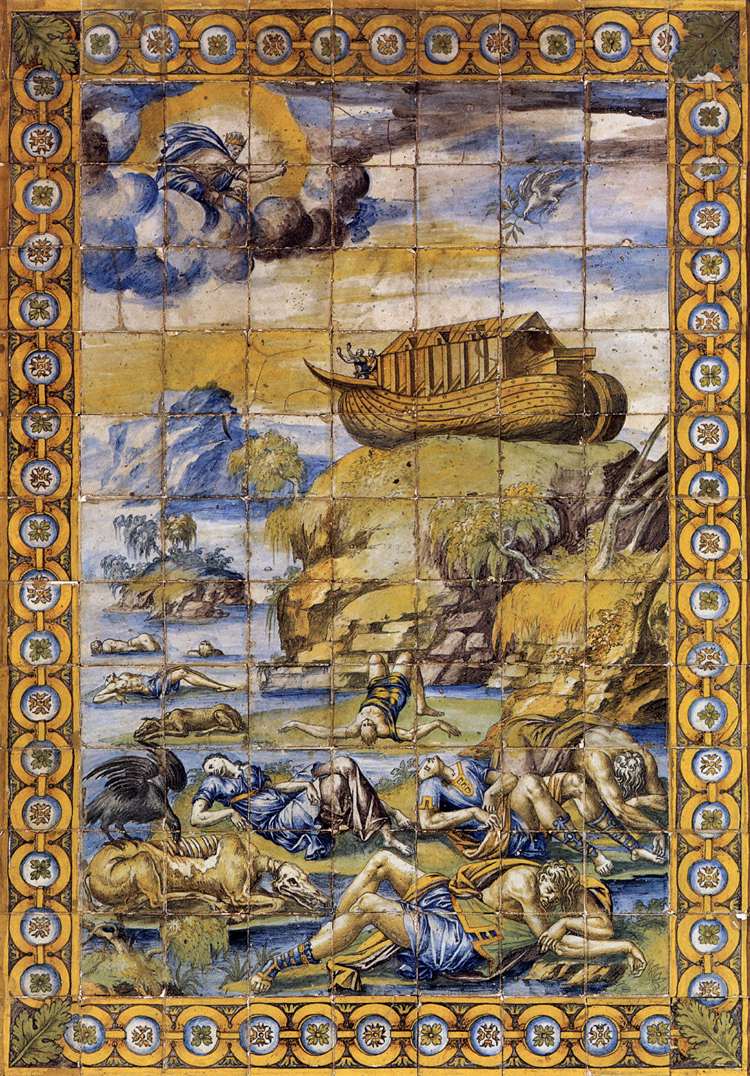
Imagining the moment before the covenant with Noah is made.
God said to Noah and to his sons with him, “I am now setting up my covenant with you, with your descendants, and with every living being with you-with the birds, with the large animals, and with all the animals of the earth, leaving the ark with you.” ~Genesis 9:8-10 CEB
The Flood, ceramic tile, 1550, Masséot Abaquesne, c.1500-1564
Commentary by Hovak Najarian
Clay often is regarded to be a lowly substance. It is formed by decomposed rock and organic matter and is used to make bricks and drainpipes. It is underfoot as pavers, and in art it is a material associated with pottery and the crafts. It is not used regularly by artists as a surface on which to paint. Masséot Abaquesne’s “The Flood,” depicting the landing of the ark, is an example of the problem with categories when art is shoe-horned into being either “fine arts” or “crafts.” Abaquesne used tiles, glaze, and metal oxides to create a painting on clay; not on wood panels or canvas.
Abaquesne had a successful ceramics business in Rouen, France. His studio specialized in majolica (muh-JAHL-i-kuh) and faience (pronounced fay-AHNS – French for Faenza, a major ceramic center in Italy), and he was influenced generally by Italian art. For The Flood, Abaquesne used a tiled surface instead of a large single flat piece because clay shrinks when it is fired and in the process, large pieces tend to warp and not remain flat.
To make “The Flood,” a majolica technique was used. The earthenware tiles were fired at a low temperature then covered entirely with a white glaze but not fired again until after Abaquesne created his painting (on the unfired white surface) using coloring pastes made with oxides: cobalt for blue, iron for dark reddish brown and antimony for yellow. It was then fired in the kiln a second time. The work shown here is one of three created by Abaquesne on the subject of the flood. [Building the ark and boarding it are the subjects of the other two works.] This scene depicts the flood after the water has subsided and the ark has landed. In a dramatic depiction of the aftermath of the event, drowned figures are strewn about and a carrion-eating bird is dining on a dead horse. On the right side of the sky, a dove is returning to the ark with an olive branch and God is in a cloud on the left side observing everything below.
Note:
Majolica ware originated in Spain and during the Renaissance it became very popular throughout Europe. The name is believed to be derived from the Spanish island, Majorca.
In addition to a glazing technique,” faïence,” is a term given to a low fired non-clay material used in ancient Egypt for crafting objects such as small blue scarabs and hippopotami. When archeologists discovered these objects, the color reminded them of the blue glaze that was made famous in the town of Faenza, Italy. They referred to the material as “faience.” Although Egyptian faience is not glazed clay, the term has remained in use.
And [Jesus] cured many who were sick with various diseases, and cast out many demons; and he would not permit the demons to speak, because they knew him. ~Mark 1:34
The Race Track (Death on a Pale Horse) oil on canvas, c.1886-1908
Albert Pinkham Ryder, 1847-1917
Commentary by Hovak Najarian
During the latter part of the nineteenth century, America was engaged in rapid growth in the areas of manufacturing, commerce, and the building of railroads. The arts were not a priority. Serious artists were likely to go to Paris to absorb the culture and milieu during an era that brought great changes in the arts of Europe. Artists who remained in America often studied in New York City and then lived there, or nearby, as they built careers and established reputations.
Like the bohemian life in Paris, artists in New York’s Greenwich Village lived in a place where they could work, socialize, and be unencumbered by the expectations and values of society at large. For most of his adult life, Albert Pinkham Ryder, lived in The Village and was dedicated to painting. He had no desire to pursue fame, or accumulate material wealth. While his contemporaries in France, the Impressionists, were going outside to paint the effects of sunlight, Ryder stayed indoors and most of his images developed from within himself. An exception was TheRace Track that he painted as the result of a direct experience.
Ryder often dined at a hotel in The Village where his brother was the proprietor. In a conversation one evening, he learned that his waiter gambled on horses and was excited about a much publicized race that would be held the following day. The waiter was going to place his entire savings on a horse that he believed would win. On the day after the race, Ryder returned to the hotel but the waiter was not there. When he inquired, he was told the favored horse came in third and the man lost his entire savings. He was unable to cope with his loss and took his own life.
Ryder’s painting, The Race Track, also known as, Death on a Pale Horse, depicts a lone skeleton-like figure on horseback carrying a scythe and circling the race track in a reverse direction. The track’s fence is broken in two places and the landscape is barren except for a lone dead tree. The race track, a metaphor for life, circles endlessly. In the foreground, a snake represents symbolically Satan, temptation, and betrayal. The man that took his life was possessed with gambling and to Ryder, the race track was, in effect, his death. As in the four horsemen of the Apocalypse, Ryder has placed the figure of death on a pale horse.
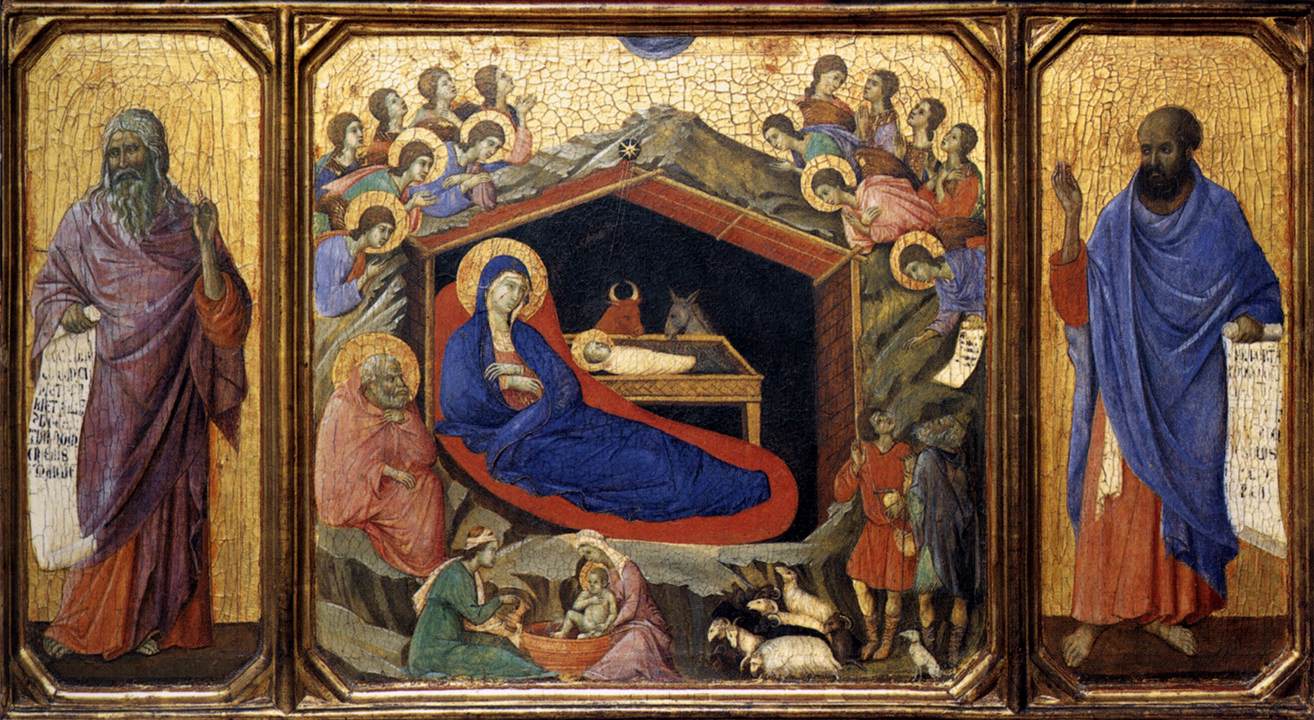
Our faith, our story, seen through the eyes of Duccio.
The Nativity (with the Prophets Isaiah and Ezekiel), 1308-1311, egg tempera, Duccio di Buoninsegna, c. 1255-1319
Commentary by Hovak Najarian
Duccio’s “Nativity” was once part of the Maesta (Majesty) which served as an altarpiece for the Cathedral of Siena, Italy. When the painting was completed in 1311, it was composed of a very large panel of the Madonna and Child surrounded by saints and angels. Its base – called a “predella” (Italian for “foot stool” which it resembled) – was below the main panel. It served physically to support the altarpiece and visually to depict seven scenes of the birth and early life of Christ. In its original form, an Old Testament prophet stood to the right of each event holding a scroll on which a passage written by him pertained to the scene.
Duccio’s “Nativity,” the second scene in the predella, takes place in a grotto with Mary reclining on a red cushion in a royal robe of blue. In keeping with the practice of increasing a person’s size in accordance with their importance, she is much larger than the other figures. In the manger, the baby Jesus is being watched over by an ox and an ass and many angels have gathered above them; some are looking heavenward in praise and others are leaning over for an adoring glance at the baby. A small star is at the peak of the cave entrance with its rays shining onto the face of Jesus. Below the figure of Mary are two related scenes. On the left, two midwives are bathing the newborn Jesus and on the right, angels are announcing Jesus’ birth to the shepherds as they stand with a sheepdog and their flock. On the left side, Joseph is sitting outside of the grotto in a pink robe, To the right of this scene is a painting of Ezekiel holding a scroll with his words; “This gate shall be kept shut: it shall not be opened, and no man may pass through it.”
In the early eighteenth century, the Maesta altarpiece was taken apart in order to divide it between the two altars of the Cathedral of Siena. During this process, damage was caused and some parts of the painting became separated and lost. Other sections were purchased and placed in museums. One of the results is Isaiah now is not with the scene to which he and his words belong. The scroll he is holding states; “Behold a young woman shall conceive and bear a son and shall call his name Immanuel” and he was placed originally at the immediate right of the “Annunciation,” (the first scene of the predella). He was separated from it and is now at the National Gallery of Art, Washington, DC standing next to the “Nativity.” Isaiah is not looking toward the birth of Jesus because in the original he was looking toward the Archangel Gabriel’s visit to Mary. The painting of the “Annunciation,” to which his words of prophecy apply is an ocean away in the National Gallery of London without its accompanying prophet, Isaiah.
Posting to resume in the Season of Epiphany (2018).
With determination (and hope) posts will again appear on our Hear the Spirit site as the Season of Epiphany (2018) begins. We invite you to come, read, and comment as you “Keep Learning” and growing in Christian maturity.
Job 38:1-7 Then the Lord answered Job out of the whirlwind: “Who is this that darkens counsel by words without knowledge? Gird up your loins like a man, I will question you, and you shall declare to me.
Job Confessing his Presumption to God who Answers from the Whirlwind 1803-05 William Blake 1757-1827 Pen, ink and watercolour over pencil on paper, 393 x 330 mm National Gallery of Scotland, Edinburgh Click image for more information
In his youth, William Blake studied engraving and attended briefly the Royal Academy in London but his art did not reflect the academic teachings of his day. Instead, the art of the Middle Ages and the Renaissance was Blake’s early interest and the influence of other historical sources was minimal. Unlike the landscape paintings of his contemporaries, Blake’s images came from within. He spoke of visits from heavenly beings and his work often is referred to as visionary. Even when we are unsure of what is being depicted, we become engaged usually by his provocative imagery.
The setting for the illustration of God answering from the whirlwind is at a time when it seemed nothing more could be done to further the anguish and discomfort of Job. All of his livestock was stolen, his thousands of sheep perished in a fire, a strong wind destroyed his house and killed his ten children, he was covered with sores, and his wife ridiculed him. His friends thought this was all brought on by his sins and advised him to confess. Job insisted adamantly that he had done no wrong and had, in fact, adhered to all of the teachings of God. At this time he had nothing more to lose and demanded answers from God regarding the cause of his losses and suffering. God came to him and spoke from a whirlwind. Instead of revealing reasons for the suffering endured by Job, however, God responded with profound questions on subjects ranging from the marvels of the creation to the wonderment of the earth and the heavens. As God brought attention to these things, Job came to realize how little he understood of the infinite differences between God’s realm and his. After God spoke, Job’s health, possessions, and family were restored.
Blake admired the work of Michelangelo and, in “Job Confessing,” a bearded God has similarities to the image of God in the Sistine Chapel’s “Creation of Adam.” Blake’s image, however, is lighter and much less physical in its appearance. There is a dream-like effect in the whirlwind that is formed by angels swirling around God and swooping down as they speed past Job and go on to move across the land. Job is kneeling and looking up with fingers spread in a state of awe. His wife and friends are overwhelmed and frightened as they bow down on the ground near him.
Note
During the late eighteenth and early nineteenth century there was a reaction to the impersonal intellectualism that tended to be part of neoclassicism. To the romanticists, feelings were important and their work often was imbued with emotional and dramatic content. Although Blake’s work was not part of the mainstream of art, it was part of the romantic tendencies of his time.
The Book of Job was of longstanding interest to Blake and he returned to it regularly. Twenty years after creating, “Job Confessing His Presumption to God who Answers from the Whirlwind,” he again took up the theme and made twenty-two illustrations on subjects based solely on the Book of Job.
Blake was not only a visual artist he also was a very gifted poet and writer. His poems, such as The Tiger, [“Tiger, tiger burning bright, in the forest of the night…”] are widely known.
It is easier for a camel to go through the eye of a needle …
Mark 10:24-25 And the disciples were perplexed at these words. But Jesus said to them again, “Children, how hard it is to enter the kingdom of God! It is easier for a camel to go through the eye of a needle than for someone who is rich to enter the kingdom of God.”
We are so accustomed to seeing line drawings that we tend to forget that lines are seldom seen in nature. Lines are an invention of humans and they often are used as a form of shorthand to depict a subject without focusing on every detail. Because it is in our nature to want a sense of completion, our mind supplies meaning to spaces within a drawing. An apple is a three-dimensional solid object but by drawing an outline of it on paper to indicate where the substance of it ends and the space around it begins, the idea “apple” is communicated. Our mind completes and interprets the area enclosed by the line. There are no actual lines on a camel’s face but, in Camel Pondering the Needle, Julie Hirsch follows the contours of its features. Even though other visual elements such as color, texture, and shape are missing, line is all that is needed to communicate its form. A closer look, however, is required to discover the drawing’s central message.
The drawing refers to Christ’s statement, “It is easier for a camel to go through the eye of a needle, than a rich man to enter into the kingdom of God” (Mark 10:25). Hirsch created an image of a camel contemplating this seemingly impossible task. The title tells us the camel is pondering a needle yet this beast of burden is looking straight ahead with no obvious needle in its line of vision. There is no dotted line (as in cartoons) connecting the eyes of the camel to a needle. The needle’s eye, however, is an essential part of the drawing. Artists such as Jan van Eyck and Diego Velazquez introduced subjects into a painting by reflecting them in a mirror. In Hirsch’s drawing we are given the sense that the eye of the needle is being observed keenly and being pondered deeply as we see its reflection in the camel’s eyes.
Note
Before there were written languages, drawings were used as a means of communication. When Phoenicians wanted to communicate a visual image of an ox (called “aleph”), they made a simple line drawing of its head and horns. At the time they made their phonetic alphabet (the word phonetic is derived from “Phoenician”) the drawing of an ox was simplified further into three straight lines. It looked like the letter “A” toppled over on its side with the cross bar extended. It is not difficult to imagine these lines as an ox head with horns and ears. “Aleph,” as a pictograph of an ox, became the first letter of the Phoenician alphabet (“aleph” continues to be the first letter of Hebrew and other alphabets). Their second letter was “beth,” their word for “house.” When the Greeks borrowed these letters; they placed the point of the “A” upward and “aleph” was changed to alpha in order to fit the sounds used in their language. The Greeks called their second letter beta. These two pictographs became the source of our word “alphabet.” In our alphabet, simple lines are made to create letters that represent sounds, and letters are placed together to make words. This contributed immeasurably to the spread of knowledge. “A picture is worth a thousand words” is not always true; yet today, thousands of years after the invention of written languages, drawings and other visual media continue to be essential. They enable us to communicate ideas that are impossible to express in words.
Here is an accessible look at the events of Holy Week. When was the “Last Supper” and was it a Seder? When was Jesus tried, condemned, and crucified? Let Jonathan Klawans guide your exploration:
Many people assume that Jesus’ Last Supper was a Seder, a ritual meal held in celebration of the Jewish holiday of Passover. And indeed, according to the Gospel of Mark 14:12, Jesus prepared for the Last Supper on the “first day of Unleavened Bread, when they sacrificed the Passover lamb.” If Jesus and his disciples gathered together to eat soon after the Passover lamb was sacrificed, what else could they possibly have eaten if not the Passover meal? And if they ate the Passover sacrifice, they must have held a Seder. […]
… I believe we must be careful not to let our emotions get the better of us when we are searching for history. Indeed, even though the association of the Last Supper with a Passover Seder remains entrenched in the popular mind, a growing number of scholars are beginning to express serious doubts about this claim.
In the middle of yesterday’s (8/5/12) conversation about being called (to know Christ, to be holy as our God is holy) and calling (to be a wife, a husband, a father, a mother, a member of the choir, a member of the Altar Guild, an intercessor in prayer, a team member working in the food distribution ministry, a neighbor, a co-worker, a teacher and you get the idea) I read this from Professor Hanvik in his commentary on Ephesians 4:1-16
Paul pairs the words “called” and “callings” in two different places in the passage (4:1 and 4:4). The reader is reminded of the relationship between our being called by God and the subsequent assignment of a calling in the world. The language of calling links the church with the election of Israel. God has chosen for himself (1:4) a people and this election depends firmly on God’s decision. It is done “before the foundation of the world” (1:4) and it relies solely on God’s gracious initiative (2:8). And the result of being called is that the faithful now have callings where they lead lives marked by humility, love and patience (4:2).
It is easy to get confused about the dual nature of a call. It is worth underlining that being called and having a calling must be distinguished but never separated. Our relationship with God simultaneously involves a relationship with neighbor or community. And these callings are multiple as it is impossible for a Christian to not be in some type of calling at all times of life.
Just as God is active in every nook and cranny of creation so God uses his people to make sure people are fed, clothed, comforted, educated, protected, etc. Proclaimers would be wise to remind listeners that a calling should not be pared down to a job or occupation. This would mean wide stretches of human experience would be outside of God’s providence. God calls us not only to work but to friendship, family life, citizenship, etc. —WorkingPreacher.com for August 5, 2012
It was a terrific conversation. Thank you. I learned a lot. Please continue the conversation here using the Comment section which follows the post. Bless you, dear reader, bless you as you bless others by exercising the ministries to which you have been called.





 Hear what the Spirit is saying
