Praying Saviour | Art for Proper 12C

Praying Saviour
CSONTVÁRY KOSZTKA, Tivadar
Praying Saviour
1903
Oil on canvas, 100 x 82 cm
 Janus Pannonius Múzeum, Pécs
Click image for more information.

Commentary by Hovak Najarian

Praying Saviour, oil on canvas, 1903, Tivadar Csontváry Kosztka, 1853-1919

During the lifetime of Hungarian artist, Tivadar Csontváry Kosztka, great changes were taking place in European art. During the first two-thirds of his life – a time when he was not painting at all – the Impressionists and Post-impressionists in France already had changed conventional thinking about art and were opening the way for developments that would take place during the twentieth century. Csontváry, as he was known in Hungary, was forty-one years old at the time he began studying art and his major works were not painted until after the turn of the century. By this time, Les Fauves (“The Wild Beasts”) in Paris were revolutionizing the way color was being used and shortly after that the Cubists would be challenging the concept of pictorial space. Instead of following areas being explored by the avant-garde however, Csontváry, after a brief time in Paris, chose to follow his personal vision. The result is an art that does not fit easily into a specific category; it tends to be an “outsider art” with elements of fantasy.

It is difficult to discern the full meaning of paintings that are based on personal visions. An interpretation is often speculative and even when artists offer explanations their paintings may not support what they say. In the “Praying Saviour,” Csontváry places an elongated Christ with lengthy hands and upraised arms close to the center of the painting; his white robe stands out against the dark foreground. To the upper far left and on a higher level is Moses with stone tablets and to his right the city of Jerusalem is glowing in the distance. In the bottom foreground are mask-like faces; they have been interpreted as disciples, yet we cannot be sure. Their expressions seem to indicate something foreboding is near. They appear to be alarmed. Perhaps they have just learned that Christ will be put to death.

Painters often utilize well known symbols but artists also are known to employ personal signs. Among Christian symbols, a cedar of Lebanon represents Christ and Csontváry visited Lebanon to make paintings of them. In “Praying Saviour,” a tall cedar tree is included with two figures clad in dark clothes at its base kneeling over a slab on top of a tomb-like rectangular stone. It would be reasonable to assume the tree represents Christ and the stone represents Christ’s tomb. Csontváry, however, sometimes used a tree as his own personal symbol; the tree may have been his way of placing himself symbolically in the painting. [It is of course also possible this tree is only meant to be a tree representing nothing more than itself.] At an upper level behind the tree is a modern day church with its lights on and the sky glowing as it would at dawn. The church lights seem to be a beacon and people are being drawn toward it. Taken together, these images may be interpreted as representing the journey of Christianity. Moses with the tablets represents the Old Testament, Christ represents the New Testament, and the light from the church and sky represents the dawning of hope and enlightenment that was brought by Christ’s word.

Hovak Najarian © 2013

Christ in the House of Mary and Martha | Art for Proper 11C

Christ in the House of Mary and Martha
VELÁZQUEZ, Diego Rodriguez de Silva y
Christ in the House of Mary and Martha
c. 1620
Oil on canvas, 60 x 103,5 cm
National Gallery, London
Click image for more information.

Commentary by Hovak Najarian

Christ in the House of Martha and Mary, oil on canvas, 1618, Diego Velázquez, 1599-1660

In the seventeenth century, Flemish painter Peter Paul Rubens and Dutch artist Rembrandt van Rijn were the two most noted artists in northern Europe, and Diego Velázquez was the unrivaled master of painting in Spain. Velázquez graduated from Don Francisco Pacheco’s workshop academy in Seville, married his daughter, and a few years later moved to Madrid. Soon he was working for King Philip IV at the Spanish Court where he remained throughout his life.

While he was still in Seville, Velázquez further developed skills and expanded his range of subjects by painting domestic settings. Kitchen scenes were popular with the public and often they conveyed an underlying message connecting everyday life in Spain with biblical events. “Christ in the House of Martha and Mary” depicts a scene of a maid preparing garlic mayonnaise to go with the fish that will be served for dinner. The maid’s expression indicates she is upset and the woman behind her is calling attention to a scene in the upper right corner of the painting. We can not be sure if the smaller scene (like an inset) is intended to be a reflection in a mirror, a hatch (an opening) through which we are looking into an adjacent room, or a painting on the kitchen wall. Velázquez used devices such as reflections and paintings within paintings throughout his career.

In the usual interpretation of this painting, the two figures in the kitchen and the figures in the upper right hand scene are many centuries apart in time. The smaller scene shows Jesus seated in the home of Martha and Mary (Luke 10: 38-42). Mary is seated at his feet and Martha is standing behind her. In the biblical story, Martha became busy serving food and drink while Mary seemed oblivious to the fact that her sister was doing all of the work alone. Instead of helping her sister, Mary sat down and listened to Jesus. Martha was frustrated at this and wondered if Jesus cared that her sister was leaving all of the serving chores up to her; she hoped Jesus would ask Mary to help her. Jesus told Martha that her concern was misplaced and that in sitting and listening to him, Mary had made a good choice.

The frustration of the maid pictured by Velázquez is similar to that of Martha. She is trying to make preparations for a meal but is working by herself and is distraught about all that needs to be done. The woman behind her is calling the maid’s attention to the scene of Jesus, Martha, and Mary; pointing out that spiritual nourishment is an important part of life as well.

It has been suggested this kitchen scene is not set in seventeenth century Spain but rather is in the home of Martha and Mary when Christ was there. If this interpretation of the painting is accepted, the person believed to be an upset maid in the kitchen is actually Martha herself and the second woman with Jesus in the smaller scene is another guest.

Hovak Najarian © 2013

Elijah on the Fire-cart | Art for Proper 8C

Elijah on the Fire-cart
Giotto
Elijah on the Fire-cart (on the decorative band)
1304-06
Fresco
Cappella Scrovegni (Arena Chapel), Padua
Click image for more information.

Cappella Scrovegni (Arena Chapel), Padua

Commentary by Hovak Najarian

Elijah on the Fire-Cart (within a decorative band), Fresco, c.1304-06, Giotto di Bondone, c.1266-1337

When image makers created icons and illuminated manuscripts for Byzantine Churches, their efforts were toward projecting a spiritual realm; they were not trying to depict the familiar world of our daily experiences. In Italy during the late thirteenth century, however, changes were taking place; interest in earthly matters and the physical world was leading the way to the Renaissance. Art gave visual form to this changing world and Giotto (JOT toe) played a key role in the advancement of painting. Early in his career, he worked with Cimabue who was shifting away from Byzantine art but Giotto broke from it even further. He depicted biblical subjects with gestures and expressions of real people in a natural world.

Very early in the fourteenth century, Giotto received a commission to paint frescos in the Scrovegni (The Arena) Chapel in Padua. The cycle of paintings depicts events in the life of Mary’s parents, the life of Christ, and the Last Judgment. These paintings fill the entire walls of the Chapel and are divided by wide borders that simulate marble mosaic patterns. Within the borders are images of saints, prophets, and Old Testament figures that are related in subject to the paintings adjacent to them. The image of “Elijah on the Fire-Cart” – painted in a quatrefoil within the border – is not a dramatic presentation; the chariot and horses are not engulfed totally in flames but the plumes of fire and overall red coloration of both the horse and cart indicates it is definitely afire. A whirlwind is not indicated but drama was not Giotto’s intent. The placement of Elijah is in accordance with a custom of showing parallels between Old and New Testament events. As a person progresses forward in the Chapel the small painting of Elijah’s ascension inside the border will be seen just before seeing, “Ascension of Christ” to its immediate right. “Elijah and the Fire-Cart” serves only as a small tie-in within the border.

Note

The Scrovegni Chapel: The wealthy Enrico Scrovegni purchased land for a palace and private chapel at the site of a former Roman amphitheatre known as the “Arena.” Hence, the chapel is known as “The Arena Chapel.”

Quatrefoil: In the fourteenth and fifteen century, circles and squares were regarded to be perfect shapes. A “quatrefoil” (meaning four leaves) is a framework made of four circles of equal diameter arranged so they all overlap equally in the center. When the overlapping lines of the circles are removed, the space it creates serves as a frame for decorative additions to architecture. Giotto’s “Elijah in the Fire-Cart” is painted in a quatrefoil.

Space Probe: Haley’s Comet passed by the earth in the year 1301. Three years later when Giotto painted the “Adoration of the Magi” in the Arena Chapel, he used an image of the comet as the star of Bethlehem. In 1986, when the European Space Agency launched sensors to examine the nucleus of Haley’s Comet, they saw it fitting to name the probe, “Giotto.”

Hovak Najarian © 2013

Elijah Fed by the Angel | Art for Proper 7C

Elijah Fed by the Angel
TINTORETTO
Elijah Fed by the Angel
1577-78
Oil on canvas, 370 x 265 cm
Scuola Grande di San Rocco, Venice
Click image for more information.

Scuola Grande di San Rocco.

Commentary by Hovak Najarian

Elijah Fed by the Angel, oil on canvas, c.1577-78, Tintoretto, 1518-1594

During the Renaissance, the composition of many paintings seemed staged but on the ceiling of the Sistine Chapel, Michelangelo did not organize figures in tableau-like fashion. Later, when he painted, “The Last Judgment,” he introduced even greater dynamic movement. Many sixteenth century artists admired this aspect of his work and it was Venetian painter Tintoretto’s stated desire to emulate the drawing ability of Michelangelo. Like Michelangelo, Tintoretto was praised in his lifetime and history also has treated him kindly; today, he continues to be regarded as an artist of the highest rank.

When Tintoretto received the commission to create paintings for the Scuola di San Rocco in Venice (an institute dedicated to charitable work), he was free from the whims of patrons. He was given permission to develop his own themes. On the ceiling of Sala Superiore (the upper room of the Scuola di San Rocco) – referred to occasionally as Tintoretto’s “Sistine” ceiling – he painted thirteen scenes from the Old Testament. The themes are on the subject of thirst, hunger, and disease; Tintoretto’s “Elijah Fed by an Angel” is one of the illustrations showing God’s providence in times of hunger.

Biblical events leading to the time when Elijah was fed by an angel goes back to when the people of Israel along with King Ahab, and the priests of Baal went to Mt. Carmel for a display of God’s power. The priests of Baal and Elijah each built an altar. When the priests prayed for fire to offer a sacrifice, their efforts were in vain but when Elijah prayed, an intense fire engulfed the altar of God. After this demonstration, hundreds of the priests of Baal were put to death and King Ahab’s wife, Jezebel, a follower of Baal, became livid. Elijah feared for his life and fled to Beersheba in Judah where he went into the wilderness. He sat under a shrub, prayed, and being exhausted, fell asleep. While asleep, an angel brought bread and water to him. Tintoretto’s painting depicts Elijah lying motionless as he is sleeping in the shade at the edge of the desert. Above him is the angel descending with wings and arms outspread. Elijah was awakened by the angel and he ate the bread; he then fell asleep again. Elijah was awakened once more and told to eat because a long journey awaited him.

Note

A painting is a surface on which pigment has been arranged to create an image. The arts of literature, music, theater, and cinema are like journeys. A duration of time is required to travel, read or listen. It also takes time to fully absorb a painting but its subject can be seen superficially in its entirety at a glance; further study will reveal details and deeper content. Artists have found that similarity (of colors shapes, lines, and textures) forms a very strong visual bond. “Elijah Fed by the Angel,” is unified clearly by similar curvilinear forms. The curves unify the composition and are also related visually to the oval-shaped canvas.

Hovak Najarian © 2013

Elijah and priests of Baal | Art for Proper 4C

Elijah and the Priests of Baal
Lucas Cranach the Younger
1515-1586
Elijah and the Priests of Baal 1545
Oil on wood
1.275 x 2.42 m
Staatliche Kunstsammlungen, Gemäldegalerie Alte Meister, Dresden
Click image for more information.

______________

Elijah and the Priests of Baal, Oil on Wood, 1545, Lucas Cranach the Younger, 1515-1886

German artist, Lucas Cranach the Elder was known as one of the foremost painters and printmakers of the Northern Renaissance. For much of his life he worked for the Electors of Saxony and was an avid supporter of the Protestant Reformation. His son, Lucas Cranach the Younger, apprenticed with his father and often worked on paintings in the studio with him. At the death of his father, he took over as supervisor of the art workshop. Both Lucas Cranach the Elder and the Younger were friends of Martin Luther and each painted several portraits of him.

Lucas Cranach the Younger’s “Elijah and the Priests of Baal” depicts the result of a long conflict between the Prophet Elijah and King Ahab. When the king married the Phoenician princess, Jezebel, she brought the worship of the idol Baal with her. She convinced Ahab to allow the worship of Baal in Israel and had Jewish prophets put to death. Elijah left Israel and upon his return saw that conditions had become impossible; he demanded a showdown. He told King Ahab to take the people of Israel and the priests of Baal to Mount Carmel. When they were together he told the people their faith could not be divided; they couldn’t have it both ways. He said, “If the LORD is God, follow him, but if Baal, then follow him.” Elijah then proposed a test. Two altars would be built; firewood and a bull as a sacrifice would be placed on each one. Then each would pray for fire to burn the wood and offer the sacrifice. The priests of Baal built their altar and prayed fervently until after midday but their efforts were futile. When it was Elijah’s turn, firewood and the bull to be sacrificed were placed on the altar. For good measure, he dug a trench around its base and asked that four jars of water to be poured over the wood. He asked the same amount to be poured on it twice more causing the wood to be well drenched. As he prayed, fire from above came down dramatically and consumed everything. The water-soaked wood, the sacrificial offering, the stones, and even the water in the trench were engulfed in flames. When the people saw this, they fell down and said, “The LORD indeed is God; the LORD indeed is God.”

The painting, “Elijah and the Priests of Baal,” is crowded densely with people who are there to witness the resolution of this conflict. The altar built by Elijah is on the left side in the foreground and a dark cloud has gathered at the top center of the painting. Pellets of fire from the cloud are sending intense heat to the altar and even the water at the base of the altar is touched by the flame. Elijah is standing to the right of the altar with his arms raised in prayer and in the lower left corner are Elijah’s assistants with their empty water vessels. The altar of Baal is on the right and its wood and sacrifice remain untouched but the persistent priests of Baal are continuing to dance and pray even as the altar built by Elijah is consumed in flames. The crowd on the left is in awe, as is King Ahab who is standing between the altars and looking at the miraculous fire.

Hovak Najarian © 2013

Head of Judas | Art for Lent 5C

At the heart of the matter

John 12:4-6
But Judas Iscariot, one of his disciples (the one who was about to betray him), said, “Why was this perfume not sold for three hundred denarii and the money given to the poor?” 
(He said this not because he cared about the poor, but because he was a thief; he kept the common purse and used to steal what was put into it.)
Head of Judas
Head of Judas
Pencil, black chalk, paste, and watercolour, 562 x 435 mm
Musées de Strasbourg, Strasbourg
Westfälisches Landesmuseum, Münster
LEONARDO da Vinci
(b. 1452, Vinci, d. 1519, Cloux, near Amboise)
Click image for more information.

______________
Commentary by Hovak Najarian

Head of Judas, c.1495, Mixed Media, Leonardo da Vinci, 1452-1519

“The Last Supper” – a large mural in the refectory (dining hall) of the Convent of Santa Maria delle Grazie, Milan – took Leonardo three years to complete. Leonardo had in mind a physical likeness of each disciple and was known to leave his work to seek the image he wanted. Upon finding a face with the right characteristics, he would follow them unnoticed, observe them closely, and later make multiple sketches. The prior of the convent complained at length about these delays. On many days Leonardo would come to the refectory just to sit, observe, and think without picking up a brush; yet other days he would paint all day without a break.

Some of the sketches Leonardo made for the face of Judas have been lost and the one presented here (from the Strasbourg Museum, Germany) and others like it, is very likely to be a tracing made by one of Leonardo’s pupils. The “Judas” portion of a sketch of “Judas and Peter,” at the Ackland Museum at Chapel Hill, North Carolina is virtually identical to the Judas at the Strasbourg Museum. It is likely it also is a tracing made directly from Leonardo’s cartoon for “The Last Supper.”

When it is not known if a work is from the direct hand of a particular artist, historians and authenticators seek clues from sources such as notebooks, correspondence, sales records, materials (pigments, paper, etc), as well as an analysis of stylistic similarities to known works. Museums enjoy the prestige associated with possessing the work of a renowned artist and when authenticity has not been established fully, museums may connect a work to an artist by using terms such as, “Attributed to…” or, “Pupil of…”

In the facial expression and body language of each disciple, Leonardo sought to convey the very moment Jesus announced that one among them would betray him. In “The Last Supper,” Judas, in profile, is the fourth figure from the left. He is looking toward Jesus and was taken aback when he heard Jesus’ words. He is seated in shadow, his elbow is on the table, and he is clutching a money purse. Salt has spilled from a tipped shaker that is near Judas’ hand. The salt makes a symbolic connection to the Near-Eastern saying, “betray the salt,” meaning to betray one’s master.

Note

No…the man selected by Leonardo to be the face of Judas in “The Last Supper” was not the same person whose face was used to portray Jesus. This contrived story tells of an innocent young man who was selected to represent Jesus but later became a degenerate criminal with a face that personified evil. According to the legend, Leonardo did not recognize the man and used his face again; this time to portray the face of Judas. Like e-mail misinformation that is forwarded repeatedly as “fact,” this fabricated story continues to be told.

Because of the prior’s incessant complaints, Leonardo joked with the Duke of Milan, that if he couldn’t find a face for Judas, he might use the prior’s face. The duke mentioned this to the prior who did no more complaining.

Hovak Najarian © 2013

A beautiful response to Luke 3:21-22

May Imagine Us Beloved by Kayla McClurg invite you deeper into the “now” of the long-ago and far-away event of the Baptism of our Lord.

Imagine with me, if you will, a world in which vast numbers of people are hearing and beginning to integrate at heart and soul level that we, the same as Jesus, are God’s beloved. That we, too, are intended to hear the blessing Jesus heard at his baptism; that God bends over each of us and whispers, “With you, even in your current state of unfinished glory, with you I am well pleased.” Continue reading “A beautiful response to Luke 3:21-22”

Rest on the Flight into Egypt | Art for Christmas 2A

What happened after the Magi left the Holy Family?

Matthew 2:13 An angel of the Lord appeared to Joseph in a dream and said, “Get up, take the child and his mother, and flee to Egypt…”

Rest on the Flight into Egypt, engraving, c. 1470-75,
Martin Schongauer, 1430 -1491

Commentary by Hovak Najarian

 When Herod learned the “King of the Jews” had been born he was troubled and ordered all males at the age of two and under in Bethlehem and nearby regions, to be killed.  Joseph was warned by an angel about Herod’s plan so “he rose and took the child and his mother by night, and departed to Egypt, and remained there until the death of Herod.” 

 Martin Schongauer’s engraving is based on an account from the non-canonical Gospel of Pseudo Matthew.   It tells of a rest taken while the Holy Family was on their journey.  After three days, Mary was tired, hungry, and thirsty so they rested under a date palm; Mary looked up at the fruit but could see that it was too high to reach.  The baby Jesus said, “O tree, bend thy branches and refresh my mother with thy fruit.”  Schongauer depicts five angels bending the tree, thus allowing Joseph to reach the dates.  Jesus then asked water to flow from the roots of a palm and the family was refreshed. 

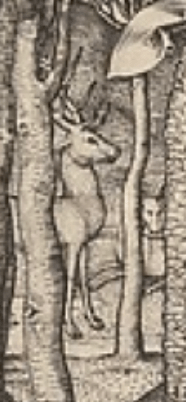
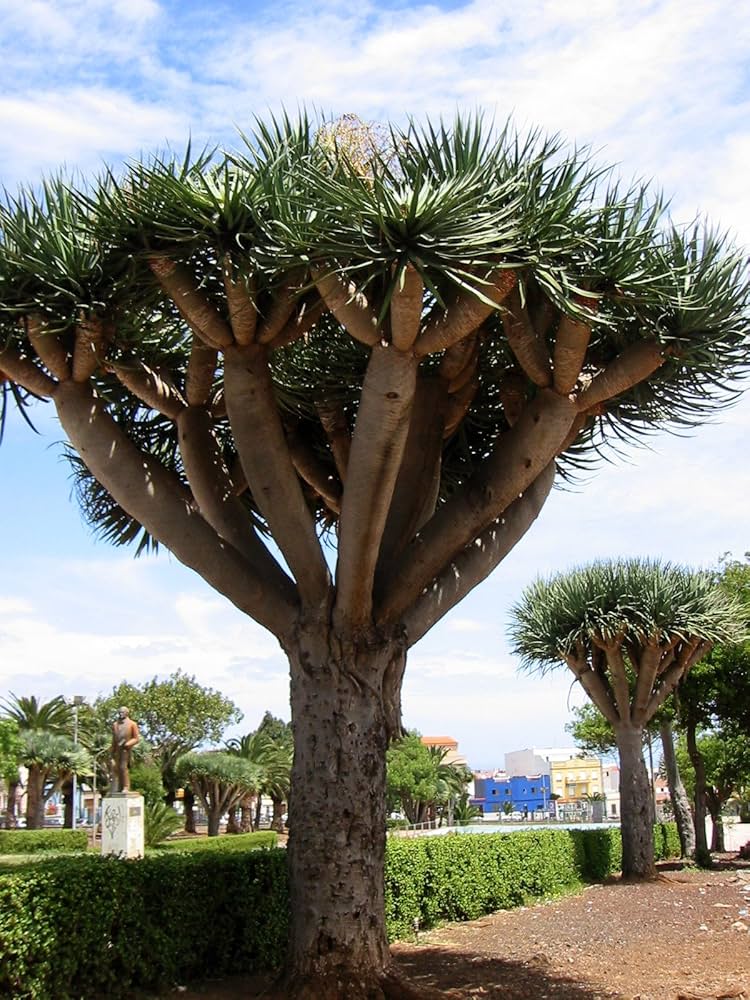
 It was a common practice for artists of this period to include symbolic content in their work.  Some of the flora and fauna in this engraving may seem gratuitous but in its day their meaning would have been understood.  The stag, a symbol for Christ and a destroyer of serpents, is standing watch through the trees in the background.  Stags shed their antlers every year and it was believed they renewed them by drinking from a spring; likewise people who drink from the spring of the spirit shed sins and are renewed.  A dandelion in the foreground on the right is a symbol of Christ’s passion and a reminder of the future that awaits the child.  The lily at the left foreground is a symbol of Mary’s purity, and at the far left is a dragon tree.  When the tree is cut it yields a red resin known as “dragon’s blood.”

 In Schongauer’s engraving, two lizards are on the trunk of the dragon tree and one is approaching it.  The presence of lizards, serpents, and dragons represents the devil and lurking danger.  At the very top of the tree is yet another symbol; a parrot.  Because a parrot has the ability to fly and talk they symbolize a messenger and are associated with the angel that brought word to Mary that she would give birth to Jesus.  In paintings of Mary, a parrot is sometimes placed on her shoulder as though it just arrived and said, “Ave Maria.” When not with Mary, a parrot may be placed high in a tree (as here in the dragon tree) where it cannot be reached by serpents.

More Information

Johannes Guttenberg invented moveable type and printed the Bible not long before Martin Schongauer engraved, “Rest on the Flight into Egypt,” but since most people could not read, art remained an essential means of learning stories of the Bible. During the fifteenth century the range of subjects expanded widely and stories about Mary were enhanced with lore. In addition to events such as the Annunciation and the Nativity, stories based on tradition often were included in illustrations of her life.

Hovak Najarian © 2013, 2020. Post updated 01.02.25


  Dragon trees are native to the Canary Islands.  It is possible that Schongauer saw one in Leipzig where the first botanical garden in Europe was established. 


This scene and folk story from The Gospel of Pseudo-Matthew (scroll down to chap 20) travelled to Europe becoming, with many changes, The Cherry Tree Carol.

The Cherry Tree Carol performed by Joan Baez

This “Art and Commentary” is based on the Gospel [Matthew 2:13-15, 19-23] appointed for the Second Sunday after Christmas, January 5, 2025.   After the wise men left Bethlehem (not reporting back to Herod) an angel appeared to Joseph and told him of Herod’s plan to find and kill Jesus.  Joseph was told to flee to Egypt with Jesus and Mary and not return until told. 

Images
  1. Web Gallery of Art
  2. “Dragon Tree” via Google Image Search

On the Way: 12/06/15

2015 Year of Mercy Logo x289Our weekly newsletter is now available.

Grace and Peace to you.

Two shooters bring death and destruction into a festive gathering just down the road from us. The media whether in print, online, or on the air, seems to need a daily dose of violence and evil to report and dissect in order to sell the products of their sponsors. The Church in its Lectionary readings features texts about the end of time and God’s judgement. Pope Francis will open an “Extraordinary Jubilee of Mercy” (a Holy Year of Mercy) on Tuesday, December 8, 2015 in Rome.

“We need constantly to contemplate the mystery of mercy. It is a wellspring of joy, serenity, and peace. Our salvation depends on it. Mercy: the word reveals the very mystery of the Most Holy Trinity. Mercy: the ultimate and supreme act by which God comes to meet us. Mercy: the fundamental law that dwells in the heart of every person who looks sincerely into the eyes of his brothers and sisters on the path of life. Mercy: the bridge that connects God and man, opening our hearts to the hope of being loved forever despite our sinfulness.” (From the Pope’s proclamation of the Extraordinary Jubilee of Mercy)

What shall be our Way? Pay attention. Prepare to receive the Divine Mercy. Pay attention. Prepare to share the Divine Mercy you know in Jesus Christ.

View the entire Newsletter

What do you hear?

If you’ve not encountered  (Pastor) Steve Garnaas-Holmes yet, let this be your introduction. Upon hearing these words from Luke…

Prepare the way of the Lord, make a straight path for God. Every valley shall be filled, and every mountain and hill shall be made low, and the crooked shall be made straight, and the rough ways made smooth; and all flesh shall see the salvation of God. —Luke 3.4-6

… Steve heard a prayer and shared it:

God of love, take my heart and change it.

Take what is rough in me and let it become gentle.

Take my fear and let it become wonder.

Read the entire prayer

And you, what do you hear?

Visit Steve’s Blog: Unfolding Light