I share a post that was among others on Religion News Service today. As I read the article I wondered if those with opinions moved beyond conversation/debate to action? It is a good question for me, and for you who read this. What happens after awareness? ~dan rondeau
John 3:1-2a Now there was a Pharisee named Nicodemus, a leader of the Jews. He came to Jesus by night…
Tanner, Henry Ossawa, 1859-1937 Nicodemus and Jesus on a Rooftop Painting 1899 Pennsylvania Academy of the Fine Arts Philadelphia, PA Click image for more information.
Commentary by Hovak Najarian
Nicodemus and Jesus on a Rooftop, Oil on Canvas, 1899, Henry Ossawa Tanner, 1859-1937
When America was a young nation, it looked to Europe for its fine arts and a person pursuing a career in painting went there to study. In the eighteenth century, Benjamin West studied in Italy, settled in London, and became the president of the Royal Academy of Art. In the nineteenth century, artist James Whistler also worked in England. Lengthy stays in Europe became almost a rite of passage in the twentieth century as American artists sought to absorb European culture and become part of revolutionary developments. When poet and art collector, Gertrude Stein was asked why she left Oakland, California, she said, “Because there was no there, there.” The hub of activity in the arts was Paris.
In addition to studying art, there were other factors that would lead a person to Paris. Opportunities for women and people of color in the arts were limited in America. Mary Cassatt went to Paris in the nineteenth century and remained there for a successful career. Henry Tanner, an African American, also made Paris his home.
Tanner’s father, a Bishop in the African Methodist Episcopal Church, moved his family from Pittsburgh, Pennsylvania to Philadelphia where his children would have better schools. An eduction in the liberal arts led Henry to develop a love of painting and he enrolled in the Pennsylvania Academy of Fine Arts. His instructor, Thomas Eakins, was one of America’s finest artists but after a visit to France in 1891, Tanner decided to leave America and live in Paris. At the time Tanner arrived in Paris, the art world was undergoing a revolution. Many of the Impressionists were still living. The Post-Impressionists and the Synbolists opened the way for developments beyond Impressionism and their work would influence painters throughout the twentieth century. Tanner learned from these developments and the mood established by the colors, spatial relationships, shadows, and figures in his “Nicodemus and Jesus on a Rooftop (shown here) indicates he was well aware of modernist trends. Tanner was mindful of the importance of his subject and created a sense that a serious conversation was taking place in a private, almost secret, meeting. While planning his composition, it is likely that Tanner recalled his father’s stories of how his ancestors in slavery had to worship in secret. The time Jesus and Nicodemus met was at night but Tanner chose to interpret it as a rooftop meeting at dusk. The sky is a blue-gray an the colors are muted. [In the Near and Middle East, rooftops were places to meet and socialize in the evening. During summer nights it was a place to sleep.]
Nicodemus, a ruler and a Pharisee, came to learn more about Jesus’ message. We see him as a white-bearded man sitting at the left with his hands on his knees. He is leaning forward slightly as though he is trying to comprehend what Jesus is saying; responses to his questions bring further questions from him. Jesus is sitting across from him on a parapet a few feet away. His eyes are fixed on Nicodemus as he gestures while he speaks. Tanner’s painting gives us a sense that we are witnessing this meeting. Unlike Medieval times when a biblical event was often given a local setting, Tanner’s setting is in the Near East as it might have been in the time of Jesus; turn of the century Paris is not the setting for this painting.
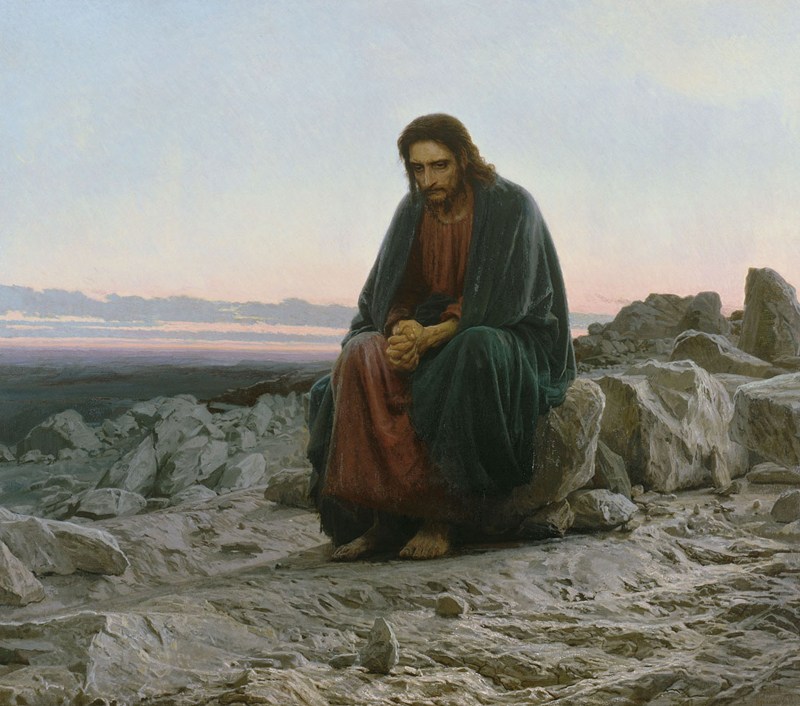
Matthew 4:1 Then Jesus was led up by the Spirit into the wilderness to be tempted by the devil.
Kramskoĭ, Ivan Nikolaevich, 1837-1887 Christ in the Desert Painting 1872 Gosudarstvennai︠a︡ Tretʹi︠a︡kovskai︠a︡ galerei︠a︡ Moscow Click image for more information.
Commentary by Hovak Najarian
Christ in the Desert, Oil on Canvas, 1872, Ivan Nikolaevich Kramskoi, 1837-1887
During the Renaissance of the fifteenth century, intellectuals believed that some subjects in art were of a higher order than others. “History painting” was judged to be the most difficult and at the highest level. In a broad interpretation of the term, these were paintings that told a story; the category included biblical and historical subjects as well as allegorical and mythological scenes. In history paintings, the figures in them interacted in settings that required an artist to have mastery of all aspects of painting. Ranked below history painting was full figure portraiture (a portrait in the form of a bust was a step lower). Ivan Nikolaevich Kramskoi (also spelled, Kramskoy) was not a painter of historic battles or mythical events, and his work was not in keeping with new trends in European painting.
Kramskoi lived in Russia at a time when France had become the center of the art world. In Paris, his contemporaries the Impressionists were changing the emphasis of painting with studies of natural light, color, and the landscape. Kramskoi was neither a history painter nor part of the Impressionist movement; he painted portraits, in a studio and his colors tended to be monochromatic. Yet, his portraits were of exceptional quality. He had an ability to imbue a sitter’s facial expression with details that gave insights into a person’s mood and character. “Christ in the Desert,” shown here, was not painted for an art-minded Parisian gallery-goer whose interest was in seeing the latest developments in the art world. Kramskoi shows us Christ in deep thought and introspection at a time before being tempted.
After his baptism, Jesus “…was led up by the Spirit into the wilderness to be tempted by the devil.” In this painting, Christ is isolated from all human and cultural contacts as he sits alone among the hard, bare, and colorless stones. He remained in this desolate place without food for forty days and was unimaginably hungry. When Satan determined Christ would be vulnerable, he came to tempt him, saying: “If you are the Son of God, command these stones to become loaves of bread.” Christ turned him away, replying: “It is written, ‘Man shall not live by bread alone, but by every word that proceeds from the mouth of God.’”
In describing this painting, novelist Ivan Goncharov wrote, “…there is nothing festive, heroic, victorious [about the figure in the painting] – the future fate of the world and all livings is concealed in that miserable, small being, in pauper appearance, under the rags, in humble simplicity, inseparable with true majesty and force.”
Matthew 17:2 And he was transfigured before them, and his face shone like the sun, and his clothes became dazzling white.
Transfiguration ANGELICO, Fra (b. ca. 1400, Vicchio nell Mugello, d. 1455, Roma) Transfiguration (Cell 6) 1440-42 Fresco, 181 x 152 cm Convento di San Marco, Florence Click image for more information.
Transfiguration, Fresco, 1440-1442, Fra Angelico, c. 1400-1455
In 1407, Guido di Pietro joined the Dominican order in Fiesole, Italy (near Florence) and at his vows took the name Giovanni. Thus he was known as Friar Giovanni da Fiesole (brother John of Fiesole). Artist/historian, Giorgio Vasari, referred to him as Fra Angelico (Brother John the Angelic one); today, he is known simply as Fra Angelico. His life as an artist was devoted to the Church and at the monastery of San Marcos in Florence he painted the walls of the cells (prayer and meditation rooms) with scenes from the life of Christ. The “Transfiguration” shown here is in cell number six.
Mathew gives the following account of the Transfiguration: “And after six days Jesus took with him Peter and James and John his brother, and led them up a high mountain apart. And he was transfigured before them, and his face shone like the sun, and his garments became white as light. And behold there appeared to them Moses and Elijah, talking to him.” (Matt. 17:1-3)
Christ, the central figure in Fra Angelico’s painting, is standing in a white robe with outstretched arms and is surrounded by a mandorla (a body halo). A traditional cruciform halo surrounds his head. Moses and Elijah are each presented here in bust form, not as full figures; Moses is on the left representing the law and Elijah is to the right representing the prophets. On the left side below Moses is the Virgin Mary with her arms folded across her chest. To the right, below Elijah, is Saint Dominic (in 1435 the Monastery of San Marcos was turned over to the Dominican order). He is standing with hands placed together in a position of prayer. Dominic’s mother reported seeing a star on his chest when he was born and in paintings, he can be identified by a star placed on or above his head. Mary and Dominic were not present at the Transfiguration but it is not unusual for artists to use creative license to include non-participating figures on the sidelines as observers of an important event. In the foreground are Peter, James, and John. They have just heard God’s voice say: “This is my son. Hear him” and “…they fell on their faces and were filled with awe.” (Matt. 17:5-6)
The actual site of the Transfiguration is not known; accounts in the Gospels do not name a specific mountain. Mt. Tabor is the traditional site but Jesus and the disciples were in the district of Caesarea Philippi prior to the Transfiguration and the closest mountain there is Mount Hermon. It is the highest mountain in Israel and it has been suggested this may have been the “high mountain” that is mentioned in the Gospels of Matthew and Mark.
MURILLO, Bartolomé Esteban (b. 1617, Sevilla, d. 1682, Sevilla The Young Beggar c. 1645 Oil on canvas, 134 x 100 cm Musée du Louvre, Paris Click image for more information.
During the seventeenth century the Spanish Empire was on the decline and there was great disparity between the wealthy and the poor. The wealthy noble class neither worked nor was required to pay taxes and the poor were in desperate need. Although the government was mismanaged it was supported by silver from mines in South America and wealth from other foreign lands. Foreign possessions and occupied lands however required attention and resources were squandered on wars. Yet, regardless of these conditions, the visual arts flourished.
Bartolomé Murillo and his contemporary, Diego Velazquez, were both natives of Seville. Velazquez became the court painter for Philip IV and worked in Madrid; he is regarded now to be the greatest painter of the Spanish baroque period. Murillo remained mostly in Seville and yet in his lifetime he was far better known than Velazquez. His work was admired throughout Europe.
Murillo built a reputation painting altarpieces but early in his career he began painting the orphaned homeless children who begged and foraged to survive. Disease was widespread among them and many died from the plague (several of Murillo’s children also died in the plague). “The Young Beggar,” (also known as, “The Louse-Ridden Boy”) shown here, was the first of Murillo’s urchin paintings. Murillo’s parents both died when he was a young boy and he identified with the difficult life of street children. He helped with charitable work through his association with the Franciscans.
“The Young Beggar” depicts a boy in patched, torn rags and dirty bare feet sitting alone in a sheltered area. He has just finished eating a lunch of apples and shrimp and now is examining himself in an effort to get rid of lice. Today, this may seem like an odd subject for a painting but it was a reality of the times. Grooming often was depicted in seventeenth century genre paintings, especially in the Netherlands and Flanders where the relationship of hygiene to health was recognized. In Dutch paintings the cleaning of lice also was symbolic of the cleansing of sin and it is thought this painting may have been commissioned by a Dutch or Flemish merchant living in Seville.
[Apart from the pesky insects, the term louse has entered our language with additional meanings. We say a contemptible person is a “louse” and we use the term also for something that is mishandled and not up to par; “It was loused up” or “That is lousy.”]
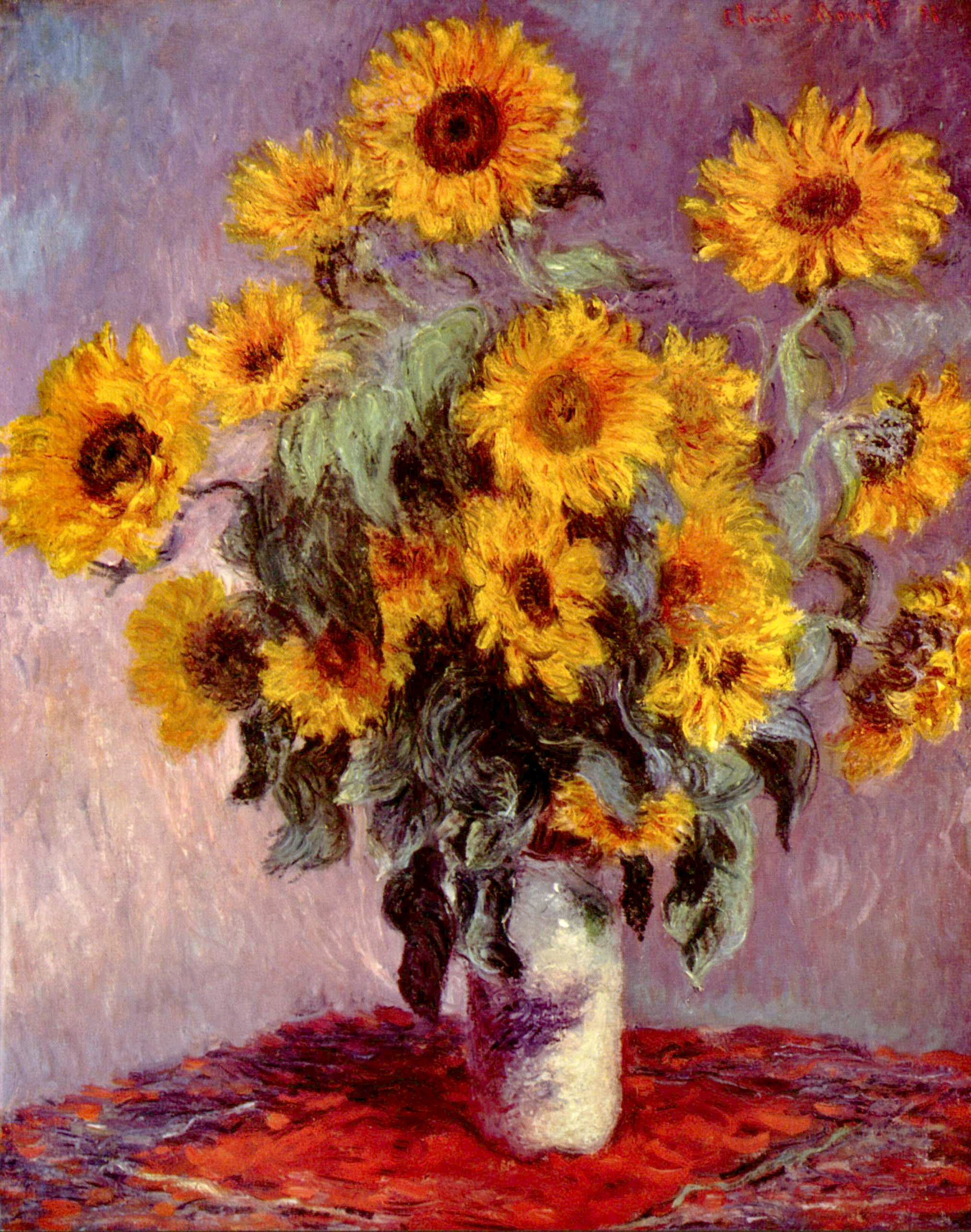
Sunflowers, Oil on Canvas, 1881, Claude Monet, 1840-1926
During the nineteenth century when Claude Monet, Auguste Renoir, and other artists in France went to the Fontainebleau Forest to paint in the open air (plein air painting), they discovered that sunlight causes subtle and constant changes in the colors we see. They observed that changes in the atmosphere and seasons affected colors as well. Further, they realized there was not a right and wrong color for the trees, sky, or water. “Reality” was a passing moment and they tried to record the colors as they appeared. Upon a return to Paris, other painters joined them in exploring the effects of light and they held an exhibition together in 1874. When the critic Louis Vauxcelles saw the title of a Monet painting, “Impression, Sunrise,” he clung to the word “Impression” and declared derogatorily that the artists were “Impressionists.” He did not understand what the artists were attempting and neither did the public. “Impressionism” became accepted as the style’s name but even today misconceptions continue. Many believe an impressionist painting is an artist’s obscure impression of a subject. It is not.
“Sunflowers,” shown here, was at the Impressionists’ exhibition of 1882. Of particular note is how Monet painted the area around the flowers. It is treated as an integral part of the painting, not a leftover to be filled in after the flowers were completed. Instead of regarding the “air” around the flowers to be “negative space,” Monet unified the painting’s surface with brushstrokes and colors that are interacting visually with the sunflowers.
Sunflowers are native to North America and were cultivated for food by Native Americans. Spanish explorers introduced them to Europe and by the 1830s its oil was being processed for commercial use. It was the Russian Orthodox Church, however, that set into motion the large industry of sunflower oil production we have today. The Church listed foods that were to be avoided during Lent; included were butter and lard. Sunflower seed oil was new, overlooked by the Church, and failed to be listed. Its widespread use during Lent helped make it enormously popular and in great demand.
Its sun-like shape and color gave the sunflower its name and its almost universal positive associations have made it a favorite subject of painters and designers. Today, sunflower motifs are seen regularly in designs that enrich our homes and when they are presented as gifts they become an unspoken sign of warmth, love, and appreciation.
[It is a myth that sunflowers turn to follow the sun throughout the day. Buds face the sun but after flowers develop, they remain in one direction; east.]
Isaiah 58:7 Is it not to share your bread with the hungry, and bring the homeless poor into your house; when you see the naked, to cover them, and not to hide yourself from your own kin?
Timothy P. Schmalz “Jesus the Homeless” contemporary bronze sculpture Canada
Art that was favored by the upper social class of Europe in the early nineteenth century had roots in classicism and romanticism. Paintings did not depict the life of farmers who were hunched over day after day working in the fields or the coal miners who lived and worked in hopeless conditions in Belgium. A few artists, known as “Realists” painted the lives of the poor but today, despite an awareness of poverty and homelessness throughout the world, the subject is seldom seen in the visual arts. The displaced victims of war are mentioned in the media occasionally but in wealthy nations the homeless are likely to be discussed as a “problem.” When people see them they tend to avoid eye contact and walk around them at a distance. It is easier to say the homeless are to blame for their own misfortune when no contact is made and their circumstances are not known.
One of the roles of sculpture throughout history has been to create an image that will represent the interests and values of a society. Sculpture often is intended to elicit such things as patriotism, nationalism, and religious fervor. It may be commissioned by governments to celebrate war heroes, leaders, events, or it may be simply enrichment to surroundings. The poor and homeless are not likely to be seen in sculpture intended to represent a group’s self image.
Sculpting monuments and memorials has been part of Timothy Schmalz’ life’s work and he has filled many commissions for churches. In general, his sculpture does not stir controversy. An exception is, “Jesus the Homeless” (shown above). This piece was the result of a direct personal experience and it differs in style and content from his usual work. On a winter’s day while in the City of Toronto, Canada, he saw a homeless man wrapped in a sleeping bag on the sidewalk while crowds passed by. It was the Christmas season and passersby were focused on their immediate priorities; the man on the sidewalk was ignored. When Schmalz saw the homeless man, Jesus’ words written in Matthew came to mind: “…I was hungry and you gave me no food, I was thirsty and you gave me no drink, I was a stranger and you did not welcome me, sick and in prison and you did not visit me.” “…as you did not to one of the least of these, you did not to me.” (Mathew 25:31-46). Schmalz developed this scene into a provocative image of a homeless Jesus. Instead of being in a sleeping bag on the sidewalk, the man was placed under a blanket on a bench. At first glance, the sculpture does not seem to represent any specific person but then, as we see the uncovered feet, we notice the wounds from a nail that pierced them during crucifixion.
Luke 2:22
When the time came for their purification according to the law of Moses, the parents of Jesus brought him up to Jerusalem to present him to the Lord (as it is written in the law of the Lord, “Every firstborn male shall be designated as holy to the Lord”), and they offered a sacrifice according to what is stated in the law of the Lord, “a pair of turtledoves or two young pigeons.”
The Presentation of Christ in the Temple Giovanni di Paolo (Giovanni di Paolo di Grazia) (Italian, Siena 1398–1482 Siena) Metropolitan Museum of Art New York Click image for more information.
Commentary by Hovak Najarian
The Presentation in the Temple, Tempera and Gold on Wood, 1435, Giovanni di Paolo (Giovanni di Paolo di Grazia), 1398-1482
We are familiar with remakes of motion pictures and rearrangements of musical scores. Writing variations of another composer’s theme also is well known. Today in painting, however, originality in subject and composition tends to be preferred. Yet, in the fifteenth century it was not unusual for an artist to reinterpret the composition of another painter. Giovanni di Paolo based, “Presentation in the Temple,” (shown above) on a scene from the predella of an altarpiece by Gentile di Fabriano but changes in colors and background architecture were made. Although in this time period (Early Renaissance) the trend in painting was toward naturalism and classical humanism, di Paolo remained in the Gothic decorative style.
According to Jewish law, a mother was instructed to go to the Temple for ritual purification forty days after the birth of a son (See Leviticus 12:1-8). Further, a firstborn son was to be presented as an offering to the Lord forty days after birth. In paintings, these requirements often were combined.
In “The Presentation in the Temple,” Joseph in a yellow robe and Mary in her traditional blue robe are at the Temple with the baby Jesus. Joseph is holding a dove. [It is presumed another dove is hidden from our view. If a family were poor they could bring two turtle doves or two young pigeons to sacrifice instead of a lamb.] As they entered the Temple they were met by Simeon, an old man who had been told by the Holy Spirit he would see the Messiah before he died. Simeon took the baby Jesus in his arms and prayed. His familiar prayer is known to us now as the Nunc Demittis: “Lord now lettest Thou thy servant depart in peace; according to thy word: for mine eyes have seen Thy salvation, which Thou hast prepared before the face of all people: to be a light to lighten the gentiles and to be the glory of Thy people Israel” (Luke 2:29-32). [The phrase, “to be a light to lighten the gentiles,” is the basis for celebration of the feast day, Candlemas, and in paintings often a person holds a candle as a symbol of Simeon’s words.]
In di Paolo’s painting, the setting is a pavilion with a burning sanctuary lamp (the “ner tamid,” Hebrew for “eternal light”). The participants are grouped together in front of the altar and the priest is behind it. The baby Jesus continues to be held by Simeon and the prophetess, Anna, an old widow living in the Temple is at his side. On the left, two women dressed in fashionable fifteenth century clothing have come to observe the rituals and to the right two beggars are seeking alms.
Matthew 4:18,21 As he walked by the Sea of Galilee, he saw two brothers, Simon, who is called Peter, and Andrew his brother… As he went from there, he saw two other brothers, James son of Zebedee and his brother John…
He, Qi Calling Disciples 2001 Painting China Click image for more information.
Commentary by Hovak Najarian
Calling Disciples, mixed media, 2001, He Qi (b. 20th Century)
During the latter part of the nineteenth century, the industrial revolution with its engineering and technological marvels was becoming part of life and there was a sense the world had entered a modern age. Being “modern” became a self-congratulatory state of mind that continued well beyond the first half of the twentieth century. Around 1970, it was proclaimed the term “modern” no longer applied to how we perceived ourselves. We were in the “Post Modern” age. Today, “Modernism” is a designated time period that started in the mid 1930s and continued to the mid 1960s. The architecture and furniture of the 1950s in particular are celebrated now in exhibits called, “mid-century modern.”
In the early part of the twentieth century, it was recognized that a painting in reality is simply an object. It is created from a canvas stretched over a frame and covered with pigments. Just as a composer of symphonic music may be more interested in a work’s orchestration than in its melody, some painters downplay the importance of creating illusions (painting the subject matter to look “realistic”), instead they give attention to matters of form. All painters, regardless of their style, orchestrate their work by combining and arranging shapes, lines, colors, textures and spaces. These visual elements may be arranged in any way a person pleases. With them, an artist may paint a still-life, a portrait, or a scene and make it look “real.” If they choose they may use the elements also to abstract a subject or to not refer to a subject at all.
He Qi’s “Calling Disciples” announces its modernity with its style. His figures, boats and sails remain recognizable yet they are not described literally. As in a cloisonné, shapes are defined by thin dark lines and the colors within them are mostly flat. Jesus is on shore in the center foreground and is flanked by disciples; three of them are looking skyward inexplicably. The disciple on the far right has turned and is waving to a lone fisherman on a boat (the white beard suggests it is Peter – Andrew is not shown). The exchange of greetings between the fisherman and the disciple interjects a light storybook quality and the entire subject is treated as a formal study.
At a time when illiteracy was commonplace, art was an important means of communication. Unlike the Middle Ages, today we are able to read Matthew’s account of the calling of the disciples and an illustration of it may not contribute anything more than what is learned from the written word. Instead of providing insights into the biblical story, He Qi’s gives us harmonious color patterns and the absence of objectionable content; his painting is likely to be satisfying particularly to people attracted to “modernism.” “Calling Disciples,” is a painting that would fit nicely with “mid-century modern” décor.
The Lamb of God (detail), Mosaic, 527, Basilica of Santi Cosma e Damiano, Rome, Italy
In Rome, Italy, many of the structures built by the ancient Romans remain in prominent areas of the city. In the Forum of Vespasian are the Temple of Romulus and the Library of Peace. In the sixth century, Theodoric, king of the Ostrogoths, conqueror of Rome, and an Aryan Christian, donated a portion of the two buildings to Pope Felix IV. Pope Felix used the space in AD 527 to build a basilica dedicated to Saints Cosmas and Damian.
According to tradition, the twin brothers, Cosmas and Damian were third century Christian physicians who practiced the art of medicine in provinces of Rome that are now in southern Turkey and northern Syria. The brothers provided healing free of charge and attracted many to the Christian faith. They were martyred in Syria, and because they accepted no payment, they were placed in a category of saints known as “Holy Unmercenaries.”
The layout of the mosaic above the apse of the Basilica of Saints Cosmas and Damian, is balanced bisymmetrically with Christ robed in gold at its center. He is much larger in size than the other figures and exists in a heavenly realm. Below him in the left foreground, Saint Paul is presenting Saint Cosmas to Christ and in the right foreground Saint Peter is presenting Saint Damian. Cosmas and Damian each have a crown of martyrdom in their hands. Behind St. Cosmas on the left is Pope Felix IV holding a model of the basilica and behind St. Damian is St. Theodore.
A row of lambs serves as a visual base or foundation to the scene of Christ in heaven with the saints. Christ, The Lamb of God (shown here), is in the center of the row facing outward toward the viewer. Twelve lambs – six on each side – represent the apostles; they are in profile facing the Lamb of God who is shown standing on a mound and wearing a halo. From the base of the mound flow the four rivers of paradise representing the Gospel going out to the four corners of the world through the apostles.
Photographs of the full apse mosaic convey the dramatic, colorful effect of Christ in heaven and the martyred physicians being presented but they do not show the Lamb of God. In the early seventeenth century, Baroque architect Domenico Castelli designed a new altar for the basilica; it extended upward and blocked a direct view of the lower central portion of the mosaic. The lambs that represent the apostles may be seen but the center lamb representing Christ (the detail that is shown here) is behind the altar.







 Hear what the Spirit is saying