Third Sunday after Pentecost, Year B

“We are determined to have a king over us, so that we also may be like other nations and that our king may govern us and go out before us and fight our battles.” 1 Samuel 8:19b-20

Israel Demands a King, engraving, 1778, J. Winter, active 18th century.
This engraving was published in The Bible and its Story, 1909, Edited by Charles Horne and Julius Brewer.

Reading: 1 Samuel 8:4-11, (12-15), 16-20, (11:14-15)

Commentary by Hovak Najarian

When the prophet Samuel was advanced in years the Israelites began to worry about their future.  Who would be their leader and how would they be able to deal with their enemies?  The elders went to Samuel with their concerns and said “You are old and your sons do not follow your ways, appoint for us a king to govern us, like other nations.”  Samuel was displeased that they asked for a king.  When he prayed, God instructed him to listen to the people, but also to warn them solemnly about what they could expect if they were to bed given a king.  Samuel warned the elders to be careful about what they wished but they would have none of it and said, “No… we are determined to have a king…


 Winter’s Israel Demands a King (detail above) the figures are placed in an open courtyard and strong opposing opinions are suggested by a face-off between Samuel and the elders.  Samuel, a slightly hunched over old man, is at the left.  He has assumed a solid stance and is pointing forcefully with both index fingers as he states his opposition to Israel having a king.  To the right an animated spokesperson for the elders is leaning forward as he argues forcefully to make a point.  He seems ready to interrupt Samuel at any moment.  The gestures of the elders are exaggerated for effect and their claw-like hands are emphasized.  A young man standing behind Samuel seems to be taken aback by the demanding elders.  Have they no respect … how could they talk to Samuel like that?    After listening, praying, and explaining what it would be like to have a king, Samuel followed the people’s wishes and anointed a king.


J. Winter, Israel Demands a King (full engraving)  

In medieval art, illustrations were added to enhance the text of gospel books.  Often subjects were events in the life of Jesus, Mary, his mother and the Apostles, and Old Testament kings, prophets and events in other’s lives were illustrated.  Illustrations also presented artists with an opportunity to venture into less-depicted subjects but sometimes these did not have visual impact.  An engraving of Samuel arguing with elders could not compete with the drama of Moses and the Israelites crossing the Red Sea or Elijah ascending to heaven in a fiery horse drawn cart.  When a subject lacked action an artist was challenged to generate interest by staging the subject in a dramatic way.  This could engage a viewer and describe a work’s subject but often these were not enough.  The arrangement of figures in Winter’s Israel Demands a King requires knowledge of the biblical text in order to understand the subject being depicted.

At mid-fifteenth century the printing press was invented and by the end of the century, books were being published.  Instead of hand-painted illustrations as in gospel books, art in the form of engravings, could be inked and printed with the text.  Engravings continued to be popular even after the halftone (a photo-mechanical process) was introduced in the late nineteenth century.

Hovak Najarian © 2024

Art & Music

For more art and art commentary search the Art & Music Category or use Hovak Najarian as your search term

Third Sunday after Pentecost, Year B

I give you thanks, O LORD, with my whole heart; before the gods I sing your praise… Psalm 138:1 (NRSV)

Welcome!

Psalm 138 (NRSVue) gives thanks and speaks powerfully to the majesty and humility of the God who loves us. Sometimes it helps to hear more than one translation of the ancient text to discover new dimensions of our relationship with God.

Here is Psalm 138 from the New Jerusalem Bible:

1I thank you, Yahweh, with all my heart, for you have listened to the cry I uttered. In the presence of angels I sing to you, 

2I bow down before your holy Temple. I praise your name for your faithful love and your constancy; your promises surpass even your fame. 

3You heard me on the day when I called, and you gave new strength to my heart. 

4All the kings of the earth give thanks to you, Yahweh, when they hear the promises you make; 

5they sing of Yahweh’s ways, ‘Great is the glory of Yahweh!’ 

6Sublime as he is, Yahweh looks on the humble, the proud he picks out from afar. 

7Though I live surrounded by trouble you give me life—to my enemies’ fury! You stretch out your right hand and save me, 

8Yahweh will do all things for me. Yahweh, your faithful love endures for ever, do not abandon what you have made.

Here is Psalm 138 from the Tanakh:

1Of David. I praise You with all my heart, sing a hymn to You before the divine beings; 

2I bow toward Your holy temple and praise Your name for Your steadfast love and faithfulness, because You have exalted Your name, Your word, above all. 

3When I called, You answered me, You inspired me with courage. 

4All the kings of the earth shall praise You, O Lord, for they have heard the words You spoke. 

5They shall sing of the ways of the Lord, “Great is the majesty of the Lord!” 

6High though the Lord is, He sees the lowly; lofty, He perceives from afar. 

7Though I walk among enemies, You preserve me in the face of my foes; You extend Your hand; with Your right hand You deliver me. 

8The Lord will settle accounts for me. O Lord, Your steadfast love is eternal; do not forsake the work of Your hands.

On Wednesday, June 5, 2024, we* read through the scriptures appointed for the Third Sunday after Pentecost, Proper 5, Year B. We spent most of our time reading and learning from Psalm 138 (NRSV)

As always, our sacred text (in its various English translations) questions us even as we speak, listen to, and hear the words:

  • Throughout the day, how often do you pause and give thanks? How often is thanksgiving done with all your heart? How might you experience or describe a half-hearted thanksgiving? A whole-hearted thanksgiving? (v. 1)
  • In verse 1 the Psalmist sings before “gods” (NRSV), “angels” (NJB), or “divine beings” (Tanakh). Which translation speaks to your heart? Why is that? Close your eyes, picture and feel and hear yourself singing your thanksgiving in such hallowed company. Well?
  • In the NRSVue verse 3 reads: “On the day I called, you answered me; “you increased my strength of soul.” The NJB translates God’s answer as “you gave new strength to my heart.” The Tanakh translates God’s answer as “You inspired me with courage.” Again, which translation speaks to your heart and why is that?

With these few examples from verses 1 and 3, I encourage you to allow the text (in various translations) to question you. Become quiet. Hear what the Spirit is saying to you. Hear how the Spirit—in the sacred text—both questions and encourages you.

divider line

*Most Wednesday mornings a group of us gather online to explore the readings that will be used in worship the following Sunday. This week’s handout features readings, commentaries, and notes for the Third Sunday after Pentecost (June 9, 2024) in Year B of the Revised Common Lectionary. Please: View or download the handout we used to guide our discussion and tune our hearts to the Spirit.

View the Revised Common Lectionary readings (NRSV translation) appointed for The Third Sunday after Pentecost, June 9, 2024, on the Revised Common Lectionary site curated by the Vanderbilt Divinity Library.

Please return to this site throughout the week to keep learning.

divider line

More thoughts on Sunday’s (June 9, 2024) readings

Be well. Do good. Pay attention. Keep learning.

Image: ChurchArt Pro

Trinity Sunday, Year B

The grace of the Lord Jesus Christ, the love of God, and the communion of the Holy Spirit be with all of you. 2 Cor 13:13 NRSVue

Welcome!

Along the way I read—and remember now—Marcus Borg’s observation that credo, “I believe,” is probably better rendered, “I give my heart to.”

Everything we say in the Nicene Creed is about giving our heart to God who we experience as one God, Father, Son, and Holy Spirit.

Enter into our Nicene Creed as an expression of trust born of love:

WE GIVE OUR HEARTS TO one God, the Father, the Almighty, maker of heaven and earth, of all that is, seen and unseen.

WE GIVE OUR HEARTS TO one Lord, Jesus Christ, the only Son of God, eternally begotten of the Father, God from God, Light from Light, true God from true God, begotten, not made, of one Being with the Father. Through him all things were made.

WE GIVE OUR HEARTS TO THE ONE WHO, For us and for our salvation, came down from heaven: by the power of the Holy Spirit he became incarnate from the Virgin Mary, and was made man. WHO, For our sake was crucified under Pontius Pilate; he suffered death and was buried.

WE GIVE OUR HEARTS TO THE ONE WHO, On the third day rose again in accordance with the Scriptures; WHO ascended into heaven and is seated at the right hand of the Father. WHO will come again in glory to judge the living and the dead, and WHOSE kingdom will have no end.

WE GIVE OUR HEARTS TO the Holy Spirit, the Lord, the giver of life, who proceeds from the Father and the Son. With the Father and the Son he is worshiped and glorified. He has spoken through the Prophets.

WE GIVE OUR HEARTS TO THE one holy catholic and apostolic Church. We acknowledge one baptism for the forgiveness of sins. We look for the resurrection of the dead, and the life of the world to come. Amen.

On Wednesday, May 22, 2024, we* read through the scriptures appointed for Trinity Sunday, Year B. We spent the most time on the reading and learning from the letter to the Romans (Chapter 8, verses 12-17)

To whom do you give your heart?

A further thought on the Mystery of the Trinity

Gregory Nazianzen wrote:

“There was the true light, which enlightens everyone who comes into the world” (John 1:9)—the Father.

“There was the true light, which enlightens everyone who comes into the world”—the Son.

“There was the true light, which enlightens everyone who comes into the world”—the other Paraclete (John 14:16, 26).

“Was” and “was” and “was,” but one thing was; “light” and “light” and “light,” but one light and one God. This is what David too imagined long ago when he said, “In your light we shall see light” (Psalm 36:10 [36:9]).

And now we have both seen and proclaimed the concise and simple theology of the Trinity: out of light (the Father) we comprehend light (the Son) in light (the Spirit).

Source: Christopher A. Beeley, Leading God’s People: Wisdom from the Early Church for Today (Grand Rapids, MI; Cambridge: William B. Eerdmans Publishing Company, 2012), 99–100.

Christopher Beeley is the Walter H. Gray Associate Professor of Anglican Studies and Patristics [Yale Macmillan Center]. He teaches early Christian theology and history and modern Anglican tradition. He is an Episcopal priest.

divider line

*Most Wednesday mornings a group of us gather online to explore the readings that will be used in worship the following Sunday. This week’s handout features readings, commentaries, and notes for Trinity Sunday (May 26, 2024) in Year B of the Revised Common Lectionary. Please: View or download the handout we used to guide our discussion and tune our hearts to the Spirit.

View the Revised Common Lectionary readings appointed for Trinity Sunday, May 26, 2024, on the Revised Common Lectionary site curated by the Vanderbilt Divinity Library.

Please return to this site throughout the week to keep learning.

divider line

More thoughts on Trinity Sunday

Be well. Do good. Pay attention. Keep learning.

The Holy Trinity

There are times when neither words nor pictures are adequate to express the depths of mystery.

Commentary by Hovak Najarian

Trinity with Three Faces via Wikimedia Commons

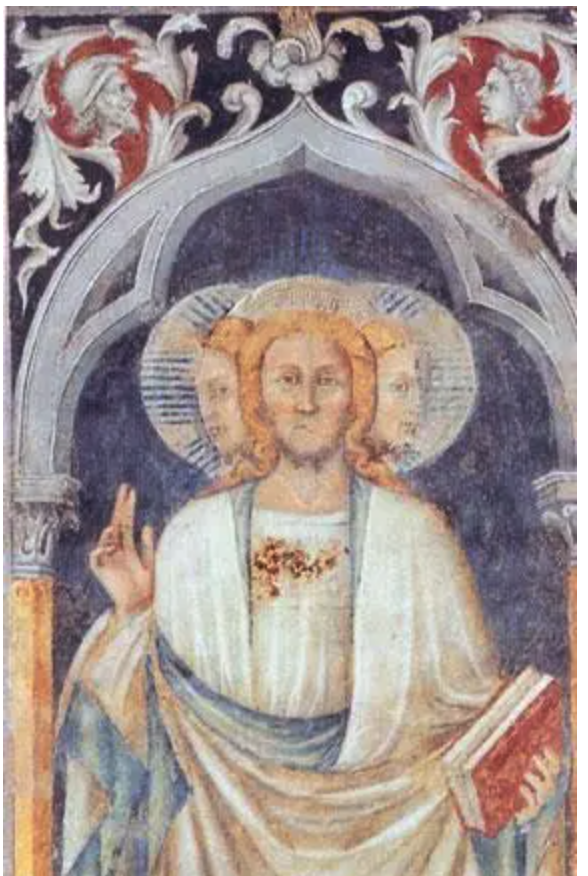
 Trinity with Three Faces, Fresco, c.1400, Antonio da Atri, c.1350-1433

 The much-quoted statement, “A picture is worth a thousand words,” is true in some instances but not all. A picture cannot represent adequately images such as those that come to mind in the words of the Twenty-third Psalm or the Sermon on the Mount. Art may at times clarify ideas that cannot be expressed by other means but there are times when neither words nor pictures are adequate. A challenge facing early Christian artists was how to create visual images that could communicate concepts found in their faith. A concept such as the Trinity was difficult to explain through art or with words.

In the early Church, there were questions about how (or if) a depiction of God should (or could) be made and if so, what would the image be? God was depicted ultimately as a bearded father figure (possibly derived from the description, “ancient of days” mentioned in the Book of Daniel). A lamb represented Jesus and a dove represented the Holy Spirit. As long as members of the Godhead were depicted as separate entities, artists did not have to deal with the problem of creating an image that represented all three.


The three figures that appeared before Abraham in the Book of Genesis were portrayed as the Trinity but they were shown as separate individuals.  By placing them adjacent to each other they were seen as a visual unit.  Official use of this form of Trinity was ended by the Pope in the eighteenth century but it continued in places such as the American Southwest.

Retablo of the Trinity
Retablo of the Trinity from an altarpiece of a mission church, New Mexico, USA

 Another attempt to depict the Trinity is found in the Basilica of Santa Maria Assunta in Atri, Italy.  Antonio da Atri’s fresco, “Trinity with Three Faces,” shows Christ standing and facing the viewer.  His right arm is raised in a blessing and his left hand is holding a book.  To depict Christ as part of the Trinity, Antonio has given the figure one body but three faces.  Right and left profiles have been added to Jesus’ head with radiating lines emanating from the halos.  As a setting for this composition, Antonio framed his Trinity image in a Late Gothic arch and decorative elements.

Multi-headed divinities existed in other religions and although a three-faced Trinity such as Antonio’s fresco was accepted by the Roman Catholic hierarchy, it was ridiculed by Protestants.  It was called the “Catholic Cerberus.”  [In Greek mythology, Cerberus was the three-headed dog that guarded the gates of Hades.]  As a consequence, in the sixteenth century, the Pope ended the use of the three-faced Trinity but the image remained in remote regions.  Pope Innocent XII went further in the seventeenth century and ordered them all to be destroyed.  The three-faced Trinity at the Basilica of Atri survived because it was not in sight.  It, and other frescos at the Basilica, had been covered with plaster for fear their surfaces might in some way contribute to the spread of the bubonic plague.

Hovak Najarian © 2013

Note: links to the artwork were updated on May 25, 2024; the content was lightly edited. Find additional images of the Trinity with Three Faces using Google Search.

Image: Antonio da Atri, Wikimedia Commons; upload of Retablo of the Trinity, ca. 1936, Watercolor, colored pencil, and graphite on Paper [This is a copy from an altarpiece], E. Elizabeth Boyd, 1903-1974.

Trinity Sunday, Year B

Wind in the Chimes: The Sunday after the Day of Pentecost is Trinity Sunday

Trinity Sunday (May 26, 2024)

Feast that celebrates “the one and equal glory” of Father, Son, and Holy Spirit, “in Trinity of Persons and in Unity of Being” (BCP, p. 380). It is celebrated on the first Sunday after Pentecost. Trinity Sunday is one of the seven principal feasts of the church year (BCP, p. 15). The proper readings and collect for Trinity Sunday are used only on the feast, not on the weekdays following. The numbered proper which corresponds most closely to the date of Trinity Sunday is used (BCP, p. 228). The BCP also provides the proper “Of the Holy Trinity” for optional use at other times, subject to the rules of the calendar of the church year (see BCP, pp. 251, 927). The Hymnal 1982 presents ten hymns in a section on The Holy Trinity (Hymns 362-371), including “Holy, holy, holy! Lord God Almighty!” (Hymn 362), “Come, thou almighty King” (Hymn 365), and “Holy Father, great Creator” (Hymn 368).

Celebration of Trinity Sunday was approved for the western church by Pope John XXII in 1334. This feast is associated with Thomas Becket (c. 1118-1170), who was consecrated bishop on Trinity Sunday, 1162. His martyrdom may have influenced the popularity of the feast in England and the custom of naming the remaining Sundays of the church year “Sundays after Trinity.” The Sarum Missal and editions of the Prayer Book through the 1928 BCP named these Sundays the Sundays after Trinity. The 1979 BCP identifies this portion of the church year as the season after Pentecost, and names these Sundays the Sundays after Pentecost (see BCP, p. 32).

Reference: “Trinity Sunday” in An Episcopal Dictionary of the Church

About Wind in the Chimes

Wind in the Chimes (renaming and reintroduction of Wind Chimes, 7/21/20)

Wind Chimes: September 25 2012 (an introduction)

The Day of Pentecost, Year B

Divided tongues, as of fire, appeared among them, and a tongue rested on each of them. All of them were filled with the Holy Spirit… (Acts 2:3-4)

Welcome!

What does Pentecost mean to you? How have you experienced the gift of the Holy Spirit breathing life into you, guiding your thinking and choosing, and enlivening your day-to-day activity?

On Wednesday, May 15, 2024, we* explored Acts 2:1-21, the account of the events on the Day of Pentecost.

Pause, remember, acknowledge, and even celebrate, the presence of the Holy Spirit “the Lord, the giver of life” in you.

From a commentary on Acts 2:1-21

The language of the Pentecost experience, with its images of “wind,” “spirit,” and being “filled” with the Spirit or the “breath” of life, is reminiscent of God’s initial creative activity (Gen. 1:2; 2:7). Here, however, the emphasis is not so much on creation or God’s works in history as on direct contact with the Spirit of God, who is now filling the world in a new way. The roll call of nations and languages points to the universality of the Spirit’s work for the whole world. God’s Spirit is the divine energy that now enables an eternal life to be real for those on whom God’s Spirit is poured and in whom the Spirit dwells (cf. Rom. 5:5).

Even more, linking the Pentecost events with the prophetic word about “last days” (Acts 2:17) points forward to the ultimate consummation of God’s reign in a “new heaven and new earth” (Rev. 21:1).

Source: Donald K. Mckim, “Theological Perspective on Acts 2:1‒21,” in Feasting on the Word: Preaching the Revised Common Lectionary: Year B, ed. David L. Bartlett and Barbara Brown Taylor, vol. 3 (Louisville, KY: Westminster John Knox Press, 2009), 2.

Donald K. McKim is the Executive Editor of Theology and Reference, Westminster John Knox Press, Germantown, Tennessee.

divider line

*Most Wednesday mornings a group of us gather online to explore the readings that will be used in worship the following Sunday. This week’s handout features readings, commentaries, and notes for the Day of Pentecost (May 19, 2024) in Year B of the Revised Common Lectionary. Please: View or download the handout we used to guide our discussion and tune our hearts to the Spirit.

View the Revised Common Lectionary readings appointed for Pentecost, Sunday, May 19, 2024, on the Revised Common Lectionary site curated by the Vanderbilt Divinity Library.

Please return to this site throughout the week to keep learning.

divider line

More about Pentecost

Be well. Do good. Pay attention. Keep learning.

Pentecost, Year B

Wind in the Chimes: our prayer and why we celebrate this day

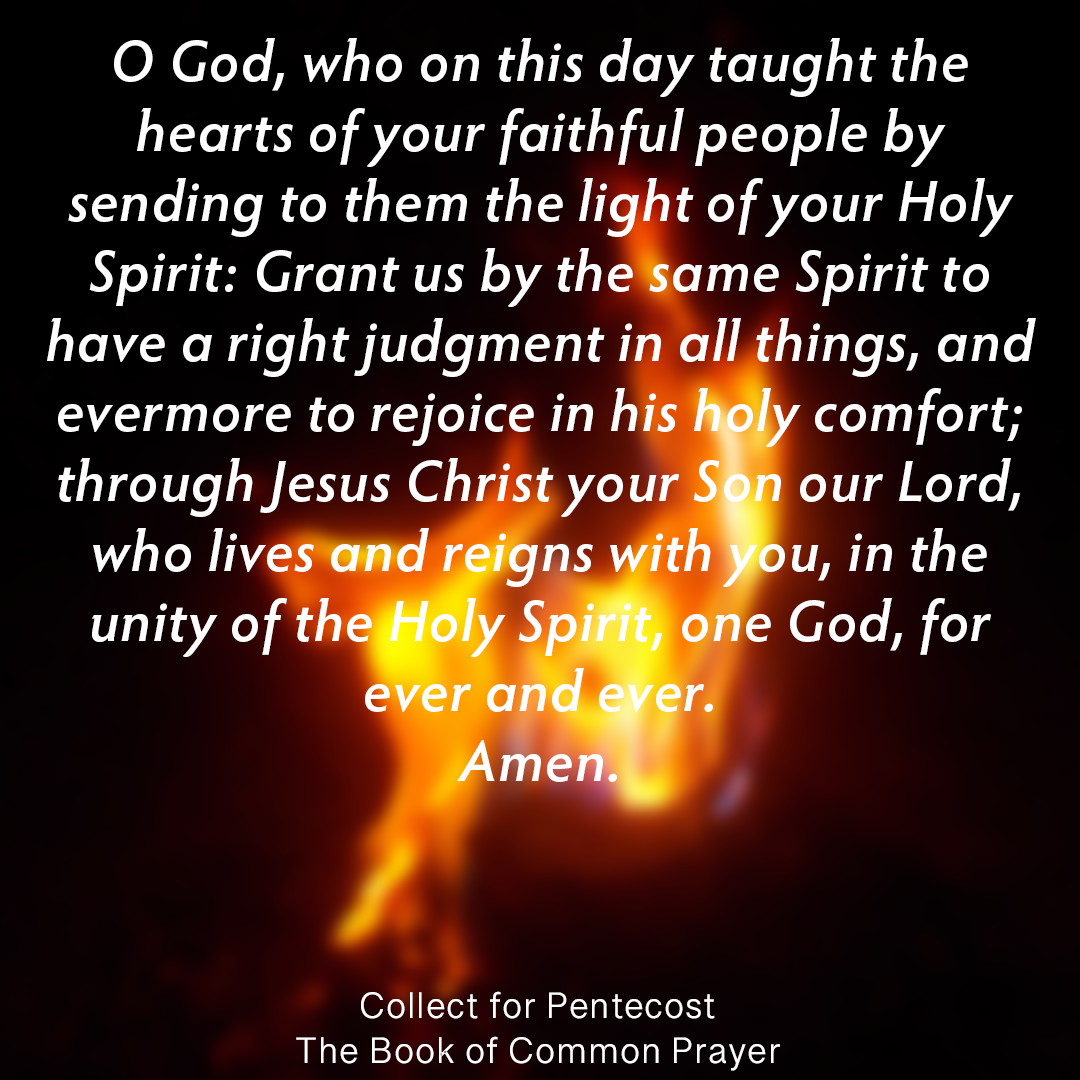
Collect for Pentecost

Pentecost

The term means “the fiftieth day.” It is used in both the OT and the NT. In the OT it refers to a feast of seven weeks known as the Feast of Weeks. It was apparently an agricultural event that focused on the harvesting of first fruits. Josephus referred to Pentecost as the fiftieth day after the first day of Passover. The term is used in the NT to refer to the coming of the Spirit on the day of Pentecost (Acts 2:1), shortly after Jesus’ death, resurrection, and ascension. Christians came to understand the meaning of Pentecost in terms of the gift of the Spirit. The Pentecost event was the fulfillment of a promise which Jesus gave concerning the return of the Holy Spirit. The speaking in tongues, which was a major effect of having received the Spirit, is interpreted by some to symbolize the church’s worldwide preaching. In the Christian tradition, Pentecost is now the seventh Sunday after Easter. It emphasizes that the church is understood as the body of Christ which is drawn together and given life by the Holy Spirit. Some understand Pentecost to be the origin and sending out of the church into the world. The Day of Pentecost is one of the seven principal feasts of the church year in the Episcopal Church (BCP, p. 15). The Day of Pentecost is identified by the BCP as one of the feasts that is “especially appropriate” for baptism (p. 312). The liturgical color for the feast is red. Pentecost has also been known as Whitsun or Whitsunday, a corruption of “White Sunday.” This term reflects the custom by which those who were baptized at the Vigil of Pentecost would wear their white baptismal garments to church on the Day of Pentecost. The BCP provides directions for observance of a Vigil of Pentecost, which begins with the Service of Light (p. 227). The Hymnal 1982 provides a variety of hymns for Pentecost (Hymns 223-230) and the Holy Spirit (Hymns 500-516).Reference: “Ascension” in An Episcopal Dictionary of the Church

Pentecost in 2 Minutes

More

  • The Collect: an Anglican/Episcopal Treasure. From the “Foreward” to The Collects of Thomas Cranmer edited by C. Frederick Barbee and Paul F. M. Zahl. This essay provides historical and liturgical background to this type of liturgical prayer.
  • A Pattern for Prayer by John D. Witvliet posted on Religion Online. The author believes the study of ancient liturgical materials facilitates special insight.  He discusses at length the understanding which lies in the structures and patterns of early collects and similar prayers, for preparing such prayers challenges us to draw on nearly the whole range of theological themes and motifs.

About Wind in the Chimes

Wind in the Chimes (renaming and reintroduction of Wind Chimes, 7/21/20)

Wind Chimes: September 25 2012 (an introduction)

They proposed two, Joseph called Barsabbas, who was also known as Justus, and Matthias.…

Before the casting of lots: heartfelt prayer for God’s guidance (Acts 1:24-25)

… and the lot fell to Matthias

Acts of the Apostles 1:23, 26 NRSV

Welcome!

On Wednesday, May 8, 2024, we explored Acts 1:15-17, 21-26, the first reading appointed for the Seventh Sunday of Easter, Year B (May 12, 2024). Our handout included commentaries on the other appointed texts from the First Letter of John (1 John 5:9-13), the Psalms (Psalm 1), and the Gospel according to John (John 17:6-19).

In her commentary on the text from Acts—from a homiletical perspective—Barbara K. Lundblad highlights the two men put forward by the group gathered together after the Ascension but before the Day of Pentecost. We are asked to “acknowledge and celebrate the ordinary people who have carried the extraordinary gospel from one generation to the next.”

Pause, remember, acknowledge, and even celebrate, the ordinary people you have met in your faith journey who have shared the Good News of God in Christ with you.

From a commentary on Acts 1:15-17, 21-26

Matthias becomes part of the inner circle; the other loses the toss of the dice. Even his name seems to be in question: Joseph called Barsabbas, who was also known as Justus. The truth is that we know very little about either one of these men.

Their lack of renown is a wondrous reality. In the next chapter Peter stands with the eleven to preach his Pentecost sermon. That would mean that Matthias must have been there even though he is not named. Where was Justus? Perhaps he was there too, for the narrator tells us that all of them were filled with the Holy Spirit. …

Rather than being disappointed by having so little information, we can be grateful for the witness of those who are so little known. [The sermon this Sunday] can be a time to acknowledge and celebrate the ordinary people who have carried the extraordinary gospel from one generation to the next. Who is Justus in your faith journey?

Source: Barbara K. Lundblad, “Homiletical Perspective on Acts 1:15–17, 21–26,” in Feasting on the Word: Preaching the Revised Common Lectionary: Year B, ed. David L. Bartlett and Barbara Brown Taylor, vol. 2 (Louisville, KY; London: Westminster John Knox Press, 2008).

The Rev. Dr. Barbara K. Lundblad is the former Joe R. Engle Professor of Preaching Emerita at Union Theological Seminary.

divider line

Most Wednesday mornings a group of us gather online to explore the readings that will be used in worship the following Sunday. Our handout this week features readings, commentaries, and notes for the Seventh Sunday of Easter (May 12, 2024) in Year B of the Revised Common Lectionary. Please: View or download the handout we used to guide our discussion and tune our hearts to the Spirit.

View the Revised Common Lectionary readings appointed for Sunday, May 12, 2024, on the Revised Common Lectionary site curated by the Vanderbilt Divinity Library.

Please return to this site throughout the week to keep learning.

divider line

About casting lots

Be well. Do good. Pay attention. Keep learning.

Ascension Day

Wind in the Chimes: the Ascension is about presence

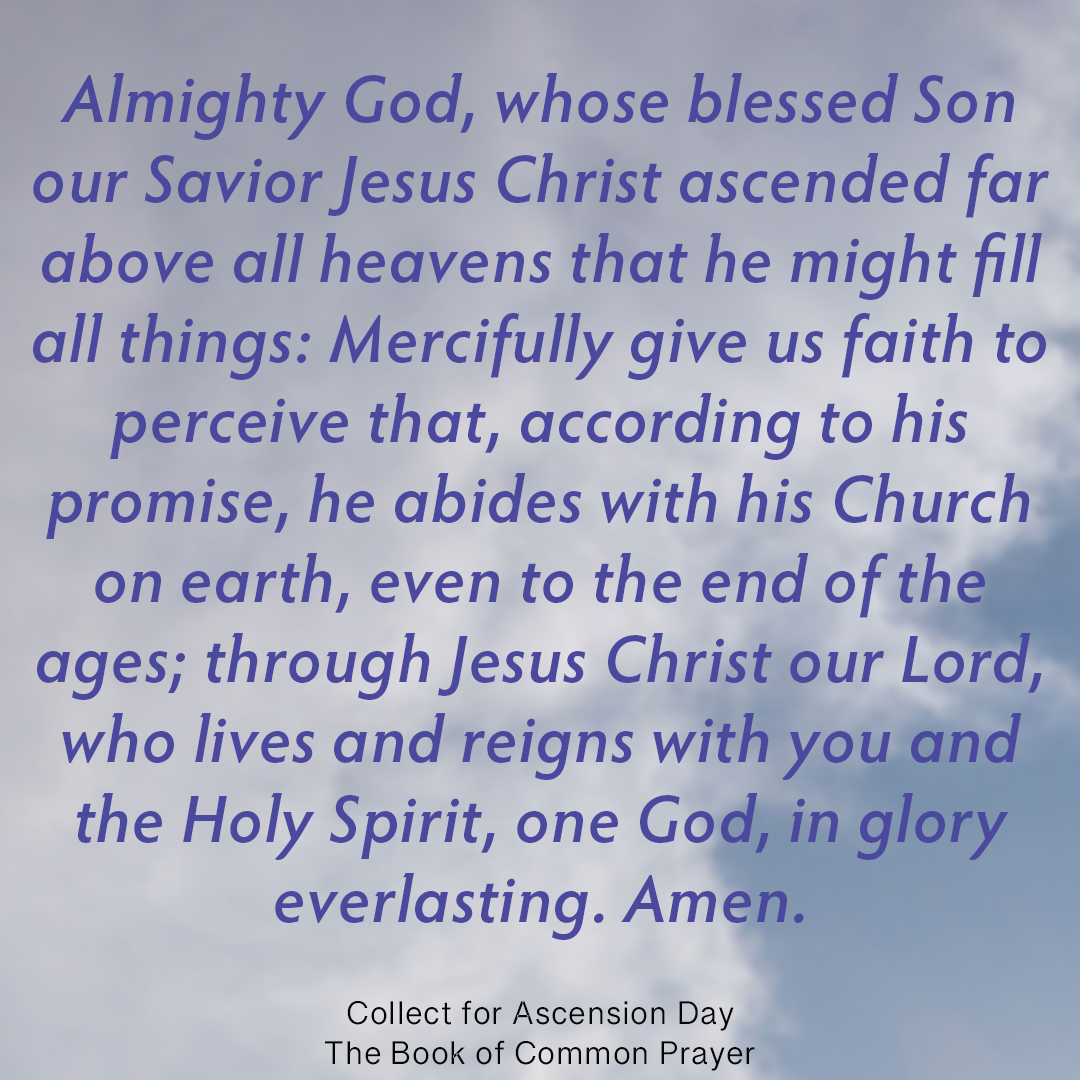
The Ascension of Christ (Ascension Day)

The occasion on which the risen Christ is taken into heaven after appearing to his followers for forty days (Acts 1:1-11, Mk 16:19). The Ascension marks the conclusion of Jesus’ post-resurrection appearances. It is the final elevation of his human nature to divine glory and the near presence of God. The Ascension is affirmed by the Nicene and Apostles’ Creeds. The Ascension is celebrated on Ascension Day, the Thursday that is the fortieth day of the Easter season. It is a principal feast of the church year in the Episcopal Church. Reference: “Ascension” in An Episcopal Dictionary of the Church

A Homily on the Feast of the Ascension

… the ascension is about presence, not absence. Jesus has not left us. Rather Christ has filled us. —Michael K. Marsh

An invitation: Hear what the Spirit is saying, in this homily “Feast of the Ascension” by Michael K. Marsh posted to Interrupting the Silence on May 21, 2009.

More

  • The Collect: an Anglican/Episcopal Treasure. From the “Foreward” to The Collects of Thomas Cranmer edited by C. Frederick Barbee and Paul F. M. Zahl. This essay provides historical and liturgical background to this type of liturgical prayer.
  • A Pattern for Prayer by John D. Witvliet posted on Religion Online. The author believes the study of ancient liturgical materials facilitates special insight.  He discusses at length the understanding which lies in the structures and patterns of early collects and similar prayers, for preparing such prayers challenges us to draw on nearly the whole range of theological themes and motifs.

About Wind in the Chimes

Wind in the Chimes (renaming and reintroduction of Wind Chimes, 7/21/20)

Wind Chimes: September 25 2012 (an introduction)

For the love of God is this …

Genuine faith is firmly connected with active love.

… that we obey his commandments.

1 John 5:3 NRSV

Welcome!

On Wednesday, May 1, 2024, we explored 1 John 5:1-6, the epistle pericope appointed for the Sixth Sunday of Easter, Year B (May 5, 2024). Our handout included commentaries on the other appointed texts from the Acts of the Apostles (Acts 10:44-48), the Psalms (Psalm 98), and the Gospel according to John (John 15:9-17).

From a commentary on 1 John 5:1-6

1 John reminds its readers that God’s commands are not burdensome. Here again we hear an echo of Jesus, who denounces the religious leaders for loading people down with “heavy burdens hard to bear” (Matthew 23:4). The Greek word that NRSV translates as “heavy” is barus, the same adjective translated as “burdensome” in 1 John 5:3. By contrast, Jesus says, “Come to me, all you that are weary and are carrying heavy burdens … For my yoke is easy, and my burden is light” (Matthew 11:28–30). Like Jesus, 1 John insists that God’s commands are not difficult. In essence, they consist in the call to love, “not in word or speech, but in truth and action” (1 John 3:18). Genuine faith, therefore, is firmly connected with active love.

Source: Commentary on 1 John 5:1-6 by Judith Jones posted May 10, 2015 to Working Preacher for Easter 6B

divider line

Most Wednesday mornings a group of us gather online to explore the readings that will be used in worship the following Sunday. Our handout features readings, commentaries, and notes for the Sixth Sunday of Easter (May 5, 2024) in Year B of the Revised Common Lectionary. Please: View or download the handout we used to guide our discussion and tune our hearts to the Spirit.

View the Revised Common Lectionary readings appointed for Sunday, May 5, 2024, on the Revised Common Lectionary site curated by the Vanderbilt Divinity Library.

Judith Jones is the Vicar, of St. Stephen & St. Luke by the Sea Episcopal Churches in Waldport, OR. More.

Please return to this site throughout the week to keep learning.

divider line

Be well. Do good. Pay attention. Keep learning.

Image: ChurchArt Pro