Blessed be the God and Father of our Lord Jesus Christ, who has blessed us in Christ with every spiritual blessing in the heavenly places… Ephesians 1:3
Welcome!
The readings on Sunday, July 14, 2024 (Proper 10B) continue the story of David as he moves the Ark of the Covenant to the City of David (Jerusalem). Psalm 24 gives praise to God and celebrates the King. In worship we start to read the Letter to the Ephesians as the Apostle sets out his vision of life in Christ. The Gospel of Mark tells the story of the death of John the Baptist.
We* had a long discussion on Psalm 24. The essay we read posed two questions we pass along to you:
How often do we approach worship, not with God in mind, but the week we have had?
How many times do we leave worship worried, not if we have worshiped God, but if we have been spiritually fed?
View or download the handout we used in our Wednesday morning forum:
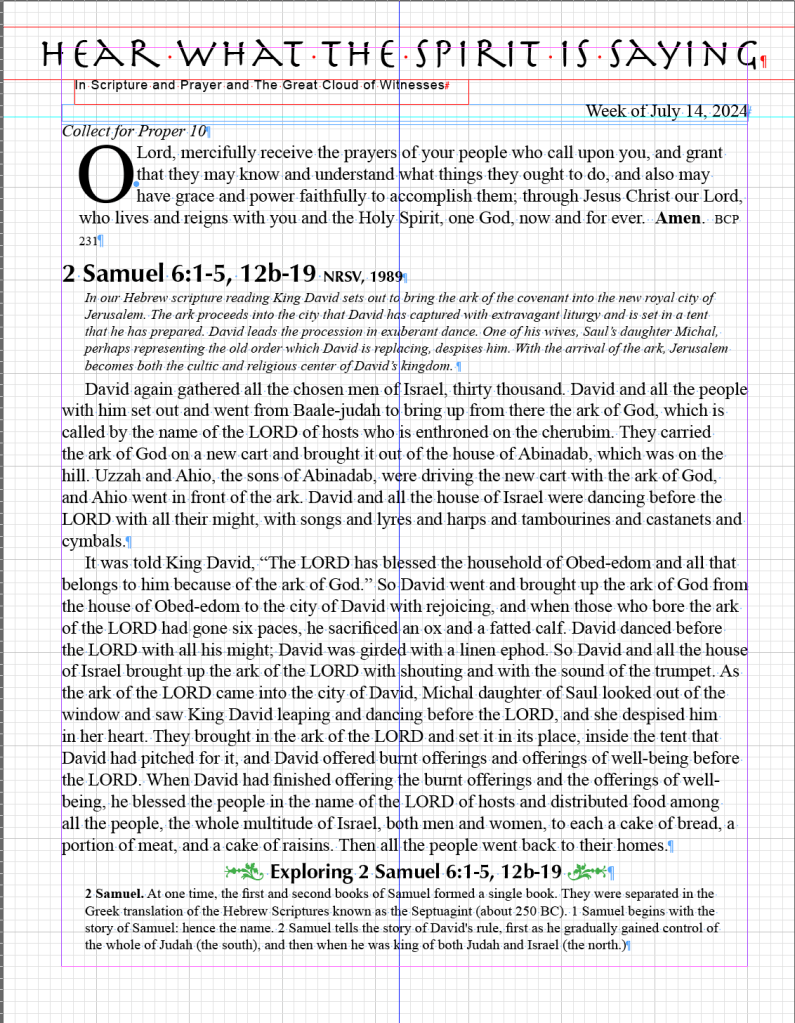
Click the image to view or download our study guide
*Most Wednesday mornings a group of us gather online to explore the readings that will be used in worship the following Sunday. This week’s handout features readings, commentaries, and notes for the Eighth Sunday after Pentecost (July 14, 2024) in Year B of the Revised Common Lectionary. Please: View or download the handoutwe used to guide our discussion and tune our hearts to the Spirit.
Out of the depths I cry to you, O Lord. Lord, hear my voice! Let your ears be attentive to the voice of my supplications! Psalm 130:1-2
Welcome!
The readings on Sunday, June 30, 2024 (Proper 8B) continue the story of David after the death of King Saul. Psalm 130 is a cry for attention and help and a confident expression that the Lord hears and will answer. There is a patient and hope-filled waiting.
Read Psalm 130 from the Tanakh. Listen carefully. In this translation, which words speak most clearly to your heart? What difference do these words make to you? To those you love?
Psalm 130:1–8 (Tanakh)
1A song of ascents. Out of the depths I call You, O Lord.
2O Lord, listen to my cry; let Your ears be attentive to my plea for mercy.
3If You keep account of sins, O Lord, Lord, who will survive?
4Yours is the power to forgive so that You may be held in awe.
5I look to the Lord; I look to Him; I await His word.
6I am more eager for the Lord than watchmen for the morning, watchmen for the morning.
7O Israel, wait for the Lord; for with the Lord is steadfast love and great power to redeem.
8It is He who will redeem Israel from all their iniquities.
View or download the handout we used in our Wednesday morning forum:
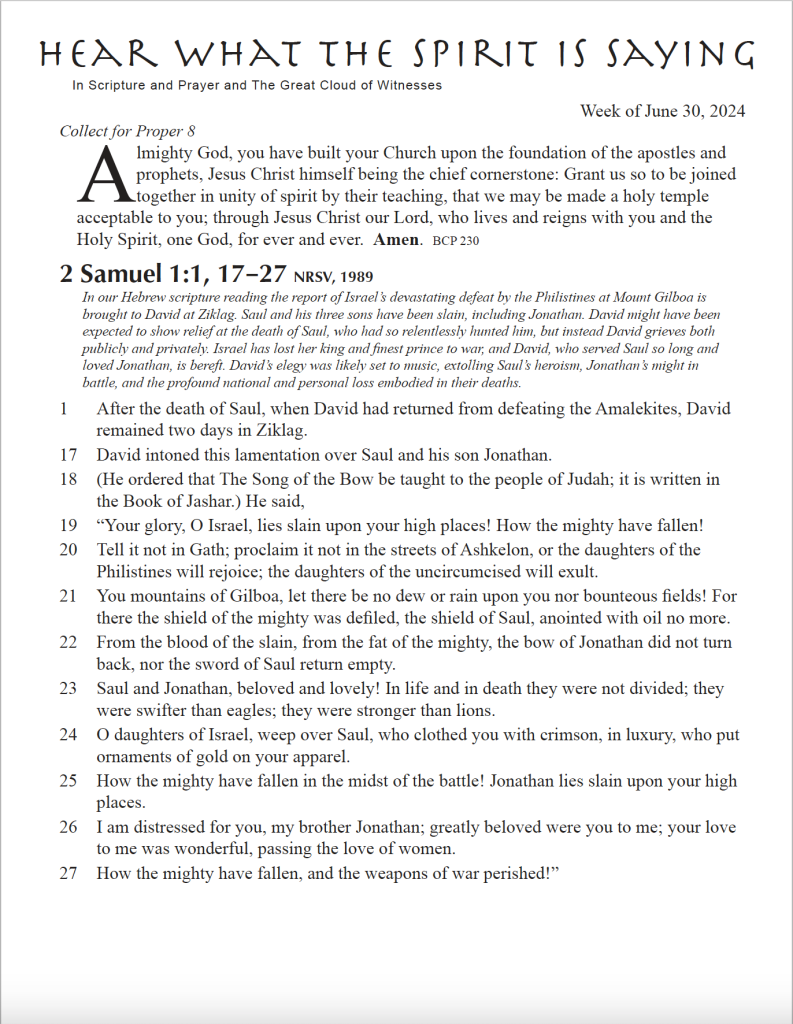
Click the image to view or download our study guide
*Most Wednesday mornings a group of us gather online to explore the readings that will be used in worship the following Sunday. This week’s handout features readings, commentaries, and notes for the Sixth Sunday after Pentecost (June 30, 2024) in Year B of the Revised Common Lectionary. Please: View or download the handoutwe used to guide our discussion and tune our hearts to the Spirit.
“O Lord, make us have perpetual love and reverence for your holy Name, for you never fail to help and govern those whom you have set upon the sure foundation of your loving-kindness…. ” Collect of the Day
Welcome!
The readings from Sunday, June 23, 2024 (Proper 7B) featured the story of David and Goliath. The verses from Psalm 9 came from a heart and a community that, through experience, trusted God in even the most difficult moments of life. Our* discussion focused on the Psalm. You are invited to join the Psalmist in lifting your heart to God.
Click image to view or download our study guide
*Most Wednesday mornings a group of us gather online to explore the readings that will be used in worship the following Sunday. This week’s handout features readings, commentaries, and notes for the Fifth Sunday after Pentecost (June 23, 2024) in Year B of the Revised Common Lectionary. Please: View or download the handoutwe used to guide our discussion and tune our hearts to the Spirit.
I give you thanks, O LORD, with my whole heart; before the gods I sing your praise… Psalm 138:1 (NRSV)
Welcome!
Psalm 138 (NRSVue) gives thanks and speaks powerfully to the majesty and humility of the God who loves us. Sometimes it helps to hear more than one translation of the ancient text to discover new dimensions of our relationship with God.
Here is Psalm 138 from the New Jerusalem Bible:
1I thank you, Yahweh, with all my heart, for you have listened to the cry I uttered. In the presence of angels I sing to you,
2I bow down before your holy Temple. I praise your name for your faithful love and your constancy; your promises surpass even your fame.
3You heard me on the day when I called, and you gave new strength to my heart.
4All the kings of the earth give thanks to you, Yahweh, when they hear the promises you make;
5they sing of Yahweh’s ways, ‘Great is the glory of Yahweh!’
6Sublime as he is, Yahweh looks on the humble, the proud he picks out from afar.
7Though I live surrounded by trouble you give me life—to my enemies’ fury! You stretch out your right hand and save me,
8Yahweh will do all things for me. Yahweh, your faithful love endures for ever, do not abandon what you have made.
Here is Psalm 138 from the Tanakh:
1Of David. I praise You with all my heart, sing a hymn to You before the divine beings;
2I bow toward Your holy temple and praise Your name for Your steadfast love and faithfulness, because You have exalted Your name, Your word, above all.
3When I called, You answered me, You inspired me with courage.
4All the kings of the earth shall praise You, O Lord, for they have heard the words You spoke.
5They shall sing of the ways of the Lord, “Great is the majesty of the Lord!”
6High though the Lord is, He sees the lowly; lofty, He perceives from afar.
7Though I walk among enemies, You preserve me in the face of my foes; You extend Your hand; with Your right hand You deliver me.
8The Lord will settle accounts for me. O Lord, Your steadfast love is eternal; do not forsake the work of Your hands.
As always, our sacred text (in its various English translations) questions us even as we speak, listen to, and hear the words:
Throughout the day, how often do you pause and give thanks? How often is thanksgiving done with all your heart? How might you experience or describe a half-hearted thanksgiving? A whole-hearted thanksgiving? (v. 1)
In verse 1 the Psalmist sings before “gods” (NRSV), “angels” (NJB), or “divine beings” (Tanakh). Which translation speaks to your heart? Why is that? Close your eyes, picture and feel and hear yourself singing your thanksgiving in such hallowed company. Well?
In the NRSVue verse 3 reads: “On the day I called, you answered me; “you increased my strength of soul.” The NJB translates God’s answer as “you gave new strength to my heart.” The Tanakh translates God’s answer as “You inspired me with courage.” Again, which translation speaks to your heart and why is that?
With these few examples from verses 1 and 3, I encourage you to allow the text (in various translations) to question you. Become quiet. Hear what the Spirit is saying to you. Hear how the Spirit—in the sacred text—both questions and encourages you.
*Most Wednesday mornings a group of us gather online to explore the readings that will be used in worship the following Sunday. This week’s handout features readings, commentaries, and notes for the Third Sunday after Pentecost (June 9, 2024) in Year B of the Revised Common Lectionary. Please: View or download the handoutwe used to guide our discussion and tune our hearts to the Spirit.
The grace of the Lord Jesus Christ, the love of God, and the communion of the Holy Spirit be with all of you. 2 Cor 13:13 NRSVue
Welcome!
Along the way I read—and remember now—Marcus Borg’s observation that credo, “I believe,” is probably better rendered, “I give my heart to.”
Everything we say in the Nicene Creed is about giving our heart to God who we experience as one God, Father, Son, and Holy Spirit.
Enter into our Nicene Creed as an expression of trust born of love:
WE GIVE OUR HEARTS TO one God, the Father, the Almighty, maker of heaven and earth, of all that is, seen and unseen.
WE GIVE OUR HEARTS TO one Lord, Jesus Christ, the only Son of God, eternally begotten of the Father, God from God, Light from Light, true God from true God, begotten, not made, of one Being with the Father. Through him all things were made.
WE GIVE OUR HEARTS TO THE ONE WHO, For us and for our salvation, came down from heaven: by the power of the Holy Spirit he became incarnate from the Virgin Mary, and was made man. WHO, For our sake was crucified under Pontius Pilate; he suffered death and was buried.
WE GIVE OUR HEARTS TO THE ONE WHO, On the third day rose again in accordance with the Scriptures; WHO ascended into heaven and is seated at the right hand of the Father. WHO will come again in glory to judge the living and the dead, and WHOSE kingdom will have no end.
WE GIVE OUR HEARTS TO the Holy Spirit, the Lord, the giver of life, who proceeds from the Father and the Son. With the Father and the Son he is worshiped and glorified. He has spoken through the Prophets.
WE GIVE OUR HEARTS TO THE one holy catholic and apostolic Church. We acknowledge one baptism for the forgiveness of sins. We look for the resurrection of the dead, and the life of the world to come. Amen.
On Wednesday, May 22, 2024, we* read through the scriptures appointed for Trinity Sunday, Year B. We spent the most time on the reading and learning from the letter to the Romans (Chapter 8, verses 12-17)
“There was the true light, which enlightens everyone who comes into the world” (John 1:9)—the Father.
“There was the true light, which enlightens everyone who comes into the world”—the Son.
“There was the true light, which enlightens everyone who comes into the world”—the other Paraclete (John 14:16, 26).
“Was” and “was” and “was,” but one thing was; “light” and “light” and “light,” but one light and one God. This is what David too imagined long ago when he said, “In your light we shall see light” (Psalm 36:10 [36:9]).
And now we have both seen and proclaimed the concise and simple theology of the Trinity: out of light (the Father) we comprehend light (the Son) in light (the Spirit).
Source: Christopher A. Beeley, Leading God’s People: Wisdom from the Early Church for Today (Grand Rapids, MI; Cambridge: William B. Eerdmans Publishing Company, 2012), 99–100.
Christopher Beeleyis the Walter H. Gray Associate Professor of Anglican Studies and Patristics [Yale Macmillan Center]. He teaches early Christian theology and history and modern Anglican tradition. He is an Episcopal priest.
*Most Wednesday mornings a group of us gather online to explore the readings that will be used in worship the following Sunday. This week’s handout features readings, commentaries, and notes for Trinity Sunday (May 26, 2024) in Year B of the Revised Common Lectionary. Please: View or download the handoutwe used to guide our discussion and tune our hearts to the Spirit.
Divided tongues, as of fire, appeared among them, and a tongue rested on each of them. All of them were filled with the Holy Spirit… (Acts 2:3-4)
Welcome!
What does Pentecost mean to you? How have you experienced the gift of the Holy Spirit breathing life into you, guiding your thinking and choosing, and enlivening your day-to-day activity?
On Wednesday, May 15, 2024, we* explored Acts 2:1-21, the account of the events on the Day of Pentecost.
Pause, remember, acknowledge, and even celebrate, the presence of the Holy Spirit “the Lord, the giver of life” in you.
From a commentary on Acts 2:1-21
The language of the Pentecost experience, with its images of “wind,” “spirit,” and being “filled” with the Spirit or the “breath” of life, is reminiscent of God’s initial creative activity (Gen. 1:2; 2:7). Here, however, the emphasis is not so much on creation or God’s works in history as on direct contact with the Spirit of God, who is now filling the world in a new way. The roll call of nations and languages points to the universality of the Spirit’s work for the whole world. God’s Spirit is the divine energy that now enables an eternal life to be real for those on whom God’s Spirit is poured and in whom the Spirit dwells (cf. Rom. 5:5).
Even more, linking the Pentecost events with the prophetic word about “last days” (Acts 2:17) points forward to the ultimate consummation of God’s reign in a “new heaven and new earth” (Rev. 21:1).
Source: Donald K. Mckim, “Theological Perspective on Acts 2:1‒21,” in Feasting on the Word: Preaching the Revised Common Lectionary: Year B, ed. David L. Bartlett and Barbara Brown Taylor, vol. 3 (Louisville, KY: Westminster John Knox Press, 2009), 2.
*Most Wednesday mornings a group of us gather online to explore the readings that will be used in worship the following Sunday. This week’s handout features readings, commentaries, and notes for the Day of Pentecost (May 19, 2024) in Year B of the Revised Common Lectionary. Please: View or download the handoutwe used to guide our discussion and tune our hearts to the Spirit.
Wind in the Chimes: a prayer on the Seventh Sunday of Easter to be strengthened
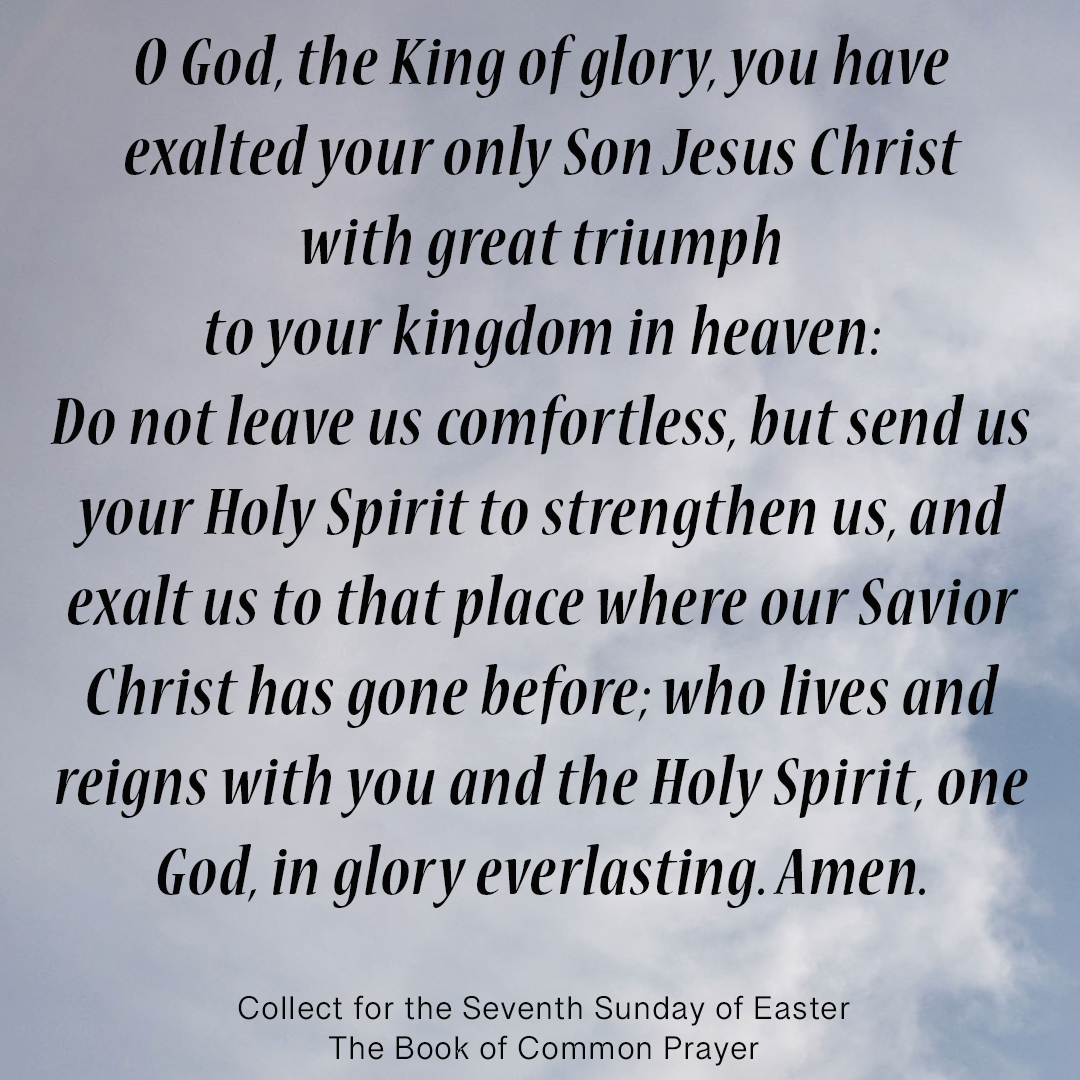
O God, the King of glory … do not leave us comfortless
On the Seventh Sunday of Easter, we first ask that our God not leave us comfortless. Then we ask for the Holy Spirit to strengthen and exalt us.
Marion Hatchett in his book, Commentary on the American Prayer Book, (New York: The Seabury Press, 1981) tells us that Thomas Cranmer (the author of the precursor of this prayer in English) “translated the word ‘orphans’ [from a more ancient prayer in Latin] with a weaker term ‘comfortless,’ which is used here in what is now an archaic meaning, ‘without strength,’… as well as ‘without consolation.'”
In this week as we prepare to remember and celebrate the coming of the Holy Spirit at Pentecost, consider how the Spirit has strengthened you in your faith journey. In what moments of your journey have you relied upon the strength of the Spirit to sustain you?
Likewise, what experiences in your faith journey have led you to trust that God, the King of glory, is even now exalting us, exalting you, “to that place where our Savior Christ has gone before?”
A Pattern for Prayer by John D. Witvliet posted on Religion Online. The author believes the study of ancient liturgical materials facilitates special insight. He discusses at length the understanding which lies in the structures and patterns of early collects and similar prayers, for preparing such prayers challenges us to draw on nearly the whole range of theological themes and motifs.
About Wind in the Chimes
Wind in the Chimes (renaming and reintroduction of Wind Chimes, 7/21/20)
If we live by the Spirit, let us also be guided by the Spirit.
Welcome. Our handout features the readings for the Third Sunday After Pentecost (June 26, 2022) in Year C of the Revised Common Lectionary.
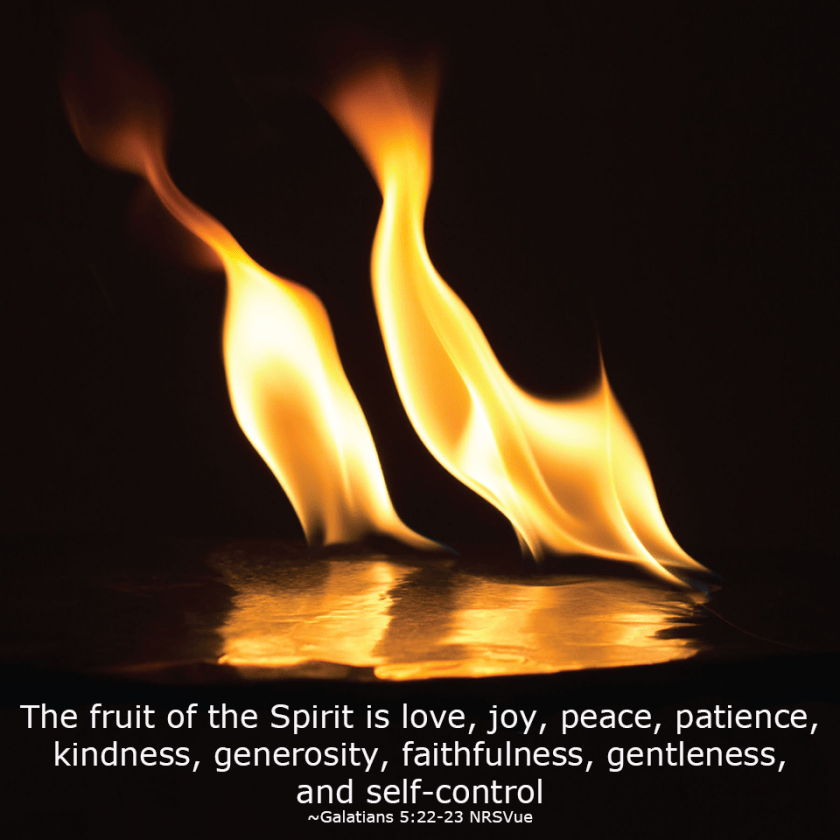
In our Forum on Wednesday, June 29, 2022, we’ll explore the portion of the letter to the Galatians that includes Paul’s understanding of the “fruit of the Spirit” and his admonition: ” If we live by the Spirit, let us also be guided by the Spirit.” Please view or download the handout we’ll use in our discussion as your own exploration continues.
Yesterday (5/19/13) we shared this video in the Sunday Morning Forum. For those of you unable to join us, please enjoy this 2 minute look at Pentecost offered by the folks at Busted Halo.
Have other questions? Please use our Comment section to continue the conversation.
Now it is after sunset (in my patch of California). On the Eve of Pentecost I share with you this presentation of the hymn “Come, Gracious Spirit.” Enjoy (more than once) as you prepare for (or celebrate) Pentecost.
So you know: “A Christian hymn of prayer to the Holy Spirit written by Simon Browne, 1720. Sung in the video by the Altar of Praise Chorale.” [YouTube caption]







 Hear what the Spirit is saying