Pour into our hearts such love …

Wind in the Chimes: Letting our collective prayer interrogate and inspire us.

The Collect for the Sixth Sunday of Easter

O God, you have prepared for those who love you such good things as surpass our understanding: Pour into our hearts such love towards you, that we, loving you in all things and above all things, may obtain your promises, which exceed all that we can desire; through Jesus Christ our Lord, who lives and reigns with you and the Holy Spirit, one God, for ever and ever. Amen.

The Book of Common Prayer, 225

A few questions from our prayer

I invite you to read through this prayer and then use these prompts as you ponder, contemplate, or journal. Please let the beauty and power of our common prayer be nourishment and refreshment along the Way.

O God, you have prepared for those who love you such good things as surpass our understanding: 

  • What evidence do you have that this is true, a trustworthy statement? From your life experiences, name some of those who have trusted this statement and share that trust with you.

Pour into our hearts such love towards you, …  

  • “Pour into our hearts…” How many ways could God (who is love, 1 John 4:8) do this pouring? How many ways has love towards God filled your heart?

that we, loving you in all things and above all things,

  • Describe the challenges of living like this.

may obtain your promises, which exceed all that we can desire;

  • What “promises” (from God) do you most cherish? Most desire to be fulfilled? What promises arouse the most curiosity in you? Why do you suppose our prayer uses a plural (promises) form?

through Jesus Christ our Lord, who lives and reigns with you and the Holy Spirit, one God, for ever and ever. Amen.

  • As disciples of Christ, as believers, we trust that “Christian prayer is [a] response to God the Father, through Jesus Christ, in the power of the Holy Spirit.” from The Book of Common Prayer, p. 836

More

  • The Collect: an Anglican/Episcopal Treasure. From the “Foreward” to The Collects of Thomas Cranmer edited by C. Frederick Barbee and Paul F. M. Zahl. This essay provides historical and liturgical background to this type of liturgical prayer.
  • A Pattern for Prayer by John D. Witvliet posted on Religion Online. The author believes the study of ancient liturgical materials facilitates special insight.  He discusses at length the understanding which lies in the structures and patterns of early collects and similar prayers, for preparing such prayers challenges us to draw on nearly the whole range of theological themes and motifs.

About Wind in the Chimes

Wind in the Chimes (renaming and reintroduction of Wind Chimes, 7/21/20)

Wind Chimes: September 25 2012 (an introduction)

Prayer is love’s choice, always

Wind in the Chimes: A thought on loving one another, even in physical distress or infirmity

1 John 4:7–8 (NRSV)

7 Beloved, let us love one another, because love is from God; everyone who loves is born of God and knows God. 8 Whoever does not love does not know God, for God is love.

If I cannot work or rise from my chair or my bed, love remains to me; I can pray.

—George Congreve SSJE, 1835–1918 (Woodgate, 1956), in  Alan Wilkinson and Christopher Cocksworth, eds., An Anglican Companion: Words from the Heart of Faith (London: SPCK; Church House Publishing, 2001), 89.

About Wind in the Chimes

Wind in the Chimes (renaming and reintroduction of Wind Chimes, 7/21/20)

Wind Chimes: September 25 2012 (an introduction)

Let’s love one another

Beloved, since God loved us so much, we also ought to love one another. 1 John 4:11 NRSV

Welcome!

1 John 4:7

On Wednesday, April 24, 2024, we explored 1 John 4:7-21, the epistle pericope appointed for the Fifth Sunday of Easter, Year B. Our handout included commentaries on the other appointed texts from the Acts of the Apostles (Acts 8:26-40), the Psalms (Psalm 22:25-31), and the Gospel according to John (John 15:1-8).

From a commentary on 1 John 4:7-21

Tucked away in verse 7 is an even more sobering claim. We know God by seeing what God has done, but seeing is not enough. We know God in the fullest and most authentic sense only when the love of God flows through us. God is love; only the one who loves can know this love that is God. Love is not a concept, known abstractly. It is an action, lived concretely. It is not enough to remember Jesus’ self-sacrifice, to think about it, or even to be moved by it. We must live it. To know the God of love is to live the love of God.

Ronald Cole-Turner, “Theological Perspective on 1 John 4:7–21,” in Feasting on the Word: Preaching the Revised Common Lectionary: Year B, ed. David L. Bartlett and Barbara Brown Taylor, vol. 2 (Louisville, KY; London: Westminster John Knox Press, 2008), 468.

divider line

Most Wednesday mornings a group of us gather online to explore the readings that will be used in worship the following Sunday. Our handout features readings, commentaries, and notes for the Fifth Sunday of Easter (April 28, 2024) in Year B of the Revised Common Lectionary. Please: View or download the handout we used to guide our discussion and tune our hearts to the Spirit.

View the Revised Common Lectionary readings appointed for Sunday, April 28, 2024, on the Revised Common Lectionary site curated by the Vanderbilt Divinity Library.

Ronald Cole-Turner is the H. Parker Sharp Chair of Theology and Ethics, at Pittsburgh Theological Seminary, Pittsburgh, Pennsylvania. More.

Please return to this site throughout the week to keep learning.

divider line

Be well. Do good. Pay attention. Keep learning.

Image: ChurchArt Pro

We ought to lay down our lives for the brothers and sisters.

Wind in the Chimes: About selfless love

1 John 3:16

On the Fourth Sunday of Easter, Year B, all the readings lead us to see Jesus as the Good Shepherd. The qualities of the Good Shepherd were learned, taught, and lived by his disciples to all who would listen and receive the love of God in Jesus Christ. This Sunday the quality of living and acting from a selfless love is highlighted in 1 John 3:16-24

Ronald Cole-Turner opens up the words of 1 John 3:16:

Love is known in action. How do we know God’s love? It is through God’s action in sending Jesus Christ into the world, and through Christ’s action of laying down his life for us. The actions of God show us what God is like.

The same test applies to our love. How do others know what is in our heart? It is by our actions. Just as God’s love is known to us through the visible action of Christ, so our love is known to others through concrete actions that mirror Christ’s own. Christ lays down his life, and we are to lay down our lives. […]

For Christians, self-sacrifice should be ordinary, not extraordinary. We ought to lay down our lives, John writes, not intending to give a grand challenge for heroic Christian but an everyday commandment for ordinary Christians. The Christian life is a life laid down for others, a life built on self-sacrifice.

Sometimes self-sacrifice can mean physical death. […] More often, the stakes are lower. But the principle is the same. Laying down our lives, at its core, can mean any number of ways in which we lay aside our claim to own our lives. We lay down our lives when we put others first. We lay down our lives when we live for the good of others. We lay down our lives when we make time for others. To love others is to lay down our life for them. When we lay down the completely normal human desire to live for ourselves, and when instead we allow the love of God to reorient us toward the needs of others, we are laying down our lives.

Ronald Cole-Turner is the H. Parker Sharp Chair of Theology and Ethics, at Pittsburgh Theological Seminary, Pittsburgh, Pennsylvania. More.

More

  • A prayer used by Episcopalians: Heavenly Father, whose blessed Son came not to be served but to serve: Bless all who, following in his steps, give themselves to the service of others; that with wisdom, patience, and courage, they may minister in his Name to the suffering, the friendless, and the needy—for the love of him who laid down his life for us, your Son our Savior Jesus Christ, who lives and reigns with you and the Holy Spirit, one God, for ever and ever. Amen. [Book of Common Prayer p. 260 (A Collect for Social Service)]
  • A prayer suggested for caregivers from the Pocket Prayers Series: Give to my eyes light to see those in need. / Give to my heart compassion and understanding. / Give to my mind knowledge and wisdom. / Give to my hands skill and tenderness. / Give to my ears the ability to listen. / Give to me Lord strength for this selfless service and enable me to bring joy to the lives of those I serve. [Author unknown quoted in Trevor Lloyd, Pocket Prayers for Healing (Pocket Prayers Series). Church House Publishing. Kindle Edition.]
  • See also Philippians 2:5-11

About Wind in the Chimes

Wind in the Chimes (renaming and reintroduction of Wind Chimes, 7/21/20)

Wind Chimes: September 25 2012 (an introduction)

By what name did you do this?

Wind in the Chimes: About healing and our centuries-long trust in the Lord.

After healing a man lame from birth Peter begins to tell the story of Jesus and the healing power of Jesus. He is arrested and then questioned about the power or name that was used to heal the man. (Acts 3-4)

Peter makes a declaration to the authorities questioning him: “…if we are being questioned today because of a good deed done to someone who was sick and are being asked how this man has been healed, let it be known to all of you … that this man is standing before you in good health by the name of Jesus Christ of Nazareth … There is salvation in no one else, for there is no other name under heaven given among mortals by which we must be saved.” Acts 4:9-12

We continue to trust the words of Peter as recorded in Acts. We continue to trust the healing power of Jesus. This is how we believe (trust), this is how we pray:

The Almighty Lord, who is a strong tower to all who put their trust in him, to whom all things in heaven, on earth, and under the earth bow and obey: Be now and evermore your defense, and make you know and feel that the only Name under heaven given for health and salvation is the Name of our Lord Jesus Christ. Amen.

Book of Common Prayer pp. 456-457 (Ministration to the Sick)

More

  • See also Philippians 2:5-11
  • A prayer for trust by one who is ill: O God, the source of all health: So fill my heart with faith in your love, that with calm expectancy I may make room for your power to possess me, and gracefully accept your healing; through Jesus Christ our Lord. Amen. [Book of Common Prayer p. 461 (Trust in God)]
  • Healing must never be seen as an end in itself. Scripture teaches us that Jesus’ healings were a sign of the reign of God come near, of God’s marvelous power and presence among us. Healing is not merely the alleviation of affliction, but testimony to the wholeness and salvation God intends for us. [Enriching Our Worship 2, p. 16 (This is a book of supplemental liturgical materials used in The Episcopal Church.)]

About Wind in the Chimes

Wind in the Chimes (renaming and reintroduction of Wind Chimes, 7/21/20)

Wind Chimes: September 25 2012 (an introduction)

I shall not want

“…I shall not want.” In what ways is this true for you?

Welcome!

On Wednesday, April 17, 2024, we explored Psalm 23 for the voice of the Spirit. Our handout included commentaries on the other appointed texts from the Acts of the Apostles (Acts 4:5-12), the First Letter of John (1 John 3:16-24), and the Gospel according to John (John 10:11-18).

Here is yet another brief look at Psalm 23. The first verse of the Psalm invites us to trust deeply.

From a commentary on Psalm 23

The psalm has been composed as the exposition of its opening line. The line makes a positive and a negative statement. The positive statement relates the LORD and the psalmist through the metaphor “shepherd.” That metaphorical statement, broadly enough understood, controls the imagery of the whole. The negative statement is a self-description of the psalmist. It uses the word “lack” (NRSV, “want”) in an absolute sense; the transitive verb is given no object. The psalmist lists what he does not lack in the rest of the psalm. […]

To say “The LORD is my shepherd” invokes all the richness of this theological and political background as well as the pastoral. The metaphor is not restricted to associations with what actual shepherds did; it is informed by what the LORD has done and what kings were supposed to do. One does not have to shift to images of guide and host to account for the whole poem. “Shepherd” understood against its usage in Israel accounts for the whole. The statement is a confession. It declares commitment and trust. It also has a polemical thrust against human rulers and divine powers. The psalm entrusts the support, guidance, and protection of life only and alone to the one whose name is the LORD.

The body of the psalm completes the sentence, “I do not lack.…” It does not leave those who say it to fill it out with what they want out of their own subjective wills. It has its own agenda of what the LORD does to fulfill one’s needs. The very personal syntax of the opening confession is maintained in the recitation of “what the LORD (he/you) does for me.” The items in the recitation can be read and understood in relation to three areas. First, what the LORD does draws on what is prayed for in the prayers for help. Second, it reflects the song of thanksgiving with its report of salvation and accompanying festivities, except here the account tells what the LORD does, not what the LORD has done in the past. Third, the recitation is at points connected with the language of Israel’s testimony to its salvation in the exodus.

Excerpted from, James Luther Mays, Psalms, Interpretation, a Bible Commentary for Teaching and Preaching (Louisville, KY: John Knox Press, 1994), 117–118.

divider line

Most Wednesday mornings a group of us gather online to explore the readings that will be used in worship the following Sunday. Our handout features readings, commentaries, and notes for the Fourth Sunday of Easter (April 21, 2024) in Year B of the Revised Common Lectionary. Please: View or download the handout we used to guide our discussion and tune our hearts to the Spirit.

View the Revised Common Lectionary readings appointed for Sunday, April 21, 2024, on the Revised Common Lectionary site curated by the Vanderbilt Divinity Library.

Please come back to this site throughout the week in order to keep learning.

divider line

Be well. Do good. Pay attention. Keep learning.

Image: ChurchArt Pro

Pentecost +8, Proper 13C

Christ is all and in all!

Welcome. Our handout features the readings for the Eighth Sunday After Pentecost (July 31, 2022) in Year C of the Revised Common Lectionary.

In our Forum on Wednesday, August 3, 2022, we’ll explore Colossians 3:1-11 for the voice of the Spirit that we might continue to grow in Christ here and now.

Please view or download the handout we’ll use in our discussion as we meet.

View the Revised Common Lectionary readings appointed for Sunday, July 31, 2022.

Pay attention. Keep learning.

View or download the Handout for Proper 13, Year C.

View or download the Art for Sunday, July 31, 2022 (Proper 13C) with commentary by Hovak Najarian.

Please come back to this site throughout the week in order to keep learning.

Image: ChurchArt Pro

Pentecost +7, Proper 12C

When you pray, say …

Welcome. Our handout features the readings for the Seventh Sunday After Pentecost (July 24, 2022) in Year C of the Revised Common Lectionary.

In our Forum on Wednesday, July 27, 2022, we’ll explore the Lord’s Prayer and the teachings of Jesus that follow (Luke 11:1-13)

Please view or download the handout we’ll use in our discussion as your own exploration continues.

View the Revised Common Lectionary readings appointed for Sunday, July 24, 2022.

Pay attention. Keep learning.

View or download the Handout for Proper 12, Year C.

View or download the Art for Sunday, July 24, 2022 (Proper 12C) with commentary by Hovak Najarian.

Please come back to this site throughout the week in order to keep learning.

Image: ChurchArt Pro

Pentecost +6, Proper 11C

He is the image of the invisible God, the firstborn of all creation

Welcome. Our handout features the readings for the Sixth Sunday After Pentecost (July 17, 2022) in Year C of the Revised Common Lectionary.

In our Forum on Wednesday, July 20, 2022, we’ll explore the opening words of the letter to the Colossians. We’ll especially look at who Jesus is to us individually and to us as a community of Christ-followers.

Please view or download the handout we’ll use in our discussion as your own exploration continues.

View the Revised Common Lectionary readings appointed for Sunday, July 17, 2022.

Pay attention. Keep learning.

View or download the Handout for Proper 11, Year C.

View or download the Art for Sunday, July 17, 2022 (Proper 11C) with commentary by Hovak Najarian.

On July 22nd, annually, we remember and celebrate Mary Magdalene. Read more about this woman who is “the Apostle to the Apostles.”

Please come back to this site throughout the week in order to keep learning.

Image: ChurchArt Pro

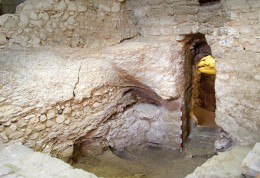
Has the Childhood Home of Jesus Been Found?

Jesus’ home in Nazareth

Excavation site in Nazareth

This essay originally appeared on Bible History Daily from the Biblical Archeology Society on March 17, 2017. It is an updated version of a 2015 posting.

Begin quote

The childhood home of Jesus may have been found underneath the Sisters of Nazareth Convent in Nazareth, Israel, according to archaeologist Ken Dark.

The excavation site located beneath the convent has been known since 1880, but it was never professionally excavated until the Nazareth Archaeological Project began its work in 2006. In “Has Jesus’ Nazareth House Been Found?” in the March/April 2015 issue of BAR, Ken Dark, the director of the Nazareth Archaeological Project, not only describes the remains of the home itself, but explores the evidence that suggests that this is the place where Jesus spent his formative years—or at least the place regarded in the Byzantine period as the childhood home of Jesus.

The excavation revealed a first-century “courtyard house” that was partially hewn from naturally occurring rock and partially constructed with rock-built walls. Many of the home’s original features are still intact, including doors and windows. Also found at the site were tombs, a cistern and, later, a Byzantine church.

The remains combined with the description found in the seventh-century pilgrim account De Locus Sanctis point to the courtyard house found beneath the convent as what may have been regarded as Jesus’ home in Nazareth. Archaeological and geographical evidence from the Church of the Annunciation, the International Marion Center and Mary’s Well come together to suggest that this location may be where Jesus transitioned from boy to man.

Ken Dark also discusses the relationship between the childhood home of Jesus, Nazareth and the important site of Sepphoris. It has been thought that Sepphoris would have provided Joseph with work and Jesus many important cultural experiences. However, Ken Dark believes that Nazareth was a larger town than traditionally understood and was particularly Jewish in its identity—as opposed to the Roman-influenced Sepphoris. This is partially based on the result of his survey of the Nahal Zippori region that separates Sepphoris and Nazareth geographically.

For more on the childhood home of Jesus, read the full article “Has Jesus’ Nazareth House Been Found?” by Ken Dark in the March/April 2015 issue of Biblical Archaeology Review.

end-quote-black-71by52

Image: Bible History Daily. Description: “This very well could be the childhood home of Jesus. It doesn’t look inviting, but this rock-hewn courtyard house was quite likely Jesus’ home in Nazareth. The recent excavation by Ken Dark and the Nazareth Archaeological Project revealed evidence suggesting this is where Jesus was raised—or at the least the place venerated as such by the Byzantine period. Photo: Ken Dark.”