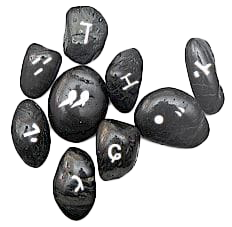
They proposed two, Joseph called Barsabbas, who was also known as Justus, and Matthias.…

Before the casting of lots: heartfelt prayer for God’s guidance (Acts 1:24-25)

… and the lot fell to Matthias

Acts of the Apostles 1:23, 26 NRSV

Welcome!

On Wednesday, May 8, 2024, we explored Acts 1:15-17, 21-26, the first reading appointed for the Seventh Sunday of Easter, Year B (May 12, 2024). Our handout included commentaries on the other appointed texts from the First Letter of John (1 John 5:9-13), the Psalms (Psalm 1), and the Gospel according to John (John 17:6-19).

In her commentary on the text from Acts—from a homiletical perspective—Barbara K. Lundblad highlights the two men put forward by the group gathered together after the Ascension but before the Day of Pentecost. We are asked to “acknowledge and celebrate the ordinary people who have carried the extraordinary gospel from one generation to the next.”

Pause, remember, acknowledge, and even celebrate, the ordinary people you have met in your faith journey who have shared the Good News of God in Christ with you.

From a commentary on Acts 1:15-17, 21-26

Matthias becomes part of the inner circle; the other loses the toss of the dice. Even his name seems to be in question: Joseph called Barsabbas, who was also known as Justus. The truth is that we know very little about either one of these men.

Their lack of renown is a wondrous reality. In the next chapter Peter stands with the eleven to preach his Pentecost sermon. That would mean that Matthias must have been there even though he is not named. Where was Justus? Perhaps he was there too, for the narrator tells us that all of them were filled with the Holy Spirit. …

Rather than being disappointed by having so little information, we can be grateful for the witness of those who are so little known. [The sermon this Sunday] can be a time to acknowledge and celebrate the ordinary people who have carried the extraordinary gospel from one generation to the next. Who is Justus in your faith journey?

Source: Barbara K. Lundblad, “Homiletical Perspective on Acts 1:15–17, 21–26,” in Feasting on the Word: Preaching the Revised Common Lectionary: Year B, ed. David L. Bartlett and Barbara Brown Taylor, vol. 2 (Louisville, KY; London: Westminster John Knox Press, 2008).

The Rev. Dr. Barbara K. Lundblad is the former Joe R. Engle Professor of Preaching Emerita at Union Theological Seminary.

divider line

Most Wednesday mornings a group of us gather online to explore the readings that will be used in worship the following Sunday. Our handout this week features readings, commentaries, and notes for the Seventh Sunday of Easter (May 12, 2024) in Year B of the Revised Common Lectionary. Please: View or download the handout we used to guide our discussion and tune our hearts to the Spirit.

View the Revised Common Lectionary readings appointed for Sunday, May 12, 2024, on the Revised Common Lectionary site curated by the Vanderbilt Divinity Library.

Please return to this site throughout the week to keep learning.
divider line

About casting lots

Be well. Do good. Pay attention. Keep learning.

Ascension Day

Wind in the Chimes: the Ascension is about presence

The Ascension of Christ (Ascension Day)

The occasion on which the risen Christ is taken into heaven after appearing to his followers for forty days (Acts 1:1-11, Mk 16:19). The Ascension marks the conclusion of Jesus’ post-resurrection appearances. It is the final elevation of his human nature to divine glory and the near presence of God. The Ascension is affirmed by the Nicene and Apostles’ Creeds. The Ascension is celebrated on Ascension Day, the Thursday that is the fortieth day of the Easter season. It is a principal feast of the church year in the Episcopal Church. Reference: “Ascension” in An Episcopal Dictionary of the Church

A Homily on the Feast of the Ascension

… the ascension is about presence, not absence. Jesus has not left us. Rather Christ has filled us. —Michael K. Marsh

An invitation: Hear what the Spirit is saying, in this homily “Feast of the Ascension” by Michael K. Marsh posted to Interrupting the Silence on May 21, 2009.

More

  • The Collect: an Anglican/Episcopal Treasure. From the “Foreward” to The Collects of Thomas Cranmer edited by C. Frederick Barbee and Paul F. M. Zahl. This essay provides historical and liturgical background to this type of liturgical prayer.
  • A Pattern for Prayer by John D. Witvliet posted on Religion Online. The author believes the study of ancient liturgical materials facilitates special insight.  He discusses at length the understanding which lies in the structures and patterns of early collects and similar prayers, for preparing such prayers challenges us to draw on nearly the whole range of theological themes and motifs.

About Wind in the Chimes

Wind in the Chimes (renaming and reintroduction of Wind Chimes, 7/21/20)

Wind Chimes: September 25 2012 (an introduction)

For the love of God is this …

Genuine faith is firmly connected with active love.

… that we obey his commandments.

1 John 5:3 NRSV

Welcome!

On Wednesday, May 1, 2024, we explored 1 John 5:1-6, the epistle pericope appointed for the Sixth Sunday of Easter, Year B (May 5, 2024). Our handout included commentaries on the other appointed texts from the Acts of the Apostles (Acts 10:44-48), the Psalms (Psalm 98), and the Gospel according to John (John 15:9-17).

From a commentary on 1 John 5:1-6

1 John reminds its readers that God’s commands are not burdensome. Here again we hear an echo of Jesus, who denounces the religious leaders for loading people down with “heavy burdens hard to bear” (Matthew 23:4). The Greek word that NRSV translates as “heavy” is barus, the same adjective translated as “burdensome” in 1 John 5:3. By contrast, Jesus says, “Come to me, all you that are weary and are carrying heavy burdens … For my yoke is easy, and my burden is light” (Matthew 11:28–30). Like Jesus, 1 John insists that God’s commands are not difficult. In essence, they consist in the call to love, “not in word or speech, but in truth and action” (1 John 3:18). Genuine faith, therefore, is firmly connected with active love.

Source: Commentary on 1 John 5:1-6 by Judith Jones posted May 10, 2015 to Working Preacher for Easter 6B

divider line

Most Wednesday mornings a group of us gather online to explore the readings that will be used in worship the following Sunday. Our handout features readings, commentaries, and notes for the Sixth Sunday of Easter (May 5, 2024) in Year B of the Revised Common Lectionary. Please: View or download the handout we used to guide our discussion and tune our hearts to the Spirit.

View the Revised Common Lectionary readings appointed for Sunday, May 5, 2024, on the Revised Common Lectionary site curated by the Vanderbilt Divinity Library.

Judith Jones is the Vicar, of St. Stephen & St. Luke by the Sea Episcopal Churches in Waldport, OR. More.

Please return to this site throughout the week to keep learning.

divider line

Be well. Do good. Pay attention. Keep learning.

Image: ChurchArt Pro

Pour into our hearts such love …

Wind in the Chimes: Letting our collective prayer interrogate and inspire us.

The Collect for the Sixth Sunday of Easter

O God, you have prepared for those who love you such good things as surpass our understanding: Pour into our hearts such love towards you, that we, loving you in all things and above all things, may obtain your promises, which exceed all that we can desire; through Jesus Christ our Lord, who lives and reigns with you and the Holy Spirit, one God, for ever and ever. Amen.

The Book of Common Prayer, 225

A few questions from our prayer

I invite you to read through this prayer and then use these prompts as you ponder, contemplate, or journal. Please let the beauty and power of our common prayer be nourishment and refreshment along the Way.

O God, you have prepared for those who love you such good things as surpass our understanding: 

  • What evidence do you have that this is true, a trustworthy statement? From your life experiences, name some of those who have trusted this statement and share that trust with you.

Pour into our hearts such love towards you, …  

  • “Pour into our hearts…” How many ways could God (who is love, 1 John 4:8) do this pouring? How many ways has love towards God filled your heart?

that we, loving you in all things and above all things,

  • Describe the challenges of living like this.

may obtain your promises, which exceed all that we can desire;

  • What “promises” (from God) do you most cherish? Most desire to be fulfilled? What promises arouse the most curiosity in you? Why do you suppose our prayer uses a plural (promises) form?

through Jesus Christ our Lord, who lives and reigns with you and the Holy Spirit, one God, for ever and ever. Amen.

  • As disciples of Christ, as believers, we trust that “Christian prayer is [a] response to God the Father, through Jesus Christ, in the power of the Holy Spirit.” from The Book of Common Prayer, p. 836

More

  • The Collect: an Anglican/Episcopal Treasure. From the “Foreward” to The Collects of Thomas Cranmer edited by C. Frederick Barbee and Paul F. M. Zahl. This essay provides historical and liturgical background to this type of liturgical prayer.
  • A Pattern for Prayer by John D. Witvliet posted on Religion Online. The author believes the study of ancient liturgical materials facilitates special insight.  He discusses at length the understanding which lies in the structures and patterns of early collects and similar prayers, for preparing such prayers challenges us to draw on nearly the whole range of theological themes and motifs.

About Wind in the Chimes

Wind in the Chimes (renaming and reintroduction of Wind Chimes, 7/21/20)

Wind Chimes: September 25 2012 (an introduction)

Prayer is love’s choice, always

Wind in the Chimes: A thought on loving one another, even in physical distress or infirmity

1 John 4:7–8 (NRSV)

7 Beloved, let us love one another, because love is from God; everyone who loves is born of God and knows God. 8 Whoever does not love does not know God, for God is love.

If I cannot work or rise from my chair or my bed, love remains to me; I can pray.

—George Congreve SSJE, 1835–1918 (Woodgate, 1956), in  Alan Wilkinson and Christopher Cocksworth, eds., An Anglican Companion: Words from the Heart of Faith (London: SPCK; Church House Publishing, 2001), 89.

About Wind in the Chimes

Wind in the Chimes (renaming and reintroduction of Wind Chimes, 7/21/20)

Wind Chimes: September 25 2012 (an introduction)

Let’s love one another

Beloved, since God loved us so much, we also ought to love one another. 1 John 4:11 NRSV

Welcome!

1 John 4:7

On Wednesday, April 24, 2024, we explored 1 John 4:7-21, the epistle pericope appointed for the Fifth Sunday of Easter, Year B. Our handout included commentaries on the other appointed texts from the Acts of the Apostles (Acts 8:26-40), the Psalms (Psalm 22:25-31), and the Gospel according to John (John 15:1-8).

From a commentary on 1 John 4:7-21

Tucked away in verse 7 is an even more sobering claim. We know God by seeing what God has done, but seeing is not enough. We know God in the fullest and most authentic sense only when the love of God flows through us. God is love; only the one who loves can know this love that is God. Love is not a concept, known abstractly. It is an action, lived concretely. It is not enough to remember Jesus’ self-sacrifice, to think about it, or even to be moved by it. We must live it. To know the God of love is to live the love of God.

Ronald Cole-Turner, “Theological Perspective on 1 John 4:7–21,” in Feasting on the Word: Preaching the Revised Common Lectionary: Year B, ed. David L. Bartlett and Barbara Brown Taylor, vol. 2 (Louisville, KY; London: Westminster John Knox Press, 2008), 468.

divider line

Most Wednesday mornings a group of us gather online to explore the readings that will be used in worship the following Sunday. Our handout features readings, commentaries, and notes for the Fifth Sunday of Easter (April 28, 2024) in Year B of the Revised Common Lectionary. Please: View or download the handout we used to guide our discussion and tune our hearts to the Spirit.

View the Revised Common Lectionary readings appointed for Sunday, April 28, 2024, on the Revised Common Lectionary site curated by the Vanderbilt Divinity Library.

Ronald Cole-Turner is the H. Parker Sharp Chair of Theology and Ethics, at Pittsburgh Theological Seminary, Pittsburgh, Pennsylvania. More.

Please return to this site throughout the week to keep learning.

divider line

Be well. Do good. Pay attention. Keep learning.

Image: ChurchArt Pro

Pentecost +3, Proper 8C

If we live by the Spirit, let us also be guided by the Spirit.

Welcome. Our handout features the readings for the Third Sunday After Pentecost (June 26, 2022) in Year C of the Revised Common Lectionary.

In our Forum on Wednesday, June 29, 2022, we’ll explore the portion of the letter to the Galatians that includes Paul’s understanding of the “fruit of the Spirit” and his admonition: ” If we live by the Spirit, let us also be guided by the Spirit.” Please view or download the handout we’ll use in our discussion as your own exploration continues.

View the Revised Common Lectionary readings appointed for Sunday, June 26, 2022.

Pay attention. Keep learning.

View or download the Handout for Proper 8, Year C.

View or download Art for Proper 8, Year C. with commentary by Hovak Najarian.

Please come back to this site throughout the week in order to keep learning.

Beauty and Breaking

Wind in the Chimes: A meditation on John 12:1-8

What does love smell like?  What does hope smell like?  What does resurrection smell like?  On this fifth Sunday of Lent, as we draw closer to Jesus’s final week, and prepare to contemplate his suffering, we’re invited into a story of the senses.  A story of love enacted in fragrance.

All four Gospels tell it — the story of a woman who kneels at Jesus’s feet, breaks an alabaster jar filled with priceless perfume, and dares to love Jesus in the flesh. 

Debbie Thomas Lectionary Essay for Lent 5C on Journey with Jesus webzine

Be inspired to find your own answers to the questions posed by Debie Thomas, one of my favorite teachers, on a favorite website, Journey with Jesus.

Consider Debie’s reflection on the embodiment of love provided by Mary of Bethany to you and me all these centuries later:

What happens between Jesus and Mary in this narrative happens skin to skin. Mary doesn’t need to use words; her yearning, her worship, her gratitude, and her love are enacted wholly through her body.  Just as Jesus later breaks bread with his disciples, Mary breaks open the jar in her hands, allowing its contents to pour freely over Jesus’s feet.  Just as Jesus later washes his disciples’ feet to demonstrate what radical love looks like, Mary expresses her love with her hands and her hair.  Just as Jesus later offers up his broken body for the healing of all, Mary offers up a costly breaking in order to demonstrate her love for her Lord.

Beauty and Breaking a Lectionary Essay by Debie Thomas
Read the full essay here: Beauty and Breaking

More

About Wind in the Chimes

Wind in the Chimes (renaming and a reintroduction of Wind Chimes, 7/21/20)

Wind Chimes: September 25 2012 (an introduction)

Image: “Mary of Bethany” Print by contemporary artist Yvette Rock

Another view on Judgment

God’s judgment is always that you need more love.

We live (as we confess in the Apostles’ Creed) in “the communion of saints.” In the communion of saints our teachers, our encouragers, our sources of inspiration are both unbound by time (i.e., they are the living and those who have died) and unbound by geography, culture, language, or any other boundary we may encounter in our earthly journey.

One of my teachers (a contemporary) is a retired Methodist minister living in Maine. Steve Garnaas-Holmes has a way with words shaped by his experiences of God’s unconditional love. I encourage you to check out his daily reflections on Unfolding Light. Here is a sample from his post today (February 10, 2022).

Before God judges you
       God loves you.

Before God sees your sin
       God sees your wound.

Before God sees how you thrashed in the world
       God sees what you are fighting off.

Before God sees you steal
       God sees your hunger.

Before God sees the awful things you do to survive
       God wants you to survive.

Before God punishes you
       God protects you from further hurt,
because God never punishes,
       but wraps gentle arms around you.

God’s judgment is always
       that you need more love.

Judgment” on Unfolding Light, a daily reflection posted by Steve Garnaas-Holmes (dated 02/10/2022).

Why I have hope for 2017 | ACNS

The Rev. Dr. Rachel Marsh

In a blog post for the Anglican Communion News Service (ACNS) the Rev. Dr. Rachel Marsh sets out “four things” that give her hope in 2017. I’m with her in being filled with hope; I especially liked “thing” #3. ~Fr. Dan

Was 2016 the year that fear and hatred won? Looking to the future, many people are filled with concern, particularly about the environment – a cause close to my heart. … We feel powerless – powerless to stop governments who say climate change is a myth; powerless to stop its impact on the most vulnerable.

And yet, we are people of faith. What is faith? It is the confident assurance that something we want is going to happen. It is the certainty that what we hope for is waiting for us, even though we cannot see it up ahead. (Hebrews 11:1 Living Bible). We know what we want to happen. How can we be assured it will happen?

Here are four things that give me hope for 2017.

Read for yourself the four things that give Rev. Marsh hope.