We are brothers and sisters…

ONE Episcopalian buys a brick
Another EPISCOPALIAN finds hope

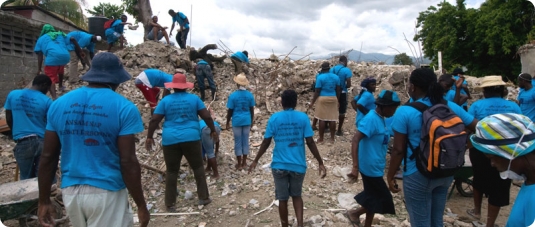
With the entire Episcopal Church—brothers and sisters in Christ, though separated by thousands of miles—the people of St. Margaret’s are giving to help in the rebuilding of Haiti. In particular we are giving to assist in the rebuilding of the cathedral in Port-au-Prince. Our Presiding Bishop, Katherine Jefferts Schori gives us perspective:

The Episcopal Church as a whole is partnering to help the Diocese of Haiti rebuild the cathedral complex in Port-au-Prince. Before the earthquake, that complex included not only the cathedral with its world famous murals (three have been conserved), but a music school and philharmonic orchestral, a vocational school, a convent, and diocesan offices. Partnerships have helped to provide necessary infrastructure for strategizing and planning the redevelopment work. Read her complete statement.

Bishop Jean Zaché Duracin of the Diocese of Haiti narrates a powerful video about the conditions in Haiti, images of rebuilding, and offers his thoughts and reflections on the second anniversary: WE ARE ONE

B Lent 3, Art for Readings for March 11, 2012

REMBRANDT Harmenszoon van Rijn
(b. 1606, Leiden, d. 1669, Amsterdam)
Click to open Web Gallery of Art Artist Biography and to explore other works by this artist.

Christ Driving the Money-Changers from the Temple
c. 1626
Oil on panel, 43 x 33 cm
Pushkin Museum, Moscow
Click to open Web Gallery of Art image. Click again for extra large view.
 Contemporary analysis sees Jesus’ action as an attack on Temple political practice itself, not money-changing per se. Money-changing was necessitated by the required ritual sacrifice by pilgrims.

In Christian art whips, flying coins, overturned tables and fleeing Jews make for exciting images and reinforce prejudicial Jewish stereotypes.

sch

Easter Hymn Post–“The Old Rugged Cross”

may have mentioned this before, but I love hymns. The texts possess a richness that is, in my opinion, difficult to find in any other genre, with the exception of the art song. This holds true for “The Old Rugged Cross.”

To be honest, I’ve never heard “The Old Rugged Cross” sung in an Episcopal church…or in any church other than the tiny Baptist church I attended as a very young child. And when we sang it, my friend, it didn’t have to be Easter. “The Old Rugged Cross” was appropriate on Christmas Eve, the Fourth of July, Mother’s Day, and any other day you can think of. Or at least that’s how it seemed to me.

So, given my early acquaintance with the hymn, I’ve never really given much thought as to who wrote it or why, but I’m glad that I started doing a little digging. It is difficult to get solid information on the hymn because most of the stories are passed down by word of mouth or presented on personal websites. However, here’s what I’ve found: The hymn was written by an itinerant Methodist minister named George Bennard (1873-1958) in 1913.

Image

While on his route through the northern states, he began meditating on Christ’s suffering on the cross. He is reputed to have written, “I saw the Christ of the cross as if I were seeing John 3:16 leave the printed page, take form, and act out the meaning of redemption.” (1)

When he arrived home to his apartment in Albion, Michigan, he began setting text to a tune he had already composed. One story goes that he only had the phrase “On a hill far away stood an old rugged cross” until he was harassed by some teens during a service. According to the story, after that incident, the rest of the words came to him. The composition process did not happen quickly, and he spent the next few months revising the text and asking for input from friends and colleagues.

In 1913, the hymn was debuted at the First Methodist Episcopal Church of Pokagon, Michigan. Four members of the choir sang, accompanied by piano and violin. His friends, Rev. and Mrs. Leroy Bostwick, paid to have the hymn printed.

The song grew in popularity and became well-loved throughout the northern states. In 1915, two years after its debut, evangelist Billy Sunday and his song leader Homer Rodeheaver bought the rights to the song for $500, and its popularity grew nation-wide thanks to Billy Sunday’s tent revivals.

Bennard died in 1958 after writing several more hymns and spending his adult life ministering to others. Because he sold the rights to “The Old Rugged Cross” so soon after its composition, he never became wealthy from the song.

When I’ve heard the hymn, it’s usually been in a slow, gospel style like this. However, there are also jazz renditions, instrumental blues covers, and, of course, Elvis.

The melody and the style might not be everyone’s cup of tea, but the words truly are timeless. And, like I learned at that little Baptist church, appropriate all year long.

On a hill far away stood an old rugged cross
The emblem of suffering and shame
And I love that old cross
Where the dearest and best
For a world of lost sinners was slain

Chorus:
So I’ll cherish the old rugged cross
‘Til my trophies at last I lay down
I will cling to the old rugged cross
And exchange it someday for a crown

Oh, that old rugged cross so despised by the world
Has a wondrous attraction for me
For the dear Lamb of God left His glory above
To  bear it to dark Calvary

In that old rugged cross, stained with blood so divine
A wondrous beauty I see
For ’twas on that old cross Jesus suffered and died
To pardon and sanctify me

To the old rugged cross I will ever be true
Its shame and reproach gladly bear
Then He’ll call me someday to His home far away
Where His glory forever I’ll share.

Sources:
http://www.lectionary.org/HymnStories/The%20Old%20Rugged%20Cross.htm (1)
http://www.the-oldruggedcross.org/history.htm
http://www.albionmich.com/history/histor_notebook/R980413.shtml
Be aware. Do good. International Women’s Day 2012

March 8th is “International Women’s Day, a day of remembrance and reflection celebrated around the world since 1913,” according to Episcopal News Service.

Here are a few of the posts on our blog that have sought to increase awareness of the needs and issues of women and girls throughout our world and right in our own neighborhoods. As always, my hope and prayer is that with increased awareness of need and the whisper of the Holy Spirit, individual and collective action to meet these needs will result. Blessings on this International Women’s Day. ~dan

Episcopal Women’s Caucus and Anglican Women’s Empowerment – introduced on the Seventh Day of Christmas, this post includes links to other organizations by and for women and girls

Two Against Gender Violence – introduced in our Advent Calendar Day 14, this post links to ECS Julian’s Housing Program for Women and Children and Shelter from the Storm

Anglican Women gather in New York to consider Communion’s Advocacy Efforts – a post linked to an Anglican Communion News release in January. The post indicates how the Anglican Communion is addressing the issue of empowering women in rural settings.

charity: water – posted in our Advent Calendar, Day 24, this post raises awareness about how women and girls are adversely impacted by doing the work of obtaining water for the household (“women’s work”) and how charity: water by bringing water to a village (via wells, or filtration and storage systems) positively impacts the lives of these women and girls (Recommended: Water Changes Everything video)

______________
Image 1 from the International Women’s Day website | Image 2 from 3 inspiring french women

Observing a holy Lent: giving alms

Are you ready for a challenge? I am. Here we go.

Go to the Haiti Response Page for more information
Image from the ERD Haiti Earthquake Response Page

On Sunday, March 4th, over a dozen Forum participants gathered with other parishioners to hear Sandra Swan talk about Haiti, about Episcopal Relief and Development, and about the efforts of every diocese and parish within the Episcopal Church—including St. Margaret’s—to learn about and “give alms” for the rebuilding of Haiti. Lane and Chet, the Vestry and its Outreach Commission, have made this our charitable effort in Lent 2012 (you can see the bricks in the Narthex every Sunday to remind you of this project).

Today, I challenge our Sunday Morning Forum (you and me) to contribute $1,000 to this Lenten alms giving. This seems like a modest goal for us who seek to be “doers of the word.” (James 1:22)

We are averaging over 20 folks in our Sunday morning gathering on campus. With just the Sunday morning crowd and a donation of $50 each we can make this goal. Reaching out to our friends and family and online Forum members we may exceed this goal for the glory of God and the relief of his people in Haiti.

If you have already given to the Haiti effort, let me know and we’ll add that to our total. Today Carol and I have donated $100 for the rebuilding of Haiti. Let’s do this as part of our effort to put our faith into action. Thank you. ~father dan

Donate Now as a doer of the word

  1. Use ParishPay (a secure website used by the church). Under One-Time Donations designate Rebuild Haiti to make your donation. (The option Carol and I used)
  2. Use the Episcopal Relief and Development secure website to make your donation; designate “Haiti Earthquake Response” to make your donation
  3. Write a check to St. Margaret’s Episcopal Church and indicate “Rebuild Haiti” on the Memo Line. Send check to: St. Margaret’s Episcopal Church | 47535 Highway 74 | Palm Desert, CA 92260 or drop the check into the Sunday collection at worship.

All contributions to St. Margaret’s for Haiti Relief will be sent to Episcopal Relief and Development whose workers and whose aid arrived in Haiti within hours of the January 12th earthquake in 2010 and whose commitment is to continue “its support throughout the recovery and rehabilitation process” (no matter how long it takes).

Additional information about how donations to ERD are used:

Additional information about how ERD is joined in a cooperative effort with other charitable organizations:

Visit the InterAction Haiti Aid Map for an interactive look at where Episcopal Relief & Development is active. Use this link to view the combined efforts of all Non-Govermental Organizations (NGOs) in Haiti.

Additional information about our parish efforts to contribute to the rebuilding of Haiti:

  • Sherry Wollenberg, our Forum member, (on Sundays in Lent you will find her near the bricks and the wheelbarrow in the Narthex or on the patio)
  • Deacon Cherry (seemingly everywhere on Sundays in Lent and via email: Deacon Cherry)

He wrote a letter to Jesus (or did he?)

Having introduced Hovak Najarian I share his first post as an author. For those who pray the “Way of the Cross” also known as the “Stations of the Cross” the legend/tradition presented here is preserved in Station 6: “A woman wipes the face of Jesus.” Growing up Roman Catholic I KNEW the name of this woman: Veronica. But did I know the truth? Decide for yourself. Leave a comment. ~dan rondeau

Image of a face from the Shroud of Turin
The image of a face from the Shroud of Turin

King Abgar V of Edessa 

In the early part of the first century AD, a time when the Romans and the Parthians were dominant powers in Asia Minor and the Near East, Abgar V, a nephew to Tigranes the Great, was the king of Armenia.  In order to stay out of the way of both major powers, he moved his court to the Mesopotamian city of Edessa where he could remain on good terms with both nations.  Edessa prospered during this time but while Abgar was away on a trip to settle a dispute between the Armenians and Persians, he became ill.  He remained ill after he returned home.  Having heard reports of Jesus’ miracles of healing, he decided to invite him to Edessa.

The legend:

King Abgar sent his archivist and court painter, Hannan, with a letter asking Jesus to come to Edessa to heal his illness.  Hannan also was asked to paint a portrait of Jesus in order that Abgar could see his image.  A return letter from Jesus stated he was unable to come to Edessa but later would send one of his disciples.  Hannan made a portrait and returned to Edessa with the letter and painting.  In his Historia Ecclesiastica (AD 325), Bishop Eusebius of Caesarea wrote of the correspondence between Abgar and Jesus and included a text of the two letters.  There may have been letters exchanged but both letters published by Bishop Eusebius have been proven to be fabrications.  A painted image of Jesus (known as The Holy Face) is of questionable origin as well.  Several early icons depicting the face of Jesus are known but there is no evidence to confirm that any of them were painted from life or if one of them was painted by Hannan.  A few centuries later it was said Jesus produced The Holy Face himself by pressing a wet cloth to his face and causing the image to appear miraculously.

After the death of Jesus, his disciple, Thaddeus, came to Edessa and gave Abgar a cloth on which there was an image of Jesus (known as the Image of Edessa) – as a result of the visit and the power of the cloth, according to the legend, Abgar was converted and healed.  The cloth was folded in such a manner that only the face could be seen.  In 942 AD, under the threat of being overrun, the Image of Edessa was turned over to the Byzantines as part of a bargain to maintain peace.  When it was taken to Byzantium (later called Constantinople and now Istanbul) and unfolded, the full figure of a man was revealed.  It is believed this is the cloth that now is known as the Shroud of Turin (a linen cloth with an unexplained imprinted image of a man who had been crucified).  It has been suggested this may have been the actual cloth placed on Jesus at the time of his burial.

Inasmuch as the cloth remained folded for many years and only the face was seen, it is speculated the legend of Veronica’s veil also is based on this shroud.  According to a story that has no scriptural bases, a woman used her veil to wipe the sweat off Jesus’ face while he was carrying his cross to Golgotha.  Afterward, a miraculous image of his face appeared on the cloth.  Church fathers accepted this story as fact and gave this mythical woman the name Veronica; a name derived from vera icon (Latin for true image).  The story has become part of Roman Catholic Church legend.

In ancient times it was not unusual for myths, legends, and partial facts to be blended, modified and embellished; later they would be recounted as “tradition” or even reported as fact.  If a tradition were of a religious nature, often it would be incorporated into church worship services and festival days.

The current status of these legends:

The Armenian Apostolic Church:

In the Armenian Church, Abgar is regarded to be a saint and his story continues to be told as tradition.  The Church calendar honors “St. Abgar” in a worship service in December of every year and the name Abgar continues as an Armenian given name.   It also is the root of the surname Abgarian (also spelled Abkarian, or Abcarian); from the family of Abgar.

The Roman Catholic Church:

Despite an absence of Biblical reference or historical evidence that a person given the name Veronica ever existed, canonization took place and now “St. Veronica” is celebrated on special church festival days.  The whereabouts of the veil is obscure; it is said to be in the Vatican archives but other locations have been suggested.   A great number of churches and schools are named in honor of Veronica and it is a popular given name.

The Shroud of Turin

The Shroud of Turin underwent radiocarbon testing in 1988 and the result of the test indicated the cloth was made during the Middle Ages approximately 1300 years after the death of Jesus.  Unanswered questions remain, however, and the test result neither satisfied nor was accepted by people who believe the Shroud is, in fact, the actual cloth used to cover the body of Jesus.  The tested portion, they believe, was from a section that was a restoration and not part of the original cloth.  It has not been tested again.

______________
ARMENIAN CONNECTIONS
Hovak Najarian © 2008

About Hovak Najarian

College of the Desert Professor Emeritus (Art) Hovak Najarian

Updated: May 14, 2024

If you are new to this blog, I am pleased to introduce you to (Dr.) Hovak Najarian. Since 2011 Hovak has introduced us to artists, art techniques, and art history to keep us growing in the knowledge and love of the Lord.

After receiving his MA in Art at Columbia University Hovak and his wife, Margie, spent 3 years in Normal, IL on the art faculty of Illinois State University. In his own words, “We soon found that natives of Florida and California were no match for winters in Illinois.”

In 1966 Hovak and Margie relocated to Southern California when Hovak accepted a teaching position at College of the Desert in Palm Desert. He retired in 1994 and was honored with the title Professor Emeritus (Art) by the College of the Desert. Again, Hovak: “During that time [1966-1994], I was Chair of the Art Department for many years, returned to Columbia University and completed my doctorate, and with Margie, raised three wonderful sons.”

In his retirement, Hovak continues his own creative work, and, has been an active participant in the Sunday Morning Forum and a regular contributor to this blog. Hovak is active in St. Margaret’s Episcopal Church and in the Armenian community in the Coachella Valley which gives him a unique perspective to share. 

As we journey together I expect to learn more about art, art history, art as an expression of faith, and art as a shaper of faith. Together, let us hear what the Spirit is saying. ~Fr. Dan

Come into the wilderness a place of promise and hope

FROM THE ARCHIVES…

Note: From 1999-2003 Stan Hirsch facilitated the Sunday Morning Forum. He collected a wealth of information. To my delight he archived the material. In the weeks to come we’ll mine this archived material for Supplemental information on our work in the Year B Lectionary. Since space is not restricted, I may add to the original material from time to time. I encourage you to follow the links when given. Come back often, go exploring, keep learning. ~dan

Mark 1:9-13

Quote . . .Lent is a season of great hope, a season of movement into the loving embrace of our Father.

Lent is a time when we are put in mind that we live today in the Kingdom of God, as we shed the distractions in order to see the reality of God’s presence with us. But Lent also is the season that is most usually symbolized by the word “wilderness.” Wilderness always comes across as an unpleasant place, but it is a very frequent setting in Scripture…

The good news about Lent and the wilderness is that it is a time for formation and reformation. It is a time when we can be formed as a people of God and it is a time when we can be renewed in our commitment to Christ…

We are reminded too in the Gospel today that Jesus was not driven into the wilderness by Satan, he was driven there by the Holy Spirit. And at the end we are told that angels ministered to him. The wilderness is not a bad place. It is a place of great promise and hope. It is a place for stripping away of all the old dependencies that tear us down and coming to grips with total reliance on God—a God who loves us and wants for us freedom and prosperity, a God of plenty, a God of love. The route through the wilderness leads us from an unsatisfying life to a life of abundance. But if you are like me, you would just as soon avoid the wilderness because leaving the familiar, leaving the known, leaving the predictable, for unpleasant thoughts, wrestling with what we fear is an altogether inadequate faith to guide us through. We want to avoid the wilderness because it means we have to struggle with hard choices. Choices of temptation. It would be so much easier if we were simply animals of instinct and did not have to make choices. But if we were, we would never be able to embrace each other in love. Nor would we be able to embrace our God with love.

…The wilderness is a place of movement to good. When we go there in the Lenten season, we face the demons of insecurity and time pressures. We face our own demons of hypertension and self-doubt. We also know that we are moving towards Easter, the resurrection and the presence with God. [1]


[1] February 21, 1999, Lent — A Season of Hope, The Rev. Dr. Robert G. Certain

 Image: From the internet–http://travelerstrails.com