Elijah and priests of Baal | Art for Proper 4C

Elijah and the Priests of Baal
Lucas Cranach the Younger
1515-1586
Elijah and the Priests of Baal 1545
Oil on wood
1.275 x 2.42 m
Staatliche Kunstsammlungen, Gemäldegalerie Alte Meister, Dresden
Click image for more information.

______________

Elijah and the Priests of Baal, Oil on Wood, 1545, Lucas Cranach the Younger, 1515-1886

German artist, Lucas Cranach the Elder was known as one of the foremost painters and printmakers of the Northern Renaissance. For much of his life he worked for the Electors of Saxony and was an avid supporter of the Protestant Reformation. His son, Lucas Cranach the Younger, apprenticed with his father and often worked on paintings in the studio with him. At the death of his father, he took over as supervisor of the art workshop. Both Lucas Cranach the Elder and the Younger were friends of Martin Luther and each painted several portraits of him.

Lucas Cranach the Younger’s “Elijah and the Priests of Baal” depicts the result of a long conflict between the Prophet Elijah and King Ahab. When the king married the Phoenician princess, Jezebel, she brought the worship of the idol Baal with her. She convinced Ahab to allow the worship of Baal in Israel and had Jewish prophets put to death. Elijah left Israel and upon his return saw that conditions had become impossible; he demanded a showdown. He told King Ahab to take the people of Israel and the priests of Baal to Mount Carmel. When they were together he told the people their faith could not be divided; they couldn’t have it both ways. He said, “If the LORD is God, follow him, but if Baal, then follow him.” Elijah then proposed a test. Two altars would be built; firewood and a bull as a sacrifice would be placed on each one. Then each would pray for fire to burn the wood and offer the sacrifice. The priests of Baal built their altar and prayed fervently until after midday but their efforts were futile. When it was Elijah’s turn, firewood and the bull to be sacrificed were placed on the altar. For good measure, he dug a trench around its base and asked that four jars of water to be poured over the wood. He asked the same amount to be poured on it twice more causing the wood to be well drenched. As he prayed, fire from above came down dramatically and consumed everything. The water-soaked wood, the sacrificial offering, the stones, and even the water in the trench were engulfed in flames. When the people saw this, they fell down and said, “The LORD indeed is God; the LORD indeed is God.”

The painting, “Elijah and the Priests of Baal,” is crowded densely with people who are there to witness the resolution of this conflict. The altar built by Elijah is on the left side in the foreground and a dark cloud has gathered at the top center of the painting. Pellets of fire from the cloud are sending intense heat to the altar and even the water at the base of the altar is touched by the flame. Elijah is standing to the right of the altar with his arms raised in prayer and in the lower left corner are Elijah’s assistants with their empty water vessels. The altar of Baal is on the right and its wood and sacrifice remain untouched but the persistent priests of Baal are continuing to dance and pray even as the altar built by Elijah is consumed in flames. The crowd on the left is in awe, as is King Ahab who is standing between the altars and looking at the miraculous fire.

Hovak Najarian © 2013

Belonging by Kaze

As we put our faith into action (see James 1:22) pause to consider this reflection by Kaze Gadway. Pay attention to her experience-filled words as you seek to do good.

kazestories's avatarkazegadway

Belonging by Kaze Gadway

     Recently a Ted Talk used the Maslow’s hierarchy of needs as a subject. I appreciate the talk, especially as it relates to the homeless.

     The physiological need is obvious. The homeless do not have consistent food, water, housing, clothing or sanitary facilities. That’s obvious.

     Physical and Economic safety are also missing. Violence, trauma, accidents are common. They are treated poorly when they go to emergency rooms. One look at their uncleanliness and poor clothes places them at the bottom of the job selection pool.

    The next three categories are not as obvious but powerful.

     One of the homeless women admits to me, “They gave me an apartment but I hate it. I take a shower there and maybe keep some food but at night, I go back on the streets and sleep at my camp with my friends. I hate being…

View original post 164 more words

A Bible Study Opportunity

Here is yet another way to join a group Bible Study

The Archbishop of Canterbury was joined by thousands of Christians around the world today [5/19/2016] for his first live Bible study on Facebook. Archbishop Justin Welby discussed John 1:35-42 with the Revd Chris Russell, the archbishop’s advisor for evengalism and witness, and answered questions from viewers.

Read the entire post on Anglican Communion News Service

Maybe this is just what you were looking for.

Image: ACNS


Trinity with Three Faces | Art for Trinity C

The Heavenly Jerusalem
Trinity with Three Faces
c.1400
Fresco
Duomo, Atri
ANTONIO DA ATRI
(b. ca. 1350, Atri, d. 1433, Atri)Click image for more information.

______________
Commentary by Hovak Najarian

Trinity with Three Faces, Fresco, c.1400, Antonio da Atri, c.1350-1433

The much quoted statement, “A picture is worth a thousand words,” is not an ancient Chinese proverb and often not even true. A picture can not represent adequately images that come to mind while hearing words of the Twenty-third Psalm or the Sermon on the Mount. However, it is true that art sometimes can clarify ideas that can not be expressed in words and yet there are times also when neither words nor pictures are adequate. Early Christian artists had to invent or adapt a visual language that could communicate concepts that were difficult to explain through art or through words.

In the early Church, there were questions about how, or if, a depiction of God should (or could) be made in art; if so, what would the image be? After several centuries, God was depicted as a bearded father figure (possibly derived from the Ancient of Days mentioned in the Book of Daniel). A lamb often symbolized Jesus and a dove symbolized the Holy Spirit. As long as members of the Godhead were separate, artists did not have to deal with creating a composite image that represented all three. The three figures that appeared before Abraham were portrayed as the Trinity but they were shown as separate individuals. By placing them adjacent to each other they were seen as a visual unit. Official use of that form of Trinity was ended by the Pope in the eighteenth century but it continued in places such as the American Southwest.

Another attempt to depict the Trinity may be seen in the Basilica of Santa Maria Assunta in Atri, Italy. Antonio da Atri’s fresco, “Trinity with Three Faces,” shows Christ standing and facing the viewer. His right arm is raised in a blessing and the left hand is holding a book. In order to depict Christ as part of the Trinity, Antonio has given the figure one body but three faces. Right and left profiles have been added to Jesus’ head. All three faces have radiating lines and halos. As a fashionable background, Antonio painted a late Gothic arch and decorative elements as a setting for the figure.

Multi-headed divinities existed in other religions and although this three-faced Trinity was accepted by the Roman Catholic hierarchy, it was ridiculed by Protestants. It was called the “Catholic Cerberus.” [In Greek mythology, Cerberus was the three-headed dog that guarded the gates of Hades.] As a consequence, in the sixteenth century the Pope ended use of the three-faced Trinity but the image remained in remote regions. Pope Innocent XII went further in the seventeenth century and ordered them all to be destroyed. The three-faced Trinity at the Basilica of Atri survived because it was not in sight. It and other frescos at the Basilica had been covered with plaster for fear their surfaces in some way could contribute to the spread of the Plague.

Note

The statement, “A picture is worth a thousand words” is not an ancient proverb. It is derived from an early twentieth century American advertising slogan.

Hovak Najarian © 2013

The Pentecost | Art for Pentecost C

The Pentecost
The Pentecost
1596-1600
Oil on canvas, 275 x 127 cm
Museo del Prado, MadridEl Greco,(b. 1541, Candia, d. 1614, Toledo)
Click image for more information.

______________

Commentary by Hovak Najarian
The Pentecost, Oil on Canvas, c.1600, El Greco, 1541-1614

Domenikos Theotokopoulos, a Greek native of Crete, first studied Byzantine art with the intention of becoming an icon painter. Crete was a Venetian colony at that time and at about age twenty Domenikos went to Venice to study the paintings of masters such as Titian. Following his stay in Venice, he worked and taught in Rome and then moved to Spain where he became known simply as El Greco (The Greek). Spain became his home for the remainder of his life and by the time “The Pentecost” was painted for an Augustinian seminary in Madrid, his style was dramatically different from his earlier work. In this late style, El Greco’s paintings have elements of expressionism and often are described as having a sense of mystery.

In Acts of the Apostles an account is given of the day of Pentecost when the twelve apostles, as well as Mary and people of many nationalities were gathered in one place. All at once the sound of a mighty rushing wind came from heaven and filled the room: “And there appeared to them tongues as of fire, distributed and resting on each one of them. And they were all filled with the Holy Spirit and began to speak in tongues, as the Spirit gave them utterance.” (Acts 2:2-4)

El Greco’s “Pentecost,” (now in the Prado Museum, Madrid) was painted to be an altarpiece. Its height above floor level would place the seminarians at the lower part of the painting and they would see the subject matter increase in complexity as their gaze moved upward toward Mary, the apostles, and the plumes of fire. A dove at the top of the painting represents the Holy Spirit; its wings are spread and the light that surrounds it is radiating downward over the gathering. The two men in the foreground at the bottom of a short flight of stairs have lifted their arms and are leaning back slightly in order to look at the dove. Mary (dressed in red and blue) is seated at the center of the painting with apostles gathered around her; two other women are included in the painting. The woman at Mary’s left shoulder is thought to be Mary Magdalene and the fourth person from the left side may be Martha. [Acts states that when the apostles prayed, they did so with “…women and Mary.”] El Greco also included himself in this painting. His face is second from the right; he is the man with a white beard who seems to be in deep thought and is not looking up toward the dove.
Although the term, “Expressionism,” did not come into use until the twentieth century, it is an apt term for El Greco’s late paintings. Expressionism is the result of an artist’s effort to project emotional intensity and inner feelings into a work. The figures in “The Pentecost” are not posing for a formal group portrait. They are an animated informal mix of people who in body language and facial expression are reacting individually, and yet they are part of the collective experience. They are responding with awe and excited emotional involvement as they take part in this miraculous event.

Hovak Najarian © 2013

What do hear?

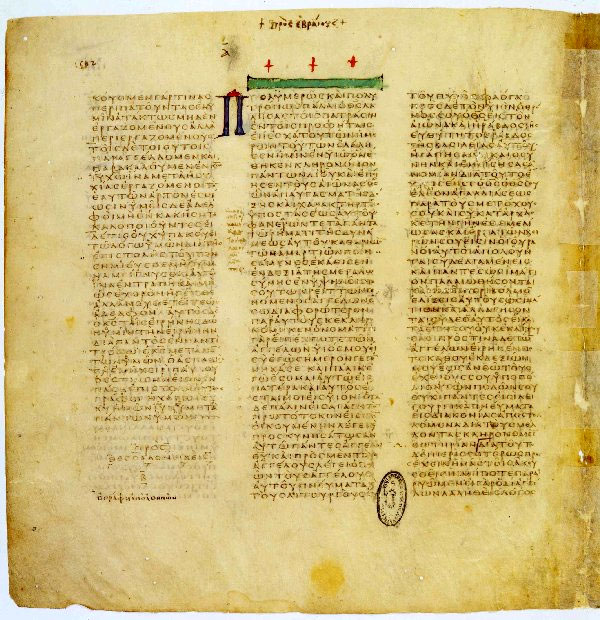
codex_vaticanus_b2c_2thess-_32c11-182c_hebr-_12c1-22c2

Catholic scholars drive a new wave on the New Testament (via Crux)

A new generation of scholars—many of them Catholic—are at last coming at the subject of New Testament scholarship with some humility and common sense.

The turning point in the scholarship has been the increased understanding of the relevance of the first century Jewish context  of the New Testament. As scholars and archeologists have uncovered an increasing amount of information about first century Jewish culture, beliefs and writings, they have come to understand more deeply the meaning and historicity of the gospels.

Put simply, a deeper understanding of first century Judaism has illuminated the New Testament, not only revealing new depths of meaning, but also affirming its early date and historical authenticity.

I encourage you to read the whole post on the Crux website. Let it inspire you to continue to do your own research and decision-making as you keep learning. ~Dan

Image: Page from Codex Vaticanus; ending of 2 Thes and beginning of Heb on Wikipedia

The Delphic Sibyl | Art for Easter 7C

The Delphic Sibyl
The Delphic Sibyl
1509
Fresco, 350 x 380 cm
Cappella Sistina, Vatican
MICHELANGELO Buonarroti
(b. 1475, Caprese, d. 1564, Roma)
Click image for more information.

______________
Commentary by Hovak Najarian

The Delphic Sibyl (detail from the Sistine Chapel), fresco, 1509, Michelangelo, 1475-1564

In Greek mythology, Gaia (mother earth) assigned a very large serpent called Python to guard the shrine at Delphi; the shrine’s location was believed to be the navel of the earth. Apollo killed the serpent and claimed the shrine as his own. The serpent rotted and the place became known as Pytho (Greek: meaning “rot”). The prophetesses at Apollo’s shrine were called, “Pythia” and there was a prevalent belief that the spirit of the dead serpent, Python, was still there and spoke through them. In Acts (16:16), a fortune telling slave girl was described as having “…a spirit of Python.” This was to say she was like the prophetesses at Delphi.

In the ancient world, a sibyl (Greek: meaning “prophetess”) was a woman who was believed to have the ability to foretell the future. Sibyls were the subject of legends and myths, and stories about them varied. Their origins were obscure. The Delphic Sibyl was said to have been the daughter of an immortal nymph and a sea monster. Other sources say she was thought to be a sister or daughter of Apollo. She was known to make her prophecies in the precinct of Apollo but she was not the same as Pythia, the priestess at the oracle. Sibyls sometimes remained in a particular locale but others were known to wander from place to place and live in caves.

Among Christians, sibyls were regarded as pagans yet when their prophecies coincided with those of biblical prophets their words tended to be acknowledged. The belief that Jesus came for everyone – gentiles as well as Jews – led early Christians to interpret particular prophecies as signs, even when they were from non-Christian sources. Also, events that a non-believer might regard circumstantial were interpreted as part of God’s plan; e.g. Because Roman Emperor Augustus called for a census, Jesus was born in Bethlehem, as was prophesied. The Magi (pagan foreigners) brought gifts for the infant Jesus, thus supporting the belief that Christ came for everyone.

Among the sibyls, five of them made prophecies that were interpreted as having a connection to the coming of Christ. Michelangelo included these five among the prophets pictured on the ceiling of the Sistine Chapel. One of them, the youthful Delphic Sibyl, is holding the scroll on which her prophecy has been written and she has turned her head in what seems to be anticipation or expectation. Perhaps she is responding to a prophetic voice that will speak through her. Like the other sibyls, the Delphic Sibyl is placed in a painted architectural setting. Behind her on either side are caryatids; figures that serve as columns. A youth is directly behind her reading prophecies.

Sibyls may seem inappropriate among biblical images but their inclusion on the ceiling of the Sistine Chapel reflects the teaching that God works through many sources. The five sibyls on the ceiling represent a diverse geographic area. They are from Africa, Asia, Greece and Ionia.

Hovak Najarian © 2013