
Giving voice to our Baptismal Covenant

Baptized with water and the SpiritWe live by our Baptismal Covenant (Book of Common Prayer 304-305). Among the questions and promises:

Will you strive for justice and peace among all people, and respect the dignity of every human being? (Our Response): I will, with God’s help.

On April 26, 2016 the bishops of North Carolina responded to recent legislation in North Carolina (HB2) that “overtly discriminates against LGBT people and goes further by cutting back on protection against discrimination for anyone in the state.” Their response comes as they fulfill their responsibilities as baptized persons and as bishops of the church. Here is the introduction to their letter. I encourage you to read their entire letter as you consider how you are to live into the promises you’ve made as a baptized person.

Dear brothers and sisters in Christ,

In our baptismal covenant, we commit “to strive for justice and peace among all people, and respect the dignity of every human being.” For many, this is the most difficult promise in the covenant, as it calls us to move beyond our differences, expectations, fears, prejudices and misunderstandings about other people and meet them where they are. At times, it means standing up in the world and speaking truth to power, knowing that there will be resistance. This promise takes us out of our comfort zone and into the uncharted territory of God’s grace.

In the highly polarized and political environment in which we live, we may be tempted to take sides on an issue or to back off entirely and be silent. But the issue of discrimination is not partisan, nor is it secular. The practice of discrimination by a state or institution limits, even prohibits, us from respecting the dignity of another human being. It inhibits our very capacity to care for one another and to work for the common good. This affects all people.

Read the entire letter here: North Carolina bishops issue statement regarding HB2 as reported by Episcopal News Service (ENS).
Remember

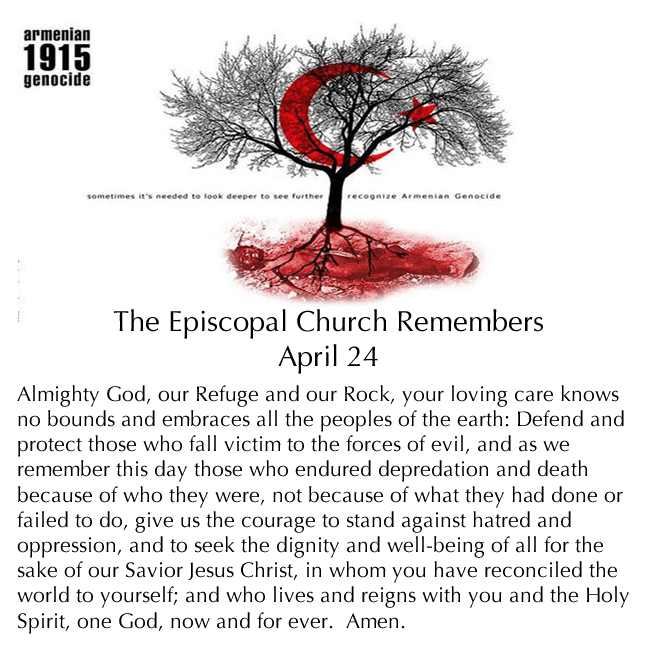
Remembering the Armenian Genocide

As you remember we direct you to a previous post: One Million Bones. Beyond remembering, the Spirit urges us to actions of healing and reconciliation and the promoting of a just peace throughout our world.

Prayers to begin, but what is to follow?

2016-04 Lahore

April 4, 2016 [ACNS, by Gavin Drake] Around 200 Christians, Muslims and Hindus gathered yesterday (Sunday) at the site of last weekend’s horrific Easter Day bomb attack for a united act of solidarity and sympathy for the victims of the attack.

This weekend’s gathering at the Gulshan-e Iqbal Park began with a peaceful demonstration at 5.40 pm – the exact moment that last week’s blast occurred.

[…] Candles were lit and Christian, Muslim and Hindu religious leaders – including the Moderator of the Church of Pakistan, Bishop Samuel Azariah, joined hands as they prayed for the victims and their families.

Amongst the 200 people present were representatives from the Episcopal Church’s Diocese of Louisiana and the presbyterian Church of Scotland. The Church of Pakistan is a United Church. In addition to being a province of the Anglican Communion it is also a member of the World Council of Reformed Churches and the World Methodist Council. See: http://www.anglicannews.org/news/2016/04/multi-faith-vigil-for-lahore-easter-bomb-victims.aspx on Anglican News Service

As the article goes on read how the Archbishop of Canterbury was confronted with words asking for more than platitudes, no matter how compassionate. The Archbishop’s unnamed friend was asking for involvement.

What do you hear the Spirit saying?

Photo Credit: Diocese of Raiwind on Anglican News Service

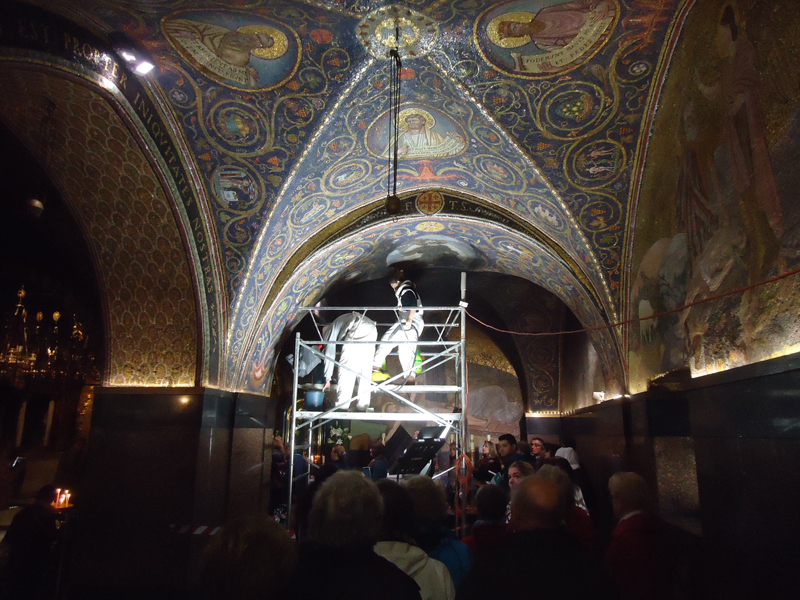
Church of the Holy Sepulchre

RNS-MOSAIC-JERICHO
A Palestinian team from the Mosaic Center, Jericho, restores a mosaic in Jerusalem’s Church of the Holy Sepulcher, the traditional site of Jesus’ crucifixion, burial and resurrection. Photo courtesy of Mosaic Center, Jericho

From Religion News Service

JERUSALEM (RNS) The tens of thousands of Christians who visited the Church of the Holy Sepulchre this month got a special Easter treat: the chance to view the newly cleaned and restored mosaic that covers the ceiling and walls of a Franciscan chapel dedicated to Calvary, or Golgotha, the hill where Jesus was crucified.

They might also pause to marvel at this: the work of restoring those mosaics involves a joint effort of Palestinian Christians and Muslims.

I encourage you to read the whole article Mosaic restoration depicting Jesus at Calvary an interfaith effort. It is demonstrates the mystery and power of art to transcend politics and religious differences while creating community.

Image:  via RNS


March 8th: International Women’s Day


berta-y-melo-705x529
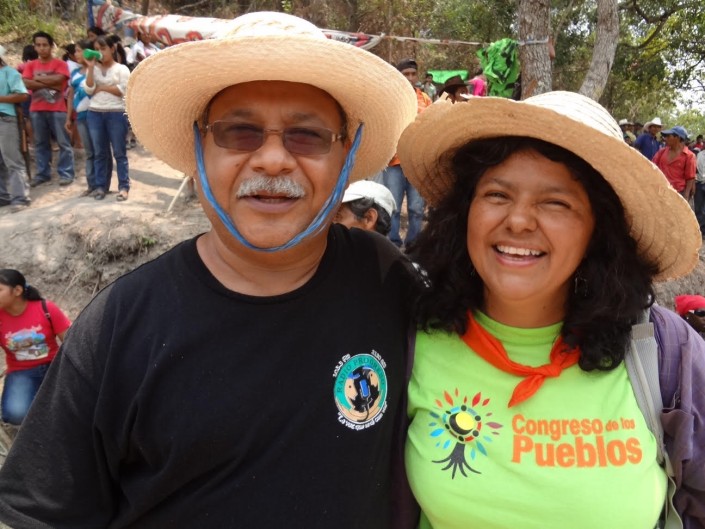
Ismael Moreno Coto, S.J. and Berta Caceres, 2013

On Thursday, March 3, 2016 Berta Caceres was murdered in Honduras.

Honduran indigenous leader Berta Caceres, who won the 2015 Goldman Environmental Prize for her role in fighting a dam project, was shot to death Thursday by attackers who broke into her home, authorities said.

Caceres, a 40-year-old Lenca Indian activist, had complained of receiving death threats from police, soldiers and local landowners because of her work.

Tomas Membreno, a member of her group, the Indian Council of People’s Organizations of Honduras, said at least two assailants broke into the home and shot Caceres in the town of La Esperanza. http://wapo.st/21jlQvj

As we consider the role of girls and women in the Global Goals established by the United Nations, let us remember the courage and the work of Berta Caceres.

For further consideration

Pain and Rage for the Loss of Berta Cáceres  by Ismael Moreno Coto, S.J. on the Ignatian Solidarity Network, 3/7/16

A killing in Honduras shows that it may be the world’s deadliest country for environmentalists in the Washington Post 3/3/16

Image: Ignatian Solidarity Net

Speaking the Truth in Love

From the Episcopal Bishop of Minnesota a timely reminder and invitation to speak the truth with love

Unknown's avatarBrian Prior

It was a casual conversation, yet as it went on, it became more and more difficult to listen to. Now I like a good story, but when a story is being spun in a way that suggests it is verifiably factual, but it’s not, my inner skeptic alarm goes off. Again, tell me a tall tale, entertain me with wit and embellishment, share something that leads to a deeper meaning or truth, I’m good. Yet to suggest something is unequivocal truth, when you know it’s not, is challenging.

I am working with a great group of people on an upcoming retreat which will focus on The Word and words. The daily themes of the retreat will include: the stories we have been told, the stories we tell others, the stories we tell ourselves, and the stories we will tell. As such, I have been thinking a lot about the stories…

View original post 337 more words

Look again

mary-700x438

How would you picture Mary?

The Blessed Virgin Mary was thoroughly Jewish. Different cultures and ethnicities have often portrayed her, Jesus, and others from the Bible as being from their group.

Since Christianity for many centuries was based largely in Europe, these important characters of salvation history have often been depicted as white Europeans. Which is fine! But other cultures have also depicted them according to their own appearances.

Take a look at how others have pictured Mary: 13 Beautiful Non-White Depictions of the Blessed Virgin Mary a post on ChurchPop by the Editor

Image: via ChurchPop

Work at being ordinary

Paul Kowalewski publishes a daily essay on his blog Desert Retreat House. In the post for Monday, February 22nd he writes:

On this ordinary Monday, plenty of people are off to work or school or off to the market or perhaps off to the gym, off to accomplish the everyday tasks of their routine lives. This sure doesn’t sound very exciting, but in fact if we just pay attention to the seemingly uneventful moments in life and work at being ordinary, a whole world of miracles unfolds without end.

The essay is an extended invitation and a meditation to “pay attention” as we move along the Way into our week. Read the entire post.

What do you hear the Spirit saying?

Speaking for the Victim – inward/outward

Refugees coming ashore. Reuters image.

From Reuters (1/29/16) Deadliest January on record for refugees raises alarm

Consider:

To speak for the victim, for the forgotten and killed, requires not only the Spirit’s truthfulness, to give us the awareness of this ‘memory of suffering’ but also an opening of our mouths….

Read more: Speaking for the Victim – inward/outward

Response to Communiqué from the Primates of the Anglican Communion

“Let’s walk together” wisdom from my friend, the Bishop of the Episcopal Diocese of Minnesota in response to the Communiqué from the Anglican bishops on January 15, 2016

Unknown's avatarBrian Prior

With friends at Calvary Episcopal Church in Rochester With friends at Calvary Episcopal Church in Rochester

We are blessed to live in a great neighborhood. There are lots of young families and there is an ever-increasing level of diversity. The kids literally play in the street, in everyone’s yard (including ours), and in the neighborhood park. Being regular dog walkers, it’s fun through the seasons for us to interact with the kids and families and watch them grow. There is a real sense of community.

With this being said, and consistent with my experiences with other places I have called home, there are distinct differences in what families value. Some kids roam at a pretty young age, virtually free without a parent in sight. Other children have either a much older sibling or a parent nearby at all times. Some kids ride all sorts of things with helmets and padding, while others wear none. Curfews are all over…

View original post 477 more words