Remembering Mark, Evangelist

The beginning of the Gospel of Mark from the 7th century Book of DurrowApril 25 The Feast of St. Mark, Evangelist

“The beginning of the good news of Jesus Christ, the Son of God.” Mark 1:1 NRSV

Almighty God, by the hand of Mark the evangelist you have given to your Church the Gospel of Jesus Christ the Son of God: We thank you for this witness, and pray that we may be firmly grounded in its truth; through Jesus Christ our Lord, who lives and reigns with you and the Holy Spirit, one God, for ever and ever. Amen.


The Book of Common Prayer, p. 240

Image: The beginning of the Gospel of Mark in the 7th century Book of Durrow. Wikimedia Commons, Public Domain.

‘Homeless Jesus’ provokes debate on what it means to be Christian

I share a post that was among others on Religion News Service today. As I read the article I wondered if those with opinions moved beyond conversation/debate to action? It is a good question for me, and for you who read this. What happens after awareness? ~dan rondeau

From RNS: ‘Homeless Jesus’ provokes debate on what it means to be Christian | Religion News Service.

Sculpture of Homeless Jesus. There is room for one to sit and pray.

We have also brought attention to “Homeless Jesus” and the question persists: what will we do with this awareness? Our posts:

O Antiphons (Dec 17-23)

The exact origin of the “O Antiphons” is not known. Boethius (c. 480-524) made a slight reference to them, thereby suggesting their presence at that time. At the Benedictine abbey of Fleury (now Saint-Benoit-sur-Loire), these antiphons were recited by the abbot and other abbey leaders in descending rank, and then a gift was given to each member of the community. By the eighth century, they are in use in the liturgical celebrations in Rome. The usage of the “O Antiphons” was so prevalent in monasteries that the phrases, “Keep your O” and “The Great O Antiphons” were common parlance. One may thereby conclude that in some fashion the “O Antiphons” have been part of our liturgical tradition since the very early Church. Read more: What are the O Antiphons from Catholic Education Resource Center

Sr. Joan Chittister has provided an entire page to help you pray the O Antiphons (from December 17th through December 23rd). Each meditation is accompanied by a women’s choir chanting the Antiphon in English. Use this online meditation to deepen your prayers as Advent comes to a close and the Nativity arrives.

The Polonsky Foundation Digitization Project

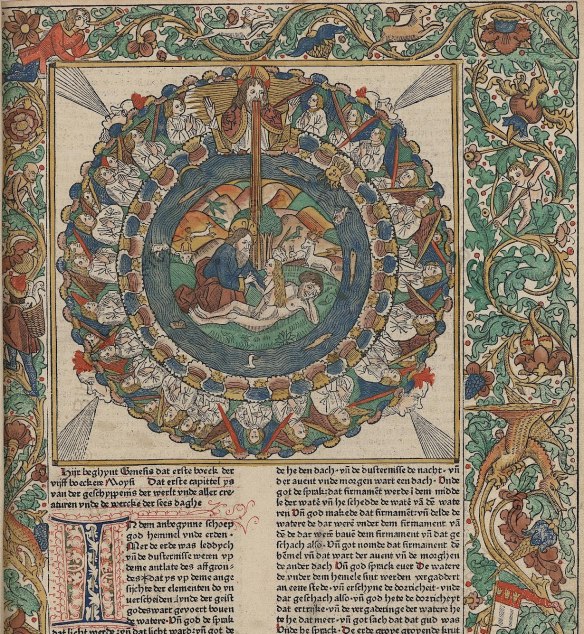
2013-1204 Stamp.Ross.283 Biblia. Tedesco.   c. 1478You’ve probably noticed that the “printed” word is more and more available digitally. This digital explosion of information is simultaneously good news and bad news.

Sadly, with the 24/7 “news cycle” more and more information is available every time a person logs on to see what’s happening. Not all the information is accurate and we haven’t yet developed, as a society, a good sense for weeding out the spurious and the superfluous. Such detection is still a work in progress. Erroneous reporting can quickly go ‘viral’ and then seems to hang on forever.

Happily, digital technology has also made available to both scholars and ‘amateurs’ printed texts that have helped form our society (artistically, linguistically, and morally). For this Sunday Morning Forum biblical texts from codices and papyri dating back thousands of years are now viewable (even if we are not proficient in ancient Hebrew or Greek). Today’s English translations of the Bible allow scholars (who are proficient in ancient languages) to make wide use of texts and have helped improve modern translations of this ancient treasure (which we put to good use in our Forum).

Two such efforts at digitization are the Ancient Biblical Manuscript Center of the Claremont School of Theology and The Digital Dead Sea Scrolls Project. 

Now the Polonsky Foundation has brought together the resources of the Bodleian Library in Oxford and the Vatican Library for digitization:

Through the generous support of the Polonsky Foundation, this project will make 1.5 million digitized pages freely available over the next three years. Portions of the Bodleian and Vatican Libraries’ collections of Hebrew manuscripts, Greek manuscripts, and incunabula have been selected for digitization by a team of scholars and curators from around the world. The selection process has been informed by a balance of scholarly and practical concerns; conservation staff at the Bodleian and Vatican Libraries have worked with curators to assess not only the significance of the content, but the physical condition of the items, prioritizing items that are robust enough to withstand being transported to the imaging studio and handled by the photographers. In order to preserve the integrity and completeness of the manuscript collections, the libraries have also agreed to digitize whole collections where appropriate. The complete list of works to be digitized can be accessed here for Greek manuscripts, here for Hebrew manuscripts, and here for incunabula.

Go to the Polonsky Foundation Digitization Project

You are encouraged to go and see for yourself what is now available online.

Image: Genesis illustration in the Cologne Bible (1478-1479) from the Vatican Library part of the Digitization Project
St. Andrew

Today (11/30) the Church remembers Andrew, brother of Peter and one of original 12 Apostles. From a short biography written by James Kiefer for Mission St. Clare:

When the Emperor Constantine established the city of Byzantium, or Constantinople, as the new capital of the Roman Empire, replacing Rome, the bishop of Byzantium became very prominent. Five sees (bishoprics) came to be known as patriarchates: Rome, Alexandria, Antioch, Jerusalem, and Byzantium. Now, the congregation at Rome claimed the two most famous apostles, Peter and Paul, as founders. Antioch could also claim both Peter and Paul, on the explicit testimony of Scripture, and of course Jerusalem had all the apostles. Alexandria claimed that Mark, who had been Peter’s “interpreter” and assistant, and had written down the Gospel of Mark on the basis of what he had heard from Peter, had after Peter’s death gone to Alexandria and founded the church there. Byzantium was scorned by the other patriarchates as a new-comer, a church with the political prestige of being located at the capital of the Empire, but with no apostles in its history. Byzantium responded with the claim that its founder and first bishop had been Andrew the brother of Peter. They pointed out that Andrew had been the first of all the apostles to follow Jesus (John 1:40-41), and that he had brought his brother to Jesus. Andrew was thus, in the words of John Chrysostom, “the Peter before Peter.” As Russia was Christianized by missionaries from Byzantium, Andrew became the patron not only of Byzantium but also of Russia.

See Morning Prayer for November 30th

More on the Bay Psalm Book

Bay Psalm Book, 1640 | Image via RNS(RNS) Three hundred and seventy-three years ago, when the chief Puritan “divines” of the young Massachusetts Bay Colony printed their own translation of the Bible’s Book of Psalms, they prided themselves on importing the continent’s very first English printing press and establishing the colony as a cultural and educational center.

What they were certainly not anticipating — the little books sold for 20 pence apiece — was that next Tuesday (Nov. 26), Sotheby’s will be auctioning off one of the 11 surviving copies of the Bay Psalter for between $10 and $30 million dollars. In that expected price range, it will be the most expensive book ever sold in public.

Read the entire post here: En route to Sotheby\’s, Bay Psalm Book traces nation\’s seesaw religious history | Religion News Service.

Earlier we shared a post from the NY Times. Here is another perspective provided by Religion News Service (RNS). The auction is Tuesday, November 26, 2013.

As both articles implied the congregation, Old South Church in Boston, was divided about selling this copy. I am reminded of the conversations I’ve had about the Roman Catholic Church selling some (many?) of its Vatican treasures in order to fund service to the poor, outcast, marginalized, and oppressed. It seems this is the purpose (funding service ministries) being pursued by the Old South Church congregation. What are your thoughts about this?

Image: via RNS

C.S. Lewis: 50 years after death, more popular than during lifetime

November 22, 1963: What a day.

When Clive Staples Lewis breathed his last on November 22, 1963, the world was looking elsewhere. The beloved American president, John F. Kennedy, had just been assassinated in Dallas, Texas. Oddly, science fiction writer Aldous Huxley also died the same day, creating a trifecta of influential deaths. But 50 years later, one of the three deceased stands above the rest in terms of continued global impact.

“[C.S.] Lewis is now more popular than he ever was,” says Robert Banks, an author and professor with a particular interest Lewis. “And each year he becomes more popular than he ever was by far in his lifetime.”

Read the entire post on RNS: C.S. Lewis: 50 years after death, more popular than during lifetime | On Faith & Culture.

How does the Pope ‘Tweet’?

I wondered. I use Twitter and often find no time to either Tweet or read Tweets. I tried to imagine how a Pope could do this. Two things about this: the Pope is involved, and he has a lot of help. ~dan rondeau

How Pope tweets on Pontifex? – Intermirifica.net.

A video description of how the Pope Tweets

via How Pope tweets on Pontifex? – Intermirifica.net.

In the digital age …

… we sometimes lose sight of the passion, dedication, sacrifices, and practical challenges of information sharing in previous ages. Here is a reminder: Let Bidding Begin for the Bay Psalm Book From 1640 (Religion in the New York Times).

Detail. Title Page of the Bay Psalm Book, 1640

From the article:

David N. Redden recited the opening of the 23rd Psalm the way he had memorized it as a child: “The Lord is my shepherd; I shall not want. He maketh me to lie down in green pastures.”

Then he opened a weathered little book and read the version it contained: “The Lord to mee a shepheard is, want therefore shall not I. Hee in the folds of tender-grasse, doth cause mee downe to lie.”

Those lines were in a volume published in Massachusetts in 1640 that amounted to the Puritans’ religious and cultural manifesto. It was the first book printed in the colonies, and the first book printed in English in the New World. The locksmith who ran the hand-operated press turned out roughly 1,700 copies. The one in Mr. Redden’s hands is one of only 11 known to exist.

Read the article online

Read more about the Bay Psalm Book on Wikipedia

Image: Janneman on Wikipedia

Wednesday’s Whim: Nones

Beth is the Executive Director of our (Episcopal) Camp Stevens. The Conference she is attending is vital on so many levels. The resources she highlights are provocative (if you will ‘read, mark, and inwardly’ explore them). Her invitation is to you and me for comment. Let’s engage in this conversation.