Visual art opening and exploring the texts we “read, study, learn and inwardly digest.” Music and notes about music used to open and celebrate the texts read in worship.
In our prayers for you we always thank God, the Father of our Lord Jesus Christ, for we have heard of your faith
Welcome. Our handout features the readings for the Fifth Sunday After Pentecost (July 10, 2022) in Year C of the Revised Common Lectionary.
In our Forum on Wednesday, July 13, 2022, we’ll explore the opening words of the letter to the Colossians. We will explore the appointed verses from Colossians through our own prayer experiences and hopes.
So let us not grow weary in doing what is right, for we will reap at harvest time, if we do not give up.
Welcome. Our handout features the readings for the Fourth Sunday After Pentecost (July 3, 2022) in Year C of the Revised Common Lectionary.
In our Forum on Wednesday, July 6, 2022, we’ll explore the final portion of the letter to the Galatians. Please view or download the handout we’ll use in our discussion as your own exploration continues.
Come, my Way, my Truth, my Life:
Such a way as gives us breath;
Such a truth as ends all strife,
Such a life as killeth death.
These words are the first stanza of a poem by George Herbert (1593-1633). See the complete poem and a short essay about George Herbert on the Journey with Jesus website (one of my favorites sites for inspiration). The Episcopal Church remembers and commemorates George Herbert annually on February 27th.
Take a moment to simply listen …
Hymn 487 in (The Episcopal) Hymnal 1982

1
Come, my Way, my Truth, my Life:
such a way as gives us breath;
such a truth as ends all strife;
such a life as killeth death.

2
Come, my Light, my Feast, my Strength:
such a light as shows a feast;
such a feast as mends in length;
such a strength as makes his guest.

3
Come, my Joy, my Love, my Heart:
such a joy as none can move;
such a love as none can part;
such a heart as joys in love.

Text:  George Herbert
Music: The Call by Ralph Vaughn Williams
For there is no distinction between Jew and Greek; the same Lord is Lord of all and is generous to all who call on him. For, “Everyone who calls on the name of the Lord shall be saved.”
Romans 10:12-13 NRSV
As we come to the end of the week that began on the First Sunday in Lent, Year C, March 6, 2022, we recall that the Church read from Paul’s letter to the Romans (Romans 10:8b-13, see also Galatians 3:28).
At our best we continue to live the wisdom of Paul, making no distinction that separates us who “call on the name of the Lord” rather we promote union in “one great fellowship of love.” In Christ there is no East or West we celebrate this kinship:
Hymn 529 in (The Episcopal) Hymnal 1982

1
In Christ there is no East or West,
in him no South or North,
but one great fellowship of love
throughout the whole wide earth.

2
Join hands, disciples of the faith,
whate'er your race may be!
Who serves my Father as his child
is surely kin to me.

3
In Christ now meet both East and West,
in him meet South and North,
all Christly souls are one in him,
throughout the whole wide earth.

Text:  John Oxenham, 1852-1941 (alt.)
Jesus, full of the Holy Spirit, returned from the Jordan and was led by the Spirit in the wilderness, where for forty days he was tempted by the devil. … When the devil had finished every test, he departed from him until an opportune time.
Luke 4:1-2, 13 NRSV
On the First Sunday in Lent, Year C, March 6, 2022, the Church read the account of the Temptation of Jesus according to Luke (Luke 4:1-13). Lord who throughout these forty days is a hymn for the season of Lent and, really, for every season of our lives as we walk with Jesus.
Index Page of “words” offered by the SSJE Brothers
“Advent Birmingham is a diverse group of musicians who lead worship services in song on Sundays at Cathedral Church of The Advent in Birmingham, Alabama. They also write and record modern hymns of their own and set ancient Christian hymns and songs to modern settings.” (YouTube description) Here is their modern offering of this Lenten hymn:
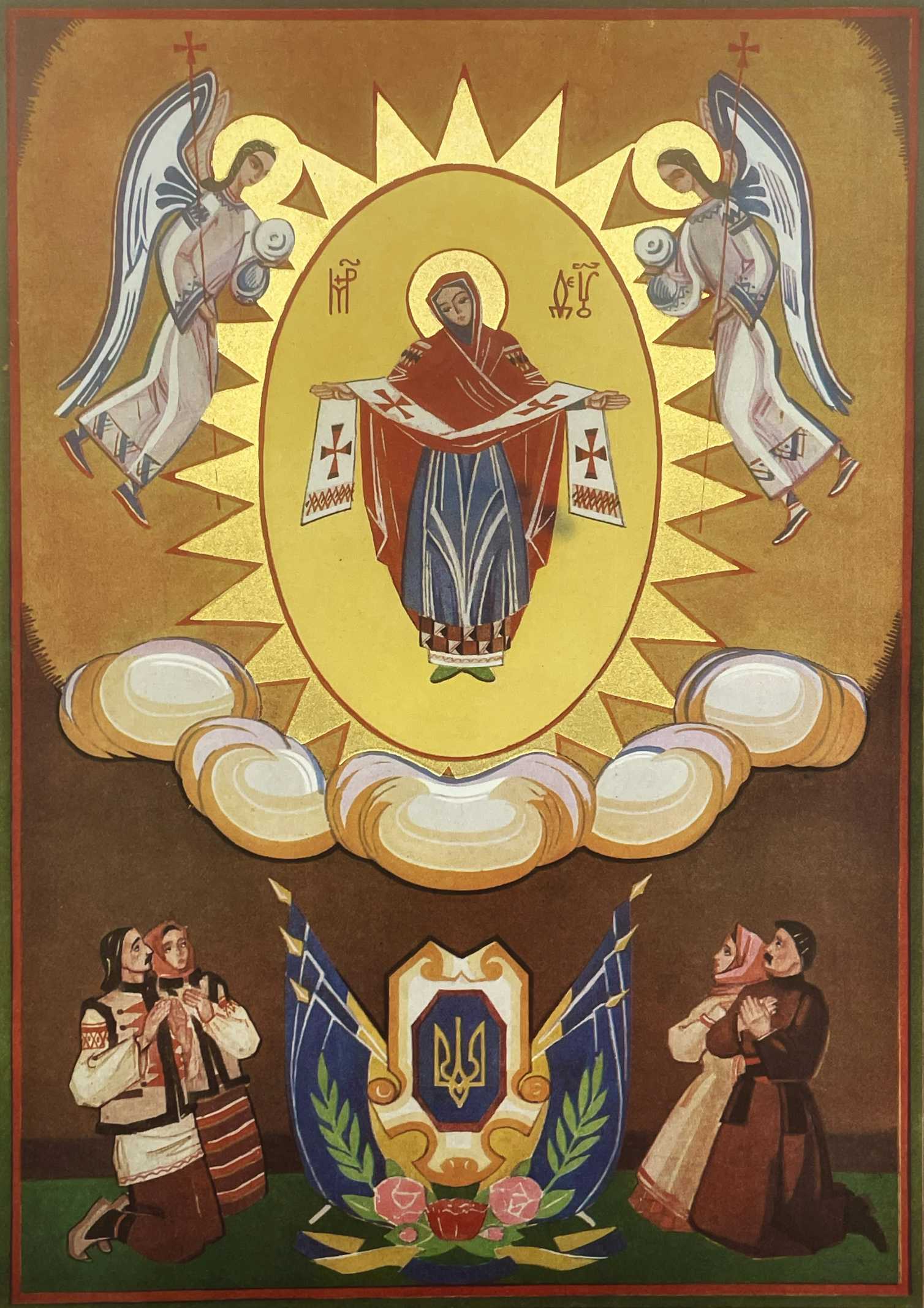
Ukrainian Marian Collection, The Marian Library, University of Dayton CC BY-ND
Ukrainian clergy demonstrating against the war in their country have appeared in media coverage carefully holding an image of the Virgin Mary, her outstretched hands lifting up the edges of a cloak.
I am an archivist for the Marian Library at the University of Dayton, which includes a collection of Ukrainian artwork about Mary. For Ukrainian Christians, both Orthodox and Catholic, the “Pokrova” image held by protesters represents a long history of seeking Mary’s protection during difficult times.
These pictures depict a particular religious icon known as the “Pokrova” in which Mary’s veil – a “pokrova,” or “cover,” in Ukrainian – is a sign of protection.
I encourage you to read more about the “Queen of Ukraine” in Harris’ article. As she notes, “It is quite common for Christians, and even people of other faiths, to ask Mary to intercede on their behalf during hardship.” Let us pray.
When Jesus and his disciples were in the district of Caesarea Philippi, he asked them “Who do they say the Son of man is?” Discussions and teachings followed “And after six days Jesus took with him Peter and James and John his brother, and led them up a high mountain apart. And he was transfigured before them, and his face shone like the sun, and his garments became white as light. And behold there appeared to them Moses and Elijah, talking to him.” (Matt. 17:1-3)
In Transfiguration, Christ is in a white robe with outstretched arms and, as appropriate, is the central figure . In addition, Fra Angelico has placed him on a pedestal-like rock above everyone, and by design he is larger than the other figures. Christ is surrounded by a mandorla (a body halo) and his head is surrounded by a traditional cruciform halo.
In this painting, Moses and Elijah are each presented in bust form, not as full figures; Moses, on the left with light emanating from his forehead represents the law and Elijah on the right represents the prophets. [In some paintings of the Transfiguration, Moses is holding the Ten Commandments and a scroll is placed in the hands of Elijah.]
Below Moses, on the left, is the Virgin Mary with her hands crossed over her chest and to the right, below Elijah, is Saint Dominic. [In 1435 the Monastery of San Marcos was turned over to the Dominican order.] He is standing with hands together in a position of prayer. Dominic’s mother reported that she saw a star on his chest when he was born and sometimes (as here within his halo) he can be identified by a star placed above his head. Of course, Mary and Dominic were not present at the Transfiguration, but it is not unusual for artists to use creative license to include non-participating figures on the sidelines as observers of an important event. In the foreground are Peter, James, and John. They have just heard God’s voice say: “This is my son. Hear him” and “…they fell on their faces and were filled with awe.” (Matt. 17:5-6)
In 1407, Guido di Pietro joined the Dominican order in Fiesole, Italy (near Florence) and at his vows took the name Giovanni. Thus he became known as Friar Giovanni da Fiesole (Brother John of Fiesole). Artist and historian, Giorgio Vasari, referred to him as Brother John the angelic one and today he is known simply as Fra Angelico. His life as an artist was devoted to the Church and at the monastery of San Marcos in Florence; he painted the walls of the cells (prayer and meditation rooms) with scenes from the life of Christ. Fra Angelico’s Transfiguration is in cell number six.
In Europe, during the early part of the fifteenth century, medieval art was still a presence, but the City of Florence was at the heart of the Renaissance. Fra Angelico was fully aware of the trend toward humanism that was influencing the art of his time. The changes that were taking place are reflected in his paintings.
The actual site of the Transfiguration is not known; accounts in the Gospels do not name a specific mountain. Mt. Tabor is the traditional site but Jesus and the disciples were in the district of Caesarea Philippi prior to the Transfiguration and the closest and highest mountain there is Mount Hermon. It is the highest mountain in Israel and this may have been the mountain noted in Matthew, Mark, and Luke.
Joseph was born at a time when his father, Jacob, was old and he became the favorite son. This favoritism caused resentment among his brothers. Negative feelings resulted also from a dream Joseph had that was interpreted to mean someday his brothers would bow down to him. Joseph was seventeen years old when he went to his brothers as they were tending sheep. When his brothers saw him coming they plotted to kill him but then instead, sold him as a slave to a passing merchant who was going to Egypt. In Egypt, Joseph interpreted Pharaoh’s dream which revealed there would be seven years of abundance followed by seven years of famine. With Joseph’s guidance, grain was stored during the time of abundance and Egypt was well prepared. When famine was experienced in Canaan, Joseph’s father sent his brothers to Egypt to purchase food. Unbeknownst to them, Joseph in the ensuing years had become a high Egyptian official and he was the one they would have to meet.
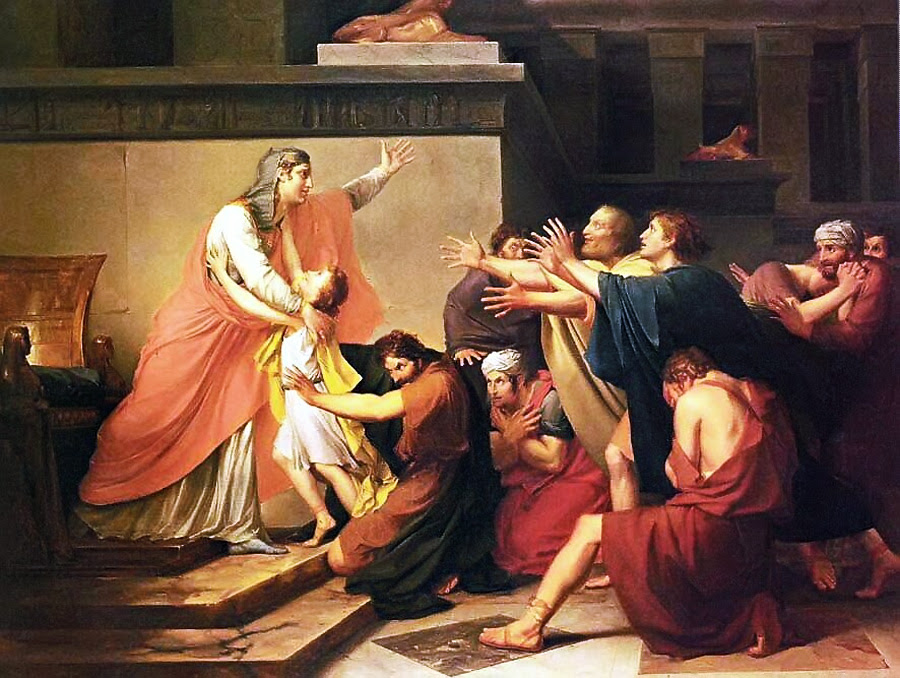
Francois Gerard’s painting, Joseph Recognized by Brothers, depicts the moment Joseph revealed his identity to his brothers. The brothers are shown displaying a range of emotions; some are kneeling and in body language seem to be exhibiting guilt and remorse for what they did. In contrast to this, two of the brothers and Joseph are reaching out to each other in joy. The brothers at the far right are staying back and holding each other. Perhaps they are fearful of what Joseph might do. The young boy reaching and looking up at Joseph is likely a nephew who came with his father. Joseph places his hand gently on the child’s shoulder.
In 1663, France initiated the Prix de Rome which gave artists (and later, musicians and architects) an opportunity to study in Italy. The purpose of this award was to put promising artists in contact with Roman culture and the masters of the Italian Renaissance. One outcome of this was a trend toward classicism in French art.
In the late 1700s after years of turmoil, the French Revolution overthrew King Louis XVI and Napoleon Bonaparte took charge ultimately as 1st Consul. Classicism in art suited Napoleon perfectly and he appointed Jacques Louis David, an avid classicist, to be the head of the French Academy of art. David’s art promoted what Napoleon favored; discipline, honor, sacrifice strength of character, and devotion of one’s efforts to the state.
Though classicism was sanctioned by the state, the concept of romanticism was always present in art and Napoleon’s campaign in Egypt (1798-1801) generated great interest in Egyptology. It set off fashion fads in both France and England and piqued the interest of painters as well. Francois Gerard’s Joseph Recognized by Brothers was painted during the time of Napoleon’s Egyptian military venture.
Gerard studied under David and elements of classicism in the painting of Joseph and his brothers are apparent in their robes. Gerard’s nod to this scene’s Egyptian location is brought in by Joseph’s headdress and the sphinxes on the arms of Joseph’s chair and the background building. Were it not for these details and its title, this painting might be taken for an illustration of a Greek tragedy.
Winning the Prize of Rome was coveted, difficult, and highly competitive. Gerard’s teacher Jacques Louis David was rejected three times and considered suicide before receiving the award on his fourth attempt. [In later years Eduard Degas and Maurice Ravel were rejected.] Gerard, too, was rejected but because of his mother’s death, he was unable to complete a painting to submit to the jury the following year. After that, he fell into poverty but recovered to gain success and acclaim through portraiture. Napoleon commissioned paintings from him and then after he fell from power, Gerard became the court painter of Louis XVIII.
Joseph an entry in the Encyclopedia of the Bible (on Bible Gateway). “The contents of this encyclopedia derive from a previously published work known as The Zondervan Pictorial Encyclopedia of the Bible, 5 Volume Set.”
The stories of Genesis 12-50 a short video presentation (~8 minutes) by the BibleProject ( around 5:20 into the video the story of Joseph is presented).
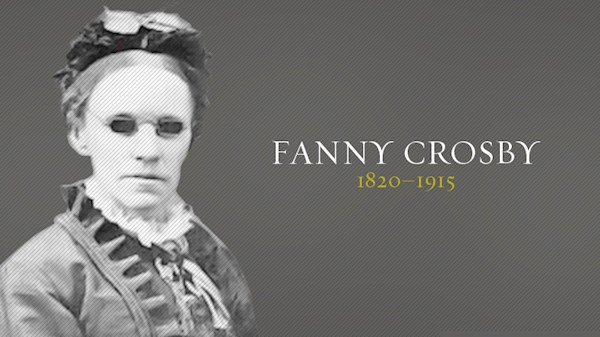
Annually on February 11th we remember Fanny Crosby. Read on.
Fanny Crosby was the most prolific writer of hymn texts and gospel songs in the American evangelical tradition of the late nineteenth and early twentieth centuries. She wrote more than eight thousand sacred texts in addition to other poetry.
Frances Jane Crosby was born in Putnam County, New York, on March 24, 1820. Although not born blind, she lost her sight as an infant as a result of complications from a childhood illness. At the age of fifteen, she entered the New York Institute for the Blind where she would later teach for a number of years. In 1858, she married Alexander van Alstyne, a musician in New York who was also blind. Crosby was a lifelong Methodist.
Crosby’s texts were so popular that nearly every well-known composer of gospel music of the period came to her for words to accompany their melodies. In most hymn writing, the words come first and then a composer sets them to music, but for Crosby the words came so quickly and naturally that composers would often take her their tunes and she would immediately begin to shape words that fit the music.
Perhaps the best example of this process led to the creation of Crosby’s most well known hymn Blessed Assurance. On a visit to the home of a friend, the composer Phoebe Knapp, a newly composed tune was played for Crosby. After listening to the tune several times, the text began to take shape, and in a very short time one of the world’s most popular gospel hymns was born. The American gospel song is a unique genre of sacred music that combines words expressive of the personal faith and witness with tunes that are simple and easily learned. Fanny Crosby’s contribution to this genre is unequaled. Dozens of her hymns continue to find a place in the hymnals of Protestant evangelicalism around the world.
Fanny Crosby died on February 12, 1915, in Bridgeport, Connecticut, where she is buried.
Readings and supplemental resources for Proper 19A in the RCL
September 13, 2020 | Pentecost +15
A generous forgiveness from the heart.
Collect for Proper 19
O God, because without you we are not able to please you, mercifully grant that your Holy Spirit may in all things direct and rule our hearts; through Jesus Christ our Lord, who lives and reigns with you and the Holy Spirit, one God, now and for ever. Amen.~BCP 233
Genesis 50:15-21 NRSV
In our Hebrew scripture lesson Joseph’s brothers fear his wrath upon learning of the death of their father Jacob.
15 Realizing that their father was dead, Joseph’s brothers said, ‘What if Joseph still bears a grudge against us and pays us back in full for all the wrong that we did to him?’ 16 So they approached Joseph, saying, ‘Your father gave this instruction before he died, 17 “Say to Joseph: I beg you, forgive the crime of your brothers and the wrong they did in harming you.” Now therefore please forgive the crime of the servants of the God of your father.’ Joseph wept when they spoke to him. 18 Then his brothers also wept, fell down before him, and said, ‘We are here as your slaves.’ 19 But Joseph said to them, ‘Do not be afraid! Am I in the place of God? 20 Even though you intended to do harm to me, God intended it for good, in order to preserve a numerous people, as he is doing today. 21 So have no fear; I myself will provide for you and your little ones.’ In this way he reassured them, speaking kindly to them.
Romans 14:1-12 NRSV
In this reading Paul calls upon the Roman disciples to live with tolerance for one another’s scruples, recognizing that everything can be done to honor the Lord with whom each Christian has a relationship.
1 Welcome those who are weak in faith, but not for the purpose of quarreling over opinions. 2 Some believe in eating anything, while the weak eat only vegetables. 3 Those who eat must not despise those who abstain, and those who abstain must not pass judgment on those who eat; for God has welcomed them. 4 Who are you to pass judgment on servants of another? It is before their own lord that they stand or fall. And they will be upheld, for the Lord is able to make them stand.
5 Some judge one day to be better than another, while others judge all days to be alike. Let all be fully convinced in their own minds. 6 Those who observe the day, observe it in honor of the Lord. Also those who eat, eat in honor of the Lord, since they give thanks to God; while those who abstain, abstain in honor of the Lord and give thanks to God.
7 We do not live to ourselves, and we do not die to ourselves. 8 If we live, we live to the Lord, and if we die, we die to the Lord; so then, whether we live or whether we die, we are the Lord’s. 9 For to this end Christ died and lived again, so that he might be Lord of both the dead and the living.
10 Why do you pass judgment on your brother or sister? Or you, why do you despise your brother or sister? For we will all stand before the judgement seat of God. 11 For it is written, ‘As I live, says the Lord, every knee shall bow to me, and every tongue shall give praise to God.’ 12 So then, each of us will be accountable to God.
Matthew 18:21-35 NRSV
In the gospel lesson Jesus bids his disciples to offer a forgiveness which is, for all practical purposes, unlimited, and he tells a parable about a man who, although forgiven much, still himself had no mercy.
Note on Matthew 18:24 The servant owes roughly 150,000 years’ worth of wages—an absurdly insurmountable debt intended to shock Jesus’ listeners and pale in comparison to the much smaller amount demanded by the servant in v. 28. The Greek text’s reference to 10,000 talents represents the largest number used in ancient calculations and the highest monetary unit at that time (one talent was equivalent to 15 years’ worth of wages).
Source: John D. Barry et al., Faithlife Study Bible (Bellingham, WA: Lexham Press, 2012, 2016), Mt 18:24.
Talent: a unit of silver equal to 6,000 Greek drachmae or Roman denarii. One talent was roughly equal to what a typical worker could make over a sixteen-year period. … In [Matthew 18:23–35], Jesus uses creative exaggeration to stress the incalculable difference between divine and human mercy. A servant owes his king (God) 10,000 talents (millions of dollars), a debt that is forgiven; but then the first servant does not forgive a fellow servant who owes him 100 denarii.
Denarius: a silver Roman coin that would have been the usual day’s wage for a typical laborer (plural, denarii). This is the most mentioned unit of currency in the NT. Jesus used a denarius as an object lesson for his teaching that one should give to the emperor what belongs to the emperor (Matt. 22:19); his disciples complained that 200 denarii would not buy enough bread for a hungry multitude (Mark 6:37).
Source: John W. Betlyon and Mark Allan Powell, “Money,” ed. Mark Allan Powell, The HarperCollins Bible Dictionary (Revised and Updated) (New York: HarperCollins, 2011), 651.
21 Then Peter came and said to him, “Lord, if another member of the church sins against me, how often should I forgive? As many as seven times?” 22 Jesus said to him, “Not seven times, but, I tell you, seventy-seven times.”
23 “For this reason the kingdom of heaven may be compared to a king who wished to settle accounts with his slaves. 24 When he began the reckoning, one who owed him ten thousand talents was brought to him; 25 and, as he could not pay, his lord ordered him to be sold, together with his wife and children and all his possessions, and payment to be made. 26 So the slave fell on his knees before him, saying, ‘Have patience with me, and I will pay you everything.’ 27 And out of pity for him, the lord of that slave released him and forgave him the debt. 28 But that same slave, as he went out, came upon one of his fellow slaves who owed him a hundred denarii; and seizing him by the throat, he said, ‘Pay what you owe.’ 29 Then his fellow slave fell down and pleaded with him, ‘Have patience with me, and I will pay you.’ 30 But he refused; then he went and threw him into prison until he would pay the debt. 31 When his fellow slaves saw what had happened, they were greatly distressed, and they went and reported to their lord all that had taken place. 32 Then his lord summoned him and said to him, ‘You wicked slave! I forgave you all that debt because you pleaded with me. 33 Should you not have had mercy on your fellow slave, as I had mercy on you?’ 34 And in anger his lord handed him over to be tortured until he would pay his entire debt. 35 So my heavenly Father will also do to every one of you, if you do not forgive your brother or sister from your heart.”
Psalm 103:8-13 BCP 733
The Psalm Response is a hymn of blessing in thanksgiving for healing forgiveness and for all the Lord’s acts of compassion and justice.
8 The Lord is full of compassion and mercy, * slow to anger and of great kindness.
9 He will not always accuse us, * nor will he keep his anger for ever.
10 He has not dealt with us according to our sins, * nor rewarded us according to our wickedness.
11 For as the heavens are high above the earth, * so is his mercy great upon those who fear him.
12 As far as the east is from the west, * so far has he removed our sins from us.
13 As a father cares for his children, * so does the Lord care for those who fear him.
Supplemental Material
“Forgive our sins as we forgive” Hymn 674 in Hymnal 1982
On Sunday, September 13th we’ll use the hymn “Forgive our sins as we forgive” after we’ve heard the reading from Romans and before we hear the Gospel passage. What follows is an essay by C. Michael Hawn, distinguished professor of church music at Perkins School of Theology. He is also director of the seminary’s sacred music program. Discipleship Ministries of the United Methodist Church is a dependable online resource for study. I recommend the site. ~Fr. Dan
Martin Luther King, Jr. once said, “Forgiveness is not an occasional act, it is a constant attitude.” Accepting and giving forgiveness may be one of the most important aspects of living. I believe that the Assurance of Pardon is one of the most significant parts of Christian worship: “In the name of Jesus Christ, you are forgiven!” These words may offer healing and hope for many in worship, even beyond anything else said or sung. Forgiveness is not only a personal way of living, but also an attribute of societies. How many times do we observe centuries of hate and hurt that, because of the inability to forgive, continue to fester and cause suffering, death, and destruction?
Portions of the Lord’s Prayer (Matthew 6:9-13) have been cited in many hymns. For example, the militant missionary hymn, “We’ve a Story to Tell to the Nations” (United Methodist Hymnal, 569) echoes “Thy kingdom come on earth” in the refrain: “And Christ’s great kingdom shall come on earth.” Presbyterian hymnologist Louis Benson concludes his Communion hymn “For the Bread which You Have Broken” (United Methodist Hymnal, 614, 615) with the first petition, “let your kingdom come, O Lord.” Forgiveness has received less attention, however.
With “Forgive Our Sins as We Forgive” by Rosamond Herklots (1905-1987), we receive a full treatment of Matthew 6:12: “And forgive us our debts, as we forgive our debtors.” (KJV) Luke 11:4 states: “And forgive us our sins; for we also forgive every one that is indebted to us.” “Trespasses” first appeared in William Tyndale’s translation in 1526 and was retained for use in the first Book of Common Prayer in English in 1549. The English Language Liturgical Consultation (1988), a group of ecumenical liturgists in the English-speaking world, proposed “and forgive us our sins as we forgive those who sin against us.” A companion Scripture is Colossians 3:13, “bearing with one another and, if one has a complaint against another, forgiving each other; as the Lord has forgiven you, so you also must forgive” (ESV).
The Companion to Hymns and Psalms (1988), the companion to the 1983 Methodist hymnal used in England, provides the origins of this hymn:
This hymn was written in June 1966 and printed soon afterward in the parish magazine of St. Mary’s Church, Bromley, Kent. The idea of the hymn had occurred to Miss Herklots when she was digging out weeds in her nephew’s garden; she reasoned that their deep roots, obstructing the growth of the flowers near them, resembled the bitterness and resentment that can become entrenched and hinder the Christian’s growth in grace.
Herklots’ language is potent in describing the blessings we miss when our “heart . . . broods on wrongs and will not let old bitterness depart” (stanza two) In stanza three, she contrasts the “trivial debts [that] are owed to us” with “our great debt to [Christ]!”
The final stanza is a prayer of petition “cleanse . . . our souls” and “bid resentment cease.” Forgiveness leads to establishing “bonds of love” so that “our lives will spread [Christ’s] peace.”
Rosamund Eleanor Herklots was born in Masuri, India, in 1905 to missionary parents. She was educated at Leeds Girls’ High School and the University of Leeds in England. Working as a teacher and secretary, she began writing hymns in the early 1940s. She submitted hymns for the “Hymns for Britain” competition, two of which were selected to be sung on television. Her total corpus of hymns numbered more than seventy. Herklots died in Greenwich, London, in 1987.
British hymnologist J. R. Watson noted changes in the original text: “At some point after 1978, when an unauthorized inclusive language version was published in the USA, the author modified the third and fourth verses: ‘How small the debts men owe to us’ became ‘What trivial debts are owed to us,’ while ‘Then, reconciled to God and man’ was altered to ‘Then, bound to all in bonds of love.’” This is the version that appears in The United Methodist Hymnal.
I was in South Africa in 1998 during the presidency of Nelson Mandela. Arch Bishop Desmond Tutu presented President Mandela with the bound volumes containing the results of the Truth and Reconciliation Commission. I was sitting among a group of black and white Methodist ministers watching this historic occasion on television as Tutu referenced one of the many important revelations that took place during the process that the Commission hoped would lead to healing and hope for South Africa. At one point, Tutu recalled a black woman who asked him, “Who murdered my husband?” Tutu responded, “We do not know.” She was insistent, however, and continued, “I must know who killed my husband.” Again, the patient Tutu responded, “I’m sorry, but we may never know who killed your husband.” Still her question persisted. Finally, Tutu asked, “My dear lady, why must you know who killed your husband?” She responded simply and quietly, “So I can forgive him.”
There are many variations of this hymn on YouTube here are two:





 Hear what the Spirit is saying