Category: Art & Music
Visual art opening and exploring the texts we “read, study, learn and inwardly digest.” Music and notes about music used to open and celebrate the texts read in worship.

A Chirst the King, Art for Readings November 20, 2011

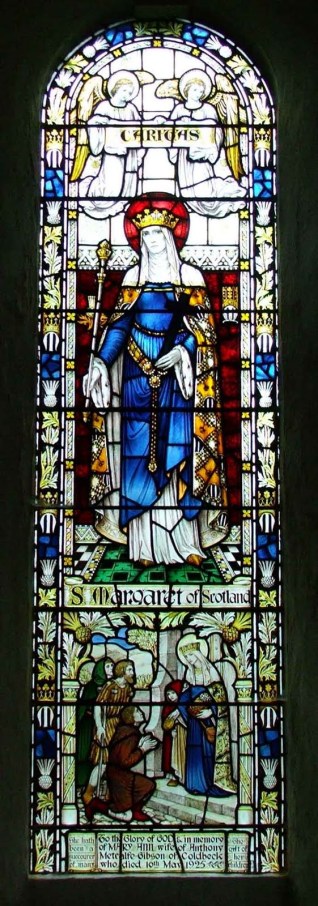
Art for St Margaret’s Day
All Saints Art for Readings Nov.1 (Celebrated Nov. 6), 2011


God’s activity is so musical!
When you have about an hour and a half and feel somewhat in a meditative mood, check out this YouTube presentation from UCTV, University of California Television. Dr. Jeremy S. Begbie takes even a non-musician (like me) into the world of music and in his talk opens, in a new way, the “speech” of the Spirit as recorded in our Bible. I wanted to hear more.
May you find yet another way to hear what the Spirit is saying.
“In a fascinating multimedia presentation, Jeremy Begbie, Professor of Music, Cambridge University, expounds upon the relationship between music and theology. Series: “Let There Be Light” [10/2003] [Humanities] [Show ID: 7906]”
A Proper 26 Art for Readings October 30, 2011

Hymn History: “All Hail the Power”
Church music has such a rich history, but we often know very little about the brave men and women who wrote our beloved hymns. As we transition into Fall, I’m hoping to write a bit more about some of these people–what their lives were like, what they did, and why they might have been inspired to write such powerful music. Today’s focus is on Edward Perronet, who wrote the text to “All Hail the Power (of Jesus’ Name).”
Edward Perronet (1726-1792) was born in Kent, England to a family that had fled France due to religious persecution. His father, an Anglican minister, was strongly supportive of the teachings of John and Charles Wesley and of George Whitefield. Edward also grew up to be an Anglican minister, though he disagreed with many practices of the Anglican church. In the 1740s and ’50s, he spent a great deal of time traveling and evangelizing with the Wesleys. Their group suffered frequent persecution and violence because of their teachings. John Wesley often encouraged Perronet to preach, but Perronet found preaching in front of the Wesleys to be far too intimidating, so he always found ways to avoid preaching in their presence. During one service, John Wesley decided that he had had enough, and, in front of the entire congregation, he called Perronet up to preach. Perronet, realizing that he had no way out, strode behind the podium and said, “I will now deliver the greatest sermon ever preached on earth.” He proceeded to read “The Sermon on the Mount” and quietly sat down.
After several years of ministering with the Wesleys, Perronet decided to part ways. The three felt that they had too many disagreements (and that Perronet was too opinionated) to effectively minister together. It was at that time that Perronet began serving at an independent church in Canterbury, where he worked until his death in 1792. Perronet’s last words were, “Glory to God in the height of His divinity! Glory to God in the depth of His humanity! Glory to God in His all-sufficiency! Into His hands I commend my spirit!”
Perronet wrote most of his hymns and poems anonymously, but “All Hail the Power of Jesus’ Name” was published in 1779, and it has been a standard in most Christian hymnals ever since. It is the only work in his name that is well-known. The song has been referred to as the “National Anthem of Christendom,” and it has been translated into nearly every language. Of it, one writer wrote, “So long as there are Christians on earth, it will continue to be sung; and after that, in heaven.”
All hail the power of Jesus’ Name!
Let angels prostrate fall;
Bring forth the royal diadem,
and crown Him Lord of all!
Ye chosen seed of Israel’s race,
ye ransomed from the fall,
Hail Him Who saves you by His grace,
and crown Him Lord of all!
Let every kindred, every tribe on this terrestrial ball,
To Him all majesty ascribe,
and crown Him Lord of all!
Oh, that with yonder sacred throng
we at His feet may fall!
We’ll join the everlasting song,
and crown Him Lord of all!
Resources: http://www.theeffectivetruth.info/testep.html, http://www.cyberhymnal.org/bio/p/e/perronet_e.htm
A Proper 25 Art for Readings October 23, 2011

Look Father, look on his anointed face
In the Sunday Forum (10/16/11) we talked about the glory of God in the face of God; glory beyond human capacity to assimilate. Mose could only see the backside of God and live (Exodus 33:20-23). David remembered a hymn in which we sing our prayer to God to see the face of Christ when looking upon us (see verse 2). Glory looking upon Glory. Isn’t that a prayer worth singing?
And now, O Father, mindful of the love
that bought us, once for all, on Calvary’s tree,
and having with us him that pleads above,
we here present, we here spread forth to thee,
that only offering perfect in thine eyes,
the one true, pure, immortal sacrifice.Look Father, look on his anointed face,
and only look on us as found in him;
look not on our misusings of thy grace,
our prayer so languid, and our faith so dim:
for lo! between our sins and their reward,
we set the passion of thy Son our Lord.And then for those, our dearest and our best,
by this prevailing presence we appeal;
O fold them closer to thy mercyís breast!
O do thine utmost for their soulís true weal!
From tainting mischief keep them pure and clear,
and crown thy gifts with strength to persevere.And so we come; O draw us to thy feet,
most patient Savior, who canst love us still!
And by this food, so awesome and so sweet,
deliver us from every touch of ill:
in thine own service make us glad and free,
and grant us nevermore to part from thee.Words: William Bright (1824–1901), alt.
Music: Unde et memores, William Henry Monk (1823–1889)
This is Hymn 337 in the Hymnal 1982 of the Episcopal Church. Lately we have talked a lot about hymns and their role in shaping and defining and encouraging our faith; check these out:
Please continue the conversation begun on Sunday by leaving a comment to share. We welcome your responses.
Then sings my soul …
Over the past several weeks we have talked about music in the Sunday Morning Forum. We have shared how words and music combined in hymns to thrill us, inform us, inspire us, encourage us, and so much more. In the Forum and in this blog I’ll continue to share your musical insights.
Richard wrote to me “It’s true there is a huge amount of power in music. I have several favorites. My first choice would have to be “How Great Thou Art”. When ever I hear it I feel completely at one with the Universe and it’s celebration which never ends.” How Great Thou Art is in our Episcopal hymnal Lift Every Voice and Sing II (No. 60)
O Lord my God, when I in awesome wonder
Consider all the worlds thy hands have made,
I see the stars I hear the rolling thunder,
Thy pow'r throughout the universe displayed.

Then sings my soul, my Savior, God, to Thee;
How great Thou art, how great Thou art!

When through the woods and forest glades I wander
And hear the birds sing sweetly in the trees,
When I look down from lofty mountain grandeur,
And hear the brook and feel the gentle breeze.

And when I think that God, his Son not sparing,
Send him to die, I scarce can take it in,
That on the cross, my burden gladly bearing,
He bled and died to take away my sin.

When Christ shall come with shout of acclamation
And take me home, what joy shall fill my heart!
Then I shall bow in humble adoration,
And there proclaim, my God how great thou art.
Words: Stuart K. Hine (b. 1899)
Music: Swedish Folk Melod; arr. Stuart K. Hine
Keep sharing your favorites (add a little note about why) and we’ll keep this conversation going. The Spirit is singing now!
 Hear what the Spirit is saying