Category: Art & Music
Visual art opening and exploring the texts we “read, study, learn and inwardly digest.” Music and notes about music used to open and celebrate the texts read in worship.

Proper 17A: Art for Track 1 Readings
A different presentation of Moses and the Burning Bush. Original post updated 8/28/20
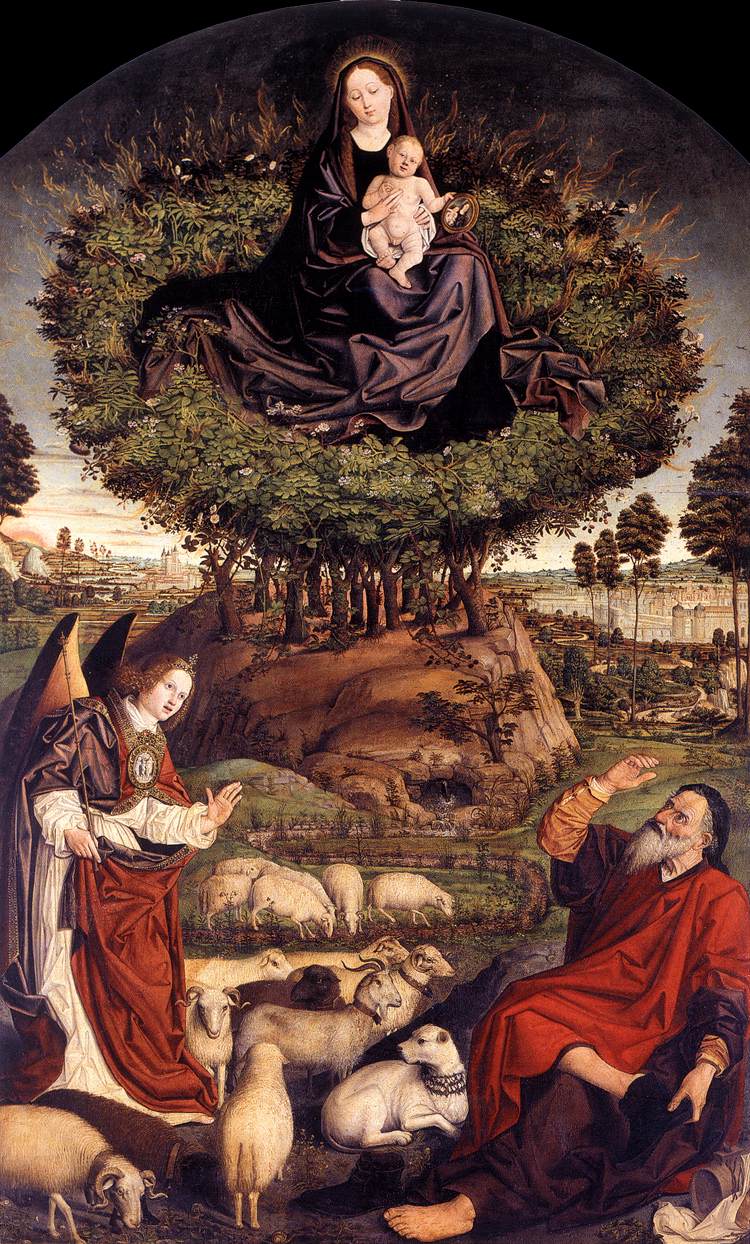
The Burning Bush
1476
Wood, 410 x 305 cm
Cathedrale Saint Sauveur, Aix-en-Provence
FROMENT, Nicolas
(b. ca. 1435, Uzes, d. ca. 1486, Avignon)Barcelona)
Click to open Web Gallery of Art display page.
Exodus 3:1-15 is one of the readings appointed for Proper 17A (Continuous Narrative). Here is an interesting depiction of that moment.
What is going on here? Mary standing in for God? Well not exactly—the infant Jesus represents God in the burning bush. Why Mary?
Welcome to typological and allegorical interpretation where Mary represents many ideas and connections. Notice the little mirror held by Jesus. Perhaps Mary, sometimes known as “the reflection of the Church” or “the reflection of faith,” brings our witness to this foundational story of God acting for justice and order in our lives.
A Proper 16 Art for Readings August 21, 2011

A Proper 15 Art for Readings August 14, 2011


The Rutter Requiem and Why It’s Awesome. Yes, I Use the Word “Awesome” Too Much, but It Totally Applies Here.
If you grew up Episcopalian or Catholic (I didn’t), you probably have a head start on all this “requiem” business, but if you’re still catching up (like me), here’s a synopsis: The requiem began as a type of mass to honor the dead. Traditionally, there are twelve parts to the requiem, beginning with the Introit and ending with the In paradisum. However, as composers began to play with the format, they began to see it more as an art form and less as a rigid liturgy. The Rutter Requiem, for example, has only seven movements. The Duruflé has nine, the Mozart seven-ish, and so on. Anyway, more on those later.
So growing up, I’d never heard of the Rutter Requiem. When I finally did, I was about nineteen, thinking that I knew oh-so-much about music (for the record, I didn’t…and still don’t!). I was given the chance to sing the second movement, “Out of the Deep” with a choir at a conference. Long story short, I’d never heard music like that before, and I couldn’t wait to find a way to hear the rest of the Requiem. I mean, I was hooked. It changed how I felt about sacred music in general. Fast forward about seven years, and I still love this work so much and could pretty much never get tired of it.
I’m not going to ramble with biographical info about John Rutter or even with more info about the Requiem itself. You can get all that stuff with a quick Google search. What I’m going to do is much more important–
Requiem aeternam
Out of the Deep (My favorite. Has been referred to as “Anglican blues.” Ahhhhh.)
Pie Jesu
Sanctus
Agnus Dei (My other favorite.)
The Lord is My Shepherd (My last favorite. Yes, I have three favorites.)
Lux aeterna
I hope you love it like I do. More requiem fun to follow.
So what do you think? Does this speak to you? It’s much more moving to hear it in person, of course, but even the recording is still pretty great. Do you have favorite movements? Favorite masses? Let’s chat it up in the comments!
Remembering artists
Things are not all so comprehensible and expressible as one would mostly have us believe; most events are inexpressible, taking place in a realm which no word has ever entered, and more inexpressible than all else are works of art, mysterious existences, the life of which, while ours passes away, endures. —Rainer Maria Rilke from Letters to a Young Poet.
On August 5th the Episcopal Church remembers Albrecht Dürer. Matthias Grünewald, Lucas Cranach the Elder, Artists.In doing so the Church commemorates all artists and the celebrates and give thanks for the role of art in forming faith and encouraging faith. I tend to be a “visual learner.” Seeing is, for me, the key to learning. As I think about art in the church I am amazed by how much of my faith is informed by what I have seen.
Pictures in story books and illustrated bibles, mass produced plaster and plastic statues, rosaries with beads of all kinds, crucifixes (I grew up Roman Catholic) with poorly formed bodies or bodies gruesome and bloody (but modestly clothed) in their depiction of death, and so on. The art was all around me; I was learning something, (most of which is still being “unlearned”), but mostly this art was simply “background noise,” static. My entry into mystery was unexpected and unforgettable. Having arrived in Rome to continue studies and seminary formation, a group of us were taken from the airport in Rome to the Piazza San Pietro and then into the basilica.
The proportions of the building were certainly awesome but the moment of mystery came as we moved to Michelangelo’s Pietà. In the blink of an eye I was moved from tourist looking at art treasures in a big church to a man in the presence of a profound mystery of life and death, of sorrow and hope, of brutal reality and fragile tenderness. I had forgotten to breathe, I was looking through eyes filled with tears. How did this happen? What just happened? How can stone have such power? How can a “mere mortal” find such power and mystery and beauty in a hunk of quarried marble?
Since that day I have continued to learn. I continue to seek out such beauty and mystery. In my own feeble way I have enjoyed opening my heart to the mysteries seen by the artist and shared with us. I am proud that our church chooses to remember all artists as we commemorate these artists. I hope that you have your own story to tell about the art that has whisked you from this world into realms unexpected, mysterious, and transformative. Please do leave your story here. Leave a comment, start a conversation.
We have selected one work from each of the artists commemorated by the church and will post them here with additional links and more information. Perhaps you would share some of your favorite works by these artists. Perhaps you will share links to your favorites. Keep the conversation going. Thanks.
Dream Vision, Albrecht Dürer, August 5

While Dürer is well known for his woodcuts and naturalistic watercolor I thought this work particularly interesting because of our recent class discussion of dreams and because it’s not that often we have the artists explanation with the painting.


 Hear what the Spirit is saying