Like us

How would you portray the face of Jesus?

Once again we find the intersection of art and faith to be both interesting and challenging. Watch this short video of one priest’s quest over the years to seek the face of Jesus:

The video is part of a story on Religion News Service: The Many Faces of Jesus. What do you think?

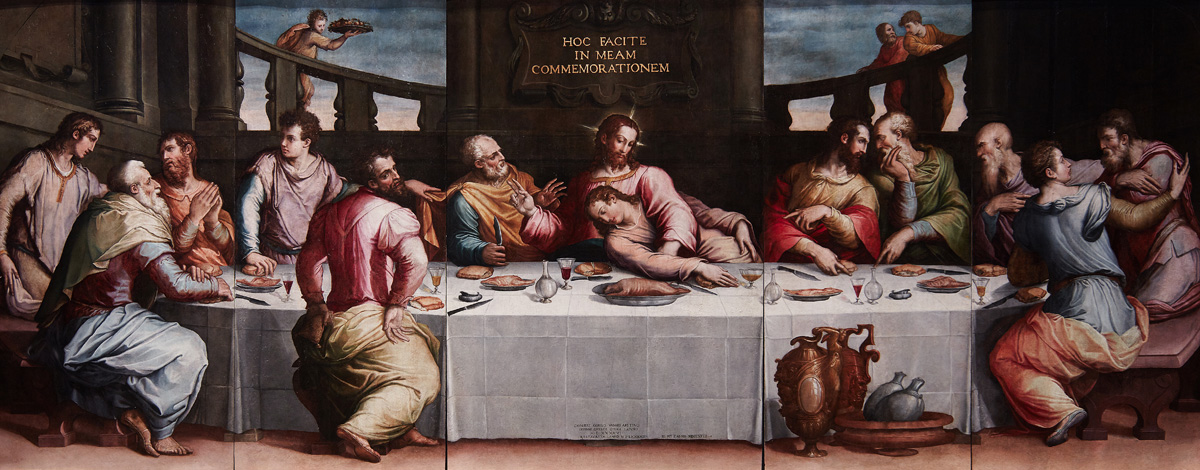
The Last Supper by Giorgio Vasari

A 50 year work of love to restore art for generations to come,.

The Last Supper. Giorgio Vasari

This originally appeared in the March/April edition of Biblical Archeology Review, p. 12

Begin quoteAfter 50 years, The Last Supper is back on display at the Santa Croce Basilica in Florence.

In 1966, a massive flood filled Florence with water, mud, sewage and debris. The flood wreaked havoc on many of the city’s structures and works of art, including The Last Supper by the Italian Renaissance artist Giorgio Vasari. Measuring 21 by 8 feet, The Last Supper is composed of five panels and dates to 1546. It portrays Jesus’ final Passover meal with his disciples before his arrest and crucifixion. During the flood, the painting—then displayed at the Santa Croce Basilica— was covered with water and mud for more than 12 hours.

When rescuers were finally able to reach the painting, they did their best to stabilize and preserve it, but the damage had already been done. Without the proper technology to restore the painting at that time, they packed up its panels and put them in storage. The painting waited there for 44 years until finally the Opificio delle Pietre Dure (Workshop of Semi-precious Stones), a conservation laboratory in Florence, undertook the feat of restoring it in 2010. The cracked, broken and damaged painting was slowly returned to its original state with the help of a three-year grant from the Getty Foundation as well as with the aid of Prada and the Protezione Civile (Italy’s Department of Civil Protection).

After several years, their work is complete, and The Last Supper can be seen once again at Santa Croce Basilica. Further, to prevent damage from future flooding, a new safety system has been put in place. If the structure should flood again, two winches will lift the painting above the flood line. The system is activated by pushing a button and requires no electricity, so the painting will be secure even if there is a power outage.

end-quote-black-71by52

Be well. Do good. Pay attention. Keep Learning.

Christ in the Desert

Wilderness. Temptations. Angels.

Christ in the desert by Ivan Kramskoi

Here is a link to our post of Christ in the Desert (Kramkoi) from March 3, 2014 (Lent 1A). The post features commentary by our Forum Member, Hovak Najarian.


First Sunday in Lent

Exploring our faith through the arts.

Christ in the desert by Ivan Kramskoi

Every year Loyola Press on the web offers Arts & Faith, “celebrating your creative expressions of faith.” Arts & Faith: Lent is among the offerings. Here is the introduction to the Year A presentations of Arts & Faith: Lent…

Enter into a visual prayer experience this Lent with Arts & Faith: Lent. Each week we’ll provide a video commentary about a work of art inspired by the Sunday Scriptures. Use these videos to take a new look at this season of spiritual renewal through the lens of sacred art.

daniella-zsupan-jerome

Commentary is by Daniella Zsupan-Jerome, assistant professor of liturgy, catechesis, and evangelization at Loyola University New Orleans. She holds a bachelor’s degree in theology from the University of Notre Dame, a master’s degree in liturgy from St. John’s University in Collegeville, a master’s degree in religion and the arts from Yale Divinity School, and a Ph.D. in theology and education from Boston College. Her unique background in faith and art brings to life a new way of observing Lent and understanding the season on a more personal level.

Christ in the desert by Ivan Kramkoi is the meditation for the First Sunday in Lent. I encourage you to use this internet resource during your Lenten Journey in 2017. ~Fr. Dan

Read the transcript of this video on Loyola Press.

Be well. Do good. Pay attention. Keep learning.

Image: Pinterst Page for the art of Ivan Kramkoi


Mercy

… for I was hungry and you gave me food, I was thirsty and you gave me something to drink, I was a stranger and you welcomed me, I was naked and you gave me clothing, I was sick and you took care of me, I was in prison and you visited me.…  Matthew 25:35-36

Caravaggio's Seven Acts of Mercy

A Caravaggio masterpiece on mercy calls to Pope Francis across the centuries

Begin quote

(RNS) If Pope Francis wanted a single image to illustrate the special Year of Mercy that is the current focus of his ministry and, indeed, the theme at the heart of his pontificate, he could do no better than choosing an underappreciated masterpiece by the thrilling Italian artist known as Caravaggio.

In fact, the 400-year-old canvas, an altarpiece in a Naples church titled “The Seven Acts of Mercy,” may represent the perfect combination of the man — or, rather, two men — and the moment: a brilliant painter with a scurrilous reputation who was striving for redemption, and a popular pontiff struggling to make the church more welcoming to outcasts.end-quote-black-71by52

Why does this painting call across the centuries?

I invite you to read the entire essay posted by Religion News Service on March 30, 2016 and learn more about Caravaggio, this remarkable painting, the theme of mercy, and how this painting (and Caravaggio himself) calls us to act with mercy and live with hope. ~Fr. Dan

Keep learning

Bethlehem shrine’s treasures being restored

Our present moment is, of course, greatly enriched by remembering and honoring our past. Today I am grateful for the work being done in the Church of the Nativity in Bethlehem. ~Fr. Dan

ROME (RNS) It is revered by different Christian sects and draws more than a million visitors to the Holy Land every year, making it the biggest tourist attraction in the Palestinian territories.

The Church of the Nativity, built by Roman Emperor Constantine in the fourth century, sits in Bethlehem above what’s believed to be the birthplace of Jesus in one of the most politically divisive regions of the world.

The church is administered jointly by Greek Orthodox, Syriac Orthodox, Roman Catholic and Armenian Apostolic authorities, and all have monastic communities there.

Since 2013, Italian experts from the art restoration firm Piacenti SpA have been working with the Palestinian government to overcome cultural and religious differences and forge ahead with an ambitious restoration expected to cost $15 million (14 million euros) when completed.

Read the entire post here: Bethlehem shrine’s treasures being restored | Religion News Service

The Sinless One to Jordan Came

An icon of the Baptism of our Lord

“The sinless one to Jordan came”
Hymnal 1982 #120
Words: G. B. Timms (b. 1910), alt.
Music: Solemnis haec festivitas, melody from Graduale, 1685;
harm. Arthur Hutchings (b. 1906)

This is a hymn used in worship on the Sunday we celebrated the Baptism of our Lord. Shared in our (almost) weekly newsletter “On the Way.” ~Fr. Dan

Llandaff Cathedral Choir

Icon: Deacon Mathew Garrett


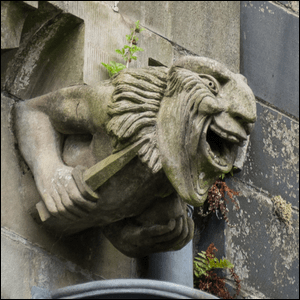
The Most Critical Feature Of A Gargoyle Is That It Is?

Think you know the answer? Click through to see if you’re right!

Source: The Most Critical Feature Of A Gargoyle Is That It Is?

Vatican restoration uncovers work of Renaissance master

Art restorers recover the 500-year old apartments of Pope Alexander VI, bringing new life to the works of the Renaissance artist “Pinturicchio.” The restoration brings attention not only to the masterful frescoes but also to the the story of the controversial pope who commissioned them, Rodrigo Borgia.

Source: Vatican restoration uncovers work of Renaissance master on Crux

Ecce Ancilla Domini

The Annunciation by Rossetti

Ecce Ancilla Domini, oil on canvas, 1850, Dante Gabriel Rossetti, 1828 – 1882

The Biblical account of the Annunciation: Luke 1:26-38

Commentary by Hovak Najarian

At the time Dante Gabriel Rossetti painted, Ecce Ancilla Domini (Latin: “Behold the handmaiden of the Lord,” also called, The Annunciation), England was the most advanced industrialized nation in the world. In the following year, 1851, the Great Exhibition in London (the first “World’s Fair”) celebrated the advancements of industry and culture. Like leaders of industry, English artists of the day were looking toward the future. Unlike many artists of his generation, however, Rossetti and like-minded friends did not follow their contemporaries. Instead of looking toward new directions in art, they looked back to medieval times and called themselves the Pre-Raphaelite Brotherhood (the name is in reference to a time before Raphael and the fifteenth century Renaissance). Among their beliefs was that art lost its spiritual quality after the Renaissance.

In subject matter, paintings of the annunciation depict the angel Gabriel greeting Mary to tell her she would bear a son and call him Jesus. Fifteenth and sixteenth century artists often placed this event at an intimate indoor setting or on a porch. Mary is pensive usually with a dove, representing the Holy Spirit above her head.

In contrast to idealized settings – often with dramatic lighting – created typically by artists of the Renaissance and beyond, the Pre-Raphaelites depicted subjects as real people in natural surroundings. In Rossetti’s, The Annunciation, Gabriel does not have dazzling rainbow-hued wings and Mary is not sitting in a throne-like chair. Instead, she is on her bed in a loose white nightgown looking as though she was awakened just a few minutes earlier and is now sitting up trying to process the message that Gabriel brought. She seems somewhat bewildered. A wingless Gabriel is standing upright by the bed, looking like an ordinary man floating in air slightly above the floor with his feet in flames. [Rossetti’s brother posed for Gabriel and he was originally without a halo. His younger sister, Christina, posed for Mary.] As in traditional depictions, Gabriel is presenting a lily (symbolizing purity) to Mary; a small haloed-dove is nearby. Although the red rectangular shape in the right foreground may not be recognized immediately, it is a sewing stand with its work-surface folded down. The image on it is a long-stemmed lily that Mary has been embroidering.

When Rossetti’s Annunciation was exhibited initially it did not receive favorable reviews. Critics were not accustomed to biblical subjects being treated in this non-traditional manner.

Notes:

In addition to painting, Dante Gabriel Rossetti wrote poems. The poetry of his younger sister, Christina, however, received far more acclaim. Her, poem, “In the Bleak Midwinter,” was set to music by Gustav Holst and is a Christmas hymn of the Anglican Church. This poem also was set to music as an anthem by Harold Darke. Anglican Churches honor Christina Rossetti with a feast day on April 27th.

Hovak Najarian © 2016