Collect: Janani Luwum

Archbishop of Uganda, and Martyr, 1977 (Feb 17)

Janani Luwum

Remembering the martyrdom of Janani Luwum—a 20th-century martyr no less—do you hear what we ask of God? “Grant us” we pray “to be so inspired by his witness that we make no peace with oppression but live as those who are sealed with the cross of Christ, who died and rose again….”

A bold intercession for ourselves and all who follow the Way of Love. May we have the heart to listen to God’s response and the courage to accept God’s grace to live as one “sealed with the cross of Christ” and confident that we, too, shall not be conquered by death but live with Christ who died and rose again.

The Collect for the Commemoration

O God, whose Son the Good Shepherd laid down his life for the sheep: We give you thanks for your faithful shepherd Janani Luwum, who after his Savior’s example, gave up his life for the people of Uganda. Grant us to be so inspired by his witness that we make no peace with oppression, but live as those who are sealed with the cross of Christ, who died and rose again, and now lives and reigns with you and the Holy Spirit, one God, for ever and ever. Amen.

Learn more

In 1969 Luwum became Bishop of Northern Uganda, where he was a faithful visitor to his parishes as well as a growing influence at international gatherings of the Anglican Communion. In 1974 he was elected Archbishop of the Church of Uganda, Rwanda, Burundi, and Boga-Zaire.

Luwum’s new position brought him into direct contact and eventual confrontation with the Ugandan military dictator, Idi Amin, as the Archbishop sought to protect his people from the brutality of Amin’s regime. In August of 1976 Makerere University was sacked by government troops. With Archbishop Luwum as their chair, the Christian leaders of the country drafted a strong memorandum of protest against officially sanctioned rape and murder.

In early February 1977 the Archbishop’s residence was searched for arms by government security forces. On February 16 President Amin summoned Luwum to his palace. He went there, accompanied by the other Anglican bishops and by the Roman Catholic cardinal archbishop and a senior leader of the Muslim community. After being accused of complicity in a plot to murder the President, most of the clerics were allowed to leave. However, Archbishop Luwum was ordered to remain behind. As his companions departed, Luwum said, “They are going to kill me. I am not afraid.” He was never seen alive again. The following day the government announced that he had been killed in an automobile accident while resisting arrest. Only after some weeks had passed was his bullet-riddled body released to his family for burial.

Janani Luwum on Standing Commission on Liturgy and Music website

Be well. Do good. Pay attention. Keep learning.

Collect: Charles Todd Quintard

Bishop of Tennessee, 1898 (Feb 16)

Thomas Bray

In prayer to “Mighty God” we recognize and confess that Bishop Quintard “persevered to reconcile the divisions among the people of his time.” We ask that today our Church (the People of God) “may ever be one, that it may be a refuge for all.” It will take the effort of each one to make this so. Today, what will you do to reconcile divisions and make the People of God a refuge for all?

The Collect for the Commemoration

Mighty God, we bless your Name for the example of your bishop Charles Todd Quintard, who persevered to reconcile the divisions among the people of his time: Grant, we pray, that your Church may ever be one, that it may be a refuge for all, for the honor of your Name; through Jesus Christ, who with you and the Holy Spirit lives and reigns, one God, for ever and ever. Amen. Amen.

Learn more

Charles Todd Quintard was the second bishop of the Diocese of Tennessee and the first Vice Chancellor of The University of the South at Sewanee.

Quintard was born in 1824 in Stamford, Connecticut. In 1847 he received the degree of Doctor of Medicine from the Medical College of New York University and worked at New York’s Bellevue Hospital. After a brief episode of practicing medicine in Athens, Georgia, Quintard became the professor of anatomy and physiology at Memphis Medical College and an editor of the Memphis Medical Reporter. In 1848, Quintard married Katherine Isabella Hand, a native of Roswell, Georgia, and together they were the parents of three children.

[…] During the Civil War, Quintard played dual roles in the Confederate Army as both chaplain and surgeon. Following the war, he was instrumental in bringing together the previously divided factions and extending the reach of the Episcopal Church, particularly among African Americans.

Bishop Quintard was a strong advocate of education at every level and played a major role in the establishment of schools. Perhaps his greatest accomplishment was the rebuilding of the University of the South at Sewanee after its destruction during the Civil War. He made several successful trips to England to raise the funds to secure the future of the University. From February 1867 to July 1872, Quintard served as the reconstituted University’s first Vice Chancellor. Quintard believed that a great Episcopal university was essential, not just to the church in Tennessee and the southeast, but to the whole church, and thus devoted much of his ministry to Sewanee.

Charles Todd Quintard on Standing Commission on Liturgy and Music website

Be well. Do good. Pay attention. Keep learning.

Collect: Thomas Bray Priest and Missionary, 1730 (Feb 15)

May we look with God’s compassion upon our world

Thomas Bray

We begin our prayer: “O God of compassion….” Thomas Bray looked into his world with the God of compassion and saw ways to teach and comfort and advocate for all God’s children. May we have the grace to do the same as we look with the God of compassion at our own world (home and family, neighborhood, workplace, city, state, nation, world, you get the idea). Today, in word and deed let us see and let us act with compassion.

The Collect for the Commemoration

O God of compassion, who opened the heart of your servant Thomas Bray to the needs of the Church in the New World, and to found societies to relieve them: Make the Church diligent at all times to propagate the Gospel, and to promote the spread of Christian knowledge; through Jesus Christ our Lord, who lives and reigns with you and the Holy Spirit, one God, for ever and ever. Amen.

Learn more

Thomas Bray was born at Marton, in Shropshire, England, in 1656. After graduating from Oxford and being ordained, he became a country parson in Warwickshire. In 1696 he was invited by the Bishop of London to be responsible for the oversight of Church work in the colony of Maryland. Three years later, as the Bishop’s Commissary, he sailed to America for his first, and only, visitation. Though he spent only two and a half months in Maryland, Bray was deeply concerned about the neglected state of the American churches, and the great need for the education of clergymen, lay people, and children.[…] His understanding of, and concern for, Native Americans and blacks were far ahead of his time. He founded thirty-nine lending libraries in America, as well as numerous schools. He raised money for missionary work and influenced young English priests to go to America.

[…] When the deplorable condition of English prisons was brought to Bray’s attention, he set to work to influence public opinion and to raise funds to alleviate the misery of the inmates. He organized Sunday “Beef and Beer” dinners in prisons, and advanced proposals for prison reform. It was Thomas Bray who first suggested to General Oglethorpe the idea of founding a humanitarian colony for the relief of honest debtors, but he died before the Georgia colony became a reality. Read more

from Holy Women, Holy Men

Be well. Do good. Pay attention. Keep learning.

Collect: Cyril, Monk, and Methodius, Bishop Missionaries to the Slavs, 869, 885 (Feb 14)

A timely prayer asking help to overcome strife by the love of Christ

Holy Trinity. Icon. Andrei Rublev.

The Collect for the Commemoration

Almighty and everlasting God, by the power of the Holy Spirit you moved your servant Cyril and his brother Methodius to bring the light of the Gospel to a hostile and divided people: Overcome all bitterness and strife among us by the love of Christ, and make us one united family under the banner of the Prince of Peace; who lives and reigns with you and the Holy Spirit, one God, now and for ever. Amen.

Today’s Collect is well timed in a world where division, violence and the threat of more violence is a constant companion. Along the Way of Love taught us by Jesus (in word and deed) we ask our God to assist us to “overcome all bitterness and strife … by the love of Christ” and unite as one “under the banner of the Prince of Peace.” May it be so in our words and deeds this day.

Learn more about these brothers

Cyril (born about 828) and Methodius (born about 817), brothers born in Thessalonika, are honored as apostles to the southern Slavs and as the founders of Slavic literary culture. Cyril was a student of philosophy and a deacon, who eventually became a missionary monastic. Methodius was first the governor of a Slavic colony, then turned to the monastic life, and was later elected abbot of a monastery in Constantinople.

In 862, the King of Moravia asked for missionaries who would teach his people in their native language. Since both Cyril and Methodius knew Slavonic, and both were learned men—Cyril was known as “the Philosopher”—the Patriarch chose them to lead the mission. Read more

from Holy Women, Holy Men

Be well. Do good. Pay attention. Keep learning.

Epiphany +6 Year C

Blessed are those who trust in the Lord, whose trust is the Lord. Jer 17:7

Glad you have come here to find the readings for the Sixth Sunday after the Epiphany (Feb. 13 in 2022) in Year C of our Lectionary.

Trust in the Lord, trust in those who testify to God’s love and purposes, trust in those who have gone before you—these are among the themes this Sunday (and this week).

Check out, too, what our Church remembers about Absalom Jones and, through this week, others who trusted in the Lord and worked tirelessly for God’s glory in the name of Jesus.

Finally, check out what Frederick Buechner has to say about the Biblical revelation about resurrection and the notion of immortality. See that he accepts the Biblical revelation and trusts God. What about you?

View or Download today’s handout

Saint Haralampus

Curiosity and the internet leading to new companions along the Way.

From Religion News Service Photos of the Week 02/12/2022

The caption on this photo: “Priests read prayers in honour of St.Haralampus, as believers gather around candles stuck to jars of honey, arranged in a cross shape, during Mass for the ‘sanctification of honey’ at the Presentation of the Blessed Virgin Church in the town of Blagoevgrad, south of the Bulgarian capital of Sofia, Thursday, Feb. 10, 2022. The Bulgarian Orthodox Church marks the feast of St. Haralampus, the Orthodox patron saint of bee-keepers, by performing a ritual for health and rich harvest.” (AP Photo/Valentina Petrova)

One of the wonderful aspects of living in the Information Age and having internet access is learning (nearly instantly) that is unbounded by geography or culture. I had never heard of St. Haralampus until today. Reading that he is the patron saint of bee-keepers led me to look further into his story and who else might be considered a patron saint of bees, bee-keeping, or bee-keepers.

If you’re interested here is some more information about the Saint (who apparently suffered a brutal martyrdom for his faith) and about patron saints of bees and bee-keepers:

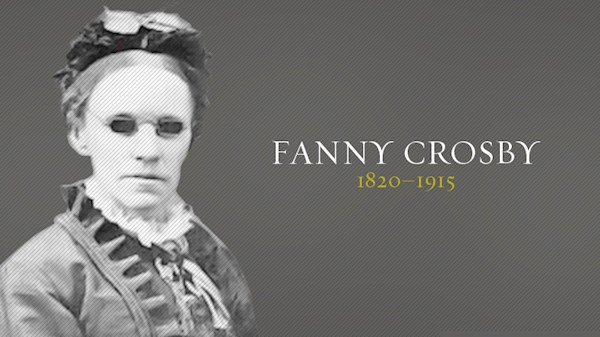
Frances Jane (Fanny) Van Alstyne Crosby, Hymnwriter, 1915

Annually on February 11th we remember Fanny Crosby. Read on.

Fanny Crosby was the most prolific writer of hymn texts and gospel songs in the American evangelical tradition of the late nineteenth and early twentieth centuries. She wrote more than eight thousand sacred texts in addition to other poetry.

Frances Jane Crosby was born in Putnam County, New York, on March 24, 1820. Although not born blind, she lost her sight as an infant as a result of complications from a childhood illness. At the age of fifteen, she entered the New York Institute for the Blind where she would later teach for a number of years. In 1858, she married Alexander van Alstyne, a musician in New York who was also blind. Crosby was a lifelong Methodist.

Crosby’s texts were so popular that nearly every well-known composer of gospel music of the period came to her for words to accompany their melodies. In most hymn writing, the words come first and then a composer sets them to music, but for Crosby the words came so quickly and naturally that composers would often take her their tunes and she would immediately begin to shape words that fit the music.

Perhaps the best example of this process led to the creation of Crosby’s most well known hymn Blessed Assurance. On a visit to the home of a friend, the composer Phoebe Knapp, a newly composed tune was played for Crosby. After listening to the tune several times, the text began to take shape, and in a very short time one of the world’s most popular gospel hymns was born. The American gospel song is a unique genre of sacred music that combines words expressive of the personal faith and witness with tunes that are simple and easily learned. Fanny Crosby’s contribution to this genre is unequaled. Dozens of her hymns continue to find a place in the hymnals of Protestant evangelicalism around the world.

Fanny Crosby died on February 12, 1915, in Bridgeport, Connecticut, where she is buried.

Source: A Great Cloud of Witnesses, 2018

If I had a choice, I would still choose to remain blind … for when I die, the first face I will ever see will be the face of my blessed Saviour.

Fanny Crosby on Christ Centered Quotes

Even more about Fanny Crosby

Additional resources you may enjoy as you walk with Fanny Crosby in the communion of saints …

Collect: Andrei Rublev, Monk and Iconographer, 1430 (Jan 29)

Generally acknowledged as Russia’s greatest iconographer, Andrei Rublev was born around 1365 near Moscow. His “writing” persists to this day.

Holy Trinity. Icon. Andrei Rublev.

Generally acknowledged as Russia’s greatest iconographer, Andrei Rublev was born around 1365 near Moscow. While very young he entered the monastery of The Holy Trinity and in 1405, with the blessing of his igumen (the Orthodox equivalent of abbot), he transferred to the Spaso-Andronikov monastery where he received the tonsure and studied iconography with Theophanes the Greek and the monk Daniel. Among his most revered works are those in the Dormition Cathedral in Vladimir.

The icon (“image” in Greek) is central to Orthodox spirituality. It finds its place in liturgy and in personal devotion. An icon is two dimensional and despite being an image of someone it is not a physical portrait. Western art, especially since the Renaissance, has sought to represent figures or events so that the viewer  might better imagine them. A western crucifix seeks to enable us to imagine what Golgotha was like. Icons seek to  provide immediate access to the spiritual and the divine unmediated by the human, historical imagination. Read more

Holy Women, Holy Men

The Collect for the Commemoration

Holy God, we bless you for the gift of your monk and icon writer Andrei Rublev, who, inspired by the Holy Spirit, provided a window into heaven for generations to come, revealing the majesty and mystery of the holy and blessed Trinity; who lives and reigns through ages of ages. Amen.

Today’s Collect simply give thanks for “the gift of …monk and icon writer Andrei Rublev.” As we view his writing, and the writings of others in icons throughout the Church, let us always give thanks for the gift of individuals with a wonderful talent to open the heavens for us. ~Fr. Dan

Be well. Do good. Pay attention. Keep learning.

The Wounded Angel

Finding meaning in the carnage of terror and the belief in Guardian Angels.

Wounded Angel
The Wounded Angel by Hugo Simberg, 1903

The following meditation was originally posted by Teresa Berger on 2 October 2017 on Pray Tell: Worship, Wit & Wisdom (a blog maintained by Liturgical Press, the School of Theology, St. John’s in Collegeville, MN, and the St. John’s Seminary). It was posted on the morning of the mass shooting in Las Vegas, NV and the observance of the Feast of Guardian Angels by the Roman Catholic Church.

Begin quote

Like many of you, I woke up this morning having Guardian Angels on my mind, whose memorial the church sets before us today. Like most of you, I woke up this morning to news of the carnage in Las Vegas. It seems almost impossible to hold the two together – until, that is, I remembered the startling painting by Hugo Simberg, “The Wounded Angel” (1903), which I saw in the Finnish National Gallery a couple of years ago. The painting shows an angel on a stretcher carried by two boys. The angel’s wing is torn, the eyes are covered by a bandage, and the figure leans heavily on the stretcher.

This morning, I see many Guardian Angels like that, being carried away, wounded and exhausted, in Las Vegas.

Be well. Do good. Pay attention. Keep learning

Manteo and Virginia Dare (Aug 17)

Remembering our story


Baptism of Virginia Dare

In the late sixteenth century, Sir Walter Raleigh established three colonies along the northeastern coast of what is now the state of North Carolina. In July 1587, the third and final settlement, consisting of 120 men, women, and children under the leadership of John White, landed on Roanoke Island, near the present-day community of Nags Head.

With the colonists was Manteo, a Native American of the Algonquian nation and resident of Croatoan who had traveled to London in an earlier expedition to become a liaison between the English and the Native Americans. On August 13, 1587, Manteo was baptized, the first recorded baptism of the Church of England in the American colonies and the first recorded baptism of a Native American person in the Church of England. Read more

Holy Women, Holy Men

The Collect for the Commemoration

O God, you have created every human being in your image and each one is precious in your sight: Grant that in remembering the baptisms of Manteo and Virginia Dare, we may grow in honoring your gift of diversity in human life; become stronger in living out our baptismal vow to respect the dignity of every human being; and bring into the fellowship of the risen Christ those who come to him in faith, baptizing them in the name of the Father, and of the Son, and of the Holy Spirit. Amen.

As God answers our prayer may we well and truly “become stronger in living out our baptismal vow to respect the dignity of every human life.” ~Fr. Dan

Be well. Do good. Pay attention. Keep learning.