Reference material, prayers in the Christian tradition, sermons, links to additional online resources for study, follow up to questions raised in the Sunday Morning Forum. and so on. Resources to invite further study and aid further study of the weekly texts in order to hear what the Spirit is saying.
On Sunday (4/21/13) we listened to a reading from Acts 9 (verses 36-43). In the reading we learned that Peter was in Lydda when he was summoned to Joppa. In Joppa he raised Tabitha (Dorcas) from the dead and restored her to the community.
Setting aside the discussion about the historical accuracy of this account (or of Acts in general) and setting aside the discussion of miracles (for now), a 21st century American studying this account may wonder where these two towns were/are located. Fortunately, we live in an age where we “have an app for that.”
In this case we have a website and an app to help us locate Lydda and Joppa (well, modern cities overlaying an ancient landscape really).
The app: Google Earth (a link to the Download Page for Google Earth)
If you already have Google Earth try out Bible Geocoding. If you do not have Google Earth, no problem: click on “preview” when seeking to locate a place named in the Bible and you will get plenty of information. For example, here is the “preview” of all the places listed in Acts 9.
We (the authors and editors of this blog) are working to build a Resources Page for your use. Our goal is to have the page active by the end of April. If you have an internet resource you would like to share, please share it via the Comments section. Let us help each other.
“The Lord is my shepherd.” This line from Psalm 23 is among the most famous images from the Bible. But as I describe in And God Said, for most people the English words hide the ancient imagery.
Hoffman, in imagining a 21st century “shepherd,” tells us he would cast Woody Allen to play the role in his imaginary movie. But he doesn’t let us stop there.
So even though the Hebrew in Psalm 23 is ro’eh, and even though ro’eh literally means “shepherd,” I don’t think “The Lord is my shepherd” is a very good translation.
He points us to the qualities of “shepherd” in the Hebrew Bible. Shepherds…
… have a surprising and surpassing ferocity about them
We see … in Jeremiah 49:19, where God is “like a lion” that can’t be stopped. Using increasingly powerful imagery, the text has God ask, “Who is like me? Who can summon me? Who is the shepherd who can stand before me?” (NRSV). In other words, God is so powerful that even a shepherd will be beaten back. In modern terms, again, the imagery is nonsensical. But in the Bible, shepherds were symbols of strength.
… are similar to royalty and nobility
King David was a shepherd. … in Micah 5:5, … shepherds are in parallel with rulers, a literary device that, in the Bible, suggests that they were similar. And in Nahum 3:18 we find shepherds in parallel with nobles.
… have “sex-appeal”
Finally, shepherds were symbols of romance. Song of Solomon, the most overtly sexual book of the Bible, is filled with images of shepherds. … The famous imagery in verse 2:16, “my lover is mine and I am his,” ends with two Hebrew words to describe the heroine’s lover. They translate as, “[the one] who is a shepherd among flowers.”
After this expansion of our wimpy 21st century understanding of “shepherd” Hoffman summarizes: “In short, for the ancient image of a shepherd, think John Wayne, not Woody Allen.”
If you’re in the desert on 4/21/13 come join us in the Sunday Morning Forum at St. Margaret’s at 9:00 am. If not, let me/us know what you think about Joel’s post and linguistic analysis; leave a comment.
Here’s a quick summary of Ash Wednesday and Lent. Produced by bustedhalo video ministries the perspective is Roman Catholic but the teaching is, well, catholic (as in universal) in its scope.
“Official” Update on the Crown Nominations Committee of the Church of England
Here is a link to the latest “official” Update about the work of the Crown Nominations Committee via the Anglican Communion News Service (ACNS) posted Sep. 28, 2012.
What did you do this weekend?
Planet Money on NPR provides an answer about the “Average American” use of weekend time. Will it surprise you that on average we spend 37min and 12secs on Volunteering and Religious Activities? Be sure to read the caveats at the end of the article. Here is the post with 2 graphics.
The Coptic Papyrus by Martin E. Marty in an online series entitled Sightings published by the University of Chicago Divinity School. The essay examines the interaction of media and religion (and scholarship).
Jesus’s Wife: Would it even matter for Women? by Sonja and posted on the blog WIT: Women in Theology. This essay examines what impact this text would have on women in the Church IF (a very big if according to the author) there was a debate 1800 years ago about the marriage status of Jesus.
Update on the Crown Nominations Committee of the Church of England
Here is a link to the latest “official” Update about the work of the Crown Nominations Committee via the Anglican Communion News Service (ACNS) posted Sep. 28, 2012.
No shoes, no taxes, no sacraments
On Monday (9/24) I read this summary of a Pastoral Letter of the Roman Catholic Bishops of Germany. Later in the week I read their defense of their action. I understand, thanks to Hovak, that an article appeared in The Desert Sun on Saturday, Sep. 29, 2012 on page A-13. More to come, I believe.
Last week didn’t go at all ‘according to plan.’ I will spare you the details. More importantly, I thank you for your patience and understanding (fewer posts, no emails, cancelled Forum on Sunday). You put up with a lot and offered only your prayers and support. Thank you.
In the middle of yesterday’s (8/5/12) conversation about being called (to know Christ, to be holy as our God is holy) and calling (to be a wife, a husband, a father, a mother, a member of the choir, a member of the Altar Guild, an intercessor in prayer, a team member working in the food distribution ministry, a neighbor, a co-worker, a teacher and you get the idea) I read this from Professor Hanvik in his commentary on Ephesians 4:1-16
Paul pairs the words “called” and “callings” in two different places in the passage (4:1 and 4:4). The reader is reminded of the relationship between our being called by God and the subsequent assignment of a calling in the world. The language of calling links the church with the election of Israel. God has chosen for himself (1:4) a people and this election depends firmly on God’s decision. It is done “before the foundation of the world” (1:4) and it relies solely on God’s gracious initiative (2:8). And the result of being called is that the faithful now have callings where they lead lives marked by humility, love and patience (4:2).
It is easy to get confused about the dual nature of a call. It is worth underlining that being called and having a calling must be distinguished but never separated. Our relationship with God simultaneously involves a relationship with neighbor or community. And these callings are multiple as it is impossible for a Christian to not be in some type of calling at all times of life.
Just as God is active in every nook and cranny of creation so God uses his people to make sure people are fed, clothed, comforted, educated, protected, etc. Proclaimers would be wise to remind listeners that a calling should not be pared down to a job or occupation. This would mean wide stretches of human experience would be outside of God’s providence. God calls us not only to work but to friendship, family life, citizenship, etc. —WorkingPreacher.com for August 5, 2012
It was a terrific conversation. Thank you. I learned a lot. Please continue the conversation here using the Comment section which follows the post. Bless you, dear reader, bless you as you bless others by exercising the ministries to which you have been called.
The last 3 weeks we have read from “Paul’s Letter to the Ephesians” in our worship. In the discussion on Sunday (7/29/12) Stan and I raised the question about who authored the letter to the Ephesians. In part, our question arises from our reading of commentaries and essays by a variety of scholars including, most recently, the scholarship of Marcus Borg and John Dominic Crossan.
THREE PAULS
Mainstream scholarship as it has developed over the last two centuries has concluded that some of the thirteen letters attributed to Paul were not written by him. Rather, they fall into three categories.
First, a massive scholarly consensus: at least seven letters are “genuine” – that is, written by Paul himself. These seven include three longer ones (Romans, I and II Corinthians), and four shorter ones (I Thessalonians, Galatians, Philippians, and Philemon). Written in the 50s of the first century, plus or minus a year or two, they are the earliest documents in the New Testament, earlier than the gospels (recall that Mark, the first gospel, was written around 70). Thus the genuine letters of Paul are the oldest witness we have to what was to become Christianity.
Second, an almost equally strong consensus: three letters were not written by Paul. These are I and II Timothy and Titus, commonly known as “the pastoral epistles” or simply “the pastorals.” Scholars estimate that they were written around the year 100, possibly a decade or two later. The reasons these are seen as “non-Pauline” include what looks like a later historical setting as well as a style of writing quite unlike the Paul of the seven genuine letters.
Thus the letters to Timothy and Titus were written in the name of Paul several decades after his death. In case some readers may think that writing in somebody else’s name was dishonest or fraudulent, we note that it was a common practice in the ancient world. It was a literary convention of the time, including within Judaism.
Third, letters about which there is no scholarly consensus, though a majority see them as not coming from Paul. Often called the “disputed” epistles, they include Ephesians, Colossians, and II Thessalonians. We are among those who see these as “post-Paul,” written a generation or so after his death, midway between the genuine letters and the later pastoral letters.
In your reading and study have you formed an opinion? What role does the Holy Spirit play in the writing, preserving, handing on, and interpreting of these letters? What role does the Spirit play as you grapple with this kind of information? Let’s keep the conversation going.
A July 25 nighttime fire destroys St. James Church in Cannon Ball, North Dakota.
The Epistle for Proper 8 Year B read on July 1, 2012: 7 Now as you excel in everything—in faith, in speech, in knowledge, in utmost eagerness, and in our love for you —so we want you to excel also in this generous undertaking. 8 I do not say this as a command, but I am testing the genuineness of your love against the earnestness of others. 9 For you know the generous act of our Lord Jesus Christ, that though he was rich, yet for your sakes he became poor, so that by his poverty you might become rich. 10 And in this matter I am giving my advice: it is appropriate for you who began last year not only to do something but even to desire to do something— 11 now finish doing it, so that your eagerness may be matched by completing it according to your means. 12 For if the eagerness is there, the gift is acceptable according to what one has—not according to what one does not have. 13 I do not mean that there should be relief for others and pressure on you, but it is a question of a fair balance between 14 your present abundance and their need, so that their abundance may be for your need, in order that there may be a fair balance. 15 As it is written, “The one who had much did not have too much, and the one who had little did not have too little.” 2 Corinthians 8:7-15
How believers use their resources — time, money, talents, and attention — is a reflection of what they believe about God and God’s actions in the world. Furthermore, how those resources are used preaches a message to others. Paul wants the Corinthians’ actions to be a reflection of the gospel in which they believe.
This passage fits in a larger section of 2 Corinthians (8:1-9:15) that is chiefly concerned with Paul’s collection for the Jerusalem church.…
In 2 Corinthians 9, Paul gets more mileage out of the Macedonian success story by shaming the Corinthian church into acting.…
Before he resorts to shaming them directly, he reminds the believers that their actions to support the Jerusalem poor demonstrate the earnestness of their faith (2 Corinthians 8:8). Paul reframes the whole collection as the gospel enacted. In 2 Corinthians 8:9, Paul retells the good news through the lens of generosity. Christ gave up extraordinary riches so that others might receive the abundant wealth of God’s grace.
A July 25 nighttime fire has destroyed St. James’ Episcopal Church in Cannon Ball, North Dakota.
Sioux County, where Cannon Ball is located, is one of the poorest counties in North Dakota and among the top ten poorest in the nation
“At 10 p.m. Central Time a parishioner who lives across the road from St. James’ saw that there was smoke and fire coming from the church,” said the Rev. Canon John Floberg, who has served as St. James’ rector for 21 years and is canon missioner for native ministry in the Diocese of North Dakota. “Flames spread quickly through the parish hall to the church itself, and by quarter of eleven the whole structure was engulfed in flames. It’s all ash today.” Read more: NORTH DAKOTA: Fire destroys St. James’ Episcopal Church
I propose that we take up a collection in the Sunday Morning Forum for the people of St. James Episcopal Church. With the Apostle and the with the Professor I believe that how we use our resources tells a lot about what we believe about God and God’s actions in the world.
On Sunday, May 20th, we heard, “[Father] as you have sent me into the world, so I have sent them into the world.” The speaker in each instance, of course, is Jesus. He is speaking to those who gather around him—in every age—to hear what he is saying. He is speaking to us. Today, WE are the ones sent into the world.
How are you responding to the Spirit as you go into the world as one sent by Jesus? How do you choose your way forward as one who is sent? I invite you to continue the conversation in the Comments section that follows.

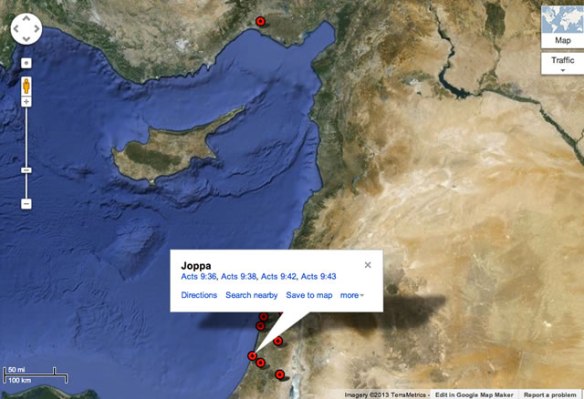 On Sunday (4/21/13) we listened to a reading from Acts 9 (verses 36-43). In the reading we learned that Peter was in Lydda when he was summoned to Joppa. In Joppa he raised Tabitha (Dorcas) from the dead and restored her to the community.




 Hear what the Spirit is saying