
It is better to light one candle, than to curse the darkness

Lighting a candle is a way to let Christ, the Light, into our lives; it is a way to let our light (of care, concern, hope, love, compassion, interconnectedness, peace) shine into the world;  it is an invitation to warmth; the fire of a candle ascends, like our prayer; it can be an offering of self, “our souls and bodies” to  God’s glory. … The lit candle can be our continuing prayer, even when our conscious praying is interrupted or distracted into oblivion.

The lit candle, especially in the darkest part of the night, is a symbol of an unquenchable hope; it is a symbol of a life-giving trust (in God).

I encourage you to light a candle, offer a prayer, give light (no, give the Light you know) to the world.

For further reading and reflection

In many different traditions lighting candles is a sacred action. It expresses more than words can express. It has to do with gratefulness. From time immemorial, people have lit candles in sacred places. Why should cyberspace not be sacred? From the website of Gratefulness.org as an introduction to a sacred space in which you can light a candle.

I have started a Group for us on Gratefulness.org. The Group initials are 4 letters: a-m-e-n. Our group is “amen” (without the quotes). As you complete the guided process to light your candle in cyberspace you will have the opportunity to enter a set of Group initials. Use “amen” (without the quote marks). All candles with the Group initials amen will appear together. If you want to find your candle, use your initials in the space provided.

“Amen.” Of course, this is a common ending to our prayers. To say Amen to a prayer is to say to all who hear “Let it be so, even more than I can say, or more than I can ask or imagine, let it be so.”

Click the image or click here: Light A Candle and go to Gratefulness.org I will greet you there and you will be guided in your candle lighting effort; God will do the rest.

Light a candle in your home or other sacred space and spend time with the light before leaving and then, take that light into the world.

Note: The headline is borrowed from The Christophers and was a frequent mantra while i was hospitalized in 2008-09.

God’s activity is so musical!

When you have about an hour and a half and feel somewhat in a meditative mood, check out this YouTube presentation from UCTV, University of California Television. Dr. Jeremy S. Begbie takes even a non-musician (like me) into the world of music and in his talk opens, in a new way, the “speech” of the Spirit as recorded in our Bible. I wanted to hear more.

May you find yet another way to hear what the Spirit is saying.

“In a fascinating multimedia presentation, Jeremy Begbie, Professor of Music, Cambridge University, expounds upon the relationship between music and theology. Series: “Let There Be Light” [10/2003] [Humanities] [Show ID: 7906]”

Going in Circles, Getting Whole

Walk the Labyrinth at St. Margaret's in Palm Desert, CA

“Going in Circles, Getting Whole” by David Burgdorf (a Forum participant) will set you in motion for the moving meditation that is the labyrinth. Every month the Labyrinth Guild at St. Margaret’s offers a time to experience the labyrinth within a group setting. I invite you to participate in this walk.

Need additional inspiration about walking the labyrinth? I share the wisdom and experience of Macrina Wiederkehr a Benedictine Nun. Hip Deep in Tears opens her experience to you and will serve as an introduction to the power of the labyrinth. This is one tiny example of encounter with the power and mystery of God within the labyrinth. You will have your own story to tell. Come and walk.

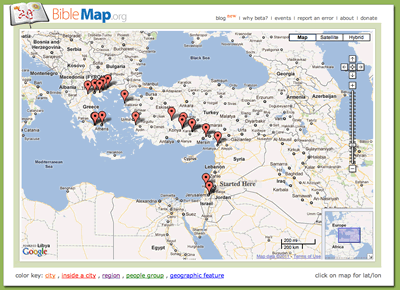
You’ll want to use BibleMap.org

Here is a resource that’s as easy to use as Google Maps: BibleMap.org. It is still being built, so be patient.

Once on the site, enter a book and chapter in the search panel (usually on the left). As soon as I selected the book (from the drop-down list) and the chapter number the map appeared.

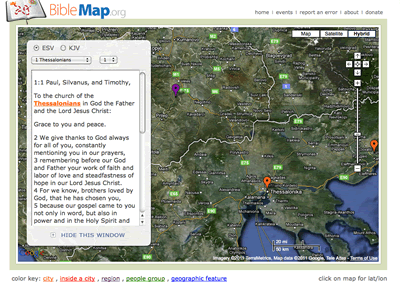
Here’s what I got for 1 Thesslonians 1

Click the map – go to the map

Once you have the map you may navigate it as you do in Google Maps (use the controls on the right side of the map). You can zoom in or out. You can navigate in all compass directions. Clicking on a map pin will give you even more information (and choices).

In addition, you will find Paul’s Missionary Journeys mapped out. In the upper right hand corner click on events (sandwiched between home and report an error). I selected Paul’s 2nd Missionary Journey from the pop-up list and received this map:

Click the map – go to the map

Have fun with this bible map tool. Share your experiences and questions here (Comments and Replies) or in the Forum on Sunday.

How’s your Hebrew?


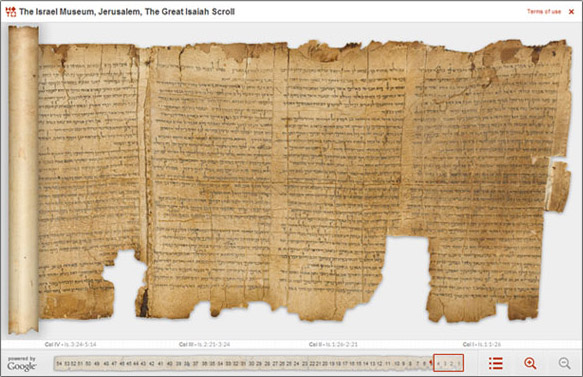
The Great Isaiah Scroll from the Dead Sea Scrolls

Some of you may have seen one of the traveling exhibits of the Dead Sea Scrolls (in 2010 the exhibit was in San Diego). Now The Digital Dead Sea Scrolls are available to all.

You can even view the video presenting this latest addition to online biblical study.

With a little effort you can compare portions of the Dead Sea Scroll to the standard Jewish translation in English (if, like me, you don’t read Hebrew). The directions are on each page describing the scroll about to be viewed, like The Great Isaiah Scroll.

You can read more about this online at The Anglican Journal.com

Enjoy. Leave a comment here. Continue this conversation. Be blessed by God’s Word today.

Can we by searching find out God or formulate his ways?

Paul exclaimed, “I want to know Christ…” (Philippians 3:10). On Sunday 10/2/2011 we explored this statement in our Sunday Morning Forum. “How do YOU know Christ? Where have YOU encountered Christ?” were among the questions we asked, sharing our answers around the table.

Once again, music was mentioned, specifically hymns used in worship, as a place of encounter and inspiration and knowledge. Bill shared one of his favorites, which happens to follow our readings from Philippians pretty closely: “Can we by searching find out God or formulate his ways?” which Hymn 476 in the 1982 Episcopal Hymnal.

Here are the lyrics

Can we by searching find out God
or formulate his ways?
Can numbers measure what he is
or words contain his praise?

Although his being is too bright
for human eyes to scan,
his meaning lights our shadowed world
through Christ, the Son of Man.

Our boastfulness is turned to shame,
our profit counts as loss,
when earthly values stand beside
the manger and the cross.

There God breaks in upon our search,
makes birth and death his own;
he speaks to us in human terms
to make his glory known. [1]

Let us hear what the Spirit is saying. Share your favorite hymn of encounter, inspiration, encouragement, or knowledge by leaving a reply and continuing the Sunday conversation here.

____________
[1] Words: Elizabeth Cosnett (b. 1936), alt.
Music: Epworth, melody att. Charles Wesley (1757–1834), alt.; harm. Martin Fallas Shaw (1875–1958), alt.

What would Jerome think? St. Jerome, that is.

Today (9/30) the church remembers Jerome, “Priest, and Monk of Jerusalem,” who died in 420 CE. Among his many accomplishments was the translation of the Bible from Hebrew and Greek into the common (vulgar) language of Latin. The Vulgate version of the Bible remains a standard text in the Roman Catholic Church and has a respected place among contemporary biblical scholars and church historians. Thus, the question, “What would Jerome think?”

Yesterday (9/29) the Episcopal News Service posted an article about a new English translation of the Bible (from Hebrew and Greek). This newest Bible is the Common English Bible (CEB). What Jerome did in his study in the early 5th century was today accomplished by “120 scholars drawn from 24 denominations” at the cost of $3.5 million over the course of 4 years. In addition, “More than 500 readers in 77 groups later field-tested their work” according to the article. Read the entire post here: New Common English Bible translation draws on expertise of 17 Anglican, Episcopal scholars.

So what would Jerome think about the choices made? What do you think? How did some of your favorite verses fare in the new translation?

Probably most of us “know” that Genesis 1:1 begins like this “In the beginning God created the heaven and the earth …” (KJV) The Common English translation? “When God began to create the heavens and the earth—”

One more example, a favorite of many, Psalm 23. The final verse, which is the most powerful to me when this Psalm is used in a Memorial Service (Ps 23:6): “Surely goodness and mercy shall follow me all the days of my life: and I will dwell in the house of the LORD for ever.” (KJV) and “Yes, goodness and faithful love will pursue me all the days of my life, and I will live in the LORD’s house as long as I live. ” (CEB) You can read the entire Psalm here: King James Version and Common English Bible

Thank you for being part of the Sunday Morning Forum (in real time or online). Like Jerome, we take seriously our study of the Word of God. Whether you like or appreciate the newest translation of the Bible, I do hope you appreciate how the Live Word of the Living God continues to demand our study and our best efforts to know and apply its God inspired wisdom. Leave a comment or two (below) to continue this conversation. What do you think about all this?

For further reflection and study

  • Common English Bible — official website of the Common English Bible. You will find many options to fully explore this new bible and to learn more about how it was produced.
  • Bible Gateway — a site with many different translations of the Bible including the Common English Bible; you can compare translations pretty easily.
  • Bible Study Tools — another site with an assembly of different versions of the Bible including the version we use in worship: the New Revised Standard Version of the Bible.

Don’t miss out. Follow us!

Tell your family, tell your friends, tell the people who sit in the pew with you on Sunday. Starting today (9/21/11) you will find a small “Follow” button in the lower right side of the blog window. By clicking this button once you will be asked to give your email address and when you click the “Sign me up!” button you will be placed on the mailing list for our blog. What could be simpler?

WordPress never shares your email address with others—nor will we. By signing up to “Follow” the blog you will receive an email notifying you when one of our wonderful authors has posted..

You will see this small little button in the bottom right corner. The button is mostly out of the way, but just noticeable enough before you leave.

You want to click the Follow button

When you click on the Follow button, it smoothly slides open, revealing a simple way to follow the blog without having the burden of checking back on your own to see if there’s anything new. You can put your email address in, click “Sign me up!” and you’ll be notified whenever the blog has a new post.

Let us keep in touch with you

On behalf of all our authors I look forward to keeping the Sunday conversation going well into the week. I look forward to growing up with you in Christ. ~dan

The Will of God: A reflection from a bombed out city

On Sunday David introduced the Forum to Leslie Weatherhead and his reflection on the will of God. The reflection was given at the London City Temple during the bombing of London (1940-41). Here is the extended quote from which David spoke:

We therefore divided our subject into three as follows:

  1. The intentional will of God – God’s ideal plan for man.
  2. The circumstantial will of God – God’s plan within certain circumstances
  3. The ultimate will of God – God’s final realization of his purposes.

Once again, even at the risk of being tiresome, let us look at the supreme illustration of the Cross.

  1. It was not the intentional will of God, surely, that Jesus should be crucified, but that he should be followed.  If the nation had understood and received his message, repented of its sins, and realized his kingdom, the history of the world would have been very different.  Those who say that the Crucifixion was the will of God should remember that it was the will of evil men.
  2. But when Jesus was faced with circumstances brought about by evil and was thrust into the dilemma of running away or of being crucified, then in those circumstances the Cross was his Father’s will.  It was in this sense that Jesus said, “Not what I will, but what thou wilt.”
  3. The ultimate will of God means, in the case of the Cross, that the high goal of man’s redemption, or to use simpler English, man’s recovery to a unity with God – a goal which would have been reached by God’s intentional plan had it not been frustrated – will still be reached through his circumstantial will.  In a sentence, no evil is finally able to defeat God or to cause any “value” to be lost.

Leslie Weatherhead, The Will of God (from a series of addresses given at the London City Temple at the time of the German bombing raids)

The Forum then spoke to these questions:

  1. Have you ever said “it is the will of God” (or had that said to you) in a way that was offensive? How do you picture the will of God?
  2. How do you discern the will of God for yourself? Where is there an authoritative source for you?
  3. Ten years later, do you think the “attack on America” was God’s will? If so, how so? How about America’s attack on al-Qaida?

You may join this conversation (ongoing) by leaving a comment. Thank you for being part of the Sunday Morning Forum.

Lord, make us instruments of your peace

The Prayers of the People within the worship at St. Margaret’s in Palm Desert, CA this past Sunday began with the words of a prayer attributed to St. Francis: “Lord, make us instruments of your peace.” The prayers were part of the Service of Remembrance, Reconciliation, and Hope.

View or download the Prayers of the People used on September 11, 2011 at St. Margaret’s Episcopal Church in Palm Desert, CA.