Reference material, prayers in the Christian tradition, sermons, links to additional online resources for study, follow up to questions raised in the Sunday Morning Forum. and so on. Resources to invite further study and aid further study of the weekly texts in order to hear what the Spirit is saying.
Every year, the Last Sunday After Epiphany is also the Sunday before Ash Wednesday. Glory and the Cross for our contemplation.
Transfiguration, fresco, 11th Century, unknown artist of Cappadocia
“And after six days Jesus took with him Peter and James and John his brother, and led them up a high mountain apart. And he was transfigured before them, and his face shone like the sun, and his garments became white as light. And behold there appeared to them Moses and Elijah, talking to him.” (Matt. 17:1-3)
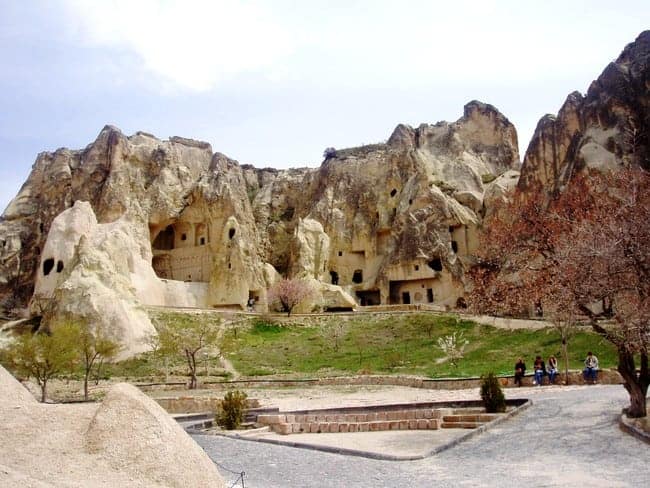
When the western part of the Roman Empire collapsed the eastern portion thrived and in time became the Byzantine Empire which extended eastward from Constantinople into Asia Minor. In a region known as Cappadocia, Greek-speaking Orthodox Christians often required protection from invaders and found it in rock formations created by volcanic eruptions. By carving into the soft rock, Christians created spaces that gave them shelter from the elements and made invasions by outside forces difficult.
In this setting, a monastic compound known as the “Dark Church,” was carved and its interior walls and ceilings were covered with frescos. Among the paintings is The Transfiguration. In it, Moses and Elijah are with Jesus in an event interpreted as a revelation that Christ is the fulfillment of the law and prophets. Moses represents the law and in paintings he often is shown holding the Torah or a stone tablet. Elijah represents the prophets. In this fresco, neither Moses nor Elijah has been given an identifying symbol but we can assume the gray-haired bearded man on the right is Moses and the un-bearded figure on the left is Elijah.
Mt. Tabor is the traditional site of the transfiguration but other places have been proposed. One of the sites that have been suggested is Mt. Hermon which has three distinct peaks. Often in paintings of the transfiguration, as in this painting from the Dark Church, three peaks are shown. In this painting,, Christ is standing on the center peak. Moses is standing on the right peak and Elijah is on the left. Below them are the disciples kneeling and crouching. At the bottom left is Peter with white hair and a beard. He is pointing upward toward Christ. The disciple John is depicted in the center as a beardless youth (his face is partially obscured by damage) and James is to the right with brown hair and a beard. Linear rays indicate there is a direct connection between Jesus and each of the disciples.
Note: The “Dark Church” is so named because it has only a small opening (oculus) for light, thus the interior is dim.
Dark Church is at the left side of photo.
Among the various people of ancient Cappadocia were the Armenians who were known then as being horse breeders. “Cappadocia,” the historic name for this region is believed to have been derived from “Kapatuka,” an Old Persian term meaning, “Land of beautiful horses.” The Crusaders referred to the region as Terra Hermeniorum: “Land of the Armenians.”
According to tradition, Byzas, a Greek colonist founded the ancient city, Byzantium, in BC 667. Later, Byzantium, along with eastward lands became part of the Roman Empire. In AD 330, when Constantine moved the capital of Rome to Byzantium, the city’s name was changed to Constantinople. After the city was conquered by the Ottoman Turks in 1453, its name was changed to Istambol (Turkish: “City of Islam”), and in 1930 it was changed again and is now, Istanbul.
Some people seem to think this is divine retribution for the sins of humanity: Kirk Cameron, former child actor, said in a video on Facebook that Hurricane Harvey and Irma were “a spectacular display of God’s immense power” and were sent so human beings could repent. Earlier, after seeing the devastation of Hurricane Harvey, conservative Christian pastor John McTernan had noted that “God is systematically destroying America” out of anger over “the homosexual agenda.”
Others disagreed over the reasons for God’s anger, but not necessarily with the assumption that God can be wrathful. Jennifer Lawrence suggested that Irma was “mother nature’s rage and wrath” at America for electing Donald Trump.
It is true that many religious traditions, including Judaism and Christianity, have seen natural disasters as divine punishment. But, as a scholar of religion, I would argue that things aren’t that simple.
The Genesis flood
Some of the earliest narratives of divine retribution go back to 2000 B.C. The Sumerian Epic of Gilgamesh tells the story of a catastrophic flood.
The gods decide to bring rain down to end the “uproar” of humankind. But the god of the waters, Enki, warns the righteous man, Utnapishtim, about the impending disaster.
Utnapishtim saves himself and his family by constructing a boat.
Elements of this story are later echoed in the Hebrew Bible’s Book of Genesis. God is angry because the Earth is filled with violence caused by human beings and vows to “destroy both them and the Earth.”
Noah is a “blameless” man, and God tells him to build an ark that would be large enough to hold his family and “two of all living creatures.” Although humanity perishes in a deluge, Noah preserves life on Earth.
It might seem straightforward to say that natural disasters in the Bible are associated with God’s anger, but that means missing the complexity of the text.
“Never again will I destroy all living creatures.”
This promise not to destroy humankind is also referred to in the Book of Isaiah, the Israelite prophet and seer. In a vision, God says that just as he vowed to Noah that water “would never again cover the Earth,” so too he promises not “to be angry.”
Biblical approaches to suffering
The question of God’s anger is intimately connected to the problem of human suffering. After all, how can a loving God cause indiscriminate human misery?
We first need to look at how suffering is portrayed in the texts. For example, it is also in the Book of Isaiah that we find the story of the “Man of Sorrows” – a man who takes on the sufferings of others and is an image of piety.
While the Bible does speak of humans suffering because of their sins, some of the most moving passages speak about how innocent people suffer as well.
The Hebrew Bible recognizes that people suffer often through no fault of their own. Most famously, Psalm 42 is an extended lament about suffering that nonetheless concludes by praising God.
The Hebrew Bible’s views on suffering cannot be encapsulated by a single message. Sometimes suffering is caused by God, sometimes by Satan and sometimes by other human beings. But sometimes the purpose behind suffering remains hidden.
The Christian tradition also provides diverse answers to the issue of suffering.
The New Testament does refer to the Genesis flood when talking about God punishing human beings. For example, Paul the Apostle observes that God brought the flood on “the ungodly” people of the world. Earthquakes are also mentioned as signs of the end of time in the Bible’s Book of Revelation.
But the Epistle of James, a letter in the New Testament often attributed to Jesus’ brother or stepbrother, says that God tests no one. In fact, those who endure trials are eventually rewarded. The early Christian philosopher Origen argued that through suffering we can understand our own weaknesses and dependence on God.
In these views, suffering is not punishment but something that draws human beings to closer God and to one another.
Believing that hurricanes, floods, and earthquakes are “God’s punishment” reduces the divine to human terms.
God is merciful
Some theologians totally reject the idea of suffering as divine retribution because such an act would be unworthy of a merciful God. From a Christian perspective, God also suffered by being crucified on the cross as Jesus Christ.
And so, as a Roman Catholic scholar, I would argue that God suffers with people in Texas and Florida – as well as with those in India,Nepal, Bangladesh, parts of Africa and Mexico.
“God heals the sicknesses and the griefs by making the sicknesses and the griefs his suffering and his grief.”
So, instead of dwelling on God’s wrath, we need to understand God’s kindness and mercy. And that, in times of crises and distress, it is kindness and mercy that require us to reach out to those who need comfort and assistance.
This is an updated version of a piece originally published on Sept. 6, 2017.
The earliest Latin commentary on the Gospels, lost for more than 1,500 years, has been rediscovered and made available in English for the first time. The extraordinary find, a work written by a bishop in northern Italy, Fortunatianus of Aquileia, dates back to the middle of the fourth century.
The earliest Latin commentary on the Gospels, lost for more than 1,500 years, has been rediscovered and made available in English for the first time. The extraordinary find, a work written by a bishop in northern Italy, Fortunatianus of Aquileia, dates back to the middle of the fourth century.
The biblical text of the manuscript is of particular significance, as it predates the standard Latin version known as the Vulgate and provides new evidence about the earliest form of the Gospels in Latin.
Despite references to this commentary in other ancient works, no copy was known to survive until Dr Lukas Dorfbauer, a researcher from the University of Salzburg, identified Fortunatianus’ text in an anonymous manuscript copied around the year 800 and held in Cologne Cathedral Library. The manuscripts of Cologne Cathedral Library were made available online in 2002.
Scholars had previously been interested in this ninth-century manuscript as the sole witness to a short letter which claimed to be from the Jewish high priest Annas to the Roman philosopher Seneca. They had dismissed the 100-page anonymous Gospel commentary as one of numerous similar works composed in the court of Charlemagne. But when he visited the library in 2012, Dorfbauer, a specialist in such writings, could see that the commentary was much older than the manuscript itself.
In fact, it was none other than the earliest Latin commentary on the Gospels.
Pearls of wisdom
In his De Viris Illustribus (Lives of Famous Men), written at the end of the fourth century, Saint Jerome, who was also responsible for the revision of the Gospels and the translation of the Hebrew Scriptures known as the Vulgate, included an entry for Fortunatianus – who had been bishop of the northern Italian diocese of Aquileia some 50 years earlier. This prominent cleric had written a Gospel commentary including a series of chapter titles, which Jerome described as “a pearl without price” and had consulted when writing his own commentary on the Gospel of Matthew.
Later Christian authors, such as Rabanus Maurus and Claudius of Turin, searched for it in vain. As with so many works from antiquity, it seemed to have been lost, the remaining copies destroyed in a Vandal raid or eaten by mice in a dusty library.
Among the features which attracted Dorfbauer’s attention was a long list of 160 chapter titles detailing the contents of the commentary, which corresponded to Jerome’s description of Fortunatianus’ work. In addition, the biblical text of the Cologne manuscript did not match the standard version of the Gospels produced by Jerome, but seemed to come from an earlier stage in the history of the Latin bible.
Groundbreaking discovery
This was where the University of Birmingham came in. The university’s Institute for Textual Scholarship and Electronic Editing (ITSEE) is home to long-term projects working on new editions of the Bible in Greek and Latin. As a specialist in the Latin New Testament, I was able to compare the biblical quotations in the Cologne manuscript with our extensive databases. Parallels with texts circulating in northern Italy in the middle of the 4th century offered a perfect fit with the context of Fortunatianus.
Astonishingly, despite being copied four centuries after the last reference to his Gospel commentary, this manuscript seemed to preserve the original form of Fortunatianus’ groundbreaking work.
Such a discovery is of considerable significance to our understanding of the development of Latin biblical interpretation, which went on to play such an important part in the development of Western thought and literature. In this substantial commentary, Fortunatianus is reliant on even earlier writings which formed the link between Greek and Latin Christianity.
This sheds new light on the way the Gospels were read and understood in the early Church, in particular the reading of the text known as “allegorical exegesis” in which elements in the stories are interpreted as symbols. So, for example, when Jesus climbs into a boat on the Sea of Galilee, Fortunatianus explains that the sea which is sometimes rough and dangerous stands for the world, while the boat corresponds to the Church in which Jesus is present and carries people to safety.
There are also moments of insight into the lives of fourth-century Italian Christians, as when the bishop uses a walnut as an image of the four Gospels or holds up a Roman coin as a symbol of the Trinity.
English translation
In the form of a single (no longer anonymous) manuscript, or even a scholarly edition of the Latin text, it will still be some time before this work becomes as widely known as the famous writings of later Christian teachers such as Ambrose, Augustine and Jerome.
For that reason, I have worked closely with Dr Dorfbauer to prepare an English translation of his full Latin edition of the commentary, the first ever to be produced.
This will enable a much wider audience to take account of this rediscovered work. In fact, this English version may be the form in which most people will encounter Fortunatianus’ commentary – as studying languages is now a much smaller component in theological study and online translation tools are beginning to produce more satisfactory results.
But for the fullest appreciation of this work, it will still be necessary to put alternatives to one side and consult the original – which is how the commentary was rediscovered in the first place.
About the Author: (Hugh Houghton) Reader in New Testament Textual Scholarship; Deputy Director, Institute for Textual Scholarship and Electronic Editing, University of Birmingham.
Sharing the news from our neighbor, St. Margaret’s Episcopal Church in Palm Desert, CA
Rabbis David Lazar of Temple Isaiah in Palm Springs and Richard Zionts of the Har-El Institute for Study and Worship in the Reform Tradition joined us for worship Sunday Morning, August 20 to celebrate a Morning of Unity and Justice at St. Margaret’s. The day offered a celebration of our unity and God’s grace in […]
Matthew 13:1-9. Pause. Look. Listen. Let the parable take you where it will.
As the Sunday Morning Forum at St. Margaret’s Episcopal Church prepares to meet, Hovak Najarian and Kathleen Kelly shared observations, poetry, and questions to lead into the Gospel parable (Matthew 13:1-9, 18-23) and to inspire your learning.
From Hovak:
Sunday’s Gospel gives us the parable of the sower and Jean Francois Millet’s painting,The Sower, came to mind immediately. This popular painting has been reproduced many times and it is likely you are familiar with it. [it is available on T-shirts.] There is a great deal that could be written about Millet’s Sower, but the focus of Christ’s parable was on what happens when seeds fall onto various surfaces … the message is not about the sower himself.
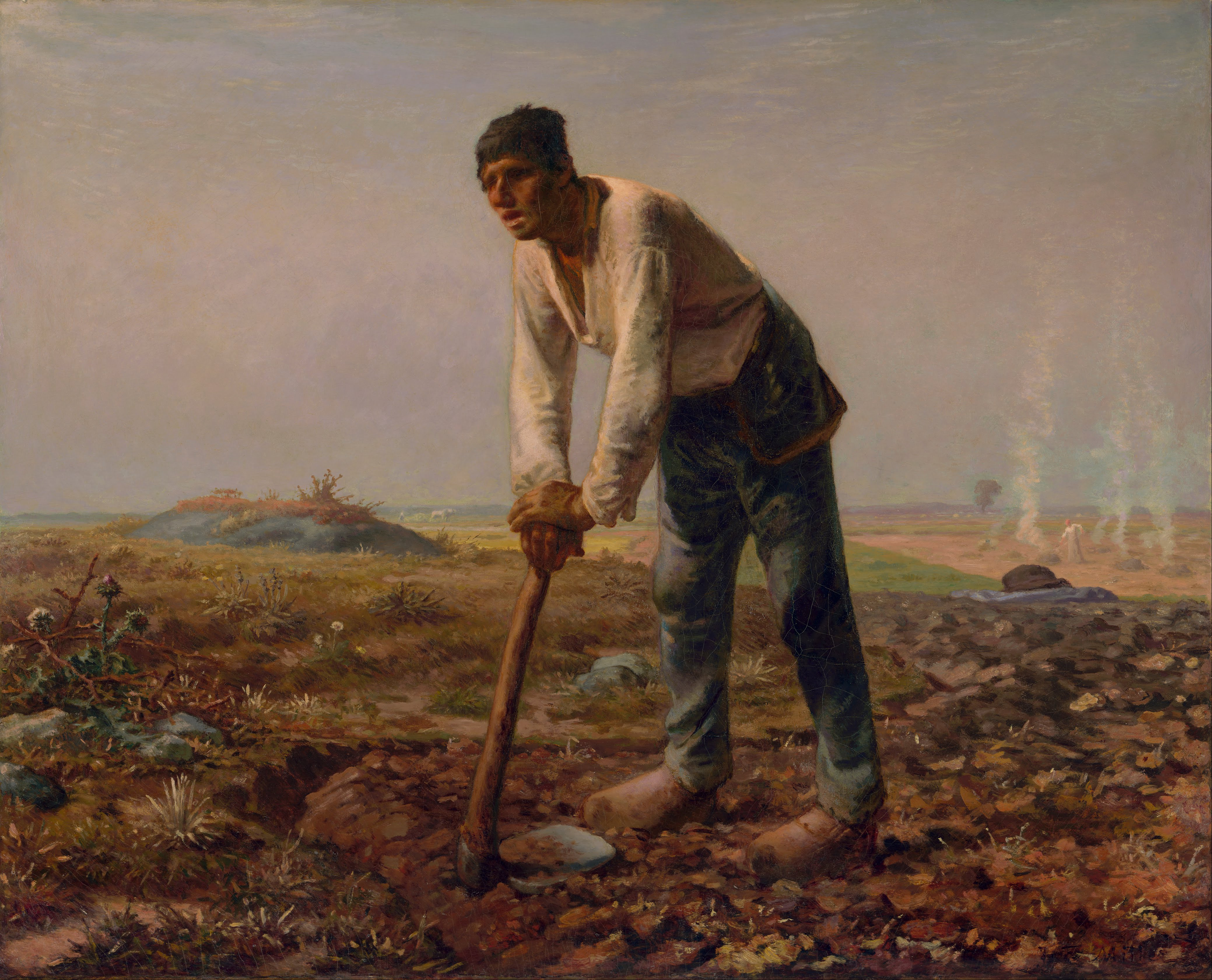
From, The Sower, my mind shifted to Millet’s, The Man With The Hoe, and a poem by Edwin Markham. Instead of writing a commentary this week, I would like to share this painting and poem with you. It is not related to either of the readings for Sunday but the painting is worth seeing and the poem worth reading.
From Kathleen:
In one sense, it could be said that the parable IS about the sower — a farmer who is willing to “squander” seed by tossing it in all directions (without regard for the conditions) as though there is no limit to the abundance of this resource.
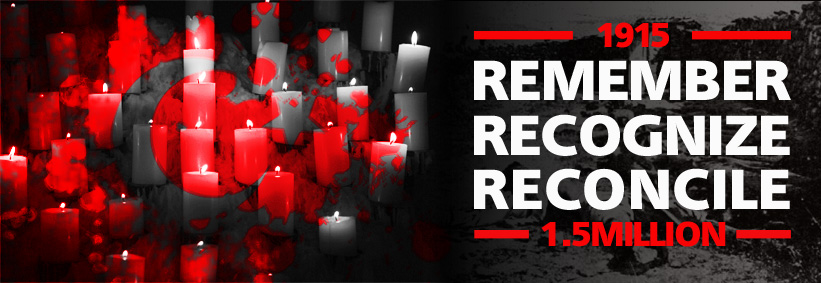
Remembering. Then acting to build a more just future for all.
This day [April 24] is set aside in the calendar of the church to hold in remembrance those who have died and those whose lives have been severely damaged as a result of acts of genocide: the systematic and intentional destruction of a people by death, by the imposition of severe mental or physical abuse, by the forced displacement of children, or by other atrocities designed to destroy the lives and human dignity of large groups of people.
This day is chosen for the commemoration because the international community recognizes April 24 as a day of remembrance for the Armenian Genocide, the systematic annihilation of the Armenian people during and just after World War I. On April 24, 1915, more than 250 Armenian notables—civic and political leaders, teachers, writers, and members of the clergy—were rounded up, imprisoned, tortured, and killed. Before the cessation of conflict, it is estimated that as many as one-and-a-half million Armenians perished,… Read more from the Episcopal Church website
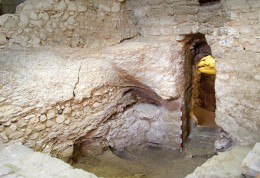
The childhood home of Jesus may have been found underneath the Sisters of Nazareth Convent in Nazareth, Israel, according to archaeologist Ken Dark.
The excavation site located beneath the convent has been known since 1880, but it was never professionally excavated until the Nazareth Archaeological Project began its work in 2006. In “Has Jesus’ Nazareth House Been Found?” in the March/April 2015 issue of BAR, Ken Dark, the director of the Nazareth Archaeological Project, not only describes the remains of the home itself, but explores the evidence that suggests that this is the place where Jesus spent his formative years—or at least the place regarded in the Byzantine period as the childhood home of Jesus.
The excavation revealed a first-century “courtyard house” that was partially hewn from naturally occurring rock and partially constructed with rock-built walls. Many of the home’s original features are still intact, including doors and windows. Also found at the site were tombs, a cistern and, later, a Byzantine church.
The remains combined with the description found in the seventh-century pilgrim account De Locus Sanctis point to the courtyard house found beneath the convent as what may have been regarded as Jesus’ home in Nazareth. Archaeological and geographical evidence from the Church of the Annunciation, the International Marion Center and Mary’s Well come together to suggest that this location may be where Jesus transitioned from boy to man.
Ken Dark also discusses the relationship between the childhood home of Jesus, Nazareth and the important site of Sepphoris. It has been thought that Sepphoris would have provided Joseph with work and Jesus many important cultural experiences. However, Ken Dark believes that Nazareth was a larger town than traditionally understood and was particularly Jewish in its identity—as opposed to the Roman-influenced Sepphoris. This is partially based on the result of his survey of the Nahal Zippori region that separates Sepphoris and Nazareth geographically.
For more on the childhood home of Jesus, read the full article “Has Jesus’ Nazareth House Been Found?” by Ken Dark in the March/April 2015 issue of Biblical Archaeology Review.
Image: Bible History Daily. Description: “This very well could be the childhood home of Jesus. It doesn’t look inviting, but this rock-hewn courtyard house was quite likely Jesus’ home in Nazareth. The recent excavation by Ken Dark and the Nazareth Archaeological Project revealed evidence suggesting this is where Jesus was raised—or at the least the place venerated as such by the Byzantine period. Photo: Ken Dark.”
The year was 166 C.E., and the Roman Empire was at the zenith of its power. The triumphant Roman legions, under the command of Emperor Lucius Verrus, returned to Rome victorious after having defeated their Parthian enemies on the eastern border of the Roman Empire. As they marched west toward Rome, they carried with them more than the spoils of plundered Parthian temples; they also carried an epidemic that would ravage the Roman Empire over the course of the next two decades, an event that would inexorably alter the landscape of the Roman world. The Antonine Plague, as it came to be known, would reach every corner of the empire and is what most likely claimed the life of Lucius Verrus himself in 169—and possibly that of his co-emperor Marcus Aurelius in 180. Read the entire post on Bible History Daily
“The Day of the Dead” William-Adolphe Bouguereau [Public domain], via Wikimedia CommonsIn this article from The Conversation, author Timothy Beal comments on our contemporary American scene while hearing, and calling attention to, the Spirit in the prophets of the Hebrew scriptures. As the title suggests the scriptures point to healing following grieving. ~Fr. Dan
For many women, people of color, LGBTQ people, Muslims and immigrants, the victory of Donald Trump seems to have endorsed discrimination against them. Acts of hatred against minorities are surfacing even more brazenly.
College campuses are reporting increasing numbers of incidents of election-related harassment and intimidation. Three days after the election, I saw a “Black Lives Matter” banner on a church wall in Denver splattered with bright red paint.
Many of us feel tremendous grief over what appears to be the end of a certain idea of American democracy. Amidst such pain and loss, many are also desperate for healing. Politicians on all sides are declaring, as Trump himself did on Nov. 9, that “it is time for America to bind the wounds of division.”
The desire to begin healing is certainly understandable. But before we can even begin to hope for healing, we need to grieve. As a scholar and teacher, I explore the many fascinating ways in which biblical images, words and even the idea of the Bible help people make meaning in their lives.
To be sure, there is a lot in the Bible about healing. But there is at least as much about grieving. The biblical tradition emphasizes the importance of grieving before moving toward healing.
To grieve is to embrace the reality of pain and loss.
The wounds are real
For many, following the elections, faith in the idea of American democracy has died. Cultural historian Neil Gabler’s “Farewell, America,” published two days after the election, expresses powerfully this sense of the end of faith in America:
“America died on Nov. 8, 2016, not with a bang or a whimper, but at its own hand via electoral suicide…Whatever place we now live in is not the same place it was on Nov. 7. No matter how the rest of the world looked at us on Nov. 7, they will now look at us differently.”
Indeed, irrespective of who got elected, the presidential race itself exposed mortal wounds on our body politic. We are not who we thought we were.
As the way to healing, pastors and religious leaders, including Anne Graham Lotz, daughter of evangelists Billy and Ruth Graham, are calling for prayer and repentance:
“When God’s people will pray with a humble heart, repenting of our sins, then God promises He will hear our prayer; He will forgive our sin and the third element is that He will heal our land.”
What do our traditions tell us?
Healing is not possible without grieving. The biblical tradition offers an invitation to sit with sadness before reaching for hope and healing. It does not simply allow for grief – it privileges it.
It dwells uncomfortably long in the valleys of loss and despair, refusing to ascend too quickly onto horizons of hope.
The Hebrew Scriptures, in fact, possess a rich vocabulary of grief. Behind the words “grief” and “grieve,” as I found in my research, there are 13 different Hebrew words with connotations ranging from physical injury, to sickness, to mourning, to rage, to agitation, to sighing, to tottering unsteadily to and fro. The most common expressions involve a mix of emotional and physical pain in the face of loss.
Angel of Grief monument in the Hill family plot in Glenwood Cemetery in Houston, Texas. Mike Schaffner, CC BY-NC-ND
This privileging of grief over and before any hope of healing is powerfully expressed in the words of the Hebrew biblical prophets. As theologian Walter Brueggemann shows in his book “Reality, Grief, Hope,” the biblical prophets were not, as we often assume, predictors of the future.
Rather they were poets who, like poets today, offered alternative ways of seeing things – that is, to the way the empire (in their case ancient Israel or Judah) wanted people to see things. The prophet confronted ancient Israel’s imperial ideology of special blessing and national exceptionalism with the realities of exploitation and violence upon which its prosperity was gotten.
Addressing an audience that was in total denial that there were any serious problems in their society, the prophet gave voice to the realities of injustice, and grieved the pain and loss that was the result. They confronted the people’s denial with grief.
The prophetic imagination
Consider these words from the prophet Amos, who addressed the prosperous of northern Israel during the eighth century B.C.:
   Alas for those who are at ease in Zion,
   and for those who feel secure on Mount Samaria,
   the notables of the first of the nations ...
   Alas for those who lie on beds of ivory,
   and lounge on their couches ...
   but are not grieved over the ruin of Joseph!
   Therefore they shall now be the first to go into exile,
   and the revelry of the loungers shall pass away.
Simultaneously pronouncing judgment for their exploitation of the poor and grief over their imminent downfall, the prophet cries out in horror for those who recline in denial of their ill-gotten prosperity and “are not grieved” (from the Hebrew word “chalah,” “made sick”) at the ruin all around.
Though they are guilty, Amos nonetheless laments that they “shall now be the first to go into exile” as a result. The prophet pronounces judgment from the inside, inviting “us” to look at ourselves, to stare at the wounds, to live into the pain, not as a path to healing but as reality in and of itself.
The crux of this “prophetic imagination” is grief. Then, and only then, is it even possible for the prophet to confront the despair of the empire in ruins with hope for the possibility of healing and restoration.
Grief as activism
I am sympathetic with those who feel driven to do something, indeed to resist despair and renew the struggle for justice. As the black feminist lawyer Florynce Kennedy famously said,
“Don’t agonize. Organize.”
A ‘Black Lives Matter’ banner on a church wall in Denver splattered with bright red paint. Timothy Beal, CC BY
But what if grief is a kind of activism? What if one of the most subversive acts right now is to give voice to our grief? To refuse to “move on”? Such grief denies denial its power to look away in desperate pursuit of healing. Just as there is no peace without justice, there is no healing without grief.
The day of Donald Trump’s election was also the anniversary of both Kristallnacht – the pogrom in 1938, when Nazi soldiers and German citizens attacked and killed many Jews and destroyed Jewish businesses, schools, and hospitals – and the fall of the Berlin Wall in 1989.
This coincidence reminds us that we together have the capacity for both atrocious horror and miraculous liberation. Even now. The difference may lie as much in how we grieve as in how we heal.
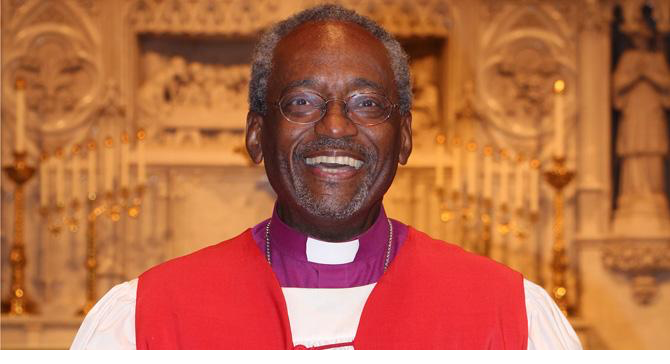
The following is a statement from Presiding Bishop and Primate Michael B. Curry via the Public Affairs Office of the Episcopal Church
This past week, Barack H. Obama, the 44th President of the United States, in the tradition of Presidents dating back to George Washington, gave his farewell address to the nation. Next week Donald J. Trump, in the same tradition of this country, will take the oath of office and be inaugurated as the 45th President.
We recognize that this election has been contentious, and the Episcopal Church, like our nation, has expressed a diversity of views, some of which have been born in deep pain.
There has been much discussion, and some controversy, about the appropriateness of the Washington National Cathedral hosting the Inaugural Prayer Service this year, and of church choirs singing at inaugural events.
Underneath the variety of questions and concerns are some basic Christian questions about prayer: when I pray for our leaders, why am I doing so? Should I pray for a leader I disagree with? When I pray what do I think I am accomplishing?
On one level these questions seem inconsequential and innocuous. But real prayer is not innocuous. It is powerful. That question can become poignant and even painful as it is for many in this moment, given that some of the values that many of us heard expressed over the past year have seemed to be in contradiction to deeply-held Christian convictions of love, compassion, and human dignity.





 This is an updated version of a piece originally published on Sept. 6, 2017.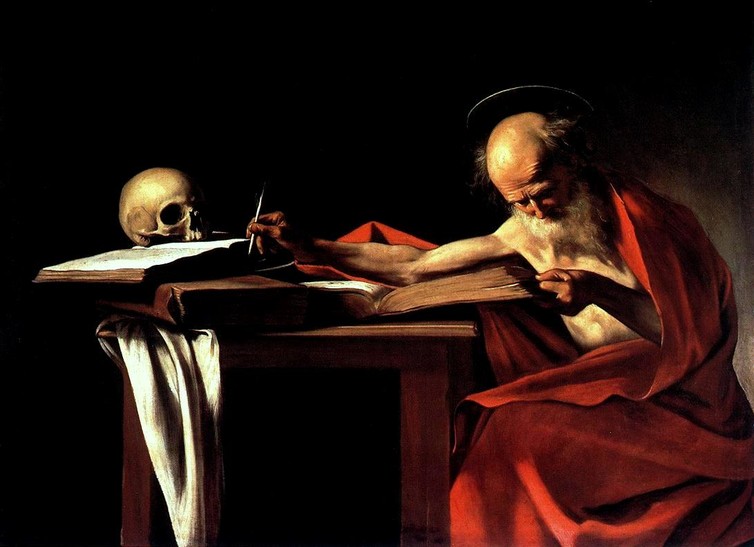



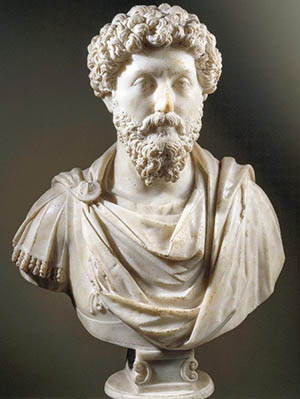
 The year was 166 C.E., and the Roman Empire was at the zenith of its power. The triumphant Roman legions, under the command of Emperor Lucius Verrus, returned to Rome victorious after having defeated their Parthian enemies on the eastern border of the Roman Empire. As they marched west toward Rome, they carried with them more than the spoils of plundered Parthian temples; they also carried an epidemic that would ravage the Roman Empire over the course of the next two decades, an event that would inexorably alter the landscape of the Roman world. The Antonine Plague, as it came to be known, would reach every corner of the empire and is what most likely claimed the life of Lucius Verrus himself in 169—and possibly that of his co-emperor Marcus Aurelius in 180.


 Hear what the Spirit is saying
