The Banquet of Esther and Ahasuerus, c. 1640, Oil on Canvas, Jan Victors 1619-1676

Commentary by Hovak Najarian

Related post B Proper 21 Art for September 30, 2012

The principal participants in Dutch artist Jan Victors’ The Banquet of Esther and Ahasuerus are:

Ahasuerus (seated on the right): King of a vast Persian Empire that extended from India to Ethiopia and included people of many nationalities.
Esther (standing): A beautiful young Jewish woman who was chosen to be Ahasuerus’ queen after his former queen, Vashti, defied him. Esther did not reveal she was Jewish until the dinner that is illustrated in Victors’ painting.
Haman (seated at the left): An official who was promoted by King Ahasuerus to be above all other princes. People were to bow to him.

Not in the painting but an important part of the story is:

Mordecai: The nephew of Esther’s father. When Esther’s parents both died, Mordecai adopted Esther and raised her as his own child.

When Esther was chosen to be queen, Mordecai remained protective of her and stayed near the gates of the palace to be aware of what was taking place. He would not bow or grovel at the sight of the egotistical and self-important Haman. This angered Haman to the extent that he devised a plan to hang Mordecai and to kill all other Jews in the kingdom as well. King Ahasuerus was not aware of Haman’s plan but Mordecai learned about it and sent word to Esther. In response, Esther set up her own plan. She organized a banquet at which Haman would be seated with Ahasuerus. The king loved Esther and offered earlier to grant anything she requested even half his kingdom.

In Victors’ painting, Esther has just revealed that she is Jewish and told Ahasuerus about Haman’s plan. She requested that her people be saved. The surprised king raised his scepter in anger. He arranged immediately to have Haman hanged along with his ten sons on the same gallows that was built to hang Mordecai. Further, a decree was given to allow Jews to kill anyone who would rise up against them. Today, the holiday Purim continues to commemorate the deliverance of the Jewish people from Haman’s plot.

Note

In lighting, clothing, and biblical subject matter, Jan Victors’ painting is influenced by Rembrandt’s style. Victors name is listed among Rembrandt’s pupils but the word “pupil” is often used loosely so this is not a certainty. Among Dutch artists of the seventeenth century, the imagery found in the Book of Esther was a favorite source of subject matter and a version of “Esther’s Banquet” also was painted by Rembrandt.

King Ahasuerus is believed to have been King Xerxes. Susa, where Ahasuerus’ palace was located, is in western Iran, about 150 miles east of the Tigris River. It is known today as the city of Shush (Shoosh).

The decision to include the Book of Esther in the Bible has been a source of debate. Martin Luther, who disagreed with the inclusion of several books, including Esther, took an extreme position and stated: “I am such an enemy to the book of Esther that I wish it did not exist…”

______________

© 2012 Hovak Najarian
Wind Chimes: 25 Sep 2012

[Jesus said], “The wind blows where it chooses, and you hear the sound of it, but you do not know where it comes from or where it goes. So it is with everyone who is born of the Spirit.”

John 3:8 NRSV [1]

Introducing Wind Chimes.

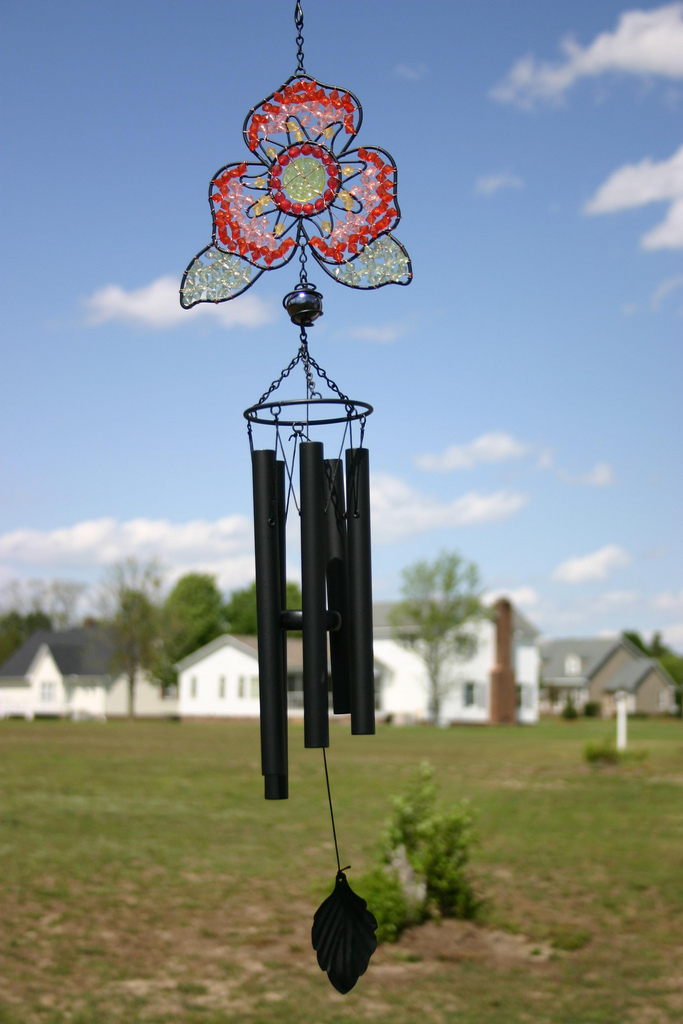
A wind chime and sun catcher in North Carolina
Photo by jscalia (click the photo to see more)

When a wind chime catches the wind (even the whisper of a wind) it makes music, it interprets the wind in ways that are always the same and always changing. In regular posts I will share links to news (religion news), reflections and meditations (related to our Sunday readings as often as possible), prayers or prayer starters, resources to help you keep learning and growing (spiritually), and whatever else I come across.

More importantly: I want to incorporate links to items you find interesting as you read, listen, or consider doing the work God has given you to do. You may use the Comments section to leave the link or you may email the link to me for inclusion in Wind Chimes.

Here is the first sampling of the music made by the Spirit. What do you hear?

Room Enough, A Place for Everyone — a sermon based on Mark 9:30-37

“Who is the greatest?” Behind this question is a deeper issue. It is a question of space and place. Is there a place for me in this family? In this church? In this business? Is there a place for my religion, my politics, my race, my lifestyle in this society and culture? Is there a place for my people, tradition, and history in this land? Is their room for me? [Read Room Enough]

3 Quotes. Jesus. Children. Fleas.

Then ]Jesus] took a little child and put it among them; and taking it in his arms, he said to them, “Whoever welcomes one such child in my name welcomes me, and whoever welcomes me welcomes not me but the one who sent me.” Mark 9:30-37 NRSV

The test of the morality of a society is what it does for its children. —Dietrich Bonhoeffer [2] 1906-1945

You just need to be a flea against injustice. Enough committed fleas biting strategically can make even the biggest dog uncomfortable and transform even the biggest nation. —Marian Wright Edelman [3] b. 1939

A Commentary on James 3:13-4:3, 7-8a by Professor Sandra Hack Polaski

After several chapters of warnings and vivid illustrations of the consequences of living contrary to the plan of God, James moves in this passage to describe the good life and give some positive guidance for pursuing it. [Read Professor Polaski’s Commentary on WorkingPreacher.org for 9/23/12]

________________________
[1] Here is how the Common English Bible (CEB) translates John 3:8 — [Jesus said], “God’s Spirit blows wherever it wishes. You hear its sound, but you don’t know where it comes from or where it is going. It’s the same with everyone who is born of the Spirit.” The footnote in both the NRSV and the CEB indicates that the Greek word at the beginning of the verse can be translated as either wind or spirit.

[2] Widely quoted on the internet and attributed to Bonhoeffer, but I have been unable to find the original source. If you know the original source of this quote would you let me/us know using the comments section? Thank you.

[3] Widely quoted on the internet and attributed to Marian Wright Edelman, but I have been unable to find the original source. If you know the original source of this quote would you let me/us know using the comments section? Thank you.

A reminder to light up the world

An unlit candle
A candle waiting to be lit by you

This is a monthly reminder to join me (and 13,000+ others) in lighting a candle in cyberspace. There are many reasons folks light candles. Every day I light candles of thanksgiving and intercession (as many as 20 a day, as few as 2 a day). Follow this link to find out more: Let’s light up the world

B Proper 20 Art for September 23, 2012

REMBRANDT Harmenszoon van Rijn
(b. 1606, Leiden, d. 1669, Amsterdam)
Click to open Web Gallery of Art Artist Biography and to explore other works by this artist.

The Little Children Being Brought to Jesus (“The 100 Guilder Print”)
1647-49
Etching and drypoint, 1st state, 278 x 388 mm
Rijksmuseum, Amsterdam
Click to open Web Gallery of Art commentary page. Click image for large view.

Related art commentary by Hovak Najarian.

Little Children Being Brought to Jesus (The Hundred Guilder Print), c. 1647-1649, Etching, Rembrandt Harmenzoon van Rijn, 1606 -1669

Commentary by Hovak Najarian

Related post B Proper 20 Art for September 23, 2012

In the Hundred Guilder Print, Rembrandt has combined several subjects taken from the nineteenth chapter of Mathew into a composite image. As a result it is known by several titles. Among them are: Little Children Being Brought to Jesus, Christ Healing the Sick, and Christ Preaching. In Rembrandt’s lifetime it was known famously as the “Hundred Guilder Print” and it continues to be known by that title today. As a masterpiece, it was first sold for a hundred guilder; a very high price at the time.

Mathew’s account tells of Jesus departing Galilee and going to Judea where multitudes followed him; many were healed. While he was there, Pharisees came and he answered their questions. When mothers brought their children to him to be blessed, the disciples rebuked them but Jesus said: “Let the children come to me, and do not hinder them; for to such belongs the kingdom of heaven.” A young rich man asked Jesus what he must do to enter heaven and was told to first give all of his possessions to the poor and then, “follow me.” Jesus noted it was easier for a camel to go through the eye of a needle than for a rich man to enter the kingdom of heaven. References to all of these subjects were combined in Rembrandt’s print.

In the center of this etching, Jesus is standing as he speaks to the crowd that surrounds him. At the far upper left a group of Pharisees are debating among themselves and to the right, the old and sick are trying to get closer to Jesus; one of them was brought in on a wheelbarrow. Others are coming in from the right as Peter (behind the pleading woman whose shadow is cast on Jesus’ robe) stretches out his arm to indicate there are too many people in the crowded space already. The rich man has returned to his camel (in the doorway); he is leaving because he cannot give up his possessions. In the central area are a variety of people of humble origins and differing needs. A woman with a child in her arms approaches Jesus (her foot is on the raised area on which Jesus is standing). Another woman (lower left) is holding her child’s hand as he reaches toward Jesus. The child’s dog is nearby. In this etching, Rembrandt demonstrates his remarkable ability to integrate and balance diverse subjects and to unify them in a single composition; the print is a superb example of his genius.

Note

Etching: An etching is made from a copper or zinc plate that has been covered with liquid asphaltum (an acid resistant ground). The artist draws an image on the plate with a scriber but scratches only through the asphaltum surface to expose the plate. The prepared plate is placed in an acid solution that eats into it and creates fine shallow grooves in the areas that have been exposed. The asphaltum then is removed, ink is pressed into the grooves, and the surface of the plate is wiped clean. A slightly moistened paper is placed over it and it is run through a press. The pressure pushes the paper against the ink and, as the paper is pulled away from the plate, it lifts the ink out of the grooves and reveals the image (in reverse).

Intaglio (Italian, from intagliare – to engrave): This term is used for a family of prints in which the ink is held in grooves beneath the surface of a plate. In an etching, acid is used to create the grooves. When making an engraving, the artist removes the metal directly with a burin. When making a drypoint, the grooves are created by scratching with pressure into the surface of a plate (this makes a groove but leaves a burr). Etchings, engravings, and drypoints are all intaglios. Although the Hundred Guilder Print is primarily an etching, it was easier for Rembrandt to use drypoint and engraving techniques when touching up and refining some areas of the plate after it was etched.

______________

© 2012 Hovak Najarian

B Proper 19 Art for September 16 2012

WIT, Jacob de
(b. 1695, Amsterdam, d. 1754, Amsterdam)
Click to open Web Gallery of Art Artist Biography and to explore other works by this artist.

Allegory of Government: Wisdom Defeating Discord
1738
Oil on canvas, 51 x 39 cm
Metropolitan Museum of Art, New York
Click to open Web Gallery of Art commentary page. Click image for large view.

Related art commentary by Hovak Najarian.

Allegory of Government: Wisdom Defeating Discord, 1738, Fresco, Jacob de Wit (1695-1754)

Commentary by Hovak Najarian

Related post B Proper 19 Art for September 16 2012
In ancient Greece, the numerous gods that were created had varying attributes and personalities. Their activities explained elements of the physical world and provided reasons for things that were imagined. Among them was Athena, a goddess acclaimed for her wisdom. In addition, she was the goddess of war and a protector of cities (the city of Athens was named for her). Also, there were gods and goddesses that caused strife. Eris was a schemer and known to the Romans as “Discord.” In an infamous event she set up a conflict that led to the Trojan War. Starting in the fifteenth century, these gods and goddesses were again depicted in art; often their deeds were presented as allegories (a representation of an idea in visual form).

Dutch artist, Jacob de Wit’s fresco, Allegory of Government: Wisdom Defeating Discord, was painted on the ceiling of Aldermen’s Hall (a meeting hall for the city’s governing body) in The Hague. The painting is in the delicate Rococo style of the early eighteenth century but in subject matter it anticipates the use of art to promote moral values as seen later in neoclassicism. In de Wit’s allegory, the figures of Athena (Wisdom) and Eris (Discord) are depicted in a battle. Wisdom is wearing a helmet and holding a shield and spear as she drives away Discord, the bringer of strife. The fresco’s message is: Following the example of Athena, a responsible alderman should make wise judgments and be protective of the city.

In this ceiling fresco, action is taking place overhead in a mythical world. We are very aware that we are looking at a painting that simulates the effect of clouds and figures, yet de Wit creates an illusion that the ceiling isn’t there; as if we are looking directly into the sky. We tend to suspend reality and move from actual space – the space we are in – into a pictorial space that takes us into another realm. Our vantage point is from below this scene but several figures are viewing this battle from within the painting itself. Among them in the distance is Zeus who has arrived to observe the outcome.

Note

De Wit’s fresco of “Wisdom Defeating Discord” had to be removed because of its poor condition. Only photographs and a preparatory study now exist.

In our lives, the horizon is part of our consciousness and we seek balance or equilibrium in visual relationships. We are conscious, too, of the pull of gravity which creates a need for verticality and stability in upright forms. Because of this we are more comfortable with paintings that are rectangular in shape (and level on the wall). An oval carpet on the floor or an oval shaped painting on a ceiling, however, does not affect our sense of balance.

De Wit’s allegory is a call for wisdom in government. The following is an invitation to individuals:

“Wisdom has built her house, she has set up her seven pillars. She has slaughtered her beasts, she has mixed her wine, she has also set her table. She has sent her maids to call from the highest places in the town, ‘Whoever is simple, let him turn in here!’ To him who is without sense she says, ‘Come, eat of my bread and drink of the wine I have mixed. Leave simpleness, and live, and walk in the way of insight.’” (Proverbs 9:1-6)

______________

© 2012 Hovak Najarian

B Proper 18, Art for September 9, 2012

Rembrandt Harmensz. van Rijn
b. 1606 Leiden, The Netherlands, d. 1669 Amsterdam, The Netherlands
Click to open Getty Artist Biography and to explore other works by this artist.

Christ and the Canaanite Woman
Rembrandt Harmensz. van Rijn
Dutch, Amsterdam, about 1650
Pen and brown ink, brown wash, corrected with white bodycolor
7 7/8 x 11 in.
Click to open the Getty presentation page. There you may click image for large view or choose zoom for close inspection.

Related art commentary by Hovak Najarian.

Christ and the Canaanite Woman, c. 1650, Pen/Ink, Rembrandt van Rijn (1606-1669)

Commentary by Hovak Najarian

Related post B Proper 18, Art for September 9, 2012

Dutch artist, Rembrandt van Rijn, began his career in Amsterdam where a large merchant class appreciated art and had the means to support it. He gained early success but managing money was not a high priority with him and during the latter years of his life he struggled financially. He continued to work steadfastly, however, and produced art of the highest order.

The biblical setting for the drawing, Christ and the Canaanite Woman, is in the region of Tyre and Sidon; two ancient cities of Canaan on the Mediterranean Sea. When Christ was there he was approached by a woman of Syrophoenician origin (far left in the drawing) who begged him to heal her daughter. It was suggested by the disciples that she be turned away but Christ made it known that his ministry was for everyone and the woman was granted her request.

It is standard practice for composers to write sketches of musical themes and for writers to keep a file of ideas. In like manner, visual artists make sketches and use them as source material for their work. Christ and the Canaanite Woman was a drawing made to develop a composition and at this stage Rembrandt was not engaged in details. Arrangement of the figures and their interaction were his immediate concerns; he did not intend this sketch to be a finished piece. Instead, it was a study that was drawn rapidly and loosely in a method known as “gesture drawing.”

As is typical for “preparation drawings,” Rembrandt reworked the sketch and edited it; white pigment was used to cover areas in order to make changes. The drawing was likely a preliminary study for an etching but Rembrandt did not develop it further. It was not used for either an etching or a painting. The reason for not following through could be because Rembrandt had other work that took precedence or perhaps the composition was not resolved to his satisfaction.

Note

Canaan and Phoenicia: The ancient land of Canaan was known as “Phoenicia” to the Greeks. Both names mean the color “purple” which is in reference to the dye that was obtained from the gland of a mollusk – a murex – found there in the Mediterranean waters and harvested. The purple dye was so rare and costly that only the very wealthy could afford it; hence, purple became known as the color of royalty. The color purple’s association with royalty is one of the reasons it has been the traditional color for the church season of Advent. A trend in recent years has been instead to use the color blue for Advent and to use purple for the season of Lent.

Tyre and Sidon: These two cities are in modern day Lebanon and have been renamed: Tyre now is called, “Sour,” and Sidon is called, “Saida.”

Drawing Ink: Rembrandt’s brown ink was made from tannic acid, derived from oak gall, mixed with ferrous sulfate and water. Artists mixed their own inks and often there were differences from one batch to another. This has enabled analysts to examine some of Rembrandt’s drawings to determine which lines were drawn first and which were made later as he reworked a composition.
______________

© 2012 Hovak Najarian

B Proper 17, Art for September 2, 2012

Icon of James the Just
unknown artist
Click to open Wikipedia article on James the Just.

Click for Wikipedia article on The Epistle of James.

Related art commentary by Hovak Najarian.