
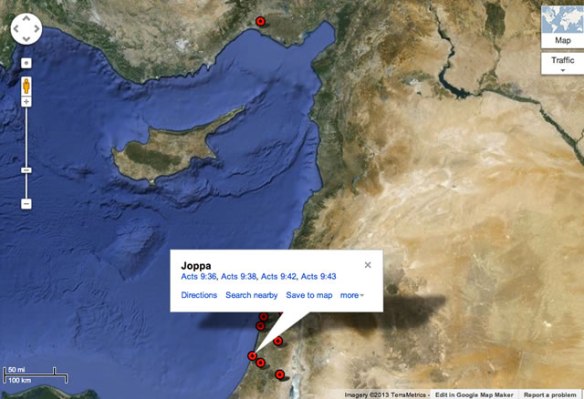
Where is Joppa? Well, we have an app for that.

Preview Map from Bible Geocoding for Acts 9On Sunday (4/21/13) we listened to a reading from Acts 9 (verses 36-43). In the reading we learned that Peter was in Lydda when he was summoned to Joppa. In Joppa he raised Tabitha (Dorcas) from the dead and restored her to the community.

Setting aside the discussion about the historical accuracy of this account (or of Acts in general) and setting aside the discussion of miracles (for now), a 21st century American studying this account may wonder where these two towns were/are located. Fortunately, we live in an age where we “have an app for that.”

In this case we have a website and an app to help us locate Lydda and Joppa (well, modern cities overlaying an ancient landscape really).

If you already have Google Earth try out Bible Geocoding. If you do not have Google Earth, no problem: click on “preview” when seeking to locate a place named in the Bible and you will get plenty of information. For example, here is the “preview” of all the places listed in Acts 9.

We (the authors and editors of this blog) are working to build a Resources Page for your use. Our goal is to have the page active by the end of April. If you have an internet resource you would like to share, please share it via the Comments section. Let us help each other.
The Lord is my shepherd

Here is a different ‘listen’ to a favorite Psalm. Dedicated to his mother, Bobby McFerrin takes poetic license in this setting of Psalm 23. Click the link to discover more: The Lord is my shepherd.

via The Lord is my shepherd.

Uncovering ancient imagery in 21st century English

The Lord is my shepherd

Psalm 23:1

“The Lord is my shepherd.” This line from Psalm 23 is among the most famous images from the Bible. But as I describe in And God Said, for most people the English words hide the ancient imagery.

So begins Joel M. Hoffman in his post, The Lord isn’t the Shepherd You Think (or: Don’t Mess with the Shepherds) on his blog God Didn’t Say That.

Hoffman, in imagining a 21st century “shepherd,” tells us he would cast Woody Allen to play the role in his imaginary movie. But he doesn’t let us stop there.

So even though the Hebrew in Psalm 23 is ro’eh, and even though ro’eh literally means “shepherd,” I don’t think “The Lord is my shepherd” is a very good translation.

He points us to the qualities of “shepherd” in the Hebrew Bible. Shepherds…

… have a surprising and surpassing ferocity about them

We see … in Jeremiah 49:19, where God is “like a lion” that can’t be stopped. Using increasingly powerful imagery, the text has God ask, “Who is like me? Who can summon me? Who is the shepherd who can stand before me?” (NRSV). In other words, God is so powerful that even a shepherd will be beaten back. In modern terms, again, the imagery is nonsensical. But in the Bible, shepherds were symbols of strength.

… are similar to royalty and nobility

King David was a shepherd. … in Micah 5:5, … shepherds are in parallel with rulers, a literary device that, in the Bible, suggests that they were similar. And in Nahum 3:18 we find shepherds in parallel with nobles.

… have “sex-appeal”

Finally, shepherds were symbols of romance. Song of Solomon, the most overtly sexual book of the Bible, is filled with images of shepherds. … The famous imagery in verse 2:16, “my lover is mine and I am his,” ends with two Hebrew words to describe the heroine’s lover. They translate as, “[the one] who is a shepherd among flowers.”

After this expansion of our wimpy 21st century understanding of “shepherd” Hoffman summarizes: “In short, for the ancient image of a shepherd, think John Wayne, not Woody Allen.”

I encourage you to read The Lord isn’t the Shepherd You Think. You may hear Psalm 23 with new ears, new hope, and new delight.

If you’re in the desert on 4/21/13 come join us in the Sunday Morning Forum at St. Margaret’s at 9:00 am. If not, let me/us know what you think about Joel’s post and linguistic analysis; leave a comment.

How does ‘the Way’ go for you?

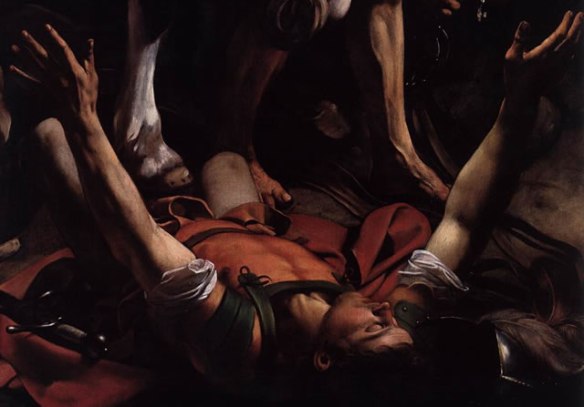
We talked about Saul’s conversion (Acts 9:1ff) on Sunday. As always, Forum members voiced a number of questions, expressed their wisdom learned by experience, and each of us left a little fuller and richer for the fellowship and conversation.

detail-conversion

Some random observations and questions from Sunday:

  • Though much of our art and poetry have God knocking Saul off his horse, the text makes no mention of horses
  • Saul is on his way to round up (and punish) any who “belonged to the Way” (v. 2) This is one of the earliest appellations used for those later called “Christian” (See also: Acts 18:23-26; Acts 19:23; Acts 24:14, 22)
  • The term “Christian” was first used in Antioch (c.40-44 CE) according to Acts:
    • 25 Then Barnabas went to Tarsus to look for Saul, 26 and when he had found him, he brought him to Antioch. So it was that for an entire year they met with the church and taught a great many people, and it was in Antioch that the disciples were first called “Christians.” Acts 11:25-26 NRSV
  • When one of our members suggested that there is often “conversion” (or recommitment in trust) as a response to trial, darkness, dryness, or the ‘Valley of the shadow of death,’ there were many nods and affirming comments.
  • Does conversion come best, deepest, profoundly, only through a ‘dark moment,’ a trial, a letting-go? A question for the week. A question for you.

Come back, as the week progresses we’ll work through some of the other comments from Sunday. Please continue the Sunday conversation by commenting here.

An Easter Blessing

An 'Easter' image from the John Muir Wilderness

The Lord who conquered darkness with light,
give peace to you.
The Lord who conquered death with life,
give peace to you.
The Lord who conquered loneliness with love,
give peace to you.

Divider

Blessing: David Adam, The Open Gate, p. 110

Image: An Easter moment in the John Muir Wilderness, ©Daniel Rondeau 2007

Wind Chimes: 11 Mar 2013

What do you hear in the chimes?A “Going-home” Prayer

Yesterday (3/10/13) was the Fourth Sunday in Lent (Year C). Jesus, that great storyteller, spoke through the centuries with his story of a man and his two sons. For many years it has been called the story of the Prodigal Son. Within my lifetime the story has also been called: The Story of the Prodigal Father, The Story of the Loving Father, The Story of the Lost Son, and more. In sum, it is an amazing story. See Luke 15:11-32

Some have said that the point of the story is, “You can go home again.” I believe this is at least one of the points contained in this very rich story. As you consider this ‘point’ I offer a prayer for your meditation as you and I journey “home” together.

Bring us, O Lord God, at our last awakening, into the house and gate of heaven, to enter into that gate and dwell in that house, where there shall be no darkness nor dazzling, but one equal light; no noise nor silence, but one equal music; no fears nor hopes, but one equal possession; no ends nor beginnings, but one equal eternity; in the habitations of thy glory and dominion, world without end. Amen.

John Donne (1571 – 1631) in Pocket Prayers for Pilgrims

DivLine360x12 Come home. Come home. You are beloved, come home. A most welcome song in the chime today. What do you hear? Please leave a comment.

Wind Chimes: 5 Mar 2013

The wind in kind of different today. It’s a prophetic sound in the chimes today. What do you hear?

“Unless you repent …” a sermon to consider

Pilate, that tyrant, has killed some Galileans at worship, a tower has collapsed in Siloam and killed 18, folks around Jesus at the time asked him to comment, and he did, but it wasn’t what they expected. Jesus’ final words of comment includes this gem, “unless you repent, you will all perish just as they did.” Michael K. Marsh, an Episcopal priest serving in the Diocese of West Texas, opens up these words of Jesus and gives us much to think about and then, quoting one of my favorite poets, Mary Oliver, poses a question to us.

A couple of excerpts:

Imagine that one day you call or come by the office to tell me that your son is getting a divorce, that your best friend has just been diagnosed with cancer, that your mom has died, or your husband just lost his job. You would not be happy if my response was, “Unless you repent….” Your next phone call or visit would probably be with Bishop Lillibridge. “Can you believe what he said? How could he say that to me? What are you going to do about this?”

Let’s just be honest about this. Jesus’ words are not all that helpful. They offer no consolation, explanation, or comfort. “Unless you repent…” is not we want to hear. Sometimes, however, it is what we need to hear. Today’s gospel is not about pastoral care. Jesus, to state the obvious, is not acting as a pastor. He is being pure prophet.

Find out what else Michael said. Discover the question being posed by Jesus now coming to us in the poetry of Mary Oliver. I definitely commend Michael’s words as we journey through Lent. PLEASE, read the entire sermon Tyrants Act and Towers Fall, Choose Life (Luke 13:1-9) by  Michael K. Marsh. And, yes, answer Michael’s question for the glory of God and the welfare of God’s people.

DivLine360x12

Wind Chimes: 4 Mar 2013

Then the Lord said,
“I have observed the misery of my people who are in Egypt;
I have heard their cry on account of their taskmasters.
Indeed, I know their sufferings, and
I have come down to deliver them from the Egyptians,
and to bring them up out of that land
to a good and broad land,
a land flowing with milk and honey…

Exodus 3:7-8 NRSV

Soacer40x20Friendly and intimate sounds come from the chimes today. What do you hear?

A God who is friend

On Sunday (3/3/13) we heard a lesson from Exodus 3:1-15 and we discussed this further in the Sunday Morning Forum. Believing that the scriptures reveal all that we need to know “for salvation” we focused on the truth of the intimate involvement of God with a whole People and by extension with individuals like you and me. Oscar Romero understood this and opens it further:

This is the beauty of prayer and of Christian life: coming to understand that a God who converses with humans has created them and has lifted them up, with the capacity of saying “I” and “you.” What would we give to have such power as to create a friend to our taste and with a breath of our own life to make that friend able to understand us and be understood by us and converse intimately–to know our friend as truly another self? That is what God has done; human beings are God’s other self. He has lifted us up so that he can talk with us and share his joys, his generosity, his grandeur. He is the God who converses with us.

Source: The violence of love as quoted on inward/outward: a project of the church of the saviour

DivLine360x12

Wind Chimes: 28 Feb 2013

Just then some Pharisees came up and said [to Jesus], “Run for your life! Herod’s on the hunt. He’s out to kill you!” Jesus said, “Tell that fox that I’ve no time for him right now. Today and tomorrow I’m busy clearing out the demons and healing the sick; the third day I’m wrapping things up.

Luke 13:31f in The Message

Sometimes the sound of the chimes is baffling. I wonder at both the beauty and the ‘terror’ of the sounds. How about you? What do you hear?

From the Gospel (Luke 13:31-35) of 2 Lent in Year C (RCL)

Warned, Jesus nonetheless continues on to Jerusalem, Herod, enemies, and death. And at the same time offers one of the most tender images of who he is and what he wants to do.:

Jerusalem, Jerusalem, the city that kills the prophets and stones those who are sent to it! How often have I desired to gather your children together as a hen gathers her brood under her wings… Luke 13:34 NRSV

Once again, I quote Steve Garnaas-Holmes on Unfolding Light as he opens this vignette and invites us to enter more deeply into the life of Jesus:

Jesus, my man, my hope, my strength,
why did you have to go and say that?
[…]
Why don’t you be a lion,
roaring over her cubs,
why not a mother bear
nobody wants to mess with?
Why not be mighty? Why not last?
[…]
Why tell that fox, that fox,
his bullying eyes, his greedy teeth,
why tell that fox you want to be
a mother hen?

Please, read his entire meditation, You tell that fox, on Unfolding Light—I believe you will like the ending; I did.

DivLine360x12

Image: L.Kenzel on Wikimedia Commons

Wind Chimes: 21 Feb 2013

As I listen to the chimes I hear a constantly changing melody. It is a delight and a wonder which leads to contemplation. And contemplation leads to remembering. What do you hear?

Do you believe this?

The original context of the question is a meeting between Jesus and Martha on a road near Bethany with both Jesus and Martha grieving the death of Lazarus. Jesus declares some pretty amazing things about who he is and what he has to offer and concludes by asking Martha, “Do you believe this?” (See John 11 especially verses 17-27)

His question is the one my heart hears over and over again, “Do you believe this?” On Sunday we heard these pieces of scripture:

When the Egyptians treated us harshly and afflicted us, by imposing hard labor on us, we cried to the Lord, the God of our ancestors; the Lord heard our voice and saw our affliction, our toil, and our oppression. The Lord brought us out of Egypt with a mighty hand and an outstretched arm, with a terrifying display of power, and with signs and wonders; (Deuteronomy 26:6-8 NRSV)

[God says] Whenever you cry out to me, I’ll answer. I’ll be with you in troubling times. I’ll save you and glorify you. I’ll fill you full with old age. I’ll show you my salvation.” (Psalm 91:15-16 CEB)

And this puts me in mind of this confession of faith (which sets a pattern, don’t you think):

Then the Lord said, “I have observed the misery of my people who are in Egypt; I have heard their cry on account of their taskmasters. Indeed, I know their sufferings, and I have come down to deliver them from the Egyptians, and to bring them up out of that land to a good and broad land, a land flowing with milk and honey…. (Exodus 3:7-8 NRSV)

And the question I heard Jesus ask on Sunday and the question I hear today is “Do you believe this?” Today I continue to work out my answer, how about you?