To speak for the victim, for the forgotten and killed, requires not only the Spirit’s truthfulness, to give us the awareness of this ‘memory of suffering’ but also an opening of our mouths….
Luke 4:25-26 But the truth is, there were many widows in Israel in the time of Elijah, when the heaven was shut up three years and six months, and there was a severe famine over all the land; yet Elijah was sent to none of them except to a widow at Zarephath in Sidon.
Elijah Increases the Oil of the Widow 1/69-70 Pewter-lead alloy, height 173 cm (without socle) Liechtenstein Museum, Vienna MESSERSCHMIDT, Franz Xaver (b. 1736, Wiesensteig, d. 1783, Bratislava Click image for more information.
______________
Commentary by Hovak Najarian
Elijah Increases the Oil of the Widow, Pewter, 1769-70, Franz Xaver Messerschmidt, 1736-1783
The title of Franz Messerschmidt’s, sculpture, “Elijah Increases the Oil of the Widow,” sets up an expectation of the biblical story (1 Kings, 17:7-16). The work only alludes to the story, however, and an occasional reference to it as the “so called Zarephath fountain” is fitting. It is primarily a fountain sculpture of a woman pouring water in the style of figures seen in courtyards and gardens throughout Europe.
The biblical account of Elijah and a poor widow tells of a time of famine. God told Elijah to go to the city of Zarephath to meet the widow. There he saw the widow gathering wood near the gate of the city. She was going to build a fire and use the last of her flour and oil to prepare bread. Then she and her son would have a final meal and it was likely they soon would die. Elijah, a stranger to the widow, asked her for water but then, as she was going to get some for him, he also asked for a piece of bread. She hesitated but Elijah promised that if she prepared bread for him she would never run out of oil and flour. The widow had faith and fed Elijah; thereafter provisions were miraculously provided for her.
Franz Messerschmidt, an Austrian, established a successful career sculpting busts of dignitaries in a fashionable baroque manner but in 1765 his studies in Rome brought him in direct contact with classical art. His visit to Italy coincided with a time when there was great interest in the excavations at Herculaneum, a Roman city covered and preserved by the ashes of Vesuvius. Upon his return to Austria, he completed several full-sized figures that were influenced clearly by classicism. Among these commissions was a courtyard fountain sculpture for a palace in Vienna. In its typical Roman niche setting, Elijah and the widow’s son are nowhere to be seen. The widow’s stance, clothing, hair style and the amphora from which she is pouring water are all from Greek and Roman sources. At the widow’s feet, Messerschmidt places two cherubs to do God’s work. One is lifting a food storage urn to the widow and another has his arms around an urn ready to offer it as well. The offering of storage urns by cherubs informs us that ongoing provisions from God are being supplied to the widow.
Note
In the eighteenth century, one of the metals alloyed with tin to make pewter was lead. Messerschmidt used pewter and as he became older he began exhibiting peculiar behavior; it is very likely this was due to lead poisoning.
In Christian art, plump rosy-cheeked cherubs were the counterparts to small Roman cupids. In appearance, cherubs often were not discernable from cupids and they were used in a similar manner. By the seventeenth century the question of whether a figure in art was a sacred cherub or a secular cupid depended on the theme of the work. As cupids, they were agents of secular love and as cherubs they represented the omnipresence of God.
Luke 4:18-19
“The Spirit of the Lord is upon me,
because he has anointed me
to bring good news to the poor.
He has sent me to proclaim release to the captives
and recovery of sight to the blind,
to let the oppressed go free,
to proclaim the year of the Lord’s favor.”
Prisoners Exercising (after-Doré) Vincent van Gogh Painting, Oil on Canvas Saint-Rémy: February 10 – 11, 1890 Pushkin Museum Moscow, Russia, Europe Click image for more information.
______________
Commentary by Hovak Najarian
Prisoners Exercising (after Gustave Doré), Oil on Canvas, 1890, Vincent van Gogh, 1853-1890
While he was a young man in the Netherlands, Vincent van Gogh worked for a gallery and seemed headed toward a career as an art dealer. A few years later, however, while working at the London branch of the dealership, an unrequited love turned his thoughts inward. He was a deeply spiritual person and his interest shifted toward becoming a minister, as was his father, in the Dutch Reform Church. Upon returning to the Netherlands, he tried to enroll in divinity school but was turned down. Vincent was turned down again when he wanted to be a missionary so he made the decision to take the Gospel to the coal miners in Belgium on his own. Miners there lived in great poverty and without hope but Vincent learned that nothing he could say or do would make a difference. As a result of his failures, he reasoned that painting might be a way he could give expression to his inner spirit without having to interact directly with people. He went about methodically to master the discipline of art and after three years of drawing and painting, he moved to Paris to be with his brother, Theo.
In Paris he became familiar with impressionism and started using bright colors but unstable conditions led him to seek a change of environment in the south of France. There, in Arles, he became immersed in his subjects as he painted the surrounding wheat fields and the orchards in bloom. He said “I feel like nature has spoken to me.” The artist, Paul Gauguin, joined him but soon their personalities clashed and after an argument, van Gogh went back to his apartment and in a state of intense frustration, severed the tip of his ear. City officials thought they had a madman in their midst and placed him in jail. His brother Theo arrived and Vincent volunteered to stay at an asylum in Saint-Remy until he felt better. It was agreed that while recovering he could go out into the surrounding countryside to paint when he felt like doing so. His masterpiece, “Starry Night” was painted during this period. At times when he became depressed, he stayed indoors and turned to his books. In them were paintings by artists he admired; he identified with aspects of some of their paintings and began to make copies. The reproductions, however, were not in color and, not having seen the originals, he painted them with colors of his own choice. He regarded this as being similar to a performer interpreting a musical score. Among the paintings he interpreted were Rembrandt’s “Raising of Lazarus,” and Delacroix’s “The Good Samaritan.” It is likely that his own confinement attracted him to Gustave Doré’s “Prisoners Exercising.” Because of his affliction it is likely also that he felt like a prisoner within himself.
Note
Medical science in the nineteenth century was in a primitive state and the cause of van Gogh’s illness is still unknown. In his time, it was thought it might have resulted from epilepsy, drinking too much absinthe, or even syphilis. Dr. Gachet thought it could have been caused by “…turpentine poisoning and the effects of too intense sunlight on a Nordic brain.”
“Let’s walk together” wisdom from my friend, the Bishop of the Episcopal Diocese of Minnesota in response to the Communiqué from the Anglican bishops on January 15, 2016
With friends at Calvary Episcopal Church in Rochester
We are blessed to live in a great neighborhood. There are lots of young families and there is an ever-increasing level of diversity. The kids literally play in the street, in everyone’s yard (including ours), and in the neighborhood park. Being regular dog walkers, it’s fun through the seasons for us to interact with the kids and families and watch them grow. There is a real sense of community.
With this being said, and consistent with my experiences with other places I have called home, there are distinct differences in what families value. Some kids roam at a pretty young age, virtually free without a parent in sight. Other children have either a much older sibling or a parent nearby at all times. Some kids ride all sorts of things with helmets and padding, while others wear none. Curfews are all over…
This is a good introduction from Religion News Service (RNS) to the recent decision of the leading bishops of the Anglican Communion (“the primates”) to remain together but in a divided way. Confusing? Yes. This helps set the foundation and offers some history. I encourage you to read more on your own, pray, speak, study, and decide for yourself what the Spirit is saying. ~Daniel Rondeau
The Anglican Communion has voted to suspend the Episcopal Church, its American branch, from participating in decision-making and governance for three years. The move came in a private meeting of Anglican leaders in Canterbury, England and is designed to send a message — Anglicans feel the decisions Episcopalians have made regarding gay clergy (they got ’em), same-sex marriage (they do ’em) are out of line with what the the majority of Anglicans consider Christian doctrine. Read more on Religion News Service http://bit.ly/1KnxLjJ
John 2:1-11 On the third day there was a wedding in Cana of Galilee, and the mother of Jesus was there.
Miracle of Cana Ivory panel Carolingian, AD 860-70 The British Museum This panel once decorated the cover of a Gospel Book (now in the Hessisches Landesmuseum, Darmstadt) written and illuminated by a scribe named Liuthard. Liuthard is known to have produced three manuscripts for the French king, Charles II, ‘the Bald’ (AD 838-77) which helps us to date the panel. Click image for more information.
______________
Commentary by Hovak Najarian
Miracle of Cana, Gospel Book Cover, Ivory, c. 860-870, Artist Unknown
Our sense of values is acquired partly through observations, direct experiences, and the process of enculturation. Among the materials of our natural world, we tend to be attracted visually to things that are rare and unusual. As we develop mentally, we construct a hierarchy based on experiences and the cultural values we have embraced. We learn that gold is valued more than clay; even though clay is more useful in many ways. Likewise, we respond to particular minerals and refer to them as “precious jewels.” We are attracted to ivory because of its pearly luster; it seems to welcome our touch. These materials have been treasured and used for thousands of years by people possessing power and wealth. During the middle ages, kings, popes and bishops built churches and private chapels. They also commissioned artists to enrich their surroundings with paintings, sculptures, and gospel books. Although art enhanced worship, it often served as a display of status as well.
Many gospel book covers were made of gold and embellished with jewels. Ivory’s whiteness symbolized purity and it was also a favorite material. The ivory relief carving of the Miracle of Cana, now in a museum in Darmstadt, Germany, was a cover for a manuscript that was likely made at the monastery at Reims during the time of Charles II, the grandson of Charlemagne. The cover depicts the well known story of Christ’s first miracle: Christ was with his mother, Mary, at a wedding banquet where there were many guests. When the wine vessels became empty, Mary asked her son for help. Water was poured into the empty vessels and Christ changed it into wine.
In this small relief sculpture, the story begins at the upper left side and proceeds in narrative form. The late O. M. Dalton of the British Museum described it as follows:
In the first scene, Christ and a disciple converse with the Virgin Mary while on the right, in a stacked perspective, servants wait upon guests seated at a table. In the bottom register two attendants pour water from vases on their shoulders into two of the six large amphorae. The story ends with the master of the feast in conversation with Christ.
Note
Today, the slaughter of elephants for their tusks has caused a sharp decrease in the size of herds in Africa. People with wealth and greed, however, continue to pay enormous prices for ivory and this has led to unconscionable poaching. There is a distinct possibility that within the present century elephants will no longer exist in the wild.
Painters are familiar with ivory black; a pigment with a name that seems to be a contradiction. It is made by heating ivory to a high temperature. The deep black pigment obtained from this process was used by Rembrandt for the dark background in many of his paintings.
Is there a poem you most need as you step further into the new year? Is there a poem written on your heart—suddenly there when you most need it?
It’s that time of the year: the time when I need to carry my favorite poem in my pocket and read it frequently. I do this to inoculate myself against the fantasies that come up about now. Not Christmas fantasies of sugar plums dancing in my head—New Year’s fantasies.
As a new year approaches I begin to imagine that I will finally grab the reins of my life and get things under control. […]
I don’t actually have to put the poem in my pocket, for I carry it within me, recalling its images whenever I need them
May Imagine Us Beloved by Kayla McClurg invite you deeper into the “now” of the long-ago and far-away event of the Baptism of our Lord.
Imagine with me, if you will, a world in which vast numbers of people are hearing and beginning to integrate at heart and soul level that we, the same as Jesus, are God’s beloved. That we, too, are intended to hear the blessing Jesus heard at his baptism; that God bends over each of us and whispers, “With you, even in your current state of unfinished glory, with you I am well pleased.” Continue reading “A beautiful response to Luke 3:21-22”
Luke 3:21-22 Now when all the people were baptized, and when Jesus also had been baptized and was praying, the heaven was opened, and the Holy Spirit descended upon him in bodily form like a dove. And a voice came from heaven, “You are my Son, the Beloved; with you I am well pleased.”
The Arian Baptistry Ravenna, Italy erected by the Ostrogothic King Theodoric the Great 5th & 6th century, (original building, now reconstructed) Click image for more information.
______________
Commentary by Hovak Najarian
Baptism of Christ, Mosaic, Late 5th cent., Arian Baptistery, Ravenna, Italy
During the first several centuries of Christianity, the nature of Christ had not been resolved. The Roman and Eastern Churches believed Christ was one with God and the Holy Spirit, and was part of a trinity. Arius, an influential church elder in Alexandria, did not agree. He believed Christ was the Son of God but not of equal status. Roman Emperor Constantine regarded Arius a heretic and anyone spreading his teachings was threatened with death. An Ecumenical Council was called in AD 325 to meet in Nicaea for the purpose of repudiating Arianism and formulating a definitive statement about the nature of Christ. Out of this Council came the Nicene Creed. Arius, however, had a following among the Ostrogoths and they were out of Constantine’s jurisdiction. They remained Arian Christians.
Among the Arians was Theodoric the Great; a powerful Ostrogoth king who conquered Italy in AD 493 and set up his capital in Ravenna. Unlike Constantine in earlier times, Theodoric was tolerant of his subjects’ beliefs. Orthodox Catholic Christians were allowed to live under their own laws and to build and worship in separate churches. In Ravenna, there was a fifth century orthodox basilica with a baptistery (referred to here as the Orthodox Baptistery) that Theodoric could have appropriated for the Arians. Instead, he chose to build a new cathedral and baptistery. The new baptistery – known as the Arian Baptistery – was similar in design to the one built fifty years earlier at the orthodox basilica.
The ceiling mosaic of both baptisteries contains a central medallion surrounded by twelve apostles; each apostle is holding a crown placed on a veil. Both medallions show John baptizing a nude Christ standing in hip-deep water with arms hanging at his side. In the Orthodox Baptistery, John is at the left and a river god is in the water at the right with a cloth to cover Christ after the baptism. In Theodoric’s Arian Baptistery, Christ is again the central figure but John has been placed instead on the right side and the river god is on the left. The river god now is only an observer, not a participant. Uppermost in the medallion is a dove spewing water from its beak onto Christ’s head.
The two mosaics differ noticeably in the physical image of Christ. In the Orthodox Baptistery, Christ is shown to be bearded and physically fit but in the Arian Baptistery, Christ’s features are androgynous. His soft body, narrow shoulders, and face with feminine characteristics contrasts with the bearded and muscular river god nearby. A question facing early image makers was how should Christ be portrayed? How could an image of Christ project his physicality as a man and at the same time depict him as a person of tenderness, sensitivity, and spirituality?
Note
The Orthodox Baptistery also is called the Neon Baptistery. It was completed by Bishop Neon after mid fifth century.
River gods were minor Roman deities. They were said to stand watch over their domain and sometimes be of assistance.
When Herod learned the “King of the Jews” had been born he was troubled and ordered all males at the age of two and under in Bethlehem and nearby regions, to be killed. Joseph was warned by an angel about Herod’s plan so “he rose and took the child and his mother by night, and departed to Egypt, and remained there until the death of Herod.”
Martin Schongauer’s engraving is based on an account from the non-canonical Gospel of PseudoMatthew. It tells of a rest taken while the Holy Family was on their journey. After three days, Mary was tired, hungry, and thirsty so they rested under a date palm; Mary looked up at the fruit but could see that it was too high to reach. The baby Jesus said, “O tree, bend thy branches and refresh my mother with thy fruit.” Schongauer depicts five angels bending the tree, thus allowing Joseph to reach the dates. Jesus then asked water to flow from the roots of a palm and the family was refreshed.
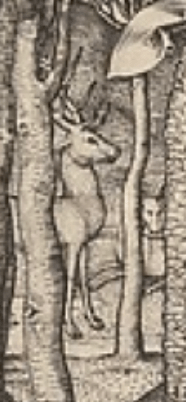
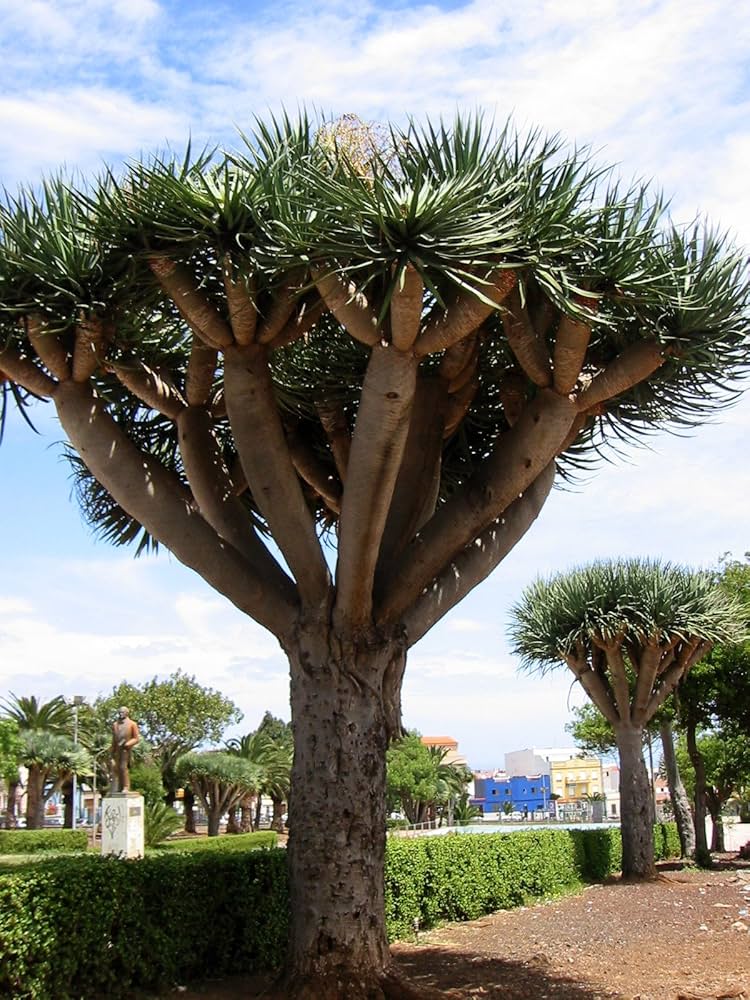
It was a common practice for artists of this period to include symbolic content in their work. Some of the flora and fauna in this engraving may seem gratuitous but in its day their meaning would have been understood. The stag, a symbol for Christ and a destroyer of serpents, is standing watch through the trees in the background. Stags shed their antlers every year and it was believed they renewed them by drinking from a spring; likewise people who drink from the spring of the spirit shed sins and are renewed. A dandelion in the foreground on the right is a symbol of Christ’s passion and a reminder of the future that awaits the child. The lily at the left foreground is a symbol of Mary’s purity, and at the far left is a dragon tree. When the tree is cut it yields a red resin known as “dragon’s blood.”
In Schongauer’s engraving, two lizards are on the trunk of the dragon tree and one is approaching it. The presence of lizards, serpents, and dragons represents the devil and lurking danger. At the very top of the tree is yet another symbol; a parrot. Because a parrot has the ability to fly and talk they symbolize a messenger and are associated with the angel that brought word to Mary that she would give birth to Jesus. In paintings of Mary, a parrot is sometimes placed on her shoulder as though it just arrived and said, “Ave Maria.” When not with Mary, a parrot may be placed high in a tree (as here in the dragon tree) where it cannot be reached by serpents.
More Information
Johannes Guttenberg invented moveable type and printed the Bible not long before Martin Schongauer engraved, “Rest on the Flight into Egypt,” but since most people could not read, art remained an essential means of learning stories of the Bible. During the fifteenth century the range of subjects expanded widely and stories about Mary were enhanced with lore. In addition to events such as the Annunciation and the Nativity, stories based on tradition often were included in illustrations of her life.
Dragon trees are native to the Canary Islands. It is possible that Schongauer saw one in Leipzig where the first botanical garden in Europe was established.
This “Art and Commentary” is based on the Gospel [Matthew 2:13-15, 19-23] appointed for the Second Sunday after Christmas, January 5, 2025. After the wise men left Bethlehem (not reporting back to Herod) an angel appeared to Joseph and told him of Herod’s plan to find and kill Jesus. Joseph was told to flee to Egypt with Jesus and Mary and not return until told.



 With friends at Calvary Episcopal Church in Rochester



 Hear what the Spirit is saying