

Tears of sadness and loss give way to tears of joy
At St. Margaret’s we strive to build the body, equip the saints, and change the world. Sometimes our focus can be sharpened by looking in another direction and then turning back to our own efforts.
Here is a story from Nigeria as reported in The Nation: “A quality, national, newspaper with credible and dependable information. Not beholden to any interest group. Loyalty is to the nation.” [About The Nation]
The story:
Every year, people facing sundry challenges get help from a women group in Ebenezer Anglican Church, Nnewi, Anambra State. The Women of Ebenezer have picked up bills for the poor. They have sheltered a good number, and have given hope to many.
This year was the turn of Mrs Ezinwanne Onwuasoeze, a widow of over seven years. In the course of her widowhood, she lost a child, even as she struggled to raise her remaining three male children. All she had for shelter was a mud building surrounded by glitzy buildings of the rich. Then one day, the mud house collapsed following a heavy downpour.
Mrs Onwuasoeze wept, naturally, but when the Women of Ebenezer Anglican Church built her a three-bedroom bungalow, she wept again, for joy.
Read the rest of the story in: The Nation – Women group rehabilitates the poor. Picture from the article.


As you read this story from a Sister Church in Nigeria, come back to our work in the Coachella Valley and see it in a new light. Add your time and talent to our efforts to serve and to change the world beginning right here in the Coachella Valley.
Teaching with humor
FROM THE ARCHIVES…

Note: From 1999-2003 Stan Hirsch facilitated the Sunday Morning Forum. He collected a wealth of information. To my delight he archived the material. In the weeks to come we’ll mine this archived material for Supplemental information on our work in the Year B Lectionary. Since space is not restricted, I may add to the original material from time to time. I encourage you to follow the links when given. Come back often, go exploring, keep learning. ~dan
Jonah is unique among the prophetic books. No kidding.
The principal figure of this deceptively simple story is presumably based on an obscure Galilean prophet from Gath‐hepher who counseled Jeroboam II (788–747 BCE) in a successful conflict with the Syrians (2 Kings 14.25 ). The author of the book of Jonah apparently drew upon legends that had collected about this prophet and put them to new use in a brief story that contains elements of folktale, fable, satire, and allegory. The two parts of the story, chs 1–2 and 3–4 , are united by their central character (Jonah), a similar plot (the ironical conversion of foreigners to faith in the LORD), and an identical theme (the breadth of God’s saving love). The influence of Jeremiah and Second Isaiah in the text suggests that the author probably lived in the postexilic period. Although the linguistic evidence is indecisive, a date in the fifth or fourth century BCE is plausible.
The book of Jonah is also uncharacteristic, when compared to other writings in the prophetic tradition, in its use of humor to make its points. Humorous qualities, such as exaggerated behavior (running away from God, 1.3 ); inappropriate actions (sleeping through a violent storm, 1.5 ); outlandish situations (offering a prayer of thanksgiving from inside a fish’s belly, 2.1 ); ludicrous commands (animals must fast and wear sackcloth, 3.7–8 ); and emotions either contrary to expectation (anger at mercy, 4.1–2 ) or out of proportion (being angry enough to die because a plant has withered, 4.9 ) appear throughout the story. But all of these qualities serve to underline the book’s themes. (Pointer added by dan)
Repentance and deliverance are the dominant themes in the story of Jonah, reflected in its use in the New Testament (Mt 12.38–41; Lk 11.29–32 ) and as the afternoon Prophetic Bible reading on the Jewish holy day of Yom Kippur (the Day of Atonement). With skill and finesse this little book calls Israel to repentance and reminds it of God’s extravagant mercy and forgiveness (Ex 34.6; Joel 2.13 ). In spirit, therefore, the book justifies its place in the Book of the Twelve Prophets.
Coogan, Michael D. . “Jonah.” In The New Oxford Annotated Bible. Oxford Biblical Studies Online, accessed (anew) 23 Jan 2012

Image: From the internet–http://travelerstrails.com
First Woman Priest in the Anglican Communion: Li Tim-Oi’s Story
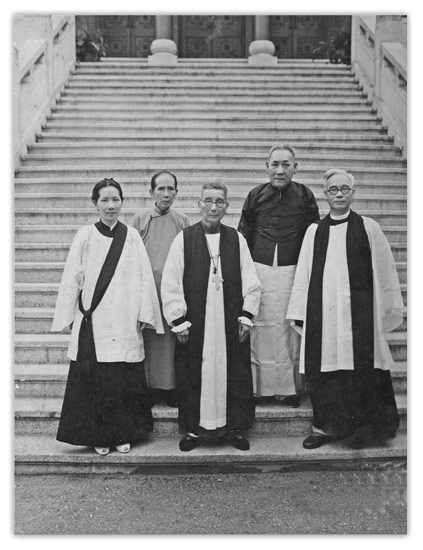
Li Tim-Oi, her mother, Bishop Mok, her father, Archdeacon Lee Kow Yan after her ordination as Deacon by Bishop R 0 Hall at St John’s Cathedral HK. Ascension Day 22 May 1941
Photo from Li Tim-Oi Story
Today (Jan, 24) the Episcopal Church commemorates Florence Li Tim-Oi: the first woman priest in the Anglican Communion (ordained on 25 January 1944). I encourage you to read her story:
At her birth in Hong Kong on 5 May 1907 Li Tim-Oi’s father called her “Much Beloved” because he valued her as a daughter even if others prefered sons.
Read the rest of her story: Litim-Oi | Li Tim-Oi’s Story.
The Li Tim-Oi Foundation was established in 1994. The Foundation funds It takes ONE woman: “It takes ONE woman sums up the story and aim of the LI TIM-OI FOUNDATION – founded in memory of the first Anglican woman priest – to empower Christian women to be agents of change in the Two-Thirds World.” (from the Foundation website)
Read more about the work of the Foundation: It takes ONE woman
Read about the Ordination of women in the Anglican Communion on Wikipedia
What can happen when the prophet is heard…
From Sunday’s (1/22/12) Forum handout:
Obviously this is a story, but it is one that teaches; it is a parable. It illuminates an issue of its time, the waywardness of Israel. God is central and powerful. He can favour whomever he chooses, even hated enemies of the past.
Chris Haslam, Revised Common Lectionary Commentary
http://montreal.anglican.org/comments/bpr03m.shtml
Note: a link to this Commentary is provided on our Blog (click on “Commentaries” in the right sidebar). Both Stan and I have made and continue to make use of this resource in our Bible studies; thank you Chris Haslam.
It makes a difference
In yesterday’s (1/22/12) Forum our group wondered aloud about God changing his mind: ” When God saw what they did, how they turned from their evil ways, God changed his mind about the calamity that he had said he would bring upon them; and he did not do it.” Jonah 3:10 NRSV
It was a lively discussion among Episcopalians and there was a spectrum of faith statements and realizations. When one of our members observed that the answer to the question about God’s ability to change God’s mind really makes a difference in how we pray there were many affirmations and nods of agreement. It does make a difference.
The questions we were responding to in the light of the reading from Jonah:
- Does God change his mind?
- Does he ever change it in response to our prayers?
- How do Bible statements that God ordains the future and that he alters his plans relate to each other?
- Does God know your next move—whether it’s a life-changing decision or a routine choice at the grocery store?
- And if he really knows it all, are you truly free?
- Does God know the future?
- Does he know it precisely or just with a high degree of probability?
- Was God taking a risk in making the human race?
- If God doesn’t know the future, how do we make sense of Bible prophecy?
- And if God doesn’t know the future, what are we to make of the Bible’s teaching that “those whom God foreknew, he also predestined to be conformed to the image of his Son”?
Questions posed in Christianity Today, May 21, 2001 in an article on Open Theism http://bit.ly/x1LGln
We also looked at how various translators have presented this one verse (Jonah 3:10), commenting on the thoughts and feelings evoked by these translations:
And God saw their works, that they turned from their evil way; and God repented of the evil, that he had said that he would do unto them; and he did it not. KJV
When God saw what they did and how they turned from their evil ways, he had compassion and did not bring upon them the destruction he had threatened. NIV
When God saw by their actions how they turned from their evil way, he repented of the evil he had threatened to do to them; he did not carry it out. NABRE
God saw what they did, how they were turning back from their evil ways. And God renounced the punishment He had planned to bring upon them, and did not carry it out. NJPS
When God saw what they did and how they gave up their wicked ways, he relented and did not inflict on them the punishment he had threatened. REB
God saw what they were doing—that they had ceased their evil behavior. So God stopped planning to destroy them, and he didn’t do it. CEB
Please join the conversation. Leave a comment. Does God change his mind? Does it make a difference?
B Epiphany 3, Art for Readings for January 22, 2012

Jonah Swallowed up by the Whale (on the decorative band)
1304-06
Fresco
Cappella Scrovegni (Arena Chapel), Padua
Click to open Web Gallery of Art display page. Click on their image to enlarge/fit page etc.
Humorous detail from the Cappella Scrovegni (Arena Chapel), Padua
Click to explore this impressive interior.
Get stirred up …
—Saint Teresa of Avila
Our categories (1) James 1:22 and (2) Opportunity Calendar may help stir up the love that you put into action. ~dan
Anglican Women gather in New York to consider Communion’s advocacy efforts
Posted On : January 19, 2012 1:40 PM | Posted By : Anglican News Service
By Rachel Chardon, at the Anglican United Nations Office
Read the entire post: Anglican Communion News Service: Anglican Women gather in New York to consider Communions advocacy efforts.
I offer this as an invitation to continue in study, prayer, and action. During Advent and Christmas our Sunday Morning Forum offered several windows into the important work being done on behalf of women.
- 16 Days of activism against gender violence
- Anglican Women’s Empowerment and Episcopal Women’s Caucus
The article (I encourage you to read the whole post) mentions the need for clean water as a way to empower rural women. Again, our Opportunity Calendar can lead you to more information and your prayers will lead you to action.
Let’s keep learning, praying, and working to extend God’s reign and share God’s Peace, God’s Shalom. ~dan
Beloved! Can you believe it?
This past Sunday we heard the story of Jesus’ baptism. The story has an ending filled with good news: “…a voice came from heaven, ‘You are my Son, the Beloved; with you I am well pleased.'” Mark 1:11
In the Forum discussion we shared our own stories of baptism and the faith within us. In the sharing we wondered about the mystery of being “in Christ” and if we are in Christ then we, too, are “beloved.” It is almost too good to be true. It certainly is a grace, unmerited, but greatly needed. Several in the group remembered that “being the beloved” was at the center of the writing and teaching of Henri J.M. Nouwen (1932-1996).
To further the Sunday conversation here is Nouwen in his own words:

- Note: the YouTube video (you will discover) has 8 parts. You will be able to find and select Parts 2-7 in the right hand panel of the YouTube screen when viewing Part 1. Alternatively you can search YouTube using “Nouwen” as your search term.
- Visit the website Henri Nouwen Society for a wealth of resources
- Beloved: Henri Nouwen in Conversation was a book read and recommended by some of our members
 Hear what the Spirit is saying