In prayer to “Mighty God” we recognize and confess that Bishop Quintard “persevered to reconcile the divisions among the people of his time.” We ask that today our Church (the People of God) “may ever be one, that it may be a refuge for all.” It will take the effort of each one to make this so. Today, what will you do to reconcile divisions and make the People of God a refuge for all?
The Collect for the Commemoration
Mighty God, we bless your Name for the example of your bishop Charles Todd Quintard, who persevered to reconcile the divisions among the people of his time: Grant, we pray, that your Church may ever be one, that it may be a refuge for all, for the honor of your Name; through Jesus Christ, who with you and the Holy Spirit lives and reigns, one God, for ever and ever. Amen. Amen.
Learn more
Charles Todd Quintard was the second bishop of the Diocese of Tennessee and the first Vice Chancellor of The University of the South at Sewanee.
Quintard was born in 1824 in Stamford, Connecticut. In 1847 he received the degree of Doctor of Medicine from the Medical College of New York University and worked at New York’s Bellevue Hospital. After a brief episode of practicing medicine in Athens, Georgia, Quintard became the professor of anatomy and physiology at Memphis Medical College and an editor of the Memphis Medical Reporter. In 1848, Quintard married Katherine Isabella Hand, a native of Roswell, Georgia, and together they were the parents of three children.
[…] During the Civil War, Quintard played dual roles in the Confederate Army as both chaplain and surgeon. Following the war, he was instrumental in bringing together the previously divided factions and extending the reach of the Episcopal Church, particularly among African Americans.
Bishop Quintard was a strong advocate of education at every level and played a major role in the establishment of schools. Perhaps his greatest accomplishment was the rebuilding of the University of the South at Sewanee after its destruction during the Civil War. He made several successful trips to England to raise the funds to secure the future of the University. From February 1867 to July 1872, Quintard served as the reconstituted University’s first Vice Chancellor. Quintard believed that a great Episcopal university was essential, not just to the church in Tennessee and the southeast, but to the whole church, and thus devoted much of his ministry to Sewanee.
We begin our prayer: “O God of compassion….” Thomas Bray looked into his world with the God of compassion and saw ways to teach and comfort and advocate for all God’s children. May we have the grace to do the same as we look with the God of compassion at our own world (home and family, neighborhood, workplace, city, state, nation, world, you get the idea). Today, in word and deed let us see and let us act with compassion.
The Collect for the Commemoration
O God of compassion, who opened the heart of your servant Thomas Bray to the needs of the Church in the New World, and to found societies to relieve them: Make the Church diligent at all times to propagate the Gospel, and to promote the spread of Christian knowledge; through Jesus Christ our Lord, who lives and reigns with you and the Holy Spirit, one God, for ever and ever. Amen.
Learn more
Thomas Bray was born at Marton, in Shropshire, England, in 1656. After graduating from Oxford and being ordained, he became a country parson in Warwickshire. In 1696 he was invited by the Bishop of London to be responsible for the oversight of Church work in the colony of Maryland. Three years later, as the Bishop’s Commissary, he sailed to America for his first, and only, visitation. Though he spent only two and a half months in Maryland, Bray was deeply concerned about the neglected state of the American churches, and the great need for the education of clergymen, lay people, and children.[…] His understanding of, and concern for, Native Americans and blacks were far ahead of his time. He founded thirty-nine lending libraries in America, as well as numerous schools. He raised money for missionary work and influenced young English priests to go to America.
[…] When the deplorable condition of English prisons was brought to Bray’s attention, he set to work to influence public opinion and to raise funds to alleviate the misery of the inmates. He organized Sunday “Beef and Beer” dinners in prisons, and advanced proposals for prison reform. It was Thomas Bray who first suggested to General Oglethorpe the idea of founding a humanitarian colony for the relief of honest debtors, but he died before the Georgia colony became a reality. Read more
A timely prayer asking help to overcome strife by the love of Christ
The Collect for the Commemoration
Almighty and everlasting God, by the power of the Holy Spirit you moved your servant Cyril and his brother Methodius to bring the light of the Gospel to a hostile and divided people: Overcome all bitterness and strife among us by the love of Christ, and make us one united family under the banner of the Prince of Peace; who lives and reigns with you and the Holy Spirit, one God, now and for ever. Amen.
Today’s Collect is well timed in a world where division, violence and the threat of more violence is a constant companion. Along the Way of Love taught us by Jesus (in word and deed) we ask our God to assist us to “overcome all bitterness and strife … by the love of Christ” and unite as one “under the banner of the Prince of Peace.” May it be so in our words and deeds this day.
Learn more about these brothers
Cyril (born about 828) and Methodius (born about 817), brothers born in Thessalonika, are honored as apostles to the southern Slavs and as the founders of Slavic literary culture. Cyril was a student of philosophy and a deacon, who eventually became a missionary monastic. Methodius was first the governor of a Slavic colony, then turned to the monastic life, and was later elected abbot of a monastery in Constantinople.
In 862, the King of Moravia asked for missionaries who would teach his people in their native language. Since both Cyril and Methodius knew Slavonic, and both were learned men—Cyril was known as “the Philosopher”—the Patriarch chose them to lead the mission. Read more
Blessed are those who trust in the Lord, whose trust is the Lord. Jer 17:7
Glad you have come here to find the readings for the Sixth Sunday after the Epiphany (Feb. 13 in 2022) in Year C of our Lectionary.
Trust in the Lord, trust in those who testify to God’s love and purposes, trust in those who have gone before you—these are among the themes this Sunday (and this week).
Check out, too, what our Church remembers about Absalom Jones and, through this week, others who trusted in the Lord and worked tirelessly for God’s glory in the name of Jesus.
Finally, check out what Frederick Buechner has to say about the Biblical revelation about resurrection and the notion of immortality. See that he accepts the Biblical revelation and trusts God. What about you?
The caption on this photo: “Priests read prayers in honour of St.Haralampus, as believers gather around candles stuck to jars of honey, arranged in a cross shape, during Mass for the ‘sanctification of honey’ at the Presentation of the Blessed Virgin Church in the town of Blagoevgrad, south of the Bulgarian capital of Sofia, Thursday, Feb. 10, 2022. The Bulgarian Orthodox Church marks the feast of St. Haralampus, the Orthodox patron saint of bee-keepers, by performing a ritual for health and rich harvest.” (AP Photo/Valentina Petrova)
One of the wonderful aspects of living in the Information Age and having internet access is learning (nearly instantly) that is unbounded by geography or culture. I had never heard of St. Haralampus until today. Reading that he is the patron saint of bee-keepers led me to look further into his story and who else might be considered a patron saint of bees, bee-keeping, or bee-keepers.
If you’re interested here is some more information about the Saint (who apparently suffered a brutal martyrdom for his faith) and about patron saints of bees and bee-keepers:
Annually on February 11th we remember Fanny Crosby. Read on.
Fanny Crosby was the most prolific writer of hymn texts and gospel songs in the American evangelical tradition of the late nineteenth and early twentieth centuries. She wrote more than eight thousand sacred texts in addition to other poetry.
Frances Jane Crosby was born in Putnam County, New York, on March 24, 1820. Although not born blind, she lost her sight as an infant as a result of complications from a childhood illness. At the age of fifteen, she entered the New York Institute for the Blind where she would later teach for a number of years. In 1858, she married Alexander van Alstyne, a musician in New York who was also blind. Crosby was a lifelong Methodist.
Crosby’s texts were so popular that nearly every well-known composer of gospel music of the period came to her for words to accompany their melodies. In most hymn writing, the words come first and then a composer sets them to music, but for Crosby the words came so quickly and naturally that composers would often take her their tunes and she would immediately begin to shape words that fit the music.
Perhaps the best example of this process led to the creation of Crosby’s most well known hymn Blessed Assurance. On a visit to the home of a friend, the composer Phoebe Knapp, a newly composed tune was played for Crosby. After listening to the tune several times, the text began to take shape, and in a very short time one of the world’s most popular gospel hymns was born. The American gospel song is a unique genre of sacred music that combines words expressive of the personal faith and witness with tunes that are simple and easily learned. Fanny Crosby’s contribution to this genre is unequaled. Dozens of her hymns continue to find a place in the hymnals of Protestant evangelicalism around the world.
Fanny Crosby died on February 12, 1915, in Bridgeport, Connecticut, where she is buried.
We live (as we confess in the Apostles’ Creed) in “the communion of saints.” In the communion of saints our teachers, our encouragers, our sources of inspiration are both unbound by time (i.e., they are the living and those who have died) and unbound by geography, culture, language, or any other boundary we may encounter in our earthly journey.
One of my teachers (a contemporary) is a retired Methodist minister living in Maine. Steve Garnaas-Holmes has a way with words shaped by his experiences of God’s unconditional love. I encourage you to check out his daily reflections on Unfolding Light. Here is a sample from his post today (February 10, 2022).
Before God judges you God loves you.
Before God sees your sin God sees your wound.
Before God sees how you thrashed in the world God sees what you are fighting off.
Before God sees you steal God sees your hunger.
Before God sees the awful things you do to survive God wants you to survive.
Before God punishes you God protects you from further hurt, because God never punishes, but wraps gentle arms around you.
Readings and supplemental resources for All Saints’ Day Year A in the RCL
November 1, 2020 | All Saints’ Day
Click this image to view or download the Bible Study for All Saints’ Day
Collect for All Saints’ Day
Almighty God, you have knit together your elect in one communion and fellowship in the mystical body of your Son Christ our Lord: Give us grace so to follow your blessed saints in all virtuous and godly living, that we may come to those ineffable joys that you have prepared for those who truly love you; through Jesus Christ our Lord, who with you and the Holy Spirit lives and reigns, one God, in glory everlasting. Amen. ~BCP 245
Revelation 7:9-17 NRSV
This lesson presents a vision of those who have survived great tribulation and now worship before the throne of God and the Lamb.
9 After this I looked, and there was a great multitude that no one could count, from every nation, from all tribes and peoples and languages, standing before the throne and before the Lamb, robed in white, with palm branches in their hands. 10 They cried out in a loud voice, saying, “Salvation belongs to our God who is seated on the throne, and to the Lamb!” 11 And all the angels stood around the throne and around the elders and the four living creatures, and they fell on their faces before the throne and worshiped God, 12 singing, “Amen! Blessing and glory and wisdom and thanksgiving and honor and power and might be to our God forever and ever! Amen.” 13 Then one of the elders addressed me, saying, “Who are these, robed in white, and where have they come from?” 14 I said to him, “Sir, you are the one that knows.” Then he said to me, “These are they who have come out of the great ordeal; they have washed their robes and made them white in the blood of the Lamb. 15 For this reason they are before the throne of God, and worship him day and night within his temple, and the one who is seated on the throne will shelter them. 16 They will hunger no more, and thirst no more; the sun will not strike them, nor any scorching heat; 17 for the Lamb at the center of the throne will be their shepherd, and he will guide them to springs of the water of life, and God will wipe away every tear from their eyes.”
1 John 3:1-3 NRSV
In this lesson we learn that through God’s love, disciples are now children of God; their destiny is to be like Christ.
1 See what love the Father has given us, that we should be called children of God; and that is what we are. The reason the world does not know us is that it did not know him. 2 Beloved, we are God’s children now; what we will be has not yet been revealed. What we do know is this: when heis revealed, we will be like him, for we will see him as he is. 3 And all who have this hope in him purify themselves, just as he is pure.
Matthew 5:1-12 NRSV
The gospel is the opening sayings of the Sermon on the Mount, words of both comfort and challenge.
1 When Jesus saw the crowds, he went up the mountain; and after he sat down, his disciples came to him. 2 Then he began to speak, and taught them, saying:
3 “Blessed are the poor in spirit, for theirs is the kingdom of heaven.
4 “Blessed are those who mourn, for they will be comforted.
5 “Blessed are the meek, for they will inherit the earth.
6 “Blessed are those who hunger and thirst for righteousness, for they will be filled.
7 “Blessed are the merciful, for they will receive mercy.
8 “Blessed are the pure in heart, for they will see God.
9 “Blessed are the peacemakers, for they will be called children of God.
10 “Blessed are those who are persecuted for righteousness’ sake, for theirs is the kingdom of heaven.
11 “Blessed are you when people revile you and persecute you and utter all kinds of evil against you falsely on my account. 12 Rejoice and be glad, for your reward is great in heaven, for in the same way they persecuted the prophets who were before you.
Psalm 34:1-10, 22 BCP 627
Our Psalm response is a hymn of blessing and praise to the Lord for deliverance.
1 I will bless the Lord at all times; * his praise shall ever be in my mouth.
2 I will glory in the Lord; * let the humble hear and rejoice.
3 Proclaim with me the greatness of the Lord; * let us exalt his Name together.
4 I sought the Lord, and he answered me * and delivered me out of all my terror.
5 Look upon him and be radiant, * and let not your faces be ashamed.
6 I called in my affliction and the Lord heard me * and saved me from all my troubles.
7 The angel of the Lord encompasses those who fear him, * and he will deliver them.
8 Taste and see that the Lord is good; * happy are they who trust in him!
9 Fear the Lord, you that are his saints, * for those who fear him lack nothing.
10 The young lions lack and suffer hunger, * but those who seek the Lord lack nothing that is good.
22 The Lord ransoms the life of his servants, * and none will be punished who trust in him.
Supplemental Material
Beloved, we are God’s children now; what we will be has not yet been revealed. What we do know is this: when he is revealed, we will be like him, for we will see him as he is.
1 John 3:2 NRSV
1 John 3:1-3 A Pastoral Perspective
By William N. Jackson, Honorably Retired Minister, Presbyterian Church (U.S.A.), Mount Joy, Pennsylvania.
John makes it very clear in this passage that it is by the lavish, generous love of God that we can rightly be called children of God. The apostle Paul is even more specific. He tells us that it is by the work of God’s Spirit that we are “adopted” as God’s children. In Romans 8:16–17a he writes of God’s Spirit “bearing witness with our spirit that we are children of God, and if children, then heirs of God and joint heirs with Christ.” We therefore have a spiritual inheritance that entitles us to all the blessings and benefits, privileges and powers, that relationship implies. Along with being nurtured and motivated in our spiritual growth, we also have the privilege of knowing God’s promises and presence in times of difficult struggle and need. Along with John’s concern for theological truth, he has some practical and pastoral things to say about the strength of the family of faith in times of adversity, sorrow, or loss. No New Testament writer expresses more consistently or more strenuously the necessity of Christian fellowship to provide “grace to help in time of need” (Heb. 4:16).
All Saints’ Day is a time when as the family of faith, children of God and joint heirs with Christ, we not only bear each other’s burdens but also claim for those who have died the hope and confidence we have together in the risen Christ. Through the credibility of the cross and the resurrection of Jesus Christ, we claim our legacy, which is grounded in the victory of Christ over sin and the grave. Edward Young once wrote, “Because of the love of Christ, nothing is dead but that which wished to die; nothing is dead but wretchedness and pain. What remains for us is a legacy of loyalty, of love, and of life.”
How blessed we are by the loyal witnesses who have been our teachers, our mentors, our critics, and our encouragers in enabling us to grow and mature in our faith. Our legacy includes a countless number of faithful witnesses who have taught us to know and believe the good news of the Word of God. We soon learn that in times of hard trials and difficult decisions the witness of faith shared with us by our mentors continues to provide incredible strength, not only for our own benefit, but also for our witness to others. In Hebrews 11:4 the writer tells us that “Abel has died, but through his faith he is still speaking” (my trans.). Our legacy as children of God is to remember that, even though our loved ones have died, through their love and compassion, their instruction and correction, their laughter and tears, their honesty and humility, their sacrifice and dedication, and, most of all, their faith, they are still speaking. What a great legacy to claim for ourselves and to share with the world!
There is also the legacy of the unparalleled blessing of God’s gift of love in Jesus Christ. That legacy is clearly defined in 1 Corinthians 13:4–7, in the familiar words, “Love is patient; love is kind; love is not envious or boastful or arrogant or rude. It does not insist on its own way it; is not irritable or resentful; it does not rejoice in wrongdoing, but rejoices in the truth. It bears all things, believes all things, hopes all things.” There is not a clearer definition of unconditional love in Christ. There is also a promise. The next paragraph begins, “Love never ends” (1 Cor. 13:8). Our legacy in that love is personal and contemporary and also eternal.
William Penn wrote at the death of a beloved member of his family, “Those who love beyond this world are never separated.” Then he added, “Death cannot kill what never dies.”2 Our legacy is the gift of God’s love, present in this life and present victoriously in the life to come.
There is also the legacy of life. From the beginning, the legacy of life has been a primary message for John. We find evidence for that in the first paragraph of the Gospel of John: “In him was life, and the life was the light of all people” (John 1:4). The opening paragraph of John’s first letter reiterates the same claim. Life is a primary gift, a privilege from God. Jesus says, “I came that they may have life, and have it abundantly” (John 10:10). In today’s passage John reminds us that the life we now know is only the beginning; there will be an even more glorious future when Christ appears. Then we shall see Christ and be found in the very likeness, the very image of God. Of course, John is thinking about the second coming. We may or may not think in those literal terms; nevertheless, there will come a time for every one of us when God will purify our hearts, when we shall see Christ and behold Christ’s glory. When God thus purifies our hearts, we will see the glorious, victorious resurrection life in Christ.
John also suggests that when the glorious gift of life in Christ is seen in us, the world may come to know who Christ is and come to receive the “light of life,” which is given for all humanity. Then that life can become the means by which we will all be bound together in a common legacy.
A man was visiting in Egypt. As he sat on a public bench privately reading Scripture, an older Egyptian man came and sat beside him. When the Egyptian noticed that the man was reading his Bible, he extended his hand in introduction and said, “I have life!” Fellow believers are held together by a legacy of life, found in their common relationship through the risen Christ. “Whoever has the Son has life” (1 John 5:12).
“Thanks be to God, who gives us the victory [the legacy] through our Lord Jesus Christ” (1 Cor. 15:57).
The Apostles’ Creed
I believe in God, the Father almighty, creator of heaven and earth.
I believe in Jesus Christ, his only Son, our Lord. He was conceived by the power of the Holy Spirit and born of the Virgin Mary. He suffered under Pontius Pilate, was crucified, died, and was buried. He descended to the dead. On the third day he rose again. He ascended into heaven, and is seated at the right hand of the Father. He will come again to judge the living and the dead.
I believe in the Holy Spirit, the holy catholic Church, the communion of saints, the forgiveness of sins, the resurrection of the body, and the life everlasting. Amen.
What do we mean by the resurrection of the body?
We mean that God will raise us from death in the fullness of our being, that we may live with Christ in the communion of the saints.
What is the communion of saints?
The communion of saints is the whole family of God, the living and the dead, those whom we love and those whom we hurt, bound together in Christ by sacrament, prayer, and praise.
From An Outline of the Faith, BCP 862
November 1 All Saints
It is believed by many scholars that the commemoration of all the saints on November 1st originated in Ireland, spread from there to England, and then to the European continent. […]
November 2 All Souls or Commemoration of All The Faithful Departed
In the New Testament, the word “saints” is used to describe the entire membership of the Christian community, and in the Collect for All Saints’ Day the word “elect” is used in a similar sense. From very early times, however, the word “saint” came to be applied primarily to persons of heroic sanctity, whose deeds were recalled with gratitude by later generations.
Beginning in the tenth century, it became customary to set aside another day on which the church remembered that vast body of the faithful who, though no less members of the company of the redeemed, are unknown in the wider fellowship of the church. It was also a day for particular remembrance of family members and friends.
Though the observance of the day was abolished at the Reformation because of abuses connected with masses for the dead, a renewed understanding of its meaning has led to a widespread acceptance of this commemoration among Anglicans, and to its inclusion as an optional observance in the calendar of the Episcopal Church.
Readings and supplemental resources for Proper 24A in the RCL
October 25, 2020 | Pentecost +20
Click this image to view or download the Bible Study for Proper 25A
Collect for Proper 25
Almighty and everlasting God, increase in us the gifts of faith, hope, and charity; and, that we may obtain what you promise, make us love what you command; through Jesus Christ our Lord, who lives and reigns with you and the Holy Spirit, one God, for ever and ever. Amen. ~BCP 235
Leviticus 19:1-2, 15-18 NRSV
In this lesson the people of Israel are called to lives of justice and love—to be holy because the Lord their God is holy.
1 The Lord spoke to Moses, saying: 2 Speak to all the congregation of the people of Israel and say to them: You shall be holy, for I the Lord your God am holy.
15 You shall not render an unjust judgment; you shall not be partial to the poor or defer to the great: with justice you shall judge your neighbor. 16 You shall not go around as a slandereramong your people, and you shall not profit by the bloodof your neighbor: I am the Lord.
17 You shall not hate in your heart anyone of your kin; you shall reprove your neighbor, or you will incur guilt yourself. 18 You shall not take vengeance or bear a grudge against any of your people, but you shall love your neighbor as yourself: I am the Lord.
1 Thessalonians 2:1-8 NRSV
In this reading Paul recalls his first visit to the Thessalonians, the troubles he endured, and the straightforward and gentle way in which he presented the gospel.
1 You yourselves know, brothers and sisters,that our coming to you was not in vain, 2 but though we had already suffered and been shamefully mistreated at Philippi, as you know, we had courage in our God to declare to you the gospel of God in spite of great opposition. 3 For our appeal does not spring from deceit or impure motives or trickery, 4 but just as we have been approved by God to be entrusted with the message of the gospel, even so we speak, not to please mortals, but to please God who tests our hearts. 5 As you know and as God is our witness, we never came with words of flattery or with a pretext for greed; 6 nor did we seek praise from mortals, whether from you or from others, 7 though we might have made demands as apostles of Christ. But we were gentleamong you, like a nurse tenderly caring for her own children. 8 So deeply do we care for you that we are determined to share with you not only the gospel of God but also our own selves, because you have become very dear to us.
Matthew 22:34-46 NRSV
In the gospel Jesus presents the double commandment of love for God and neighbor, and then asks a question concerning whose son the Christ is.
34 When the Pharisees heard that he had silenced the Sadducees, they gathered together, 35 and one of them, a lawyer, asked him a question to test him. 36 “Teacher, which commandment in the law is the greatest?” 37 He said to him, “ ‘You shall love the Lord your God with all your heart, and with all your soul, and with all your mind.’ 38 This is the greatest and first commandment. 39 And a second is like it: ‘You shall love your neighbor as yourself.’ 40 On these two commandments hang all the law and the prophets.”
41 Now while the Pharisees were gathered together, Jesus asked them this question: 42 “What do you think of the Messiah? Whose son is he?” They said to him, “The son of David.” 43 He said to them, “How is it then that David by the Spirit calls him Lord, saying,
44 ‘The Lord said to my Lord, “Sit at my right hand, until I put your enemies under your feet” ’?
45 If David thus calls him Lord, how can he be his son?” 46 No one was able to give him an answer, nor from that day did anyone dare to ask him any more questions.
Psalm 1 BCP 585
The Lord makes fruitful those who choose the way of righteousness.
1 Happy are they who have not walked in the counsel of the wicked, * nor lingered in the way of sinners, nor sat in the seats of the scornful!
2 Their delight is in the law of the Lord, * and they meditate on his law day and night.
3 They are like trees planted by streams of water, bearing fruit in due season, with leaves that do not wither; * everything they do shall prosper.
4 It is not so with the wicked; * they are like chaff which the wind blows away.
5 Therefore the wicked shall not stand upright when judgment comes, * nor the sinner in the council of the righteous.
6 For the Lord knows the way of the righteous, * but the way of the wicked is doomed.
Supplemental Material
“Teacher, which commandment in the law is the greatest?”
Matthew 22:36 NRSV
A Homily on Matthew 22:34-46
Laurel Mathewson, Living by the Word in The Christian Century –http://bit.ly/1tlARPW
When I was fresh out of college and chock-full of vocational angst, I was lucky enough to be invited into a book club composed primarily of working and retired pastors, therapists, and professors. One evening over tea and cookies, as this multigenerational group of women delved (somewhat) into the book and (more fully) into the issues of our lives, my angst spilled over into earnest whining: But what are we to do? How are we to live? It’s so complicated!
The response that followed has lingered in my memory. A Catholic theologian in her sixties with short, curly hair looked at me. “Oh, but we have been given a simple code,” she said. “Love God, love your neighbor. When things get overwhelming for me, I repeat again and again: Love God, love your neighbor. ”
A few days later, I was taking a winter walk on the beach and came across the unlikely gift of a big and beautiful labyrinth a stranger had left in the sand. Still feeling pretty confused and tormented, I began to walk the labyrinth, repeating those words like a mantra: Love God, love your neighbor. Tellingly, I don’t remember exactly what “next step” emerged for me, but I do remember that as I prayed and walked, those simple words seemed to unlock a door. I left the beach with clarity and relief, the simplicity of the commandment releasing the weighty pressures of countless social codes and expectations.
This teaching of the two greatest commandments is Jesus’ gentle yoke. In Jesus’ time, a rabbi’s “yoke” was a set of teachings—that which was required of you under the law according to a particular teacher. The “easy and gentle” yoke of our Lord—who can often be read as quite demanding—makes most sense to me in light of this historical factoid and this week’s lesson: we yearn for clarity about what is essential, and we long to be guided toward the things that really matter.
It is an aspect of the gospel so basic that it is easily overlooked by preachers. In my early-twenties vocational crisis, I was already a confirmed and hopeless church nerd. I’d heard lots of sermons, been to lots of Bible studies. Yet the liberating force of this basic discipleship teaching hit me like a fresh gust of wind on stagnant sails. Similar memories are scattered throughout my life: I realize that I have been surprised by the grace of this greatest-commandments gospel again and again. It is not the foundational gospel of resurrection and shouldn’t replace it. But for all who are trying their darnedest in a world full of dubious codes for righteous living, this teaching remains good news.
Glennon Doyle Melton—author of Carry On, Warrior and the popular Momastery blog—wrote a post in August called “Give Me Gratitude or Give Me Debt.” After receiving unsolicited advice that she should update her kitchen, Melton aims to cultivate gratitude for the bounty of her North American life with new “perspectacles.” Talking about her microwave, she says, “This is the magical box in which I put uncooked stuff, push some buttons, and then a minute later—pull out cooked stuff. It is like the JETSONS up in here.”
Melton experiences gratitude as liberty from desire: “I will not be a slave to the Tyranny of Trend any longer. I am almost 40 years old and no catalog is the Boss of Me anymore.” The gospel offers all sorts of liberation to all sorts of people, and many seem weightier than middle-class psychological unburdening. But don’t dismiss the liberation of those ensnared by consumerism. I’ve been there many times; if you haven’t, count that a special grace from God. The powers of marketing are real. We need the Spirit’s help and a good word to walk through a store with such a freedom intact. Melton offers a testimony many hunger for.
But what is the difference between this liberty born of gratitude and the liberty offered by the greatest commandments? They function similarly, yet ultimately a liberating code that includes the prayerful love of God and neighbor will be richer and more robust than thanksgiving alone—and more complicated. Simple does not mean easy, and simple commandments have complicated implications. Judging from the holiness code of Leviticus 19, this paradox has always been the case. What does it look like in 2014, in this place, to love your neighbor? To love God above all else? Whenever I think that these are tired old questions, I know I am not really paying attention.
How did I love my poor neighbor today? Did I even think about my poor neighbor? In what ways do I continue to defer to the ways and the will of the “successful” class? Paul knows that even proclaiming the gospel to new faces can be an occasion for greed and false flattery. Living by a different holiness code than the ones on offer from contemporary culture takes discernment. It also takes courage. We are freed from expectations we find onerous. But we also may be required to give up praise and positions that gladden our egos.
Readings and supplemental resources for Proper 24A in the RCL
October 18, 2020 | Pentecost +20
Click this image to view or download the Bible Study for Proper 24A
Collect for Proper 24
Almighty and everlasting God, in Christ you have revealed your glory among the nations: Preserve the works of your mercy, that your Church throughout the world may persevere with steadfast faith in the confession of your Name; through Jesus Christ our Lord, who lives and reigns with you and the Holy Spirit, one God, for ever and ever. Amen. ~BCP 235
Isaiah 45:1-7 NRSV
In this Hebrew Bible reading the Lord anoints Cyrus, King of Persia, to be God’s agent in freeing the chosen people from exile.
1 Thus says the Lord to his anointed, to Cyrus, whose right hand I have grasped to subdue nations before him and strip kings of their robes, to open doors before him— and the gates shall not be closed: 2 I will go before you and level the mountains, I will break in pieces the doors of bronze and cut through the bars of iron, 3 I will give you the treasures of darkness and riches hidden in secret places, so that you may know that it is I, the Lord, the God of Israel, who call you by your name. 4 For the sake of my servant Jacob, and Israel my chosen, I call you by your name, I surname you, though you do not know me. 5 I am the Lord, and there is no other; besides me there is no god. I arm you, though you do not know me, 6 so that they may know, from the rising of the sun and from the west, that there is no one besides me; I am the Lord, and there is no other. 7 I form light and create darkness, I make weal and create woe; I the Lord do all these things.
1 Thessalonians 1:1-10 NRSV
In company with Silvanus and Timothy, Paul greets the new Christians of Thessalonica, giving thanks for their faith and their conversion from idols to the worship of the true and living God.
1 Paul, Silvanus, and Timothy,
To the church of the Thessalonians in God the Father and the Lord Jesus Christ: Grace to you and peace
2 We always give thanks to God for all of you and mention you in our prayers, constantly 3 remembering before our God and Father your work of faith and labor of love and steadfastness of hope in our Lord Jesus Christ. 4 For we know, brothers and sisters beloved by God, that he has chosen you, 5 because our message of the gospel came to you not in word only, but also in power and in the Holy Spirit and with full conviction; just as you know what kind of persons we proved to be among you for your sake.
6 And you became imitators of us and of the Lord, for in spite of persecution you received the word with joy inspired by the Holy Spirit, 7 so that you became an example to all the believers in Macedonia and in Achaia. 8 For the word of the Lord has sounded forth from you not only in Macedonia and Achaia, but in every place your faith in God has become known, so that we have no need to speak about it. 9 For the people of those regions report about us what kind of welcome we had among you, and how you turned to God from idols, to serve a living and true God, 10 and to wait for his Son from heaven, whom he raised from the dead—Jesus, who rescues us from the wrath that is coming.
Matthew 22:15-22 NRSV
In our gospel lesson Jesus answers a question about taxation by teaching that people should pay what belongs to the emperor to the emperor and the things of God to God.
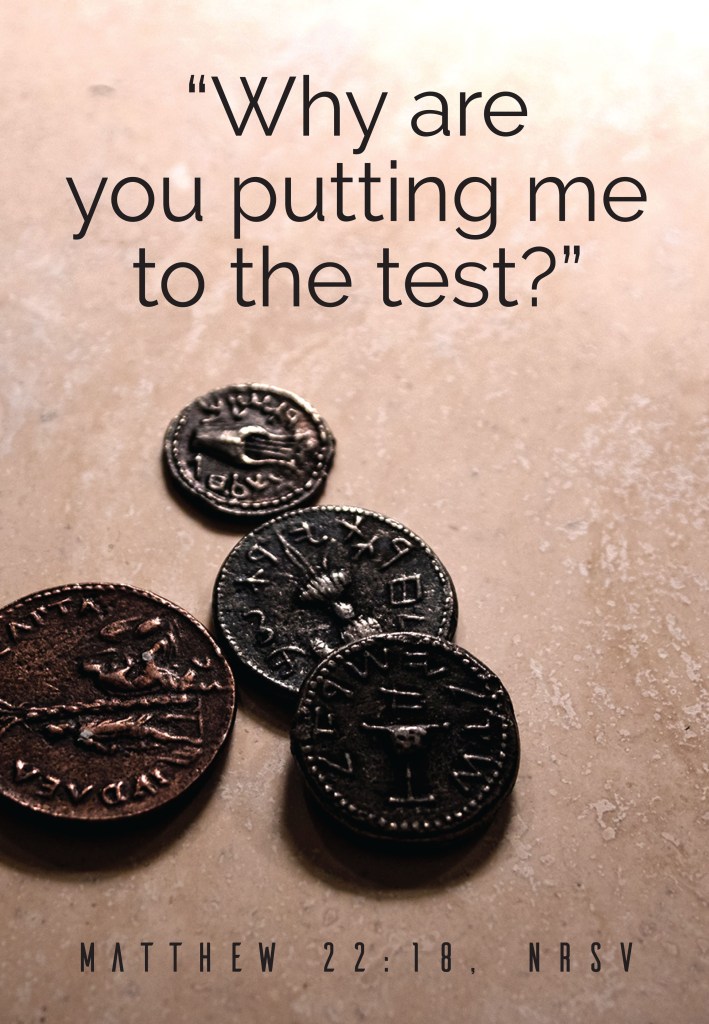
15 Then the Pharisees went and plotted to entrap him in what he said. 16 So they sent their disciples to him, along with the Herodians, saying, “Teacher, we know that you are sincere, and teach the way of God in accordance with truth, and show deference to no one; for you do not regard people with partiality. 17 Tell us, then, what you think. Is it lawful to pay taxes to the emperor, or not?” 18 But Jesus, aware of their malice, said, “Why are you putting me to the test, you hypocrites? 19 Show me the coin used for the tax.” And they brought him a denarius. 20 Then he said to them, “Whose head is this, and whose title?” 21 They answered, “The emperor’s.” Then he said to them, “Give therefore to the emperor the things that are the emperor’s, and to God the things that are God’s.” 22 When they heard this, they were amazed; and they left him and went away.
Psalm 96:1-9 BCP 612
Our Psalm response is a hymn of trust in the Lord. God will guard and deliver the one who loves and seeks refuge with God.
1 Sing to the Lord a new song; * sing to the Lord, all the whole earth.
2 Sing to the Lord and bless his Name; * proclaim the good news of his salvation from day to day.
3 Declare his glory among the nations * and his wonders among all peoples.
4 For great is the Lord and greatly to be praised; * he is more to be feared than all gods.
5 As for all the gods of the nations, they are but idols; * but it is the Lord who made the heavens.
6 Oh, the majesty and magnificence of his presence! * Oh, the power and the splendor of his sanctuary!
7 Ascribe to the Lord, you families of the peoples; * ascribe to the Lord honor and power.
8 Ascribe to the Lord the honor due his Name; * bring offerings and come into his courts.
9 Worship the Lord in the beauty of holiness; * let the whole earth tremble before him.
Supplemental Material
We always give thanks to God for all of you and mention you in our prayers, constantly remembering before our God and Father your work of faith and labor of love and steadfastness of hope in our Lord Jesus Christ.
1 Thessalonians 1:2-3 NRSV
1 Thessalonians 1:1-10. A Pastoral Perspective
By Jill Y. Crainshaw, Associate Professor and Academic Dean, Wake Forest University Divinity School, Winston-Salem, North Carolina689
Susan simultaneously pastored seven small congregations in the mountains of Virginia. Most of her colleagues never understood how she managed what, from their perspectives, had to be a chaotic and complex task. Preaching responsibilities alone seemed to them enough to tax Susan’s mind, soul, and body. Several lay ministers assisted Susan, but in the minds and hearts of most congregants in those small rural churches, she was the beloved pastor.
Susan was a contemporary version of late eighteenth- and early nineteenth-century traveling clergy, or circuit preachers. Circuit preachers, popularly called “circuit riders” or “saddleback riders,” were common sights, particularly in American Methodism during the Second and Third Great Awakenings. Due to a clergy shortage, some pastors were assigned multiple congregations. Riding on horseback from one “charge” to another, these pastors traveled light, reportedly carrying only what could fit into saddlebags.
Susan traveled from church to church in an old Honda Civic rather than on horseback, but like early circuit riders, she provided a pastoral presence to communities unable to afford full-time ministers. As for Susan’s churches, they learned to share with one another their pastor, their weekly “collections,” and their ministries. Susan spoke often about how she “stayed in touch” with congregations between her monthly preaching visits to each. Few congregants in those years (1982–88) had access to e-mail. Hand-scripted letters became Susan’s primary way to encourage and advise communities during her absences from them.
“I learned over time,” Susan recalled. “Letters sometimes say more, sometimes less, than you intend. When letters are the primary way we communicate with one another, we have to exercise particular care about what we say. We also have to let the ink flow from a well of gratitude. Writing and then sending letters when angry or frustrated can lead to unhappy results. Also, we have to keep in mind the lives and stories of the people who will read the letters. Most of all, we have to be prepared to be misunderstood on occasion and to stay in conversation about what we really meant by what we wrote.”
Paul is a kindred spirit to Susan and other circuit-riding preachers throughout history. Paul, like Susan, corresponded by letter with his multiple congregations. We can learn a great deal about pastoral leadership and communicating the gospel from Paul’s letter to the Thessalonian church.
Paul is a complex biblical character. Some interpreters extol Paul’s theological views. Others know firsthand the painful power of Paul’s voice when interpreters turn that voice against them. Still others wrestle with Paul’s sometimes strident representation of himself as authoritative leader. Each of these perspectives points to challenges of understanding Paul’s first-century message.
Often overlooked is the relational texture of Paul’s writings. Paul wrote letters, distinct forms of communication intended to encourage, teach, and sometimes reprimand particular congregations where he was deemed pastoral leader. Paul did not imagine a twenty-first-century readership. First Thessalonians was crafted for people with whom Paul had a personal bond.
When contemporary readers delve into the letter to the Christians in Thessalonica, they struggle to hear in Paul’s ancient words a gospel word for today. Thus they sometimes miss the vibrancy of Paul’s letter-writing style. A skilled correspondent, Paul inventively wove together words, images, and ideas common to his context. Paul’s letters illuminate the world of his day, even as they reveal theological values and ideas. Paul’s letters, particularly the letter to the Christians at Thessalonica, also reveal the concern with which he communicated with each of his churches.
Paul cared deeply for the Christians at Thessalonica. The opening words of 1 Thessalonians reflect this. The first verse sets the tone: “Grace to you and peace” (1:1c). As the first chapter unfolds, Paul’s gratitude for the work he and the Thessalonian community do together to carry gospel wisdom into places like Macedonia and Achaia (vv. 7–8) is evident.
This is the first letter Paul scripted as a “circuit-riding” preacher. In it, he affirms and encourages Thessalonian gospel collaborators. He has great affection for these believers, who have kept on ministering in spite of persecution (v. 6). Paul enjoys, and perhaps personally needs, the friendship of this community of coministers.
Paul’s letter to the church at Thessalonica invites the attention of contemporary believers. Certainly, it is not without interpretive challenges, often posed by Paul’s epistles. However, the letter overall depicts a pastoral leader intent on mentoring a community of believers. Paul characterizes his vocational identity in verse 2 with words that texturize the remainder of the letter: “We always give thanks to God for all of you.” Paul’s relationship with the church at Thessalonica is a relationship enriched and emboldened by thankfulness.
Circuit-riding preachers of the nineteenth-century variety are a thing of the past. A number of pastoral leaders today travel between two, or perhaps three, congregations. This is no doubt a challenging vocational responsibility; but “saddlebag riders” are no more. Also, technological innovations—text messages, cell phones, Skype, Internet—have bathed correspondence in the speed of light. Words now travel faster, farther, and with greater ease than physical bodies.
Paul’s handwritten and snail-mailed words of greeting to the church at Thessalonica continue to offer wisdom for today’s faith communities and their leaders. Congregations are to be bonded to one another in Christ by a spirit of thanksgiving for one another. What are the gifts of such a spirit? A spirit of thanksgiving can motivate us as believers to be more intentional and thoughtful in all of the ways we communicate with one another. A spirit of thanksgiving can motivate us toward greater communal intimacy. A spirit of thanksgiving can motivate us to forgive and seek forgiveness, especially as each of us works to be understood and to understand. Finally, a spirit of thanksgiving can and should motivate us toward collaborative ministries that spin out threads of relational authenticity and depth.
There is little doubt that 1 Thessalonians, the 13th book in the NT canon, is an authentic letter written by the apostle Paul to the Christian community at Thessalonica in Macedonia. It is the oldest document contained in the NT.
David Noel Freedman, ed., “Thessalonians, First and Second Epistles to The,” The Anchor Yale Bible Dictionary (New York: Doubleday, 1992), 515.
Saint Paul
Paul, St (d. prob. AD 62–5), the ‘Apostle of the Gentiles’. Born during the first years of the Christian era, the future St Paul, originally ‘Saul’, was a Jew of the tribe of Benjamin, a native of *Tarsus in Cilicia, said by Acts to possess Roman citizenship. He was brought up a Pharisee (Phil. 3:5, Acts 26:5) and perhaps had some of his education at Jerusalem under *Gamaliel (so Acts 22:3). This life in Judaism (Gal. 1:14) gave him his trust in God, experience of the Law, and a thorough knowledge of the Scriptures, as well as his methods of arguing from Scripture. As a Jew of the Diaspora he spoke and wrote Greek and shows some knowledge of rhetoric. Within a short time of the Crucifixion, he came in contact with the new ‘Way’ of the followers of Jesus, apparently in Palestine, and persecuted the Church (1 Cor. 15:9, Gal. 1:13). Acts 7:58 represents him as present at the martyrdom of St Stephen, and 9:1–2 as authorized by the High Priest to arrest converts in Damascus. As he drew near he was himself converted.
… The sketch in the Acts of St Paul of a ‘man small of stature, with a bald head and crooked legs, in a good state of body, with eyebrows meeting and nose somewhat hooked …’ is probably imaginative, though Paul admits to his weak bodily presence (2 Cor. 10:10) and a ‘thorn in the flesh’ (2 Cor. 12:7).
F. L. Cross and Elizabeth A. Livingstone, eds., The Oxford Dictionary of the Christian Church (Oxford; New York: Oxford University Press, 2005), 1243.
A book and sword are the common attributes of Saint Paul
The book carried by Saint Paul represents his epistles in the New Testament of the Bible.
The sword is a reminder of the means of his martyrdom – he was beheaded in Rome in 67 AD.







 Hear what the Spirit is saying