
Welcome!
Along the way I read—and remember now—Marcus Borg’s observation that credo, “I believe,” is probably better rendered, “I give my heart to.”
Everything we say in the Nicene Creed is about giving our heart to God who we experience as one God, Father, Son, and Holy Spirit.
Enter into our Nicene Creed as an expression of trust born of love:
WE GIVE OUR HEARTS TO one God, the Father, the Almighty, maker of heaven and earth, of all that is, seen and unseen.
WE GIVE OUR HEARTS TO one Lord, Jesus Christ, the only Son of God, eternally begotten of the Father, God from God, Light from Light, true God from true God, begotten, not made, of one Being with the Father. Through him all things were made.
WE GIVE OUR HEARTS TO THE ONE WHO, For us and for our salvation, came down from heaven: by the power of the Holy Spirit he became incarnate from the Virgin Mary, and was made man. WHO, For our sake was crucified under Pontius Pilate; he suffered death and was buried.
WE GIVE OUR HEARTS TO THE ONE WHO, On the third day rose again in accordance with the Scriptures; WHO ascended into heaven and is seated at the right hand of the Father. WHO will come again in glory to judge the living and the dead, and WHOSE kingdom will have no end.
WE GIVE OUR HEARTS TO the Holy Spirit, the Lord, the giver of life, who proceeds from the Father and the Son. With the Father and the Son he is worshiped and glorified. He has spoken through the Prophets.
WE GIVE OUR HEARTS TO THE one holy catholic and apostolic Church. We acknowledge one baptism for the forgiveness of sins. We look for the resurrection of the dead, and the life of the world to come. Amen.
On Wednesday, May 22, 2024, we* read through the scriptures appointed for Trinity Sunday, Year B. We spent the most time on the reading and learning from the letter to the Romans (Chapter 8, verses 12-17)
To whom do you give your heart?
A further thought on the Mystery of the Trinity
Gregory Nazianzen wrote:
“There was the true light, which enlightens everyone who comes into the world” (John 1:9)—the Father.
“There was the true light, which enlightens everyone who comes into the world”—the Son.
“There was the true light, which enlightens everyone who comes into the world”—the other Paraclete (John 14:16, 26).
“Was” and “was” and “was,” but one thing was; “light” and “light” and “light,” but one light and one God. This is what David too imagined long ago when he said, “In your light we shall see light” (Psalm 36:10 [36:9]).
And now we have both seen and proclaimed the concise and simple theology of the Trinity: out of light (the Father) we comprehend light (the Son) in light (the Spirit).
Source: Christopher A. Beeley, Leading God’s People: Wisdom from the Early Church for Today (Grand Rapids, MI; Cambridge: William B. Eerdmans Publishing Company, 2012), 99–100.
Christopher Beeley is the Walter H. Gray Associate Professor of Anglican Studies and Patristics [Yale Macmillan Center]. He teaches early Christian theology and history and modern Anglican tradition. He is an Episcopal priest.

*Most Wednesday mornings a group of us gather online to explore the readings that will be used in worship the following Sunday. This week’s handout features readings, commentaries, and notes for Trinity Sunday (May 26, 2024) in Year B of the Revised Common Lectionary. Please: View or download the handout we used to guide our discussion and tune our hearts to the Spirit.
View the Revised Common Lectionary readings appointed for Trinity Sunday, May 26, 2024, on the Revised Common Lectionary site curated by the Vanderbilt Divinity Library.
Please return to this site throughout the week to keep learning.
More thoughts on Trinity Sunday
- Trinity Sunday, Year B (Interrupting the Silence)
- Trinity Sunday (Prayer Book Guide to Christian Education)
- Trinity Sunday (At the Edge of the Enclosure)
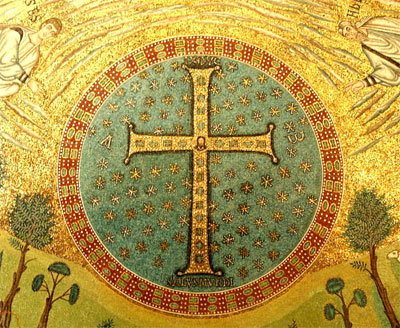 In the last two days Marcus Borg, teacher and scholar, posted a two-part essay on the Meaning of the Cross for Christians. Part 1 described the understanding of the cross held by many (most?) 21st century Christians in the United States (Jesus “paid” for our sins). Part 2 described ancient understandings of the Cross (understandings lost when the currently dominant theme of payment ascended in the 12th century). How is the Spirit speaking to the Church through this scholar? How is the meaning of the Cross (and Resurrection) expanded or narrowed for you? I commend the two essays to you:
 Hear what the Spirit is saying